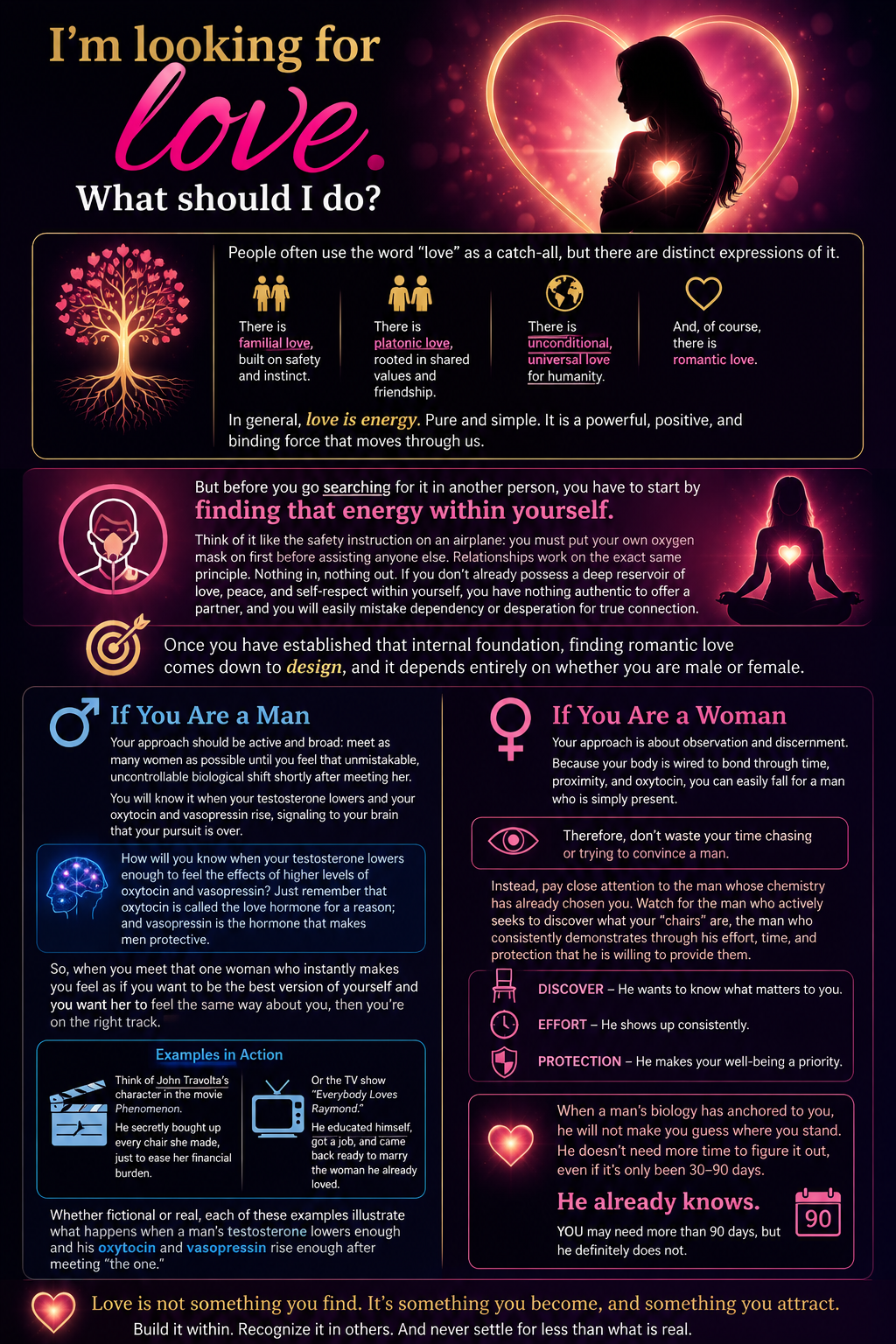
I’m looking for love. What should I do?
People often use the word “love” as a catch-all, but there are distinct expressions of it. There is familial love, built on safety and instinct. There is platonic love, rooted in shared values and friendship. There is unconditional, universal love for humanity. And, of course, there is romantic love.
In general, love is energy. Pure and simple. It is a powerful, positive, and binding force that moves through us. But before you go searching for it in another person, you have to start by finding that energy within yourself.
Think of it like the safety instruction on an airplane: you must put your own oxygen mask on first before assisting anyone else. Relationships work on the exact same principle. Nothing in, nothing out. If you don’t already possess a deep reservoir of love, peace, and self-respect within yourself, you have nothing authentic to offer a partner, and you will easily mistake dependency or desperation for true connection.
Once you have established that internal foundation, finding romantic love comes down to design, and it depends entirely on whether you are male or female.
If You Are a Man
Your approach should be active and broad: meet as many women as possible until you feel that unmistakable, uncontrollable biological shift shortly after meeting her. You will know it when your testosterone lowers and your oxytocin and vasopressin rise, signaling to your brain that your pursuit is over. How will you know when your testosterone lowers enough to feel the effects of higher levels of oxytocin and vasopressin? Just remember that oxytocin is called the love hormone for a reason; and vasopressin is the hormone that makes men protective. So, when you meet that one woman who instantly makes you feel as if you want to be the best version of yourself and you want her to feel the same way about you, then you’re on the right track.
Once that shift happens, your natural instinct will be to protect her and lighten her load. Think of John Travolta’s character in the movie Phenomenon. Kyra Sedgwick’s character was a struggling single mother making ugly, uncomfortable chairs that no one wanted to buy. Travolta’s character liked her so much, that he secretly bought up every single chair she made, just to ease her financial burden. He didn’t do it for applause; his chemistry simply drove him to care for her.
Don’t like fictional examples? Let’s try the TV show “Everybody Loves Raymond.” The episodes in that show were based on real life. In one episode, the couple reminisces on how they got together. Basically, he wanted to marry her, but he didn’t have enough to offer. Once he got educated and came back with a job, she was ready to marry him. His feeling for her motivated him to do what was necessary to win her heart (which he already had) and her hand in marriage.
Whether fictional or real, each of these examples illustrate what happens when a man’s testosterone lowers enough and his oxytocin and vasopressin rise enough after meeting “the one.”
If You Are a Woman
Your approach is about observation and discernment. Because your body is wired to bond through time, proximity, and oxytocin, you can easily fall for a man who is simply present.
Therefore, don’t waste your time chasing or trying to convince a man. Instead, pay close attention to the man whose chemistry has already chosen you. Watch for the man who actively seeks to discover what your “chairs” are, the man who consistently demonstrates through his effort, time, and protection that he is willing to provide them. When a man’s biology has anchored to you, he will not make you guess where you stand. He doesn’t need more time to figure it out, even if it’s only been 30-90 days. He already knows. YOU may need more than 90 days, but he definitely does not.
Scientific References
- Scheele, D., Wille, A., Kendrick, K. M., Stoffel-Wagner, B., Becker, B., Güntürkün, O., Maier, W., & Hurlemann, R. (2013). Oxytocin Enhances Brain Reward System Responses in Men Viewing the Face of Their Female Partner. Proceedings of the National Academy of Sciences, 110(50), 20308-20313.
Available at: https://pubmed.ncbi.nlm.nih.gov/24277856/ - Schneiderman, I., Zagoory-Sharon, O., Leckman, J. F., & Feldman, R. (2012). Oxytocin during the Initial Stages of Romantic Attachment: Relations to Couples’ Interactive Reciprocity. Psychoneuroendocrinology, 37(8), 1277-1285.
Available at: https://pubmed.ncbi.nlm.nih.gov/22281209/ - Turner, D. R. (2026). And That’s Why Men Like Virgins: How Biology & Silence Keep Good Girls in the Dark.
Available at: virtualvillagemom.com
Continue Exploring Bio-Relational Science
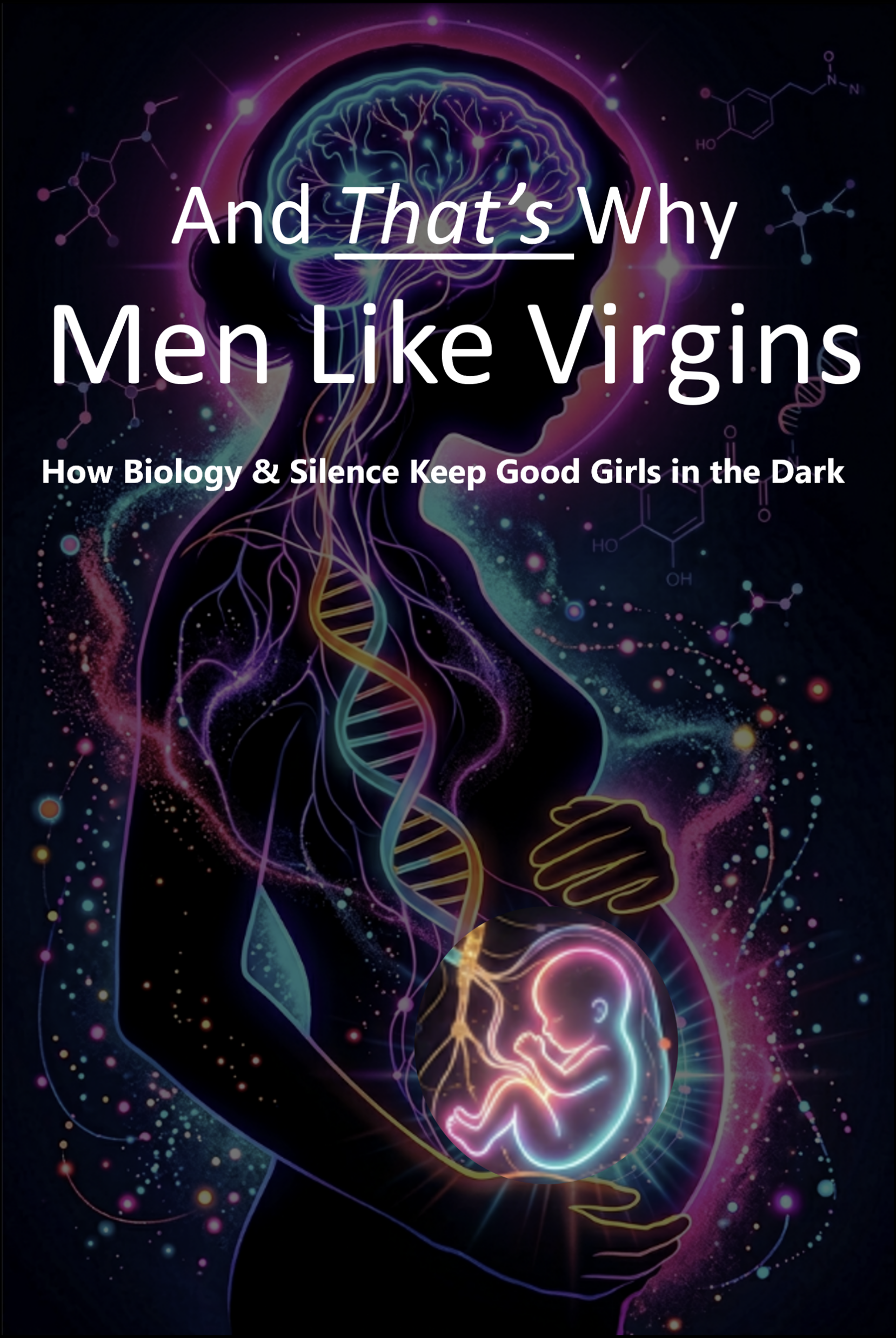
And That’s Why Men Like Virgins
Explore attraction, attachment, intimacy, heartbreak, male romantic behavior, stress, trauma, and relationship decision-making in one practical book written for adult women.