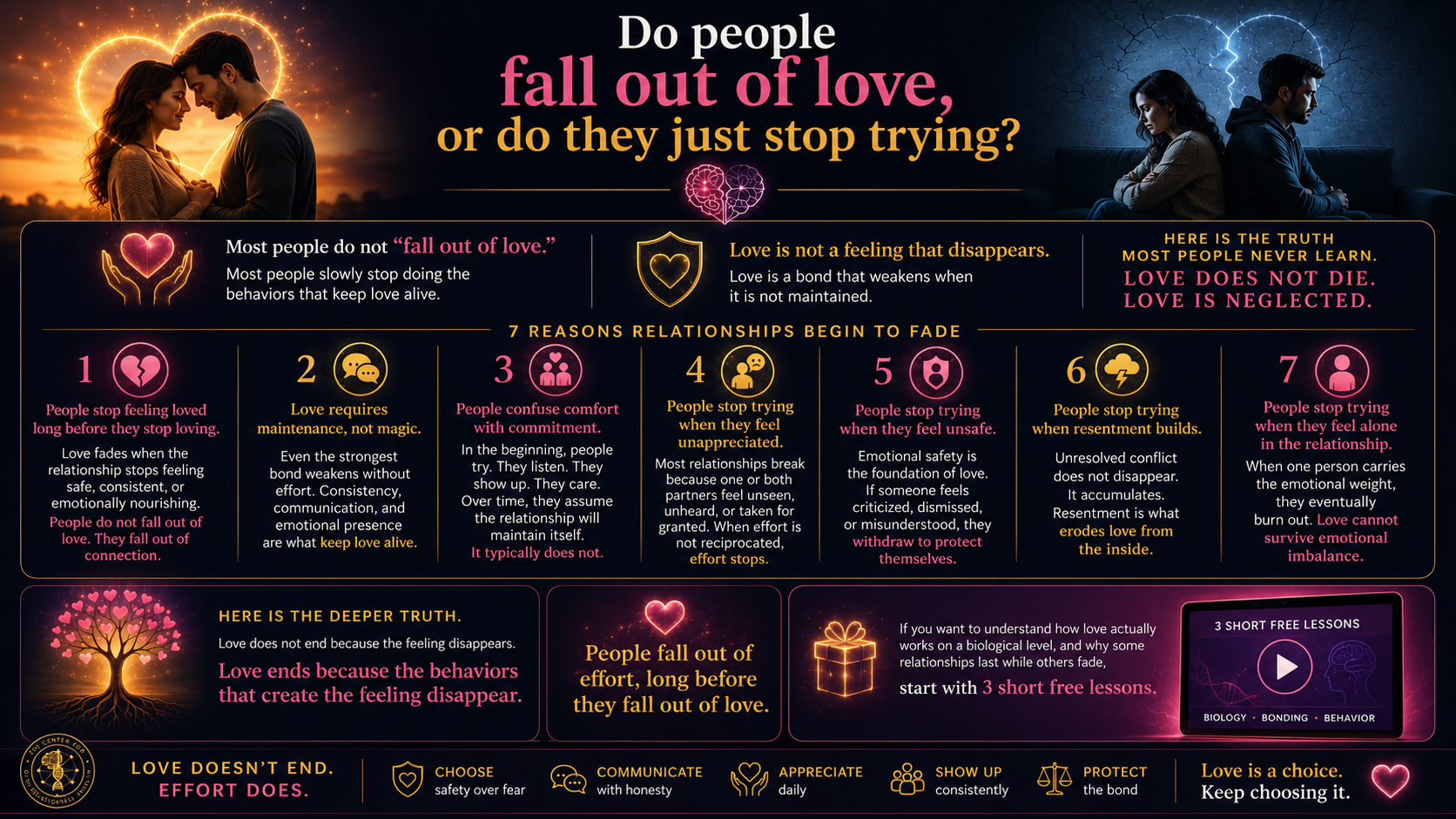
Do People Fall Out of Love or Do They Just Stop Trying?
Most people do not “fall out of love.” Most people slowly stop doing the behaviors that keep love alive.
Love is not a feeling that disappears. Love is a bond that weakens when it is not maintained.
Here is the truth most people never learn: love does not die, love is neglected.
- People stop feeling loved long before they stop loving. Love fades when the relationship stops feeling safe, consistent, or emotionally nourishing. People do not fall out of love. They fall out of connection.
- Love requires maintenance, not magic. Even the strongest bond weakens without effort. Consistency, communication, and emotional presence are what keep love alive.
- People confuse comfort with commitment. In the beginning, people try. They listen. They show up. They care. Over time, they assume the relationship will maintain itself. It typically does not.
- People stop trying when they feel unappreciated. Most relationships break because one or both partners feel unseen, unheard, or taken for granted. When effort is not reciprocated, effort stops.
- People stop trying when they feel unsafe. Emotional safety is the foundation of love. If someone feels criticized, dismissed, or misunderstood, they withdraw to protect themselves.
- People stop trying when resentment builds. Unresolved conflict does not disappear. It accumulates. Resentment is what erodes love from the inside.
- People stop trying when they feel alone in the relationship. When one person carries the emotional weight, they eventually burn out. Love cannot survive emotional imbalance.
Here is the deeper truth. Love does not end because the feeling disappears. Love ends because the behaviors that create the feeling disappear.
People fall out of effort, long before they fall out of love.
If you’d like to explore the biology behind lasting love in greater depth, you can begin with my free introductory lessons in the Truth Talk app.
Scientific References
- Blumenthal, S. A., & Young, L. J. (2023). The Neurobiology of Love and Pair Bonding from Human and Animal Perspectives. Biology, 12(6), 844.
https://pubmed.ncbi.nlm.nih.gov/37372130/ - Schneiderman, I., Zagoory-Sharon, O., Leckman, J. F., & Feldman, R. (2012). Oxytocin during the initial stages of romantic attachment: Relations to couples’ interactive reciprocity. Psychoneuroendocrinology, 37(8), 1277-1285.
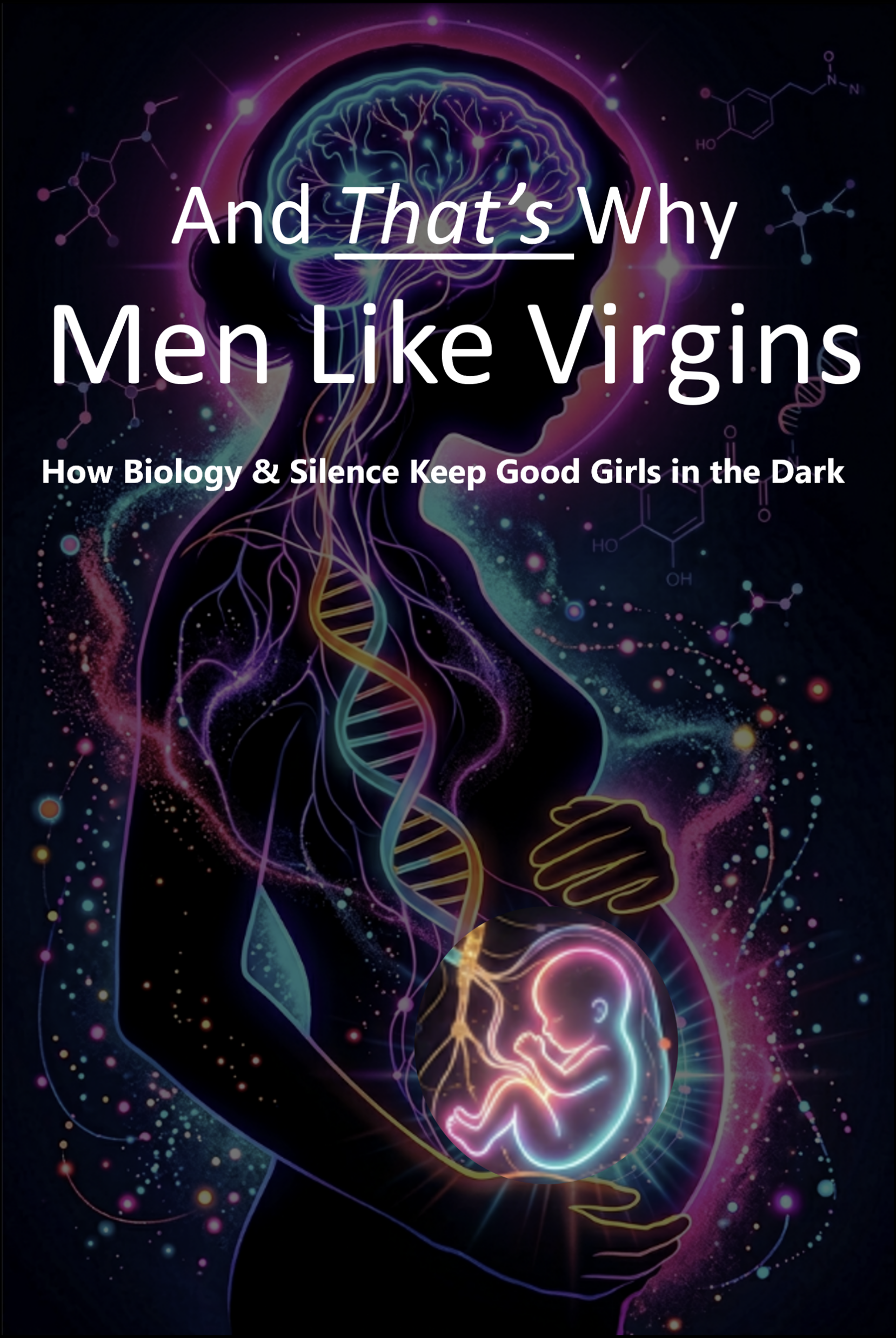
https://pubmed.ncbi.nlm.nih.gov/22281209/ - Turner, D. R. (2026). And That’s Why Men Like Virgins: How Biology & Silence Keep Good Girls in the Dark.
https://virtualvillagemom.com/
Continue Exploring Bio-Relational Science
And That’s Why Men Like Virgins
Explore attraction, attachment, intimacy, heartbreak, male romantic behavior, stress, trauma, and relationship decision-making in one practical book written for adult women.