Estimated reading time: 21-minutes July 29, 2026
In This Article
Evidence Note: This article integrates peer reviewed findings from developmental neuroscience, neuroendocrinology, reproductive immunology, virology, stress physiology, and public health. Every claim is tied to a cited primary source, and every source is listed in full with its digital object identifier at the end of the article. The Bio-Relational Science framework presented here is an original educational synthesis that translates this body of research into language the general reader can act on.
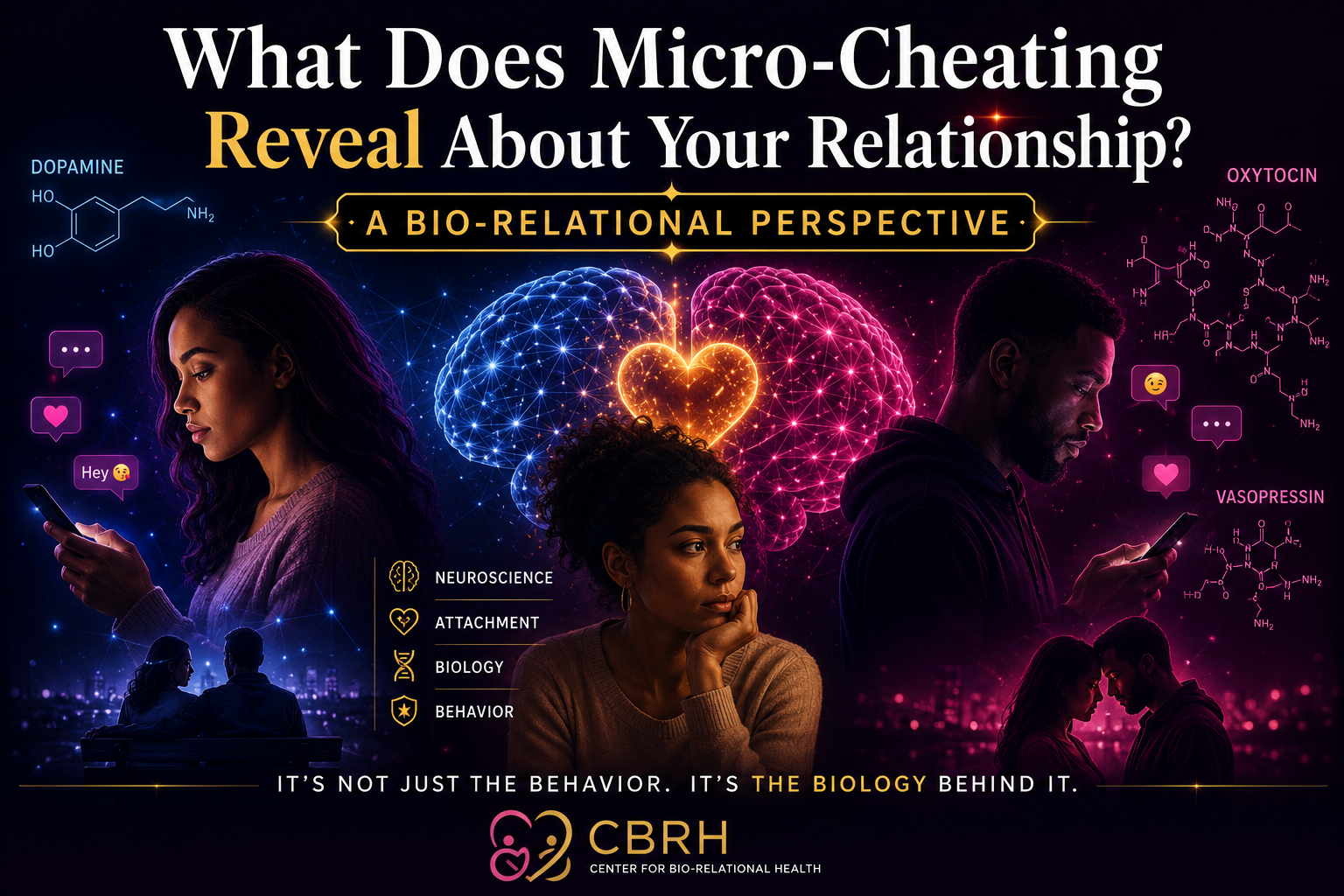
What Does Micro-Cheating Reveal About Your Relationship?
A Bio-Relational Perspective
Abstract
Micro-cheating is a cultural term for behaviors that stop short of physical or full emotional infidelity yet still erode trust, including concealed contact with a former partner, flirtatious messaging, presenting oneself as available online, and repeatedly seeking romantic validation outside the relationship. This article argues that the more useful question is not whether such behavior qualifies as cheating but what it reveals about the attachment state of the person doing it, and that the answer differs by sex because the underlying bonding architecture differs by sex. Four bodies of evidence support that position. Oxytocin and vasopressin receptor systems governing partner preference and attachment are organized differently in males and females (Dumais & Veenema, 2016; Insel & Hulihan, 1995; Winslow et al., 1993). In pair bonded men, oxytocin increases social distance from attractive strangers and heightens reward system response to the partner’s face rather than to unfamiliar faces, which means an established bond actively redirects attention inward (Scheele et al., 2012, 2013). Testosterone opposes oxytocin in human social cognition, and higher testosterone is associated with unfaithful behavior in men, which is why the male bonding shift tends to occur early or not at all (Crespi, 2016; Klimas et al., 2019). Female attachment remains responsive to ongoing relational conditions, deepening under emotional safety, touch, and sexual intimacy, and weakening under chronic stress and elevated cortisol (Bosch & Young, 2018; Carter et al., 1995; DeVries et al., 1996; Schneiderman et al., 2012). Drawing on And That’s Why Men Like Virgins: How Biology and Silence Keep Good Girls in the Dark (Turner, 2026), this article reframes micro-cheating as a diagnostic signal of attachment state and specifies the different questions it should raise for each partner.
Keywords: micro-cheating, infidelity, pair bonding, attachment asymmetry, oxytocin, vasopressin, testosterone, bio-relational science, relationship education
Introduction
Micro-cheating is a cultural term, not a clinical diagnosis. It describes behavior that stops short of a physical affair or a full emotional affair yet still undermines trust through secrecy, flirtation, redirected emotional investment, or boundary testing. The familiar examples are concrete: hiding conversations with an ex, trading flirtatious messages, presenting oneself as single online, keeping a person in reserve, and returning repeatedly to sources of romantic validation outside the relationship.
Most discussion of these behaviors gets stuck on definition. Couples argue about where the line sits, whether a particular message crossed it, and whether naming the category is fair or merely controlling. That argument cannot be settled, because the category was never built to be precise.
Bio-Relational Science asks a different question. If a person is repeatedly directing romantic or sexual attention outside an existing relationship, what does that behavior reveal about the state of their attachment system? Treated that way, micro-cheating stops being a rules dispute and becomes information.
The information is not identical for both sexes, because the biology producing it is not identical. Both men and women form deep pair bonds. The receptor systems, hormonal conditions, and timing that govern those bonds differ in ways that are well documented and consequential (Dumais & Veenema, 2016; Young & Wang, 2004). A woman and a man can perform the same micro-cheating behavior and be reporting two different underlying states.
That asymmetry is the subject of this article. It is also the reason the same behavior calls for different responses, and why advice that treats the two cases alike fails both of them.
Conceptual Framework
Bio-Relational Science treats intimate pairing as a biological process with relational consequence, governed simultaneously by bonding systems, reward systems, stress systems, and learning history (Carter, 2017; Turner, 2026). Four constructs organize the present analysis.
Attachment asymmetry holds that men and women arrive at exclusive romantic attachment through different pathways and on different timelines. The claim is mechanistic rather than evaluative. Oxytocin and vasopressin receptor distributions, gonadal steroid environments, and stress sensitivity differ by sex, and those differences appear in partner preference formation and bond maintenance (Dumais & Veenema, 2016; Insel & Hulihan, 1995; Winslow et al., 1993).
The bonding shift names the early, involuntary reorganization of attraction, reward valuation, and partner preference that characterizes male romantic attachment. It is experienced as falling in love rather than as deciding to commit. Its neural and endocrine signature is measurable, and its most important property for present purposes is that it either occurs near the beginning of a relationship or it does not occur (Aron et al., 2005; Fisher et al., 2006; Scheele et al., 2013; Turner, 2026).
Diagnostic behavior treats micro-cheating as a readout rather than an offense. The behavior is not primarily interesting as a moral infraction. It is interesting because attention is a limited resource that bonded systems allocate, and where a person allocates it discloses what their bonding system is actually doing (DeWall et al., 2011; Ma et al., 2019; Scheele et al., 2012).
Conditional maintenance holds that female attachment remains responsive to ongoing relational conditions after it forms. It can deepen under safety, responsiveness, touch, and sexual intimacy, and it can erode under chronic stress, neglect, and unpredictability (Bosch & Young, 2018; DeVries et al., 1995; Schneiderman et al., 2012). This construct is what makes one of the two cases recoverable and the other one not.
Discussion
What micro-cheating names, and what the label obscures
The term has real utility as a signal word. It gives partners language for behavior that erodes trust incrementally, below the threshold that would trigger a confrontation, and it invites attention to that erosion before it compounds.
Its weakness is that it directs the conversation toward enforcement. Once a couple is litigating whether a given message counted, both people are working on the wrong problem. Nothing about the classification changes what the behavior indicates.
The research literature does not use the term, but it studies the behavior extensively under other names, including attention to attractive alternatives, derogation of alternatives, extradyadic behavior, monogamy maintenance, and concealment. That work consistently treats orientation toward alternatives as a measure of relationship state rather than as an isolated act (Lee & O’Sullivan, 2019; Ma et al., 2019; Rodrigues et al., 2017). This article adopts the same posture.
Bonding architecture is not identical in men and women
Popular relationship advice assumes a single bonding process running in both partners. The neurobiology does not support that assumption.
Oxytocin and vasopressin are the principal peptides governing partner preference and attachment, and their receptor systems show substantial sex differences in distribution and in the regulation of social behavior (Dumais & Veenema, 2016). The mechanistic dissociation was established directly. Insel and Hulihan (1995) demonstrated that central oxytocin facilitated partner preference formation in females, and Winslow et al. (1993) established central vasopressin as the corresponding pathway in males. Cho et al. (1999) showed that both peptides can act in both sexes while differing in potency and route.
Receptor density determines how readily a bond forms at all. Keebaugh and Young (2011) increased oxytocin receptor expression in the nucleus accumbens of prepubertal females and produced enhanced partner preference in adulthood. Ross et al. (2009) showed that accumbens oxytocin receptor density has differential behavioral consequences across species with different mating systems. In men, variation in the vasopressin receptor 1a gene is associated with pair bonding behavior, including reported relationship quality and marital status (Walum et al., 2008).
The reviews converge on the same summary. Pair bonding is produced by overlapping but distinguishable systems in the two sexes, involving oxytocin, vasopressin, dopamine, gonadal steroids, and the stress axis in different configurations (Blumenthal & Young, 2023; Bosch & Young, 2018; Carter, 2017; Young & Wang, 2004).
What oxytocin does to a bonded man’s attention
Two experiments make the attentional consequences of male bonding unusually concrete, and they bear directly on micro-cheating.
Scheele et al. (2012) administered intranasal oxytocin to men and measured the physical distance they maintained from an attractive female stranger. In pair bonded men, oxytocin increased that distance. It did not increase distance in single men. The peptide most associated with closeness produced avoidance of an alternative specifically in men who already had a partner.
Scheele et al. (2013) then showed that oxytocin enhanced reward system and dopaminergic response when men viewed the face of their own female partner, without producing the same enhancement for unfamiliar or other familiar women. The bond does not merely add a preference. It reweights the reward value of faces.
Taken together, these findings describe an active mechanism. A functioning male pair bond redirects attention and reward toward the partner and away from alternatives. That is the behavioral signature a woman is implicitly looking for when she notices where his attention goes.
Zheng et al. (2021) extend the picture from the other direction, finding that intranasal oxytocin reduced jealousy evoked by imagined and actual partner interactions with a rival, consistent with oxytocin supporting bond stability rather than merely generating affection.
Testosterone, the oxytocin brake, and the timing of the male shift
Oxytocin does not operate in isolation in men. Crespi (2016) synthesizes evidence that oxytocin and testosterone exert broadly opposing influences on human social cognition, with testosterone shifting behavior toward status, competition, and self interest and oxytocin shifting it toward affiliation and bond maintenance. The two systems function as counterweights.
That antagonism has a direct behavioral correlate. Klimas et al. (2019) found that higher testosterone levels were associated with unfaithful behavior in men. The endocrine profile that suppresses oxytocin driven affiliation is the profile associated with looking outward.
The trajectory runs the other way when a bond takes hold. Gettler et al. (2011) demonstrated longitudinally that fatherhood decreases testosterone in human males, and Gettler et al. (2013) linked those declines to sexual behavior across the marital transition. Grebe et al. (2019) provide a meta analytic account of pair bonding, fatherhood, and testosterone, and Grebe et al. (2017) show that oxytocin tracks investment in relationships a partner perceives as vulnerable.
This is the mechanistic basis for a claim that women find difficult and that the evidence nonetheless supports. Because testosterone opposes the oxytocin dependent affiliative state, the involuntary shift into exclusive romantic attachment in men tends to occur early in a relationship or not at all. It is not a reward that accumulates in response to a partner’s effort. The neural signature of early stage intense romantic love involves reward and motivation circuitry that engages rapidly (Aron et al., 2005; Fisher et al., 2005), and long term intense romantic love shows continued engagement of those same systems rather than their construction from nothing years later (Acevedo et al., 2012).
When a man is micro-cheating
Persistent redirection of romantic or sexual attention outside the relationship indicates that an exclusive bonding shift is not governing his behavior. Given the Scheele findings, this follows directly: a bonded male attentional system moves away from alternatives, so a man whose attention keeps moving toward them is reporting the absence of that state (Klimas et al., 2019; Scheele et al., 2012, 2013).
When the shift has occurred, seeking outside validation would conflict with the system organizing his behavior. Oxytocin, vasopressin, dopamine, and reduced testosterone jointly orient him toward protecting the woman and preserving the bond (Blumenthal & Young, 2023; Gettler et al., 2011; Walum et al., 2008). Micro-cheating is not a small failure within that configuration. It is evidence that the configuration is not present.
This is why a woman’s reaction to persistent micro-cheating is so often disproportionate to the individual act. She is not responding to a text message. Instinctively, she recognizes that she has been reading his comfort, dependence, companionship, and appreciation as evidence of a romantic bond that never formed in the way she believed. What she fears losing is a love she herself developed and that never existed in that form for him (Turner, 2026).
What female investment can and cannot produce
The practical consequence is clarifying rather than cruel. Female investment cannot manufacture an involuntary male attachment response.
A woman can improve a relationship substantially. She can make his life more comfortable, become genuinely important to him, and secure his loyalty in the ordinary sense. None of that constructs the exclusive in love state she may assume her effort is building, because that state depends on an early internal shift in attraction and reward rather than on accumulated evidence of her worth (Aron et al., 2005; Crespi, 2016; Scheele et al., 2013; Turner, 2026).
Time, devotion, sex, sacrifice, financial support, and shared hardship deepen attachment in her. That is the pathway her own system runs. Applying it to him and expecting the same output is the single most common error in heterosexual relationship reasoning, and it is an error about mechanism, not about effort (Dumais & Veenema, 2016; Schneiderman et al., 2012).
When a woman discovers persistent micro-cheating and recognizes that the early exclusive shift never occurred, the most protective response is to stop investing. Continued investment will not produce the attachment she wants, and the cost of continuing falls disproportionately on her (Turner, 2026).
When a woman is micro-cheating
In women, the same behaviors more often report a change in conditions rather than the absence of a bond.
Female attachment is sustained by oxytocin signaling that responds to social contact, touch, emotional responsiveness, and sexual intimacy, with estrogen modulating oxytocin systems and amplifying those effects (Bosch & Young, 2018; Gao et al., 2025; Oliveira & Bakker, 2022; Schneiderman et al., 2012; Sorokowski et al., 2019). Because the inputs are ongoing, the output is not fixed.
This means her attachment state remains responsive to what is actually happening in the relationship. When she feels safe, seen, and emotionally connected, attachment deepens and loyalty strengthens. When she feels chronically unsafe, neglected, unsupported, or disconnected, attention and emotional energy begin moving elsewhere.
Female micro-cheating is therefore more often a symptom of eroding conditions than a report that no bond was ever present. That distinction matters for what can be done about it.
Stress, cortisol, and the erosion of female attachment
The stress axis regulates bonding capacity, and it does so in a sexually dimorphic direction that matters here.
DeVries et al. (1995) found that lowering corticosterone accelerated partner preference formation in female prairie voles, while administering corticosterone prevented the formation of new preferences without disrupting bonds already established. Carter et al. (1995) reported the same asymmetry. DeVries et al. (1996) established the dimorphism directly, with stress facilitating bond formation in males while inhibiting it in females. Anacker et al. (2016) replicated the dissociation between new and established relationships.
In humans, the corresponding findings are consistent. Heinrichs et al. (2003) showed that social support combined with oxytocin produced the lowest cortisol response to a laboratory stressor. Ditzen et al. (2009) found that intranasal oxytocin increased positive communication and lowered cortisol during couple conflict. Buchheim et al. (2009) found that oxytocin enhanced the experience of attachment security. Pietromonaco et al. (2013) document that adult attachment differences appear in cortisol reactivity to relational stress.
Two implications follow. Chronic relational stress degrades the conditions that maintain female attachment, which is a mechanism for erosion rather than a failure of character. And because the effect operates on formation more than on maintenance, a woman under sustained relational load may find it harder to attach to someone new than to remain attached to someone who has already harmed her.
Secrecy as the active ingredient
Much of what makes micro-cheating corrosive is not the content of the contact but its concealment.
Lehmiller (2009) found that secret romantic relationships carried consequences for personal and relational well being. Uysal et al. (2012) found that self concealment from a partner was associated with lower relationship well being. Davis et al. (2021) show that the burden of a secret operates through the fear of discovery rather than through the concealed content alone.
This explains a pattern couples often misread. A partner insists the exchange was harmless, and in terms of content it may have been. The concealment is the part that carries the cost, because it establishes a domain of the relationship that operates outside shared knowledge and requires ongoing management.
Digital environments and the supply of alternatives
Micro-cheating became a named phenomenon because the opportunity structure changed. Persistent private messaging, permanent access to former partners, and continuous availability of new contacts raise the supply of alternatives and lower the cost of testing them.
Commitment research treats orientation toward alternatives as an active process rather than a passive exposure. DeWall et al. (2011) showed that relationship commitment recruits attentional strategies for handling attractive alternatives, and Ma et al. (2019) found attentional biases away from attractive alternatives and rivals in people experiencing romantic love. Rodrigues et al. (2017) examined how commitment shapes derogation of an attractive alternative. Birnbaum et al. (2024) tested whether perspective taking reduces the appeal of alternative partners, and Lee and O’Sullivan (2019) assessed how successful deliberate monogamy maintenance efforts actually are.
The digital layer has measurable relational costs. Șerban et al. (2022) document infidelity related behaviors on social media platforms. Mushquash et al. (2022) found that technology interference is associated with reduced intimacy. Navarro et al. (2020) examined the psychological correlates of ghosting and breadcrumbing, the practice of supplying intermittent attention sufficient to maintain interest without offering commitment.
Breadcrumbing is worth naming specifically, because it is micro-cheating viewed from the other side. It is the deliberate maintenance of a low investment connection, and its existence in the research literature confirms that people recognize the pattern well enough to practice it strategically.
Sexual exposure, seminal signaling, and biological persistence
Sexual intimacy is not a neutral relational activity that can be withdrawn without residue. It is an endocrine and immunological transaction.
Seminal plasma contains cytokines, prostaglandins, and signaling molecules that interact with the female reproductive tract and alter immune parameters relevant to tolerance and implantation (Robertson, 2007; Schjenken & Robertson, 2015, 2020). Schjenken et al. (2021) demonstrated that sperm modulate uterine immune parameters relevant to embryo implantation and reproductive success. Wilkinson et al. (2025) found that prior mating without fertilization increased subsequent litter size, isolating the contribution of exposure itself.
Persistence extends further than the encounter. Chan et al. (2012) identified male microchimerism in the human female brain, demonstrating that male derived cells can be present in female brain tissue. Boddy et al. (2015) and Fjeldstad et al. (2020) review fetal microchimerism and its implications for maternal health.
For relationship education the point is simple. Repeated sexual intimacy with a specific partner is participation in a physiological process, and it operates alongside the oxytocin conditioning that deepens female attachment (Schneiderman et al., 2012). A woman evaluating whether to keep investing in a relationship marked by persistent micro-cheating is not making a purely emotional decision. She is deciding how much more of this exposure to accumulate.
Coping: different questions for men and women
Because the two cases are mechanistically different, the useful questions differ.
For a woman who has discovered persistent micro-cheating, the question is not how to make him stop. It is whether the early exclusive bonding shift ever occurred. If the honest answer is that the relationship has always been comfortable, convenient, and situational for him, then further investment will not produce the attachment she wants, and leaving protects her from accumulating more emotional and physical cost (Klimas et al., 2019; Scheele et al., 2013; Turner, 2026).
For a man, the question is whether he experienced a clear early shift with this partner, an in love state marked by heightened oxytocin and vasopressin driven attachment and reduced testosterone, or whether the relationship has always been casual and situational (Blumenthal & Young, 2023; Crespi, 2016; Gettler et al., 2011).
If he did experience that shift and wants to preserve the relationship, sustained effort is warranted and can work, because the conditions supporting her attachment are responsive to his behavior. Reducing chronic stress and rebuilding emotional safety, responsiveness, affection, reliability, and intimacy supports the oxytocin signaling her attachment depends on (Bosch & Young, 2018; Ditzen et al., 2009; Heinrichs et al., 2003; Schneiderman et al., 2012). That is not a guarantee, and it does not excuse betrayal. It is a statement about which of the two systems remains open to change.
If he did not experience that shift and regards the relationship as temporary or convenient, then policing her behavior while withholding commitment is the least honest option available. Stepping away is the kinder action.
The asymmetry reduces to one sentence. It is generally easier for a man to change a woman’s experience of the relationship than for a woman to produce a romantic attachment state in a man that never appeared.
Is micro-cheating a useful term?
As a signal word, yes. It gives partners a way to notice behavior that quietly erodes trust before the erosion compounds, and the underlying behavior is well studied even though the label is informal.
As a diagnosis, no. It becomes counterproductive when it is used only to police small infractions, because that use substitutes enforcement for the question that actually matters: why is one partner seeking attention or validation outside the relationship, and what does that tell us about the state of the bond?
Relation to Bio-Relational Science
Bio-Relational Science is the interdisciplinary framework that makes micro-cheating legible. It integrates developmental neuroscience, neuroendocrinology, reproductive immunology, stress physiology, educational psychology, and public health to explain how intimate relationships operate in the body as well as in the mind (Turner, 2026).
The framework was developed at length in And That’s Why Men Like Virgins: How Biology and Silence Keep Good Girls in the Dark, which synthesizes research on bonding neurochemistry, reproductive asymmetry, biological imprinting, and trauma physiology into a model ordinary readers can apply (Turner, 2026).
Its central contribution here is the separation of processes that popular advice treats as interchangeable. Attraction, chemistry, attachment, connection, comfort, loyalty, and love are distinct phenomena with distinct substrates and distinct time courses. Collapsing them is precisely what allows a woman to interpret a man’s comfort and reliance as romantic attachment, and what allows years of effort to be spent generating a state that either formed at the beginning or did not.
The framework also holds that attachment direction should be visible early, through pursuit, clarity, consistency, care, and investment, rather than inferred from continued presence. Micro-cheating is valuable within this framework for exactly that reason. It is early, visible, and informative.
Implications for Women’s Wellness and Bio-Relational Education
A relationship curriculum built on this evidence would teach women to read micro-cheating as data rather than as an insult to be negotiated.
It would teach the attentional evidence directly, because it is unusually clear. A bonded male system moves away from attractive alternatives and reweights reward toward the partner (Scheele et al., 2012, 2013). A woman who understands that finding does not need to adjudicate individual messages.
It would teach the timing claim honestly, including the part that is unwelcome. Because testosterone opposes oxytocin driven affiliation, the male shift occurs early or not at all, and no amount of female investment induces it later (Crespi, 2016; Klimas et al., 2019). Teaching this early protects years of a woman’s life.
It would teach that her own attachment is being conditioned while she evaluates him, through touch, sexual intimacy, and repeated closeness (Bosch & Young, 2018; Schneiderman et al., 2012), and that sexual exposure carries physiological consequence independent of how the relationship turns out (Chan et al., 2012; Robertson, 2007; Schjenken & Robertson, 2020).
It would teach stress physiology, so that a woman who cannot attach to a decent partner understands she may be reading a regulated biological state rather than a personal failing (DeVries et al., 1995, 1996; Pietromonaco et al., 2013).
And it would teach the concealment finding, because it settles a common argument. Secrecy carries relational cost on its own terms, whatever the content it conceals (Davis et al., 2021; Lehmiller, 2009; Uysal et al., 2012).
For clinicians and educators, the implication is that orientation toward alternatives deserves treatment as a measurable indicator of relationship state rather than as a matter for moral instruction. Loneliness and relational disconnection carry hard health endpoints (Hawkley & Cacioppo, 2010; Holt-Lunstad et al., 2015; Wang et al., 2023), which places accurate relationship literacy inside the scope of public health.
Conclusion
Micro-cheating is not primarily an offense to be classified. It is a signal to be read.
In a man, persistent redirection of romantic attention outside the relationship indicates that the early exclusive bonding shift is not governing his behavior, because a bonded male attentional system moves the other way. In a woman, the same behavior more often indicates that the conditions maintaining her attachment have degraded, because her attachment remains responsive to those conditions.
That difference determines what is worth doing. One case is recoverable through changed behavior. The other is not recoverable through effort, and recognizing it early is what protects a woman from spending years building toward a state that was decided at the beginning.
The behavior is small. What it reveals is not.
References
Acevedo, B. P., Aron, A., Fisher, H. E., & Brown, L. L. (2012). Neural correlates of long-term intense romantic love. Social Cognitive and Affective Neuroscience, 7(2), 145-159. https://doi.org/10.1093/scan/nsq092
Anacker, A. M. J., Reitz, K. M., Goodwin, N. L., & Beery, A. K. (2016). Stress impairs new but not established relationships in seasonally social voles. Hormones and Behavior, 79, 52-57. https://doi.org/10.1016/j.yhbeh.2016.01.004
Aron, A., Fisher, H., Mashek, D. J., Strong, G., Li, H., & Brown, L. L. (2005). Reward, motivation, and emotion systems associated with early-stage intense romantic love. Journal of Neurophysiology, 94(1), 327-337. https://doi.org/10.1152/jn.00838.2004
Birnbaum, G. E., Bachar, T., Levy, G. F., Zholtack, K., & Reis, H. T. (2024). Put me in your shoes: Does perspective-taking inoculate against the appeal of alternative partners? Journal of Sex Research, 61(6), 936-945. https://doi.org/10.1080/00224499.2022.2150998
Blumenthal, S. A., & Young, L. J. (2023). The neurobiology of love and pair bonding from human and animal perspectives. Biology, 12(6), 844. https://doi.org/10.3390/biology12060844
Boddy, A. M., Fortunato, A., Wilson Sayres, M., & Aktipis, A. (2015). Fetal microchimerism and maternal health: A review and evolutionary analysis of cooperation and conflict beyond the womb. BioEssays, 37(10), 1106-1118. https://doi.org/10.1002/bies.201500059
Bosch, O. J., & Young, L. J. (2018). Oxytocin and social relationships: From attachment to bond disruption. Current Topics in Behavioral Neurosciences, 35, 97-117. https://doi.org/10.1007/7854_2017_10
Buchheim, A., Heinrichs, M., George, C., Pokorny, D., Koops, E., Henningsen, P., O’Connor, M. F., & Gündel, H. (2009). Oxytocin enhances the experience of attachment security. Psychoneuroendocrinology, 34(9), 1417-1422. https://doi.org/10.1016/j.psyneuen.2009.04.002
Carter, C. S. (2017). The oxytocin-vasopressin pathway in the context of love and fear. Frontiers in Endocrinology, 8, 356. https://doi.org/10.3389/fendo.2017.00356
Carter, C. S., DeVries, A. C., Taymans, S. E., Roberts, R. L., Williams, J. R., & Chrousos, G. P. (1995). Adrenocorticoid hormones and the development and expression of mammalian monogamy. Annals of the New York Academy of Sciences, 771, 82-91. https://doi.org/10.1111/j.1749-6632.1995.tb44672.x
Chan, W. F. N., Gurnot, C., Montine, T. J., Sonnen, J. A., Guthrie, K. A., & Nelson, J. L. (2012). Male microchimerism in the human female brain. PLoS ONE, 7(9), e45592. https://doi.org/10.1371/journal.pone.0045592
Cho, M. M., DeVries, A. C., Williams, J. R., & Carter, C. S. (1999). The effects of oxytocin and vasopressin on partner preferences in male and female prairie voles (Microtus ochrogaster). Behavioral Neuroscience, 113(5), 1071-1079. https://doi.org/10.1037/0735-7044.113.5.1071
Crespi, B. J. (2016). Oxytocin, testosterone, and human social cognition. Biological Reviews, 91(2), 390-408. https://doi.org/10.1111/brv.12175
Davis, C. G., Brazeau, H., Xie, E. B., & McKee, K. (2021). Secrets, psychological health, and the fear of discovery. Personality and Social Psychology Bulletin, 47(5), 781-795. https://doi.org/10.1177/0146167220946195
DeVries, A. C., DeVries, M. B., Taymans, S., & Carter, C. S. (1995). Modulation of pair bonding in female prairie voles (Microtus ochrogaster) by corticosterone. Proceedings of the National Academy of Sciences, 92(17), 7744-7748. https://doi.org/10.1073/pnas.92.17.7744
DeVries, A. C., DeVries, M. B., Taymans, S. E., & Carter, C. S. (1996). The effects of stress on social preferences are sexually dimorphic in prairie voles. Proceedings of the National Academy of Sciences, 93(21), 11980-11984. https://doi.org/10.1073/pnas.93.21.11980
DeWall, C. N., Maner, J. K., Deckman, T., & Rouby, D. A. (2011). Forbidden fruit: Inattention to attractive alternatives provokes implicit relationship reactance. Journal of Personality and Social Psychology, 100(4), 621-629. https://doi.org/10.1037/a0021749
Ditzen, B., Schaer, M., Gabriel, B., Bodenmann, G., Ehlert, U., & Heinrichs, M. (2009). Intranasal oxytocin increases positive communication and reduces cortisol levels during couple conflict. Biological Psychiatry, 65(9), 728-731. https://doi.org/10.1016/j.biopsych.2008.10.011
Dumais, K. M., & Veenema, A. H. (2016). Vasopressin and oxytocin receptor systems in the brain: Sex differences and sex-specific regulation of social behavior. Frontiers in Neuroendocrinology, 40, 1-23. https://doi.org/10.1016/j.yfrne.2015.04.003
Fisher, H. E., Aron, A., & Brown, L. L. (2005). Romantic love: An fMRI study of a neural mechanism for mate choice. The Journal of Comparative Neurology, 493(1), 58-62. https://doi.org/10.1002/cne.20772
Fisher, H. E., Aron, A., & Brown, L. L. (2006). Romantic love: A mammalian brain system for mate choice. Philosophical Transactions of the Royal Society B: Biological Sciences, 361(1476), 2173-2186. https://doi.org/10.1098/rstb.2006.1938
Fjeldstad, H. E., Johnsen, G. M., & Staff, A. C. (2020). Fetal microchimerism and implications for maternal health. Obstetric Medicine, 13(3), 112-119. https://doi.org/10.1177/1753495X19884484
Gao, T., Ying, Z., Yang, Y., & Xu, X. (2025). Effects of estrogen on social recognition and oxytocin regulating synaptic plasticity. Physiology and Behavior, 293, 114843. https://doi.org/10.1016/j.physbeh.2025.114843
Gettler, L. T., McDade, T. W., Agustin, S. S., Feranil, A. B., & Kuzawa, C. W. (2013). Do testosterone declines during the transition to marriage and fatherhood relate to men’s sexual behavior? Evidence from the Philippines. Hormones and Behavior, 64(5), 755-763. https://doi.org/10.1016/j.yhbeh.2013.08.019
Gettler, L. T., McDade, T. W., Feranil, A. B., & Kuzawa, C. W. (2011). Longitudinal evidence that fatherhood decreases testosterone in human males. Proceedings of the National Academy of Sciences, 108(39), 16194-16199. https://doi.org/10.1073/pnas.1105403108
Grebe, N. M., Kristoffersen, A. A., Grøntvedt, T. V., Emery Thompson, M., Kennair, L. E. O., & Gangestad, S. W. (2017). Oxytocin and vulnerable romantic relationships. Hormones and Behavior, 90, 64-74. https://doi.org/10.1016/j.yhbeh.2017.02.009
Grebe, N. M., Sarafin, R. E., Strenth, C. R., & Zilioli, S. (2019). Pair-bonding, fatherhood, and the role of testosterone: A meta-analytic review. Neuroscience and Biobehavioral Reviews, 98, 221-233. https://doi.org/10.1016/j.neubiorev.2019.01.010
Hawkley, L. C., & Cacioppo, J. T. (2010). Loneliness matters: A theoretical and empirical review of consequences and mechanisms. Annals of Behavioral Medicine, 40(2), 218-227. https://doi.org/10.1007/s12160-010-9210-8
Heinrichs, M., Baumgartner, T., Kirschbaum, C., & Ehlert, U. (2003). Social support and oxytocin interact to suppress cortisol and subjective responses to psychosocial stress. Biological Psychiatry, 54(12), 1389-1398. https://doi.org/10.1016/S0006-3223(03)00465-7
Holt-Lunstad, J., Smith, T. B., Baker, M., Harris, T., & Stephenson, D. (2015). Loneliness and social isolation as risk factors for mortality: A meta-analytic review. Perspectives on Psychological Science, 10(2), 227-237. https://doi.org/10.1177/1745691614568352
Insel, T. R., & Hulihan, T. J. (1995). A gender-specific mechanism for pair bonding: Oxytocin and partner preference formation in monogamous voles. Behavioral Neuroscience, 109(4), 782-789. https://doi.org/10.1037/0735-7044.109.4.782
Keebaugh, A. C., & Young, L. J. (2011). Increasing oxytocin receptor expression in the nucleus accumbens of pre-pubertal female prairie voles enhances alloparental responsiveness and partner preference formation as adults. Hormones and Behavior, 60(5), 498-504. https://doi.org/10.1016/j.yhbeh.2011.07.018
Klimas, C., Ehlert, U., Lacker, T. J., Waldvogel, P., & Walther, A. (2019). Higher testosterone levels are associated with unfaithful behavior in men. Biological Psychology, 146, 107730. https://doi.org/10.1016/j.biopsycho.2019.107730
Lee, B. H., & O’Sullivan, L. F. (2019). Walk the line: How successful are efforts to maintain monogamy in intimate relationships? Archives of Sexual Behavior, 48(6), 1735-1748. https://doi.org/10.1007/s10508-018-1376-3
Lehmiller, J. J. (2009). Secret romantic relationships: Consequences for personal and relational well-being. Personality and Social Psychology Bulletin, 35(11), 1452-1466. https://doi.org/10.1177/0146167209342594
Ma, Y., Xue, W., Zhao, G., Tu, S., & Zheng, Y. (2019). Romantic love and attentional biases toward attractive alternatives and rivals: Long-term relationship maintenance among young Chinese adults. Evolutionary Psychology, 17(4), 1474704919897601. https://doi.org/10.1177/1474704919897601
Mushquash, A. R., Charlton, J. K., MacIsaac, A., & Ryan, K. (2022). Romance behind the screens: Exploring the role of technoference on intimacy. Cyberpsychology, Behavior, and Social Networking, 25(12), 814-820. https://doi.org/10.1089/cyber.2022.0068
Navarro, R., Larrañaga, E., Yubero, S., & Víllora, B. (2020). Psychological correlates of ghosting and breadcrumbing experiences: A preliminary study among adults. International Journal of Environmental Research and Public Health, 17(3), 1116. https://doi.org/10.3390/ijerph17031116
Oliveira, V. E. M., & Bakker, J. (2022). Neuroendocrine regulation of female aggression. Frontiers in Endocrinology, 13, 957114. https://doi.org/10.3389/fendo.2022.957114
Pietromonaco, P. R., DeBuse, C. J., & Powers, S. I. (2013). Does attachment get under the skin? Adult romantic attachment and cortisol responses to stress. Current Directions in Psychological Science, 22(1), 63-68. https://doi.org/10.1177/0963721412463229
Robertson, S. A. (2007). Seminal fluid signaling in the female reproductive tract: Lessons from rodents and pigs. Journal of Animal Science, 85(13 Suppl), E36-E44. https://doi.org/10.2527/jas.2006-578
Rodrigues, D., Lopes, D., & Kumashiro, M. (2017). The “I” in us, or the eye on us? Regulatory focus, commitment and derogation of an attractive alternative person. PLoS ONE, 12(3), e0174350. https://doi.org/10.1371/journal.pone.0174350
Ross, H. E., Freeman, S. M., Spiegel, L. L., Ren, X., Terwilliger, E. F., & Young, L. J. (2009). Variation in oxytocin receptor density in the nucleus accumbens has differential effects on affiliative behaviors in monogamous and polygamous voles. The Journal of Neuroscience, 29(5), 1312-1318. https://doi.org/10.1523/JNEUROSCI.5039-08.2009
Scheele, D., Striepens, N., Güntürkün, O., Deutschländer, S., Maier, W., Kendrick, K. M., & Hurlemann, R. (2012). Oxytocin modulates social distance between males and females. The Journal of Neuroscience, 32(46), 16074-16079. https://doi.org/10.1523/JNEUROSCI.2755-12.2012
Scheele, D., Wille, A., Kendrick, K. M., Stoffel-Wagner, B., Becker, B., Güntürkün, O., Maier, W., & Hurlemann, R. (2013). Oxytocin enhances brain reward system responses in men viewing the face of their female partner. Proceedings of the National Academy of Sciences, 110(50), 20308-20313. https://doi.org/10.1073/pnas.1314190110
Schjenken, J. E., & Robertson, S. A. (2015). Seminal fluid signalling in the female reproductive tract: Implications for reproductive success and offspring health. Advances in Experimental Medicine and Biology, 868, 127-158. https://doi.org/10.1007/978-3-319-18881-2_6
Schjenken, J. E., & Robertson, S. A. (2020). The female response to seminal fluid. Physiological Reviews, 100(3), 1077-1117. https://doi.org/10.1152/physrev.00013.2018
Schjenken, J. E., Sharkey, D. J., Green, E. S., Chan, H. Y., Matias, R. A., Moldenhauer, L. M., & Robertson, S. A. (2021). Sperm modulate uterine immune parameters relevant to embryo implantation and reproductive success in mice. Communications Biology, 4(1), 572. https://doi.org/10.1038/s42003-021-02038-9
Schneiderman, I., Zagoory-Sharon, O., Leckman, J. F., & Feldman, R. (2012). Oxytocin during the initial stages of romantic attachment: Relations to couples’ interactive reciprocity. Psychoneuroendocrinology, 37(8), 1277-1285. https://doi.org/10.1016/j.psyneuen.2011.12.021
Șerban, I., Salvati, M., & Enea, V. (2022). Sexual orientation and infidelity-related behaviors on social media sites. International Journal of Environmental Research and Public Health, 19(23), 15659. https://doi.org/10.3390/ijerph192315659
Sorokowski, P., Żelaźniewicz, A., Nowak, J., Groyecka, A., Kaleta, M., Lech, W., Samorek, S., & Stachowska, K. (2019). Romantic love and reproductive hormones in women. International Journal of Environmental Research and Public Health, 16(21), 4224. https://doi.org/10.3390/ijerph16214224
Turner, D. R. (2026). And That’s Why Men Like Virgins: How Biology and Silence Keep Good Girls in the Dark. VirtualVillageMom Publishing.
Uysal, A., Lin, H. L., Knee, C. R., & Bush, A. L. (2012). The association between self-concealment from one’s partner and relationship well-being. Personality and Social Psychology Bulletin, 38(1), 39-51. https://doi.org/10.1177/0146167211429331
Walum, H., Westberg, L., Henningsson, S., Neiderhiser, J. M., Reiss, D., Igl, W., Ganiban, J. M., Spotts, E. L., Pedersen, N. L., Eriksson, E., & Lichtenstein, P. (2008). Genetic variation in the vasopressin receptor 1a gene (AVPR1A) associates with pair-bonding behavior in humans. Proceedings of the National Academy of Sciences, 105(37), 14153-14156. https://doi.org/10.1073/pnas.0803081105
Wang, F., Gao, Y., Han, Z., Yu, Y., Long, Z., Jiang, X., Wu, Y., & Pei, B. (2023). A systematic review and meta-analysis of 90 cohort studies of social isolation, loneliness and mortality. Nature Human Behaviour, 7(8), 1307-1319. https://doi.org/10.1038/s41562-023-01617-6
Wilkinson, L. R. B., Try, H., Robertson, S. A., Brooks, R. C., & Garratt, M. (2025). Prior mating without fertilization increases subsequent litter size in mice. Biology Letters, 21(4), 20240659. https://doi.org/10.1098/rsbl.2024.0659
Winslow, J. T., Hastings, N., Carter, C. S., Harbaugh, C. R., & Insel, T. R. (1993). A role for central vasopressin in pair bonding in monogamous prairie voles. Nature, 365(6446), 545-548. https://doi.org/10.1038/365545a0
Young, L. J., & Wang, Z. (2004). The neurobiology of pair bonding. Nature Neuroscience, 7(10), 1048-1054. https://doi.org/10.1038/nn1327
Zheng, X., Xu, X., Xu, L., Kou, J., Luo, L., Ma, X., & Kendrick, K. M. (2021). Intranasal oxytocin may help maintain romantic bonds by decreasing jealousy evoked by either imagined or real partner infidelity. Journal of Psychopharmacology, 35(6), 668-680. https://doi.org/10.1177/0269881121991576
About the Author
Donna R. Turner, Ed.S., MPH, CHES, HSMI, CDVA is the founder of the Center for Bio-Relational Health (CBRH) and the developer of the Bio-Relational Science educational framework. Her work integrates educational psychology, public health, neuroscience, reproductive biology, and relationship science to improve health literacy and relationship decision-making.
A Certified Health Education Specialist (CHES), Turner has spent more than two decades developing educational programs that translate complex scientific research into practical knowledge for the public. Her research interests include pair bonding, neuroendocrinology, reproductive health, human papillomavirus (HPV), stress physiology, and evidence-based relationship education.
She is the author of And That’s Why Men Like Virgins: How Biology & Silence Keep Good Girls in the Dark, the inventor of a patent-pending over-the-counter HPV sperm testing technology, and the creator of the Truth Talk relationship education series.
Learn more about the Center for Bio-Relational Health, explore additional Featured Articles, browse the Relationship Question Library for practical, evidence-informed answers grounded in Bio-Relational Science, or explore the app for free relationship lessons and unlock Ask Donna René for personalize guidance to your relationship questions.
Continue Exploring Bio-Relational Science
Want the broader relationship framework?
Explore attraction, attachment, intimacy, heartbreak, male romantic behavior, stress, trauma, and relationship decision-making in one practical book written for adult women.
Explore the Book