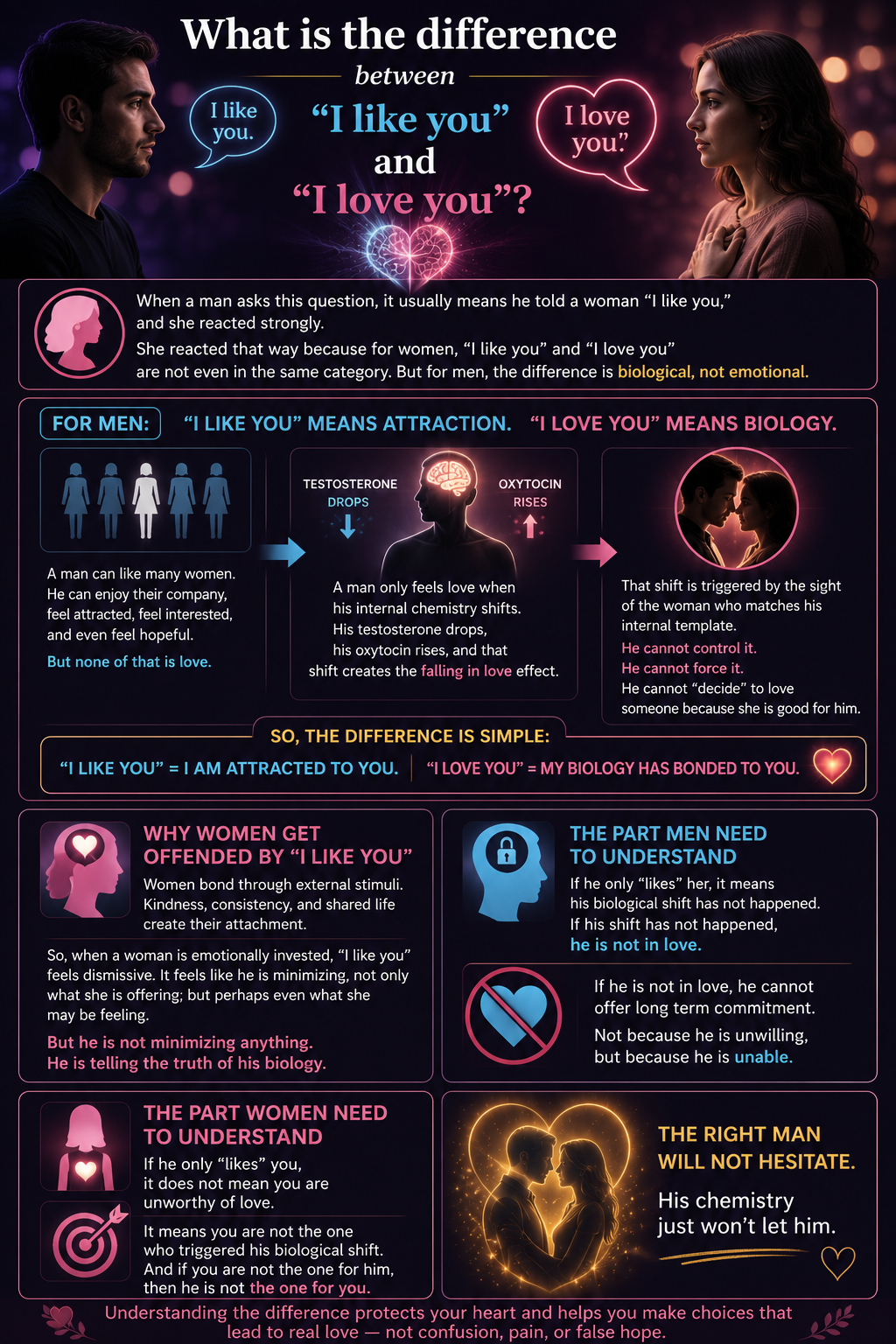
What is the difference between “I like you” and “I love you?”
When a man asks this question, it usually means he told a woman “I like you,” and she reacted strongly. She reacted that way because for women, “I like you” and “I love you” are not even in the same category. But for men, the difference is biological, not emotional.
**For men, “I like you” means attraction.
“I love you” means biology.**
A man can like many women. He can enjoy their company, feel attracted, feel interested, and even feel hopeful. But none of that is love. A man only feels love when his internal chemistry shifts. His testosterone drops, his oxytocin rises, and that shift creates the falling‑in‑love effect.
That shift is triggered by the sight of the woman who matches his internal template. He cannot control it. He cannot force it. He cannot “decide” to love someone because she is good for him.
So, the difference is simple:
“I like you” = I am attracted to you. “I love you” = My biology has bonded to you.
Why women get offended by “I like you”
Women bond through external stimuli. Kindness, consistency, and shared life create their attachment. So, when a woman is emotionally invested, “I like you” feels dismissive. It feels like he is minimizing, not only what she is offering; but perhaps even what she may be feeling.
But he is not minimizing anything. He is telling the truth of his biology.
The part men need to understand
If he only “likes” her, it means his biological shift has not happened. If his shift has not happened, he is not in love. If he is not in love, he cannot offer long‑term commitment.
Not because he is unwilling, but because he is unable.
The part women need to understand
If he only “likes” you, it does not mean you are unworthy of love. It means you are not the one who triggered his biological shift. And if you are not the one for him, then he is not the one for you.
The right man will not hesitate. His chemistry just won’t let him.
Scientific References
- Scheele, D., Wille, A., Kendrick, K. M., Stoffel-Wagner, B., Becker, B., Güntürkün, O., Maier, W., & Hurlemann, R. (2013). Oxytocin Enhances Brain Reward System Responses in Men Viewing the Face of Their Female Partner. Proceedings of the National Academy of Sciences, 110(50), 20308-20313.
Available at: https://pubmed.ncbi.nlm.nih.gov/24277856/ - Schneiderman, I., Zagoory-Sharon, O., Leckman, J. F., & Feldman, R. (2012). Oxytocin during the Initial Stages of Romantic Attachment: Relations to Couples’ Interactive Reciprocity. Psychoneuroendocrinology, 37(8), 1277-1285.
Available at: https://pubmed.ncbi.nlm.nih.gov/22281209/ - Turner, D. R. (2026). And That’s Why Men Like Virgins: How Biology & Silence Keep Good Girls in the Dark.
Available at: virtualvillagemom.com
cheele, D., Wille, A., Kendrick, K. M., Stoffel-Wagner, B., Becker, B., Güntürkün, O., Maier, W., & Hurlemann, R. (2013). Oxytocin Enhances Brain Reward System Responses in Men Viewing the Face of Their Female Partner. Proceedings of the National Academy of Sciences, 110(50), 20308-20313.
Available at: https://pubmed.ncbi.nlm.nih.gov/24277856/
Schneiderman, I., Zagoory-Sharon, O., Leckman, J. F., & Feldman, R. (2012). Oxytocin during the Initial Stages of Romantic Attachment: Relations to Couples’ Interactive Reciprocity. Psychoneuroendocrinology, 37(8), 1277-1285.
Available at: https://pubmed.ncbi.nlm.nih.gov/22281209/
rner, D. R. (2026). And That’s Why Men Like Virgins: How Biology & Silence Keep Good Girls in the Dark.
Available at: virtualvillagemom.com
Continue Exploring Bio-Relational Science
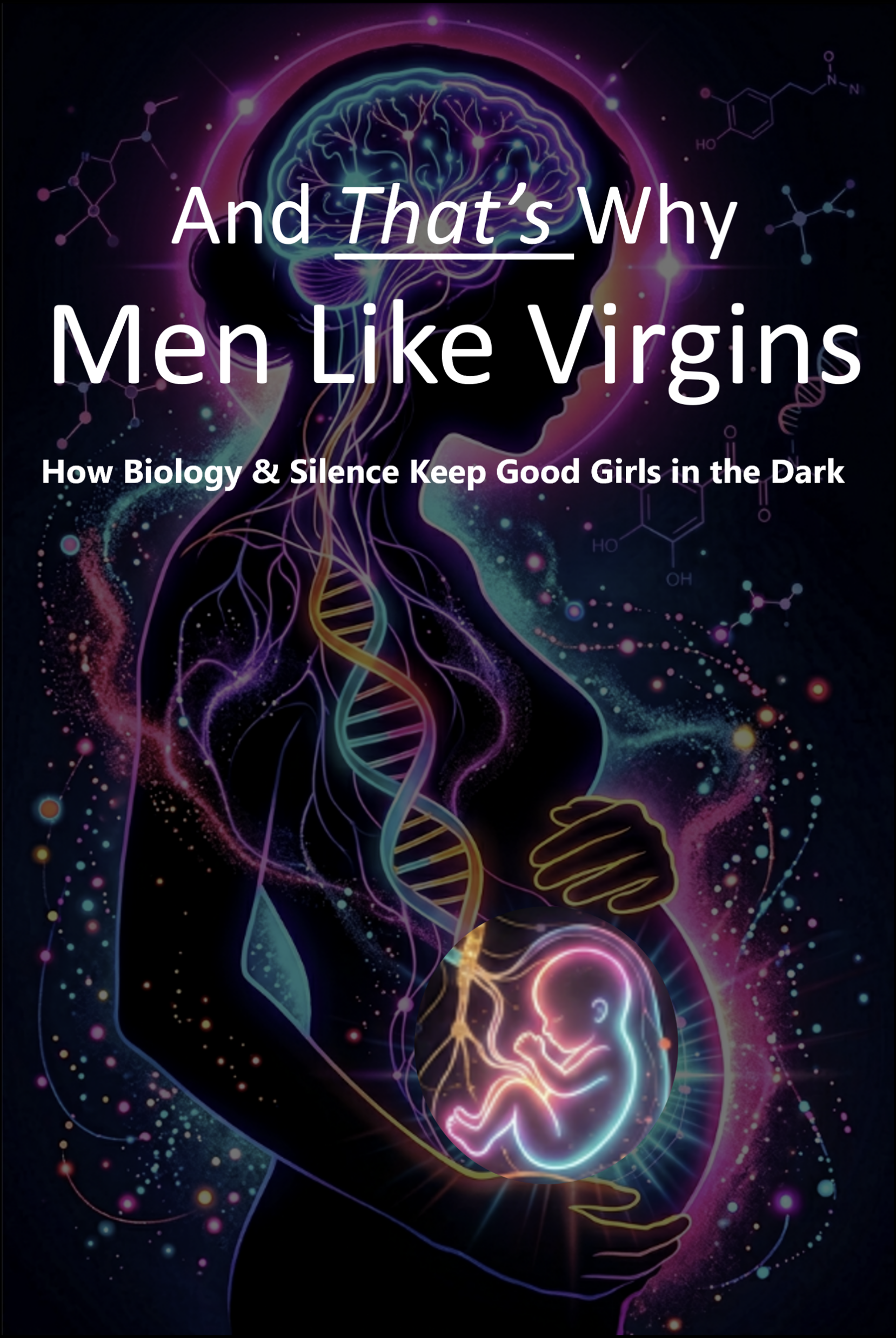
And That’s Why Men Like Virgins
Explore attraction, attachment, intimacy, heartbreak, male romantic behavior, stress, trauma, and relationship decision-making in one practical book written for adult women.