Peer Reviewed Evidence · Bio-Relational Science
Academic Papers: Consent, Sexual Violence, and Reproductive Burden
Peer reviewed scientific answers to questions about consent, sexual violence, and what assault and rape-caused pregnancy leave behind in a woman’s body and life. Each paper includes an abstract, a conceptual framework, and a complete reference list. Select a paper to read it here on this page.
Nothing in the library matches that search yet.
Bio-Relational Science Research Library
Sexual Violence as Biological and Relational Injury: Trauma Physiology, Reproductive Consequence, and the Long-Term Burden Carried by Women
Abstract
Sexual violence is often minimized as a private sexual event, a misunderstanding, a regretted encounter, or a moment that should end when the perpetrator leaves. That framing is biologically incomplete and legally dangerous. This article examines sexual violence as a biological and relational injury through the Bio-Relational Science framework. It integrates evidence on trauma-related threat-system activation, posttraumatic stress, sexual and relational disruption, intoxication-related incapacity, reproductive consequences, seminal-fluid signaling, and pregnancy-related fetal microchimerism. The article distinguishes established human evidence from mechanism-oriented animal research and from questions that remain unresolved. The central argument is not that every survivor experiences the same outcome or that recovery is impossible. It is that a person who exploits incapacity or proceeds without freely given, meaningful consent may impose an afterload that extends far beyond the encounter itself. That burden can include altered safety perception, sleep disruption, hypervigilance, avoidance, dissociation, sexual difficulty, reproductive risk, pregnancy, and enduring physiological change. When pregnancy results, fetal-origin cells carrying genetic material inherited from the perpetrator may persist in maternal tissues for decades and potentially across the remainder of her life. Law and public education must therefore evaluate sexual violence not only as an act that occurred in a moment, but also as an event whose biological, psychological, relational, and reproductive burden may be carried by the woman long after the man has decided it was over.
Keywords: sexual violence, rape, consent, intoxication, trauma physiology, PTSD, reproductive burden, fetal microchimerism, Bio-Relational Science, women’s wellness
Introduction
Rape is not a sexual misunderstanding that becomes serious only when a woman is visibly injured, reports immediately, fights in a way outsiders recognize, or was drugged without her knowledge. It is the use of another person’s body without her freely given and meaningful consent. A man may call it a mistake because he wants the event to end where it began, with him. Yet its effects do not end there, and they are not only psychological. They are physiological as well.
Public arguments about rape often shrink the question to a few seconds of alleged agreement and lean toward blaming the woman. What was she wearing? Why was she there? Did she say yes? Did she drink? Was she flirtatious? Did she go home with him? Did she fight? Did she report immediately? Did she have a boyfriend? Was she a virgin? Some of those questions may be legally relevant in particular cases. Others reflect bias rather than law. None of them answers the biological and relational question: What does a violation of sexual autonomy do inside the person whose body was used and violated?
Sexual violence is associated with elevated risk for posttraumatic stress disorder (PTSD), depression, anxiety, suicidal ideation, substance-use problems, sleep disturbance, sexual dysfunction, and difficulty with intimate relationships. These outcomes do not occur because survivors are weak, dramatic, or incapable of moving forward. They occur because human bodies and brains are designed to learn from threat. When closeness, touch, sexual access, alcohol, coercion, or loss of control become paired with danger, the nervous system may continue responding long after the immediate event has ended (Chivers-Wilson, 2006; Dworkin et al., 2017).
Bio-Relational Science is a framework for understanding how intimate and reproductive relationships are written into biology as well as memory (Turner, 2026). In the context of sexual violence, the framework asks a direct question: what changes when sexual exposure occurs without agency, safety, and meaningful consent? The answer is not reducible to one hormone, one symptom, or one legal definition. It requires attention to trauma physiology, relational safety, reproductive asymmetry, and the cellular consequences of pregnancy.
Conceptual Framework
This article uses four constructs drawn from the Bio-Relational Science framework (Turner, 2026) to organize the evidence.
Autonomy violation: the removal or exploitation of a person’s meaningful ability to decide whether sexual activity occurs, continues, or results in reproductive exposure.
Threat-system recalibration: the process through which the nervous system learns to detect danger in cues associated with a traumatic event, including touch, sexual activity, alcohol, male attention, enclosed spaces, or loss of control.
Reproductive burden asymmetry: the fact that pregnancy, childbirth, pregnancy complications, and pregnancy-related physiological change occur in the woman’s body, not in the body of the man who caused conception.
Relational afterload: the accumulated psychological, physiological, social, legal, sexual, and relational burden that may remain after the assault itself has ended.
These constructs do not imply that all women respond the same way. They identify pathways of risk and burden that can be clinically meaningful even when individual outcomes differ.
Consent Is a Biological Boundary
Consent is not a small legal detail placed on top of an otherwise ordinary sexual act. It is the boundary that distinguishes voluntarily chosen intimacy from bodily invasion. Consensual sexual contact depends on agency, safety, comprehension, and the freedom to stop. Sexual violence removes or exploits those conditions. The body may register the encounter not as mutual closeness, but as an actual violation carried out against it.
This is why it is insufficient to ask what she wore, whether she flirted, whether she had sexual contact with the man before, or why she was there. A person can be physically present without being psychologically safe, cognitively capable, or freely willing. A person can freeze, dissociate, comply out of fear, or become too impaired to make a meaningful decision. In a study of 298 women seen at an emergency clinic after sexual assault, 70 percent reported significant tonic immobility, an involuntary paralysis, and 48 percent reported extreme tonic immobility. Tonic immobility predicted later PTSD and severe depression (Möller et al., 2017). None of those states converts access to her body into consent.
Threat-System Recalibration and the Bodily Memory of Sexual Violence
Trauma is not merely a painful story stored in the mind. It can involve persistent changes in threat detection, stress response, attention, memory, sleep, and bodily arousal. In survivors of sexual assault, trauma-related dysregulation may involve the brain, autonomic nervous system, hypothalamic-pituitary-adrenal stress axis, endocrine signaling, and immune function. When the body remains prepared for danger after the danger has passed, the result can extend beyond fear or sadness. Women may experience disrupted sleep, elevated startle response, chronic muscle tension, headaches, gastrointestinal disturbance, pelvic or other chronic pain, fatigue, changes in appetite, sexual pain or difficulty, and worsening physical health over time. Among U.S. women, lifetime rape victimization was associated with significantly higher adjusted odds of asthma, irritable bowel syndrome, frequent headaches, chronic pain, difficulty sleeping, activity limitations, and poor physical or mental health (Basile et al., 2021). PTSD is associated with poorer physical health across body systems and with elevated inflammatory markers (Pacella et al., 2013; Passos et al., 2015), and sexual abuse is associated with lifetime diagnoses of functional gastrointestinal disorders, chronic pain, and chronic pelvic pain (Paras et al., 2009).
PTSD following sexual assault may include intrusive memories, nightmares, avoidance, hypervigilance, exaggerated startle response, negative beliefs about self or safety, dissociation, and changes in mood and connection. Sexual assault is associated with particularly severe psychopathology across diagnostic categories, including PTSD, depression, anxiety, and substance-use disorders, as well as increased risk for chronic physical health concerns (Basile et al., 2021; Chivers-Wilson, 2006; Dworkin et al., 2017). A meta-analysis of 22 prospective samples found that 74.58 percent of survivors met diagnostic criteria for PTSD in the first month after sexual assault, and 41.49 percent still met criteria at 12 months (Dworkin et al., 2023).
In ordinary language, threat-system recalibration means that the body can learn that situations once associated with normal life are no longer safe. A scent, a song, a drink, a hallway, a medical examination, a hand placed on the shoulder, the pressure of someone standing too close, or the expectation of sex may trigger panic, numbness, anger, shutdown, or a need to escape. The response may occur before the survivor has consciously decided that she is in danger.
That is one reason men must understand that sexual violence does not necessarily end when the physical act ends. A later husband or partner may reach for her gently and find that her body freezes before her mind has decided he is safe. She may want intimacy and still be unable to relax. She may distrust her own judgment because someone used her impaired state, her fear, or her inability to resist as access to her body. These outcomes do not mean she can never recover. They mean her nervous system learned from an act of violence and violation to which she did not, or could not, freely give meaningful consent, and may need an indeterminable amount of time to recover a stable sense of safety and regulation.
Voluntary Intoxication and Capacity to Consent
A woman may make an earlier decision to drink alcohol or use a substance and later become too impaired to understand, evaluate, communicate, or freely choose sexual activity. The earlier decision to consume a substance does not continue making decisions for her after her functional capacity has diminished. Drinking is not a standing permission slip for sex.
Teravskis and colleagues reviewed felony criminal sexual conduct statutes in all 50 states and Washington, D.C. Their analysis identified major variation in how jurisdictions treat intoxication and capacity. Nearly half of U.S. jurisdictions required that a victim be involuntarily intoxicated to be considered incapacitated, and 21 states, by the plain meaning of their statutes, treated a victim as mentally incapacitated only if the intoxication was involuntary. The authors argued that the relevant question should be capacity, not the route by which intoxication arose (Teravskis et al., 2022).
That statement deserves to be understood plainly. A person who is too impaired to understand what is occurring, appreciate the consequences, form a reasoned decision, communicate a meaningful choice, or resist or leave may lack capacity even if she poured the drink herself. This does not mean every person who has consumed alcohol lacks capacity. Intoxication exists on a continuum. It means that the law should not confuse an earlier choice to consume a substance with continuing capacity to agree to sexual access later in the night.
The core contractual-capacity principle recognized in Johnson v. Harmon (1876) remains reflected in modern American contract doctrine. A person’s voluntary decision to drink does not create capacity once intoxication has left him unable to understand the nature and consequences of a transaction or act reasonably in relation to it. Under Restatement (Second) of Contracts § 16, the resulting contractual duties are voidable when the other party has reason to know of the impairment.
We do not tell a visibly incapacitated man that he chose to sign away his house because he first chose to drink. Instead, we recognize that impairment can erase his capacity for meaningful agreement. Sexual access should not be the one area in which a person’s incapacity suddenly becomes permission. The same capacity-centered principle is supported in the sexual-assault context. Teravskis et al. (2022) concluded that “the manner in which the individual becomes intoxicated does not change whether, after becoming intoxicated, the person possesses the capacity to consent.”
Seminal Exposure as Biological Signaling
Sex is not simply skin on skin. It is biological exposure. Seminal fluid is not an inert carrier for sperm. It contains a complex mixture of signaling factors, including cytokines, prostaglandins, hormones, growth factors, enzymes, glycans, extracellular vesicles, and other molecules that interact with female reproductive tissues. Across mammalian species, seminal fluid is biologically active and capable of influencing immune, inflammatory, endocrine, and reproductive processes (Robertson & Sharkey, 2016; Schjenken & Robertson, 2020).
The human evidence is clearest in the reproductive tract. In women sampled before and after intercourse, seminal fluid induced proinflammatory cytokine and chemokine expression in the cervix and a robust recruitment of macrophages, dendritic cells, and memory T cells (Sharkey et al., 2012). Biological markers of semen exposure have also been associated with altered cervicovaginal cytokine concentrations and changes in the bacterial environment of the female genital tract (Jewanraj et al., 2020). A woman’s body does not simply receive seminal fluid and remain biologically unchanged. It detects male-derived signals and responds.
The mechanisms are especially well characterized in mammals. In mouse models, seminal-fluid exposure after mating recruits immune cells into the female reproductive tract, alters uterine gene expression, expands regulatory T cells, and contributes to maternal tolerance of paternal antigens. These processes affect the conditions under which implantation, placental development, and embryo development occur. In pigs, seminal plasma changes immune signaling and transcriptional activity in the female reproductive tract, including the oviduct, endometrium, and uterine-draining lymph nodes. In horses and other domestic mammals, seminal plasma influences inflammatory response, immune-cell recruitment, cytokine signaling, and the reproductive environment after breeding (Robertson & Sharkey, 2001; Schjenken & Robertson, 2014, 2020).
Human studies cannot ethically replicate every controlled experiment performed in animals, especially where coercion, repeated exposure, or invasive tissue sampling would be required. That limitation does not erase the cross-species biological pattern. It identifies the ethical boundary around what can be directly tested in women (Schjenken & Robertson, 2020).
Fruit-fly studies provide an additional line of evidence. In Drosophila melanogaster, seminal-fluid proteins transferred during mating cross the vaginal wall into the female circulatory system, giving them access to tissues beyond the reproductive tract, including potential access to the nervous and endocrine systems (Lung & Wolfner, 1999; Ravi Ram et al., 2005). The male-derived sex peptide acts through a receptor in the female nervous system and produces sustained post-mating changes, including increased egg laying and reduced receptivity to subsequent males (Yapici et al., 2008). Because sex peptide binds to stored sperm and is released gradually, these effects persist for days (Peng et al., 2005). Mating also alters gene expression in female head and brain tissue, and female neural genes influence how competing males’ sperm are used (Chow et al., 2013; Dalton et al., 2010). The female’s biology becomes more responsive to the reproductive interests of the male whose seminal proteins she received.
Taken together, the human, mammalian, and invertebrate evidence supports the conclusion that seminal fluid functions as a biological signaling system. It does more than deliver sperm. It can initiate biological responses within the female organism that receives it. Bio-Relational Science treats that cross-species pattern as a reason to take seriously what unconsented seminal exposure may set in motion in a woman’s body (Turner, 2026).
Pregnancy From Rape and Fetal Microchimerism
If rape results in pregnancy, the biological consequence becomes more than a question of trauma response or reproductive-tract signaling. Pregnancy is not a temporary event that occurs outside of a woman. It changes cardiovascular, endocrine, immune, metabolic, neurological, and reproductive physiology. It also creates a living cellular exchange between mother and fetus, which includes the perpetrator’s DNA.
Pregnancy can place the father’s genetic contribution inside a woman’s body for decades and, in some cases, potentially across the remainder of her life. During pregnancy, fetal-origin cells cross the placenta and enter the mother’s circulation. Some settle in maternal tissues, including blood, skin, thyroid, liver, lungs, heart, bone marrow, breast tissue, and brain (Boddy et al., 2015; Cómitre-Mariano et al., 2022). Scientists call this fetal microchimerism. Fetal-origin cells have been documented in maternal tissues and organs long after pregnancy, including in the human brain (Chan et al., 2012).
Every fetal cell carries a complete genetic blueprint inherited from both parents. The mother naturally possesses her own DNA. What pregnancy adds to her body is fetal-origin material that includes DNA and antigens inherited from the father. Whether the child is a boy or a girl, fetal-origin cells can carry the father’s genetic contribution into maternal tissues. Her immune system must recognize, tolerate, and biologically accommodate that paternal contribution in order for the pregnancy to continue (Cómitre-Mariano et al., 2022).
Researchers often identify fetal microchimerism by testing for Y-chromosome DNA. A male fetus is easier to identify because the mother does not naturally carry a Y chromosome. This method does not mean pregnancies involving female fetuses fail to leave fetal-origin cells behind. A daughter’s fetal cells also carry genetic material inherited from her father and can persist in her mother’s body. Studies using Y-chromosome detection therefore reveal only the portion of fetal microchimerism that is easiest to see, not the full extent of pregnancy-related cellular exchange (Chan et al., 2012; Gammill & Nelson, 2010).
In a 2012 autopsy study, researchers examined brain tissue from 59 deceased women who died between the ages of 32 and 101. Male microchimerism, detected through Y-chromosome DNA, was found in 37 of the 59 brains, or 63 percent of the sample, and appeared across multiple brain regions. The oldest woman in whom male microchimerism was detected in brain tissue was 94 years old. Complete pregnancy histories were unavailable for most participants. The researchers identified prior pregnancy with a male fetus as the most likely source. The study demonstrates that genetically male cellular material can remain detectable in women’s brains deep into later life (Chan et al., 2012).
Researchers are still determining when fetal microchimeric cells may contribute to tissue repair, when they may be associated with inflammatory or autoimmune conditions, and when they may be present without a known clinical effect. Their effects may differ by tissue, condition, and person (Boddy et al., 2015; Nelson, 2012). However, the established fact is already consequential. A pregnancy resulting from rape may leave fetal-origin cells carrying the father’s genetic contribution in the mother’s tissues for years, decades, and potentially across the remainder of her life (Cómitre-Mariano et al., 2022).
The child is innocent. That fact does not change. Neither does it erase what pregnancy requires of the woman who carries it.
Forced Continuation and the Burden on Future Children
A law that forces continuation of a rape-caused pregnancy is not asking her merely to wait nine months. It is requiring her body to undergo a process capable of producing persistent physiological change and a cellular legacy that may outlast the assault, the pregnancy, and the legal case itself, and may remain with her for the rest of her life. Pregnancy reshapes the maternal brain, with gray matter reductions that remain detectable at least two years after birth (Hoekzema et al., 2017; Pritschet et al., 2024). In the United States, the risk of death associated with childbirth has been estimated at approximately 14 times the risk associated with legal induced abortion (Raymond & Grimes, 2012). Pregnancy complications such as preeclampsia are associated with elevated later risk of hypertension, ischemic heart disease, and stroke (Bellamy et al., 2007). Women who were denied a wanted abortion and gave birth later reported worse physical health, including more chronic headaches or migraines and joint pain, than women who obtained an abortion (Ralph et al., 2019). Physical violence from the man involved in the pregnancy declined over time for women who obtained an abortion but not for women who were denied one and gave birth (Roberts et al., 2014).
Furthermore, it asks the woman to risk not only her own health and life to give birth to the perpetrator’s child, but possibly to pass part of that burden to children she has not yet conceived. A woman does not produce new eggs across her lifetime. Her ovarian reserve forms before she is born and peaks at approximately 18 to 22 weeks after conception (Wallace & Kelsey, 2010). The eggs from which her future children may develop are therefore already in her body during the assault, the pregnancy, and the aftermath. In rats, chronic stress before reproduction increased expression of a stress-hormone receptor gene in mature eggs, and the offspring showed altered brain expression of that receptor and altered behavior (Zaidan et al., 2013). In mice, maternal stress during egg development reduced the developmental potential of the eggs and produced fewer and lighter offspring (Zhang et al., 2011). In humans, offspring of mothers exposed to Holocaust trauma during their own childhood, years before conception, showed lower methylation of FKBP5, a stress-regulating gene, than control participants, which the researchers attributed to maternal developmental programming (Bierer et al., 2020).
The burden can also reach later pregnancies through her immune system and through the cells the first pregnancy leaves behind. A pregnancy can sensitize a mother’s immune system to red-cell antigens inherited from the father. In later pregnancies, those antibodies can cross the placenta and destroy a future baby’s red blood cells, causing hemolytic disease of the fetus and newborn (de Haas et al., 2015). Immunity to male-specific H-Y antigens after the birth of a boy has been linked to repeated miscarriage after a first birth and to fewer live births in later pregnancies (Nielsen, 2011). Mothers acquire new fetal cells with each pregnancy, so cells from an older sibling may be transferred to younger siblings (Kinder et al., 2017; Nørgaard-Pedersen et al., 2021). A pregnancy resulting from rape may therefore leave fetal-origin cells carrying the perpetrator’s genetic contribution not only in her tissues but potentially in children she later conceives with someone else. If that pregnancy ends in cesarean delivery, her risk of placenta accreta in later pregnancies rises, and it climbs with each additional cesarean (Silver et al., 2006).
The Relational Afterload of Sexual Violence: What Men Must Understand
The effects of sexual violence can continue through areas of a woman’s life the perpetrator may never witness, including sleep, medical care, work, dating, sexuality, and later relationships. If rape results in pregnancy, he may never witness or even know that fetal-origin cells carrying his genetic contribution may remain in her body indefinitely, affecting her health and future births. These effects remain consequences of what he chose to do, even after he has left and decided the encounter is over. They vary among survivors, but they are sufficiently common and consequential that sexual violence cannot honestly be described as a private event with no enduring bodily cost to the woman (Basile et al., 2021; Dworkin et al., 2017).
She may struggle to sleep beside a partner who has never harmed her. She may avoid medical care, alcohol, social settings, dating, touch, or sex. She may experience panic, shame, anger, numbness, distrust, dissociation, or a body that reacts before she fully understands why. A recent scoping review found that PTSD, depression, anxiety, alcohol-related problems, and sleep disturbance were among the recurring psychosocial outcomes reported across studies of women who had experienced sexual assault (Serrano-Rodríguez et al., 2025).
Outcomes vary. Some survivors report resilience and do not identify lasting romantic-relationship impairment, while other survivors report poorer relationship quality and lower trust (Person et al., 2024). That variation is important to note. It does not erase the basic ethical fact: a man has no right to gamble with another person’s safety, health, future relationships, reproductive life, or recovery process simply because he wants sex in the moment.
If he encounters a woman who is unconscious, severely impaired, frightened, frozen, unable to communicate clearly, or unable to understand what is occurring, her physical presence is not the same as her freely given, meaningful consent. A prior flirtation or going home with him is not consent. Silence is not consent. Nor is physical stillness. A decision to drink alcohol or use drugs is not consent. Consent requires both willingness and capacity, free from force, threat, coercion, or incapacitation. A recent systematic review of consent research emphasizes that incapacity and coercive conditions are central to how nonconsensual sexual experiences are defined and measured (Anyadike-Danes et al., 2024).
The ethical response to uncertainty about a woman’s capacity is not to press forward and later argue about what she did or did not say. It is to stop. The 2022 legal and forensic-psychiatry review reaches this essential conclusion: “The manner in which the individual becomes intoxicated does not change whether, after becoming intoxicated, the person possesses the capacity to consent” (Teravskis et al., 2022).
Discussion
The evidence reviewed in this article supports a conclusion that public conversation and law often fail to make plain: sexual violence is not limited to the moment in which penetration or physical contact occurs. It can produce a biological and relational aftermath that continues long after the perpetrator has left, after evidence is collected, after a case is closed, or after others decide the woman should be over it.
That aftermath may include fear, hypervigilance, sleep disruption, PTSD symptoms, chronic pain, physical injury, sexual-health consequences, avoidance of medical care, reduced work or school participation, difficulty with later intimacy, pregnancy, and the complex physiological consequences of pregnancy itself, which may extend to the health of her future pregnancies and children. In a nationally representative study of U.S. women, 71.3 percent of women who reported rape victimization reported at least one health, mental-health, or health-related behavioral impact associated with violence by a rape perpetrator. Fear was reported by 65.2 percent, safety concerns by 58.9 percent, PTSD symptoms by 56.6 percent, injury by 35.7 percent, missed work or school by 25.9 percent, and need for medical care by 25.4 percent (Basile et al., 2021).
These figures describe a risk of lasting harm that is real, measurable, and common. His decision to call it a mistake, his claim that she seemed willing, or his decision to treat intoxication as access does not erase the consequences of what he did.
A woman is never responsible for her own rape. Responsibility belongs entirely to the person who chose to proceed without her freely given and meaningful consent. Yet the person who commits the violation may leave the scene while the woman is left to manage what his decision set in motion: fear, interrupted sleep, changes in health, medical appointments, therapy, court involvement, difficulty trusting, possible harm to her future pregnancies and children, and the work of feeling safe in her own body again. Her recovery is not evidence that she caused the assault or failed to prevent it. It is the cost of surviving an act she did not choose.
Relation to Bio-Relational Science
Bio-Relational Science, as articulated in Turner’s And That’s Why Men Like Virgins: How Biology & Silence Keep Good Girls in the Dark (2026), treats intimate relationships as events with biological as well as emotional consequences. It does not reduce women to hormones, trauma, or reproduction. It recognizes that the female body is not a neutral location where sexual access occurs without consequence. Sexual violence can activate threat physiology, impair relational safety, create reproductive risk, and, if pregnancy occurs, initiate biological changes that the perpetrator will never physically carry.
The framework also rejects the false choice between psychological and biological explanation. Fear conditioning, stress hormones, memory, sleep disturbance, immune signaling, reproductive physiology, attachment disruption, pregnancy, and cellular exchange do not occur in separate universes. They interact. A complete account of sexual violence must therefore be both survivor-centered and biologically literate.
Implications for Women’s Wellness and Bio-Relational Education
Women and girls deserve education that makes the stakes of consent clear before harm occurs. That education must reject victim blaming. A woman’s clothing, dating history, sexual history, decision to drink, or decision to accept a ride does not authorize another person to exploit incapacity or ignore a lack of freely given consent. Men need this education as well.
Prevention education should teach that consent requires more than the absence of visible force. It requires a person who is capable, informed, free from coercion, and able to communicate a meaningful, unencumbered yes or no. It should teach men that uncertainty is a reason to stop, not a challenge to overcome. It should teach lawmakers that capacity-focused statutes better reflect the functional reality of intoxication than rules that protect only people who were secretly drugged or forcibly intoxicated. As Teravskis et al. (2022) concluded, laws that “continue to buttress a meaningful distinction between voluntary and involuntary intoxication perpetuate victim-blaming and impede the process of holding assailants accountable.”
For survivors, a biologically informed explanation must never become another burden. Trauma-related symptoms are not proof of weakness. Pregnancy-related cellular persistence may leave fetal-origin cells carrying the perpetrator’s genetic contribution in her tissues for the rest of her life. Recovery from sexual violence cannot be reduced to whether a woman eventually says she is over it. It may take months, years, or much longer and may require trauma-focused therapy, medical care, treatment for anxiety, depression, chronic pain, sleep disturbance, or PTSD, support from trusted people, legal protection, distance from the perpetrator, and repeated work to rebuild bodily safety, agency, trust, and sexual autonomy. Healing is not amnesia. A woman may build secure relationships, experience safe intimacy, reclaim ownership of her body, and live a full and meaningful life while still carrying reminders and physiological aftereffects of what was done to her. The point of this article is not to declare women permanently damaged. It is to insist that the burden of recovery must never be confused with responsibility for the assault.
Conclusion
Sexual violence is not “just sex” because consent changes the meaning of the act at every level. It determines whether sexual contact is chosen intimacy or bodily invasion. The consequences of that invasion may be psychological, physiological, sexual, relational, reproductive, and legal. They may appear immediately, emerge later, or remain invisible to everyone except the woman carrying them.
A man may call an assault a mistake because he wants the event to end where it began, with him. But the effects on a woman are not just psychological. A woman’s body may carry the evidence of its meaning long after he has decided it was over, and possibly for the rest of her life. A just law must see that difference and act accordingly. A decent man must refuse to create the situation.
References
Anyadike-Danes, N., Reynolds, M., Armour, C., & Lagdon, S. (2024). Defining and measuring sexual consent within the context of university students’ unwanted and nonconsensual sexual experiences: A systematic literature review. Trauma, Violence, & Abuse, 25(1), 231-245. https://doi.org/10.1177/15248380221147558
Basile, K. C., Smith, S. G., Chen, J., & Zwald, M. (2021). Chronic diseases, health conditions, and other impacts associated with rape victimization of U.S. women. Journal of Interpersonal Violence, 36(23-24), NP12504-NP12520. https://doi.org/10.1177/0886260519900335
Bellamy, L., Casas, J.-P., Hingorani, A. D., & Williams, D. J. (2007). Pre-eclampsia and risk of cardiovascular disease and cancer in later life: Systematic review and meta-analysis. BMJ, 335(7627), 974. https://doi.org/10.1136/bmj.39335.385301.BE
Bierer, L. M., Bader, H. N., Daskalakis, N. P., Lehrner, A., Provençal, N., Wiechmann, T., Klengel, T., Makotkine, I., Binder, E. B., & Yehuda, R. (2020). Intergenerational effects of maternal Holocaust exposure on FKBP5 methylation. American Journal of Psychiatry, 177(8), 744-753. https://doi.org/10.1176/appi.ajp.2019.19060618
Boddy, A. M., Fortunato, A., Wilson Sayres, M., & Aktipis, A. (2015). Fetal microchimerism and maternal health: A review and evolutionary analysis of cooperation and conflict beyond the womb. BioEssays, 37(10), 1106-1118. https://doi.org/10.1002/bies.201500059
Chan, W. F. N., Gurnot, C., Montine, T. J., Sonnen, J. A., Guthrie, K. A., & Nelson, J. L. (2012). Male microchimerism in the human female brain. PLOS ONE, 7(9), e45592. https://doi.org/10.1371/journal.pone.0045592
Chivers-Wilson, K. A. (2006). Sexual assault and posttraumatic stress disorder: A review of the biological, psychological and sociological factors and treatments. McGill Journal of Medicine, 9(2), 111-118. https://pmc.ncbi.nlm.nih.gov/articles/PMC2323517/
Chow, C. Y., Wolfner, M. F., & Clark, A. G. (2013). Large neurological component to genetic differences underlying biased sperm use in Drosophila. Genetics, 193(1), 177-185. https://doi.org/10.1534/genetics.112.146357
Cómitre-Mariano, B., Martínez-García, M., García-Gálvez, B., Paternina-Die, M., Desco, M., Carmona, S., & Gómez-Gaviro, M. V. (2022). Feto-maternal microchimerism: Memories from pregnancy. iScience, 25(1), 103664. https://doi.org/10.1016/j.isci.2021.103664
Dalton, J. E., Kacheria, T. S., Knott, S. R. V., Lebo, M. S., Nishitani, A., Sanders, L. E., Stirling, E. J., Winbush, A., & Arbeitman, M. N. (2010). Dynamic, mating-induced gene expression changes in female head and brain tissues of Drosophila melanogaster. BMC Genomics, 11, 541. https://doi.org/10.1186/1471-2164-11-541
de Haas, M., Thurik, F. F., Koelewijn, J. M., & van der Schoot, C. E. (2015). Haemolytic disease of the fetus and newborn. Vox Sanguinis, 109(2), 99-113. https://doi.org/10.1111/vox.12265
Dworkin, E. R., Jaffe, A. E., Bedard-Gilligan, M., & Fitzpatrick, S. (2023). PTSD in the year following sexual assault: A meta-analysis of prospective studies. Trauma, Violence, & Abuse, 24(2), 497-514. https://doi.org/10.1177/15248380211032213
Dworkin, E. R., Menon, S. V., Bystrynski, J., & Allen, N. E. (2017). Sexual assault victimization and psychopathology: A review and meta-analysis. Clinical Psychology Review, 56, 65-81. https://doi.org/10.1016/j.cpr.2017.06.002
Gammill, H. S., & Nelson, J. L. (2010). Naturally acquired microchimerism. International Journal of Developmental Biology, 54(2-3), 531-543. https://doi.org/10.1387/ijdb.082767hg
Hoekzema, E., Barba-Müller, E., Pozzobon, C., Picado, M., Lucco, F., García-García, D., Soliva, J. C., Tobeña, A., Desco, M., Crone, E. A., Ballesteros, A., Carmona, S., & Vilarroya, O. (2017). Pregnancy leads to long-lasting changes in human brain structure. Nature Neuroscience, 20(2), 287-296. https://doi.org/10.1038/nn.4458
Jewanraj, J., Ngcapu, S., Osman, F., Mtshali, A., Singh, R., Mansoor, L. E., Abdool Karim, S. S., Abdool Karim, Q., Passmore, J. S., & Liebenberg, L. J. P. (2020). The impact of semen exposure on the immune and microbial environments of the female genital tract. Frontiers in Reproductive Health, 2, 566559. https://doi.org/10.3389/frph.2020.566559
Johnson v. Harmon, 94 U.S. 371 (1876).
Kinder, J. M., Stelzer, I. A., Arck, P. C., & Way, S. S. (2017). Immunological implications of pregnancy-induced microchimerism. Nature Reviews Immunology, 17(8), 483-494. https://doi.org/10.1038/nri.2017.38
Lung, O., & Wolfner, M. F. (1999). Drosophila seminal fluid proteins enter the circulatory system of the mated female fly by crossing the posterior vaginal wall. Insect Biochemistry and Molecular Biology, 29(12), 1043-1052. https://doi.org/10.1016/S0965-1748(99)00078-8
Möller, A., Söndergaard, H. P., & Helström, L. (2017). Tonic immobility during sexual assault: A common reaction predicting post-traumatic stress disorder and severe depression. Acta Obstetricia et Gynecologica Scandinavica, 96(8), 932-938. https://doi.org/10.1111/aogs.13174
Nelson, J. L. (2012). The otherness of self: Microchimerism in health and disease. Trends in Immunology, 33(8), 421-427. https://doi.org/10.1016/j.it.2012.03.002
Nielsen, H. S. (2011). Secondary recurrent miscarriage and H-Y immunity. Human Reproduction Update, 17(4), 558-574. https://doi.org/10.1093/humupd/dmr005
Nørgaard-Pedersen, C., Kesmodel, U. S., & Christiansen, O. B. (2021). Women with recurrent pregnancy loss more often have an older brother and a previous birth of a boy: Is male microchimerism a risk factor? Journal of Clinical Medicine, 10(12), 2613. https://doi.org/10.3390/jcm10122613
Pacella, M. L., Hruska, B., & Delahanty, D. L. (2013). The physical health consequences of PTSD and PTSD symptoms: A meta-analytic review. Journal of Anxiety Disorders, 27(1), 33-46. https://doi.org/10.1016/j.janxdis.2012.08.004
Paras, M. L., Murad, M. H., Chen, L. P., Goranson, E. N., Sattler, A. L., Colbenson, K. M., Elamin, M. B., Seime, R. J., Prokop, L. J., & Zirakzadeh, A. (2009). Sexual abuse and lifetime diagnosis of somatic disorders: A systematic review and meta-analysis. JAMA, 302(5), 550-561. https://doi.org/10.1001/jama.2009.1091
Passos, I. C., Vasconcelos-Moreno, M. P., Costa, L. G., Kunz, M., Brietzke, E., Quevedo, J., Salum, G., Magalhães, P. V., Kapczinski, F., & Kauer-Sant’Anna, M. (2015). Inflammatory markers in post-traumatic stress disorder: A systematic review, meta-analysis, and meta-regression. The Lancet Psychiatry, 2(11), 1002-1012. https://doi.org/10.1016/S2215-0366(15)00309-0
Peng, J., Chen, S., Büsser, S., Liu, H., Honegger, T., & Kubli, E. (2005). Gradual release of sperm bound sex-peptide controls female postmating behavior in Drosophila. Current Biology, 15(3), 207-213. https://doi.org/10.1016/j.cub.2005.01.034
Person, A. I., Frazier, P. A., Selvey-Bouyack, A. M., Anders, S. L., Shallcross, S. L., & Simpson, J. A. (2024). Associations between sexual assault and romantic relationship functioning: A mixed-methods analysis. Journal of Social and Personal Relationships, 41(8), 2297-2322. https://doi.org/10.1177/02654075241241496
Pritschet, L., Taylor, C. M., Cossio, D., Faskowitz, J., Santander, T., Handwerker, D. A., Grotzinger, H., Layher, E., Chrastil, E. R., & Jacobs, E. G. (2024). Neuroanatomical changes observed over the course of a human pregnancy. Nature Neuroscience, 27(11), 2253-2260. https://doi.org/10.1038/s41593-024-01741-0
Ralph, L. J., Schwarz, E. B., Grossman, D., & Foster, D. G. (2019). Self-reported physical health of women who did and did not terminate pregnancy after seeking abortion services: A cohort study. Annals of Internal Medicine, 171(4), 238-247. https://doi.org/10.7326/M18-1666
Ravi Ram, K., Ji, S., & Wolfner, M. F. (2005). Fates and targets of male accessory gland proteins in mated female Drosophila melanogaster. Insect Biochemistry and Molecular Biology, 35(9), 1059-1071. https://doi.org/10.1016/j.ibmb.2005.05.001
Raymond, E. G., & Grimes, D. A. (2012). The comparative safety of legal induced abortion and childbirth in the United States. Obstetrics & Gynecology, 119(2, Part 1), 215-219. https://doi.org/10.1097/AOG.0b013e31823fe923
Restatement (Second) of Contracts § 16 (Am. L. Inst. 1981).
Roberts, S. C. M., Biggs, M. A., Chibber, K. S., Gould, H., Rocca, C. H., & Foster, D. G. (2014). Risk of violence from the man involved in the pregnancy after receiving or being denied an abortion. BMC Medicine, 12, 144. https://doi.org/10.1186/s12916-014-0144-z
Robertson, S. A., & Sharkey, D. J. (2001). The role of semen in induction of maternal immune tolerance to pregnancy. Seminars in Immunology, 13(4), 243-254. https://doi.org/10.1006/smim.2000.0320
Robertson, S. A., & Sharkey, D. J. (2016). Seminal fluid and fertility in women. Fertility and Sterility, 106(3), 511-519. https://doi.org/10.1016/j.fertnstert.2016.07.1101
Schjenken, J. E., & Robertson, S. A. (2014). Seminal fluid and immune adaptation for pregnancy: Comparative biology in mammalian species. Reproduction in Domestic Animals, 49(Suppl. 3), 27-36. https://doi.org/10.1111/rda.12383
Schjenken, J. E., & Robertson, S. A. (2020). The female response to seminal fluid. Physiological Reviews, 100(3), 1077-1117. https://doi.org/10.1152/physrev.00013.2018
Serrano-Rodríguez, E., Luque-Ribelles, V., & Hervías-Parejo, V. (2025). Psychosocial consequences of sexual assault on women: A scoping review. Archives of Sexual Behavior, 54(1), 231-258. https://doi.org/10.1007/s10508-024-03013-1
Sharkey, D. J., Tremellen, K. P., Jasper, M. J., Gemzell-Danielsson, K., & Robertson, S. A. (2012). Seminal fluid induces leukocyte recruitment and cytokine and chemokine mRNA expression in the human cervix after coitus. The Journal of Immunology, 188(5), 2445-2454. https://doi.org/10.4049/jimmunol.1102736
Silver, R. M., Landon, M. B., Rouse, D. J., Leveno, K. J., Spong, C. Y., Thom, E. A., Moawad, A. H., Caritis, S. N., Harper, M., Wapner, R. J., Sorokin, Y., Miodovnik, M., Carpenter, M., Peaceman, A. M., O’Sullivan, M. J., Sibai, B., Langer, O., Thorp, J. M., Ramin, S. M., . . . National Institute of Child Health and Human Development Maternal-Fetal Medicine Units Network. (2006). Maternal morbidity associated with multiple repeat cesarean deliveries. Obstetrics & Gynecology, 107(6), 1226-1232. https://doi.org/10.1097/01.AOG.0000219750.79480.84
Teravskis, P. J., Grossman-Kahn, R., & Gulrajani, C. (2022). Victim intoxication and capacity to consent in sexual assault statutes across the United States. Journal of the American Academy of Psychiatry and the Law, 50(4), 600-610. https://doi.org/10.29158/JAAPL.220032-21
Turner, D. (2026). And that’s why men like virgins: How biology & silence keep good girls in the dark. VirtualVillageMom Press.
Wallace, W. H. B., & Kelsey, T. W. (2010). Human ovarian reserve from conception to the menopause. PLOS ONE, 5(1), e8772. https://doi.org/10.1371/journal.pone.0008772
Yapici, N., Kim, Y.-J., Ribeiro, C., & Dickson, B. J. (2008). A receptor that mediates the post-mating switch in Drosophila reproductive behaviour. Nature, 451(7174), 33-37. https://doi.org/10.1038/nature06483
Zaidan, H., Leshem, M., & Gaisler-Salomon, I. (2013). Prereproductive stress to female rats alters corticotropin releasing factor type 1 expression in ova and behavior and brain corticotropin releasing factor type 1 expression in offspring. Biological Psychiatry, 74(9), 680-687. https://doi.org/10.1016/j.biopsych.2013.04.014
Zhang, S.-Y., Wang, J.-Z., Li, J.-J., Wei, D.-L., Sui, H.-S., Zhang, Z.-H., Zhou, P., & Tan, J.-H. (2011). Maternal restraint stress diminishes the developmental potential of oocytes. Biology of Reproduction, 84(4), 672-681. https://doi.org/10.1095/biolreprod.110.087890
Continue Exploring Bio-Relational Science
Want the broader relationship framework?
Explore attraction, attachment, intimacy, heartbreak, male romantic behavior, stress, trauma, and relationship decision-making in one practical book written for adult women.
Explore the Book
Peer Reviewed Evidence · Bio-Relational Science
Academic Papers: Attachment, Bonding, and Relational Stress
Peer reviewed scientific answers to the relationship questions people actually ask. The question on each card is the plain language form of the research question its paper addresses, and each paper is a full analysis of how bonds form, hold, and break down under stress, with an abstract, a conceptual framework, and a complete reference list. Select a paper to read it here on this page.
Nothing in the library matches that search yet.
Bio-Relational Science Research Library
Bio-Relational Bonding Capacity: Chronic Relational Stress, Oxytocin Receptor Signaling, and Why a Woman May Leave a Responsive Partner
Abstract
Popular relationship discourse assumes that a kind, stable, and faithful partner should be sufficient to secure a woman's attachment, and that a woman who leaves such a partner is acting against her own interests. This article argues that the assumption mistakes partner quality for bonding capacity. Drawing on attachment theory, relationship science, and neuroendocrine research, it proposes that a woman's ability to form a new bond is a physiological capacity that can be reduced by cumulative relational stress, and that reduced capacity produces withdrawal from responsive partners rather than attraction to them. Evidence indicates that romantic bonding involves measurable oxytocin activity and altered stress physiology (Carter, 2017; Heinrichs et al., 2003; Pietromonaco et al., 2013; Schneiderman et al., 2012), that chronic social stress lowers oxytocin and oxytocin receptor levels within bonding circuitry and suppresses social preference (Wang et al., 2018), that glucocorticoids interfere with oxytocin signal transduction (Link et al., 1993), and that elevated corticosterone prevents the formation of new pair bonds in females while leaving established bonds intact (Anacker et al., 2016; Carter et al., 1995; DeVries et al., 1995, 1996). Using And That's Why Men Like Virgins: How Biology and Silence Keep Good Girls in the Dark (Turner, 2026) as its governing conceptual source, this article develops a bio-relational account of bonding capacity, distinguishes bond formation from bond maintenance, and identifies threat recalibration as the mechanism by which a responsive partner's consistency can be experienced as risk. The article concludes that leaving a good partner is frequently a physiological outcome rather than a preference, and that relationship education for women should assess bonding capacity directly.
Keywords: bonding capacity, oxytocin receptor, cortisol, pair bond formation, relational stress, attachment security, women's wellness, Bio-Relational Science
Introduction
Advice given to women who leave responsive partners tends to be moral rather than biological. She is told that she does not know a good thing when she has it, that she is addicted to chaos, or that she will regret the decision. The advice assumes that attachment follows automatically from partner merit, and that a failure to bond therefore reveals a failure of character or judgment.
This assumption is difficult to sustain against the evidence. Romantic bonding is not only an evaluative act. It is a neuroendocrine process with identifiable mediators, measurable individual differences, and demonstrated sensitivity to stress exposure (Carter, 2017; Schneiderman et al., 2012). A process with biological requirements can fail to complete even when the partner meets every social criterion, in the same way that a nutrient can be present in a diet and still fail to be absorbed.
Within a bio-relational science framework, treating a woman well is understood as a property of the man, while the capacity to bond is understood as a property of the woman's physiology at that moment in her life (Turner, 2026). The two are independent variables. A woman may encounter a genuinely responsive partner while carrying a bonding system that has been altered by years of relational stress, betrayal, or early adversity. Under those conditions, her withdrawal is not a referendum on his worth.
This article develops that distinction, specifies the mechanisms that reduce bonding capacity, and considers what the distinction requires of relationship education directed at women. Its aim is practical. Women are routinely advised to override what their bodies are reporting, and they are rarely told that the reporting instrument can be damaged, or that damage to it is measurable, mechanistically understood, and responsive to intervention.
Conceptual Framework
Bio-relational science integrates biology, attachment, behavior, and relational meaning into a single explanatory framework. Human pairing is treated as a biological process carrying relational consequence, shaped simultaneously by bonding systems, stress systems, and learning history (Carter, 2017; Pietromonaco et al., 2013; Turner, 2026). Within this framework, four constructs organize the present analysis.
Bonding capacity refers to the current physiological ability to convert relational experience into attachment. It is distinct from desire for attachment and distinct from opportunity for attachment. A woman may want a bond, be offered a bond, and still lack the receptor level and circuit level conditions required to form one. Bonding capacity is a state variable rather than a trait, which is what makes it a legitimate target for intervention.
Relational load refers to the cumulative burden of relational stress a woman carries into a new relationship, including betrayal, deception, coercion, abandonment, and early caregiving adversity. Relational load is additive rather than episodic. Its effects are documented in emotion regulation, in the appraisal of partner behavior, and in the development of the central oxytocin system itself (Baracz et al., 2020; Simpson et al., 2025; Vaillancourt-Morel et al., 2023).
Bond formation versus bond maintenance distinguishes the process of establishing a new attachment from the process of sustaining an existing one. The distinction is not rhetorical. The two processes are dissociable under stress, and the dissociation is central to the behavior this article explains (Anacker et al., 2016; DeVries et al., 1995).
Threat recalibration refers to the reassignment of closeness from a comfort signal to a risk signal following relational harm. Recalibration operates at the level of appraisal and at the level of early perceptual processing, which is why it is not readily corrected by reassurance alone (Hein & Monk, 2017; Lemche et al., 2006; Parianen Lesemann et al., 2020).
Discussion
Bonding as a measurable physiological process
The claim that bonding has biological requirements rests on direct measurement. Schneiderman et al. (2012) assessed 163 young adults and found that plasma oxytocin was significantly higher in 120 new lovers than in 43 non-attached singles, that the elevation persisted at six months, and that oxytocin levels tracked the couple's interactive reciprocity. Oxytocin measured at the first assessment also distinguished couples who remained together from those who separated, indicating that bonding physiology carries prognostic information about the relationship itself.
Partner presence also acts on stress physiology. Heinrichs et al. (2003) found that social support combined with oxytocin produced the lowest cortisol response to a laboratory stressor, together with greater calm and reduced anxiety. Carter (2017) situates these findings within the oxytocin and vasopressin pathway that supports mammalian pair bonding, love, and the regulation of fear. Adult attachment differences are likewise expressed in cortisol reactivity to relational stress (Pietromonaco et al., 2013).
Bonding and stress regulation are therefore a single coupled system rather than two adjacent topics. This coupling is what makes bonding capacity vulnerable to stress exposure, and it is the foundation of the bio-relational position that relationship history is carried physiologically rather than only psychologically.
Chronic relational stress and oxytocin receptor signaling
The most direct evidence for reduced bonding capacity comes from controlled work in social mammals. Wang et al. (2018) exposed adult female mandarin voles to chronic social defeat and measured both behavior and the oxytocin system within the nucleus accumbens, a central node of bonding and reward processing. The defeated females showed reduced social preference, reduced exploration, and reduced intimacy, alongside increased freezing, self grooming, and defensive behavior. In the shell of the nucleus accumbens, both oxytocin levels and oxytocin receptor levels were decreased. Microinjection of oxytocin into that region reversed the social deficits, and an oxytocin receptor antagonist abolished the reversal.
This experiment establishes the full causal sequence relevant to the present argument. Chronic relational stress reduced receptor availability in bonding circuitry, reduced receptor availability produced social withdrawal and defensive behavior, and restoring receptor signaling restored social engagement. The withdrawal was not a preference for isolation. It was a signaling deficit with a behavioral signature, and it was reversible at the receptor.
Glucocorticoids act on the same signaling pathway more immediately. Link et al. (1993) demonstrated that corticosterone and a selective glucocorticoid receptor agonist reduced oxytocin stimulated output by approximately sixty percent within thirty minutes, that the effect was abolished by a glucocorticoid receptor antagonist, and that the interference occurred downstream of calcium mobilization. The oxytocin signal continued to arrive. The cellular response to it was suppressed. Translated into relational terms, closeness can be delivered accurately and still fail to register.
Developmental timing compounds these effects. Reviewing the early life stress literature, Baracz et al. (2020) concluded that early adversity alters the developmental trajectory of the central oxytocin system, the same system governing social behavior and emotion regulation, with consequences that persist into adulthood. A woman carrying both early adversity and adult relational harm is therefore not carrying a single injury to bonding capacity but a developmental trajectory plus an acquired load.
Stress hormones block bond formation while preserving established bonds
The dissociation between forming and maintaining bonds explains the behavior that observers find most confusing: a woman who cannot attach to a responsive new partner while remaining vulnerable to a former partner who harmed her.
DeVries et al. (1995) found that in female prairie voles, reducing corticosterone accelerated partner preference formation, whereas administering corticosterone prevented a new partner preference from forming. Corticosterone did not disrupt preferences that had already been established. Carter et al. (1995) reported the same asymmetry from the opposite direction, with corticosterone injections inhibiting pair bond formation in females and adrenalectomy facilitating it. DeVries et al. (1996) further established that the effect is sex specific, since stress facilitated bond formation in males while inhibiting it in females. Anacker et al. (2016) replicated the formation and maintenance dissociation in meadow voles, where stress reduced partner huddling in newly formed female pairs and left established pairs unaffected.
Read together, these findings support a specific proposition: elevated stress hormones selectively close the window for new bonding in females while leaving prior attachments operative. A woman under high relational load is therefore not choosing the wrong man over the right one. She is operating a bonding system in which the only fully functional pathways are the ones already built, including the ones built under harm.
This is what bio-relational science means when it describes a bonding system pushed past what it was designed to handle. The system does not fail randomly. It fails in the specific direction that conserves existing attachments and blocks new ones, which is a protective configuration rather than a defective one.
Threat recalibration and the misreading of consistency
Reduced bonding capacity is accompanied by altered appraisal. Lemche et al. (2006), combining functional imaging with autonomic measurement, found bilateral amygdala activity under a stress prime to be associated with attachment insecurity. Hein and Monk (2017), pooling twenty studies and 1,733 participants, found maltreatment associated with heightened bilateral amygdala response to emotional faces. Threat detection is tuned upward, and closeness is reassigned from comfort to risk.
Recalibration also appears at the level of early perceptual processing and gene regulation. Parianen Lesemann et al. (2020) found that methylation of the oxytocin receptor gene and the oxytocin gene shaped women's early neural response to human faces, with higher methylation predicting a weakened response. The social signal that should command attention arrives muted.
These findings account for a specific clinical observation. A responsive partner's steadiness is not evaluated by a neutral instrument. It is evaluated by a system that has learned to anticipate cost, and that system can read consistency as pressure, predictability as confinement, and safety as something that has not yet revealed itself.
Cumulative relational load in women's accounts
Women describe this configuration accurately when asked. St Vil et al. (2021), working with survivors of intimate partner violence, documented vulnerability and fear, altered relationship expectations, shame, and communication difficulty as the barriers to forming new intimate relationships. The reported obstacle was not absence of desire for love.
The load accumulates measurably. Following 491 women across 28 months, Simpson et al. (2025) found that increases in cumulative partner violence predicted increasing difficulty regulating emotion, including reduced access to effective regulation strategies under distress. Beck et al. (2009) identified emotional numbing as a specific contributor to interpersonal strain following trauma.
Relational load also alters what a woman can perceive in a partner who is treating her well. Vaillancourt-Morel et al. (2023), studying 228 couples with daily reports and a one year follow up, found that greater childhood maltreatment predicted lower perceived partner responsiveness and greater instability in that perception, with emotional neglect predicting decline over time. Labella et al. (2018), using prospective data from birth through age 32, found childhood abuse and neglect predicted lower romantic competence in adulthood. The instrument for detecting care is itself affected by the history of being cared for badly.
Relation to Bio-Relational Science
The present analysis extends the conceptual argument developed in And That's Why Men Like Virgins: How Biology and Silence Keep Good Girls in the Dark (Turner, 2026), which holds that women make intimate decisions inside conditions of biological consequence and informational silence. Here that argument is applied to a specific decision point, and the neuroendocrine literature is used to specify the mechanism the framework predicts.
Three commitments of the framework are supported by the evidence reviewed. First, relationship behavior is biologically mediated, so relational history is carried in tissue and signaling rather than in memory alone. Second, women's bonding physiology is not identical to men's, and the sex specific direction of stress effects on bond formation is one instance of a broader pattern the framework treats as consequential (Carter et al., 1995; DeVries et al., 1996). Third, protective behavior that appears irrational at the level of social narrative is frequently coherent at the level of mechanism.
The framework also supplies what the empirical literature does not: a decision structure for the woman living inside the mechanism. Knowing that bonding capacity is reduced does not tell a woman whether to stay, leave, wait, or heal. Bio-relational science treats that judgment as the point of the knowledge, not an afterthought to it.
Implications for Women's Wellness and Bio-Relational Education
If bonding capacity is physiological, relationship education directed at women should assess it rather than assume it. Four implications follow.
Relational literacy belongs in women's health education. A model of wellness that addresses nutrition, exercise, and stress management while omitting the quality and physiology of intimate bonds omits a determinant of both psychological and physical well-being (Pietromonaco et al., 2013; Turner, 2026).
Women should be taught to distinguish capacity from compatibility. Feeling nothing for a responsive partner is diagnostic information about the state of the bonding system, not proof that the partner is wrong. The appropriate response is assessment of load and capacity, not immediate exit and not forced endurance.
Recovery should be framed as achievable and specific. Bayraktaroglu et al. (2023) found across fledgling couples and newlyweds that frequent positive relationship events predicted measurable declines in attachment avoidance, mediated by positive affect. Wang et al. (2018) showed that restoring oxytocin signaling in bonding circuitry reversed stress induced social withdrawal directly. Sun et al. (2014) demonstrated that bond disruption produces lasting neuropeptide and behavioral change in the systems that govern bonding, which establishes that these systems remain biologically active and therefore modifiable. Safety applied consistently over time is the intervention, and the mechanism by which it works is identifiable.
Prevention should precede crisis. Teaching women to recognize bonding capacity, relational load, and threat recalibration before they enter high stakes relationships is prevention education in the public health sense. Women currently learn these concepts, if at all, after the damage has already accumulated.
Conclusion
A woman who leaves a man who loves her and treats her well is not necessarily rejecting his goodness. She is frequently operating a bonding system altered by cumulative relational stress, in which oxytocin receptor signaling has been reduced, the formation of new bonds has been selectively suppressed, prior attachments remain operative, and closeness has been recalibrated as threat. Under those conditions she cannot feel the depth of the bond she is genuinely seeking, and her withdrawal is a protective mechanism rather than a preference.
The available evidence indicates that this configuration is biological, sex specific in important respects, mechanistically understood, and responsive to intervention (Anacker et al., 2016; Baracz et al., 2020; Carter et al., 1995; DeVries et al., 1995, 1996; Link et al., 1993; Wang et al., 2018). Her walls are not merely a psychological choice. They are a physical mechanism of survival.
The useful question is therefore not whether he deserves her, and not whether she should be grateful. It is whether her bonding system is currently in a condition that can register what he offers, and what conditions would allow it to recover (Turner, 2026). That question protects women, and the biology supports asking it.
References
Anacker, A. M. J., Reitz, K. M., Goodwin, N. L., & Beery, A. K. (2016). Stress impairs new but not established relationships in seasonally social voles. Hormones and Behavior, 79, 52-57. https://doi.org/10.1016/j.yhbeh.2016.01.004
Baracz, S. J., Everett, N. A., & Cornish, J. L. (2020). The impact of early life stress on the central oxytocin system and susceptibility for drug addiction: Applicability of oxytocin as a pharmacotherapy. Neuroscience and Biobehavioral Reviews, 110, 114-132. https://doi.org/10.1016/j.neubiorev.2018.08.014
Bayraktaroglu, D., Gunaydin, G., Selcuk, E., Besken, M., & Karakitapoglu-Aygun, Z. (2023). The role of positive relationship events in romantic attachment avoidance. Journal of Personality and Social Psychology, 124(5), 958-970. https://doi.org/10.1037/pspi0000406
Beck, J. G., Grant, D. M., Clapp, J. D., & Palyo, S. A. (2009). Understanding the interpersonal impact of trauma: Contributions of PTSD and depression. Journal of Anxiety Disorders, 23(4), 443-450. https://doi.org/10.1016/j.janxdis.2008.09.001
Carter, C. S. (2017). The oxytocin-vasopressin pathway in the context of love and fear. Frontiers in Endocrinology, 8, 356. https://doi.org/10.3389/fendo.2017.00356
Carter, C. S., DeVries, A. C., Taymans, S. E., Roberts, R. L., Williams, J. R., & Chrousos, G. P. (1995). Adrenocorticoid hormones and the development and expression of mammalian monogamy. Annals of the New York Academy of Sciences, 771, 82-91. https://doi.org/10.1111/j.1749-6632.1995.tb44672.x
DeVries, A. C., DeVries, M. B., Taymans, S., & Carter, C. S. (1995). Modulation of pair bonding in female prairie voles (Microtus ochrogaster) by corticosterone. Proceedings of the National Academy of Sciences, 92(17), 7744-7748. https://doi.org/10.1073/pnas.92.17.7744
DeVries, A. C., DeVries, M. B., Taymans, S. E., & Carter, C. S. (1996). The effects of stress on social preferences are sexually dimorphic in prairie voles. Proceedings of the National Academy of Sciences, 93(21), 11980-11984. https://doi.org/10.1073/pnas.93.21.11980
Hein, T. C., & Monk, C. S. (2017). Research review: Neural response to threat in children, adolescents, and adults after child maltreatment, a quantitative meta-analysis. Journal of Child Psychology and Psychiatry, 58(3), 222-230. https://doi.org/10.1111/jcpp.12651
Heinrichs, M., Baumgartner, T., Kirschbaum, C., & Ehlert, U. (2003). Social support and oxytocin interact to suppress cortisol and subjective responses to psychosocial stress. Biological Psychiatry, 54(12), 1389-1398. https://doi.org/10.1016/S0006-3223(03)00465-7
Labella, M. H., Johnson, W. F., Martin, J., Ruiz, S. K., Shankman, J. L., Englund, M. M., Collins, W. A., Roisman, G. I., & Simpson, J. A. (2018). Multiple dimensions of childhood abuse and neglect prospectively predict poorer adult romantic functioning. Personality and Social Psychology Bulletin, 44(2), 238-251. https://doi.org/10.1177/0146167217736049
Lemche, E., Giampietro, V. P., Surguladze, S. A., Amaro, E. J., Andrew, C. M., Williams, S. C. R., Brammer, M. J., Lawrence, N., Maier, M. A., Russell, T. A., Simmons, A., Ecker, C., Joraschky, P., & Phillips, M. L. (2006). Human attachment security is mediated by the amygdala: Evidence from combined fMRI and psychophysiological measures. Human Brain Mapping, 27(8), 623-635. https://doi.org/10.1002/hbm.20206
Link, H., Dayanithi, G., & Gratzl, M. (1993). Glucocorticoids rapidly inhibit oxytocin-stimulated adrenocorticotropin release from rat anterior pituitary cells, without modifying intracellular calcium transients. Endocrinology, 132(2), 873-878. https://doi.org/10.1210/endo.132.2.8381078
Parianen Lesemann, F. H., Spencer, H., Montoya, E. R., Kraaijenvanger, E. J., He, Y., Branje, S., Boks, M. P., & Bos, P. A. (2020). Methylation of oxytocin related genes and early life trauma together shape the N170 response to human faces. European Neuropsychopharmacology, 39, 19-28. https://doi.org/10.1016/j.euroneuro.2020.08.008
Pietromonaco, P. R., DeBuse, C. J., & Powers, S. I. (2013). Does attachment get under the skin? Adult romantic attachment and cortisol responses to stress. Current Directions in Psychological Science, 22(1), 63-68. https://doi.org/10.1177/0963721412463229
Schneiderman, I., Zagoory-Sharon, O., Leckman, J. F., & Feldman, R. (2012). Oxytocin during the initial stages of romantic attachment: Relations to couples' interactive reciprocity. Psychoneuroendocrinology, 37(8), 1277-1285. https://doi.org/10.1016/j.psyneuen.2011.12.021
Simpson, L. E., Kumar, S. A., Brockdorf, A. N., Brock, R. L., Messman, T. L., Gratz, K. L., & DiLillo, D. (2025). The cumulative impact of recurrent experiences of intimate partner violence on emotion dysregulation: A longitudinal investigation. Journal of Interpersonal Violence, 40(11-12), 2760-2783. https://doi.org/10.1177/08862605241278996
St Vil, N. M., Carter, T., & Johnson, S. (2021). Betrayal trauma and barriers to forming new intimate relationships among survivors of intimate partner violence. Journal of Interpersonal Violence, 36(7-8), NP3495-NP3509. https://doi.org/10.1177/0886260518779596
Sun, P., Smith, A. S., Lei, K., Liu, Y., & Wang, Z. (2014). Breaking bonds in male prairie vole: Long-term effects on emotional and social behavior, physiology, and neurochemistry. Behavioural Brain Research, 265, 22-31. https://doi.org/10.1016/j.bbr.2014.02.016
Turner, D. R. (2026). And That's Why Men Like Virgins: How Biology and Silence Keep Good Girls in the Dark. VirtualVillageMom Publishing.
Vaillancourt-Morel, M. P., Rosen, N. O., Peloquin, K., & Bergeron, S. (2023). Maltreatment in childhood and perceived partner responsiveness in adult romantic relationships: A dyadic daily diary and longitudinal study. Child Maltreatment, 28(1), 163-175. https://doi.org/10.1177/10775595211057230
Wang, L., Hou, W., He, Z., Yuan, W., Yang, J., Yang, Y., Jia, R., Zhu, Z., Zhou, Y., & Tai, F. (2018). Effects of chronic social defeat on social behaviors in adult female mandarin voles (Microtus mandarinus): Involvement of the oxytocin system in the nucleus accumbens. Progress in Neuro-Psychopharmacology and Biological Psychiatry, 82, 278-288. https://doi.org/10.1016/j.pnpbp.2017.11.002
Continue Exploring Bio-Relational Science
Want the broader relationship framework?
Explore attraction, attachment, intimacy, heartbreak, male romantic behavior, stress, trauma, and relationship decision-making in one practical book written for adult women.
Explore the BookBio-Relational Science Research Library
Attachment Orientation as a Rate Variable: How Nervous System Patterning Sets the Speed and Intensity of Early Bonding
Abstract
Two people can meet the same partner and arrive at entirely different emotional timelines. This article argues that attachment orientation functions as a rate variable in bonding rather than as a personality label, and that the differences it produces are visible in neural and autonomic measurement. Imaging work shows that attachment style modulates amygdala and striatal activation during social appraisal, alters neural responses to rejection, and changes recruitment during mentalizing, while resting-state analyses identify structural and connectivity correlates of attachment anxiety and avoidance (Deng et al., 2021; DeWall et al., 2012; Schneider-Hassloff et al., 2015; Vrticka et al., 2008). Hormonal work shows that oxytocin administration increases the experience of attachment security and narrows attentional interest toward a romantic partner, indicating that the same neurochemical signal is read differently depending on existing orientation (Buchheim et al., 2009; Freeman et al., 2021). Genetic work shows that attachment orientation interacts with oxytocin receptor variation in shaping social outcomes (Carollo et al., 2021; Notzon et al., 2016), and developmental work shows that early adversity leaves measurable signatures in reward anticipation decades later (Dillon et al., 2009). Using And That's Why Men Like Virgins: How Biology and Silence Keep Good Girls in the Dark (Turner, 2026) as its governing conceptual source, this article concludes that the speed at which a woman falls is set by nervous system patterning she did not choose, that speed carries no information about partner quality, and that knowing her own rate is a practical form of protection.
Keywords: attachment orientation, bonding speed, amygdala, oxytocin receptor variation, emotion regulation, individual differences, bio-relational science
Introduction
The question of how fast a person falls is usually treated as a matter of temperament or discipline. Some people are described as rushing in, others as taking their time, and both descriptions carry moral weight.
The evidence supports a different framing. Attachment orientation is a patterned way of processing social information, and the pattern is measurable in the brain and the autonomic nervous system before it is visible in behavior (Deng et al., 2021; Vrticka et al., 2008). It determines how quickly a signal of interest is converted into felt closeness, how strongly ambiguity registers as threat, and how much regulatory relief contact provides.
That has a direct implication for women. If bonding speed is set by nervous system patterning, then falling quickly is not evidence of a partner's worth and falling slowly is not evidence of his inadequacy. Both are properties of the person doing the bonding (Turner, 2026).
This article sets out what is known about the mechanisms, then states what a woman can do with knowledge of her own rate.
Conceptual Framework
Bio-relational science holds that women are taught to interpret the strength and speed of their feelings as information about a man, when both are largely properties of their own physiology (Turner, 2026). Four constructs organize this analysis.
Bonding rate refers to the speed at which social contact is converted into felt attachment. Bonding rate is an individual characteristic with measurable neural correlates rather than a choice made in each relationship.
Threat weighting refers to how strongly ambiguity, delay, or inconsistency in a partner's behavior is processed as danger, which determines whether uncertainty produces withdrawal or pursuit.
Regulatory yield refers to how much stress relief a person obtains from contact with a partner. High yield accelerates bonding because the partner rapidly becomes physiologically valuable.
Rate awareness refers to a woman's explicit knowledge of her own bonding rate, which bio-relational science treats as a protective asset because it allows her to install external limits proportionate to her speed (Turner, 2026).
Discussion
Attachment orientation is visible in the brain during social appraisal
The clearest evidence that attachment orientation is a processing pattern rather than a self-report style comes from imaging. Vrticka et al. (2008) found that individual attachment style modulated amygdala and striatum activation during social appraisal, with attachment anxiety and avoidance producing different responses to the same social feedback. Schneider-Hassloff et al. (2015) found that adult attachment style modulated neural responses during a mentalizing task, indicating that orientation shapes how partners' intentions are inferred.
Deng et al. (2021) examined the neural basis of attachment anxiety and avoidance using amplitude of low-frequency fluctuations and resting-state functional connectivity, identifying correlates present at rest rather than only under provocation. Krause et al. (2016) found that dismissing attachment characteristics dynamically modulated brain networks subserving social aversion.
These findings support a mechanistic reading of orientation. The same gesture from the same partner is not the same input to two differently patterned systems, which is why two women can report different experiences of one man without either misperceiving him.
Rejection and ambiguity are weighted differently
Bonding speed depends not only on how closeness is processed but on how its absence is processed. DeWall et al. (2012) examined whether neural responses to rejection depend on attachment style and found that attachment orientation shaped activation in regions associated with social pain regulation. Eisenberger et al. (2003) and Kross et al. (2011) established that social rejection recruits pain-related and somatosensory representations, which sets the baseline cost that orientation then modulates.
Mikulincer and Shaver (2019) reviewed attachment orientations and emotion regulation, describing the characteristic strategies associated with anxiety and avoidance: intensified monitoring and pursuit of closeness in the first case, and suppression and distancing in the second.
The consequence for bonding rate is direct. A system that weights ambiguity heavily is under pressure to resolve it, and resolution through closeness accelerates attachment. A system that weights closeness itself as threatening slows the same process even when attraction is present.
The same hormonal signal is read differently
Bonding depends on oxytocin and vasopressin signaling, but signaling does not produce identical effects across individuals.
Buchheim et al. (2009) found that oxytocin administration enhanced the experience of attachment security, with effects that varied by baseline attachment representation. Freeman et al. (2021) found that oxytocin administration supported romantic attachment formation through diminished interest in close others and strangers, which describes a narrowing of social attention toward a specific partner. Heinrichs et al. (2003) showed that oxytocin and social support interacted to suppress cortisol and subjective stress responses, establishing the regulatory value of closeness.
Genetic variation modulates these effects. Notzon et al. (2016) found that attachment style and oxytocin receptor gene variation interacted in influencing social anxiety, and Carollo et al. (2021) found relations among oxytocin receptor gene polymorphisms, adult attachment, and social behavior. Ross et al. (2009) established in animals that accumbens oxytocin receptor density governs affiliative behavior, and Keebaugh and Young (2011) showed that raising receptor expression produced adults who formed partner preferences more readily.
The pattern across these literatures is that receptor configuration and prior orientation jointly determine what a given dose of closeness does. Bonding rate is therefore a property of the receiving system, not of the gesture received.
Early experience sets the parameters
If orientation is a pattern, it was installed. Two lines of evidence indicate when and how.
Dillon et al. (2009) found that childhood adversity was associated with left basal ganglia dysfunction during reward anticipation in adulthood, placing the reward component of bonding under the influence of developmental history. Keebaugh and Young (2011) showed in animals that receptor expression increased before puberty produced adults with altered adult bonding behavior, providing a developmental mechanism in a controlled preparation.
Wang et al. (2018) found that chronic social defeat in adult female mandarin voles reduced oxytocin and receptor expression in the nucleus accumbens alongside impaired social behavior, and that accumbens oxytocin reversed the deficit. This shows that the parameters remain sensitive to experience in adulthood, which matters for women whose orientation was shaped by relationships rather than by childhood alone.
Bio-relational science treats this developmental evidence as the basis for a non-blaming account. A woman who attaches at speed is running parameters set by history, and the correct response is to work with the parameters rather than to argue with them (Turner, 2026).
Speed of feeling and quality of partner are independent
The most consequential point follows from the preceding sections. Early-stage romantic love produces a distinctive physiological state, including reward and motivation system activation and hormonal changes that are largely independent of who the partner is (Aron et al., 2005; Marazziti & Canale, 2004). Marazziti et al. (1999) found altered platelet serotonin transporter function in people in the early stages of romantic love, at levels comparable to those seen in obsessive conditions, which indicates how far the state departs from ordinary functioning. Emanuele et al. (2006) found raised plasma nerve growth factor in early-stage romantic love that correlated with intensity of feeling.
None of these markers index the partner's suitability. They index the state of the person experiencing them. Loving et al. (2009) found acute cortisol elevations in women thinking about a passionate relationship, showing that even the cognitive rehearsal of early love engages stress physiology.
A woman evaluating a new relationship by the intensity or speed of her own feelings is therefore reading an instrument that measures her, not him. Bio-relational science treats this as the central practical finding of the attachment literature for women (Turner, 2026).
What rate awareness makes possible
Knowing one's own rate converts a liability into a manageable variable. Three applications follow from the evidence.
A woman with a fast bonding rate benefits from time-based rather than feeling-based decisions, because her felt certainty will arrive before the information that would justify it (Aron et al., 2005; Marazziti & Canale, 2004).
A woman whose system weights ambiguity heavily benefits from treating inconsistency as disqualifying rather than as a puzzle to solve, because uncertainty amplifies pursuit rather than clarifying it (Anselme, 2015).
A woman with a slow or defended rate benefits from knowing that her hesitation is a processing pattern rather than a verdict on a specific man, since dismissing characteristics measurably modulate networks involved in social aversion (Krause et al., 2016; Mikulincer & Shaver, 2019).
Relation to Bio-Relational Science
This analysis develops a claim central to And That's Why Men Like Virgins: How Biology and Silence Keep Good Girls in the Dark (Turner, 2026): that a woman's bonding system commits on its own schedule, and that the schedule is set by her physiology rather than by the merits of the man in front of her.
Three of the framework's commitments are supported here. First, attachment orientation is a nervous system pattern with measurable neural correlates, not a personality preference, so bonding speed is a physiological parameter (Deng et al., 2021; Vrticka et al., 2008). Second, the same closeness produces different effects depending on receptor configuration and prior orientation, which explains why women differ so widely in how quickly they attach (Carollo et al., 2021; Notzon et al., 2016). Third, the markers of early love index the state of the person in love rather than the quality of the partner, which is why feeling cannot function as an evaluation (Marazziti et al., 1999; Marazziti & Canale, 2004).
The framework contributes the protective step the literature implies. A woman who knows her rate can install limits sized to it, which is the only intervention available before her system has already committed (Turner, 2026).
Implications for Women's Wellness and Bio-Relational Education
Bonding rate should be taught as an individual physiological characteristic, so that women stop treating rapid attachment as a character flaw and slow attachment as a deficiency in the partner.
Attachment orientation should be presented with its neural evidence rather than as a personality quiz result, since the imaging and resting-state findings give the concept a mechanistic basis that self-report categories alone do not (Deng et al., 2021; Schneider-Hassloff et al., 2015).
Women with fast rates should be given structural tools, including time thresholds and information requirements that are set in advance rather than during the state in which felt certainty is highest (Aron et al., 2005).
Educators should address the interaction between history and biology directly, given the evidence that early adversity alters reward anticipation and that chronic relational stress alters accumbens oxytocin signaling (Dillon et al., 2009; Wang et al., 2018).
Clinicians should treat orientation as modifiable rather than fixed, since the same animal and human work that documents its installation also documents its responsiveness to changed conditions (Keebaugh & Young, 2011; Wang et al., 2018).
Conclusion
Attachment orientation sets the rate at which contact becomes attachment. It modulates amygdala and striatal responses to social appraisal, shapes neural responses to rejection, changes how partners' intentions are inferred, and interacts with receptor variation to determine what closeness does in a given nervous system (Carollo et al., 2021; DeWall et al., 2012; Freeman et al., 2021; Vrticka et al., 2008).
Because these are properties of the person bonding, the speed and intensity of early feeling carry no information about the partner producing them. The physiological signature of early love is a signature of a state, and it appears whether or not the relationship is a good one (Emanuele et al., 2006; Marazziti et al., 1999).
A woman who falls fast is not reckless. She is running a high-rate system and is entitled to know it, because knowing it is what allows her to decide with something other than the feeling itself (Turner, 2026).
References
Anselme, P. (2015). Incentive salience attribution under reward uncertainty: A Pavlovian model. Behavioural Processes, 111, 6-18. https://doi.org/10.1016/j.beproc.2014.10.016
Aron, A., Fisher, H., Mashek, D. J., Strong, G., Li, H., & Brown, L. L. (2005). Reward, motivation, and emotion systems associated with early-stage intense romantic love. Journal of Neurophysiology, 94(1), 327-337. https://doi.org/10.1152/jn.00838.2004
Buchheim, A., Heinrichs, M., George, C., Pokorny, D., Koops, E., Henningsen, P., O'Connor, M. F., & Gündel, H. (2009). Oxytocin enhances the experience of attachment security. Psychoneuroendocrinology, 34(9), 1417-1422. https://doi.org/10.1016/j.psyneuen.2009.04.002
Carollo, A., Bonassi, A., Cataldo, I., Gabrieli, G., Tandiono, M., Foo, J. N., Lepri, B., & Esposito, G. (2021). The relation between oxytocin receptor gene polymorphisms, adult attachment and Instagram sociability. Heliyon, 7(9), e07894. https://doi.org/10.1016/j.heliyon.2021.e07894
Deng, M., Zhang, X., Bi, X., & Gao, C. (2021). Neural basis underlying the trait of attachment anxiety and avoidance revealed by the amplitude of low-frequency fluctuations and resting-state functional connectivity. BMC Neuroscience, 22(1), 11. https://doi.org/10.1186/s12868-021-00617-4
DeWall, C. N., Masten, C. L., Powell, C., Combs, D., Schurtz, D. R., & Eisenberger, N. I. (2012). Do neural responses to rejection depend on attachment style? An fMRI study. Social Cognitive and Affective Neuroscience, 7(2), 184-192. https://doi.org/10.1093/scan/nsq107
Dillon, D. G., Holmes, A. J., Birk, J. L., Brooks, N., Lyons-Ruth, K., & Pizzagalli, D. A. (2009). Childhood adversity is associated with left basal ganglia dysfunction during reward anticipation in adulthood. Biological Psychiatry, 66(3), 206-213. https://doi.org/10.1016/j.biopsych.2009.02.019
Eisenberger, N. I., Lieberman, M. D., & Williams, K. D. (2003). Does rejection hurt? An fMRI study of social exclusion. Science, 302(5643), 290-292. https://doi.org/10.1126/science.1089134
Emanuele, E., Politi, P., Bianchi, M., Minoretti, P., Bertona, M., & Geroldi, D. (2006). Raised plasma nerve growth factor levels associated with early-stage romantic love. Psychoneuroendocrinology, 31(3), 288-294. https://doi.org/10.1016/j.psyneuen.2005.09.002
Freeman, H., Scholl, J. L., AnisAbdellatif, M., Gnimpieba, E., Forster, G. L., & Jacob, S. (2021). I only have eyes for you: Oxytocin administration supports romantic attachment formation through diminished interest in close others and strangers. Psychoneuroendocrinology, 134, 105415. https://doi.org/10.1016/j.psyneuen.2021.105415
Heinrichs, M., Baumgartner, T., Kirschbaum, C., & Ehlert, U. (2003). Social support and oxytocin interact to suppress cortisol and subjective responses to psychosocial stress. Biological Psychiatry, 54(12), 1389-1398. https://doi.org/10.1016/S0006-3223(03)00465-7
Keebaugh, A. C., & Young, L. J. (2011). Increasing oxytocin receptor expression in the nucleus accumbens of pre-pubertal female prairie voles enhances alloparental responsiveness and partner preference formation as adults. Hormones and Behavior, 60(5), 498-504. https://doi.org/10.1016/j.yhbeh.2011.07.018
Krause, A. L., Borchardt, V., Li, M., van Tol, M. J., Demenescu, L. R., Strauss, B., Kirchmann, H., Buchheim, A., & Walter, M. (2016). Dismissing attachment characteristics dynamically modulate brain networks subserving social aversion. Frontiers in Human Neuroscience, 10, 77. https://doi.org/10.3389/fnhum.2016.00077
Kross, E., Berman, M. G., Mischel, W., Smith, E. E., & Wager, T. D. (2011). Social rejection shares somatosensory representations with physical pain. Proceedings of the National Academy of Sciences, 108(15), 6270-6275. https://doi.org/10.1073/pnas.1102693108
Loving, T. J., Crockett, E. E., & Paxson, A. A. (2009). Passionate love and relationship thinkers: Experimental evidence for acute cortisol elevations in women. Psychoneuroendocrinology, 34(6), 939-946. https://doi.org/10.1016/j.psyneuen.2009.01.010
Marazziti, D., Akiskal, H. S., Rossi, A., & Cassano, G. B. (1999). Alteration of the platelet serotonin transporter in romantic love. Psychological Medicine, 29(3), 741-745. https://doi.org/10.1017/S0033291798007946
Marazziti, D., & Canale, D. (2004). Hormonal changes when falling in love. Psychoneuroendocrinology, 29(7), 931-936. https://doi.org/10.1016/j.psyneuen.2003.08.006
Mikulincer, M., & Shaver, P. R. (2019). Attachment orientations and emotion regulation. Current Opinion in Psychology, 25, 6-10. https://doi.org/10.1016/j.copsyc.2018.02.006
Notzon, S., Domschke, K., Holitschke, K., Ziegler, C., Arolt, V., Pauli, P., Reif, A., Deckert, J., & Zwanzger, P. (2016). Attachment style and oxytocin receptor gene variation interact in influencing social anxiety. The World Journal of Biological Psychiatry, 17(1), 76-83. https://doi.org/10.3109/15622975.2015.1091502
Ross, H. E., Freeman, S. M., Spiegel, L. L., Ren, X., Terwilliger, E. F., & Young, L. J. (2009). Variation in oxytocin receptor density in the nucleus accumbens has differential effects on affiliative behaviors in monogamous and polygamous voles. The Journal of Neuroscience, 29(5), 1312-1318. https://doi.org/10.1523/JNEUROSCI.5039-08.2009
Schneider-Hassloff, H., Straube, B., Nuscheler, B., Wemken, G., & Kircher, T. (2015). Adult attachment style modulates neural responses in a mentalizing task. Neuroscience, 303, 462-473. https://doi.org/10.1016/j.neuroscience.2015.06.062
Turner, D. R. (2026). And That's Why Men Like Virgins: How Biology and Silence Keep Good Girls in the Dark. VirtualVillageMom Publishing.
Vrticka, P., Andersson, F., Grandjean, D., Sander, D., & Vuilleumier, P. (2008). Individual attachment style modulates human amygdala and striatum activation during social appraisal. PLoS ONE, 3(8), e2868. https://doi.org/10.1371/journal.pone.0002868
Wang, L., Hou, W., He, Z., Yuan, W., Yang, J., Yang, Y., Jia, R., Zhu, Z., Zhou, Y., & Tai, F. (2018). Effects of chronic social defeat on social behaviors in adult female mandarin voles (Microtus mandarinus): Involvement of the oxytocin system in the nucleus accumbens. Progress in Neuro-Psychopharmacology and Biological Psychiatry, 82, 278-288. https://doi.org/10.1016/j.pnpbp.2017.11.002
Continue Exploring Bio-Relational Science
Want the broader relationship framework?
Explore attraction, attachment, intimacy, heartbreak, male romantic behavior, stress, trauma, and relationship decision-making in one practical book written for adult women.
Explore the BookBio-Relational Science Research Library
Rapid Onset Attachment: Why Strong Feelings Can Arrive Before a Person Is Actually Known
Abstract
People routinely report developing strong feelings faster than they expected, often for someone they barely know. This article argues that rapid onset feeling is a physiological event rather than a cognitive error, and that it follows a documented sequence in which reward, stress, and bonding systems engage before evaluative knowledge of the partner exists. Imaging work shows that early-stage intense romantic love recruits dopamine-rich reward and motivation regions, a finding replicated across populations (Aron et al., 2005; Bartels & Zeki, 2000; Xu et al., 2011). Endocrine work shows measurable hormonal change in this period, including lower testosterone in men who have recently fallen in love, elevated cortisol, and raised nerve growth factor that scales with intensity of feeling (Emanuele et al., 2006; Loving et al., 2009; Marazziti & Canale, 2004). Oxytocin administration narrows social interest toward a single partner, which provides a mechanism by which attention itself is captured early (Freeman et al., 2021). In men, the bonding shift appears early in contact or not at all, consistent with animal work in which the behavioral transition to partner preference occurs within a short window (Insel et al., 1995; Winslow et al., 1993). Using And That's Why Men Like Virgins: How Biology and Silence Keep Good Girls in the Dark (Turner, 2026) as its governing conceptual source, this article concludes that the speed of feeling reflects the engagement of a biological system and should not be read as evidence about compatibility.
Keywords: rapid attachment, early-stage romantic love, testosterone decline, nerve growth factor, reward system, internal template, bio-relational science
Introduction
A common report in relationship education is that feelings arrived ahead of information. The person describing it has usually concluded that something went wrong, either in their judgment or in their self-control.
The physiological record suggests that nothing went wrong. Early-stage romantic love is a distinct state with its own neural signature, its own hormonal profile, and its own attentional consequences, and it can be established well before a partner has been observed under enough conditions to be assessed (Aron et al., 2005; Emanuele et al., 2006; Marazziti & Canale, 2004).
Bio-relational science treats this as a sequencing problem rather than a character problem. The bonding system engages on a biological schedule, evaluation proceeds on a much slower informational schedule, and the gap between the two is where most avoidable harm occurs (Turner, 2026).
This article sets out the mechanism of the early state, examines what determines its speed, and states what follows for women who want their decisions to outrun their chemistry rather than the reverse.
Conceptual Framework
Bio-relational science holds that attachment is a physiological commitment triggered by cues rather than a conclusion reached through deliberation, and that women pay the higher cost when the two are confused (Turner, 2026). Four constructs organize this analysis.
Early state engagement refers to the onset of the distinctive neurochemical profile of early romantic love, which is measurable and does not require extended acquaintance to appear.
Template triggering refers to the observation that a bonding shift is initiated by cues matching an internal preference structure rather than by accumulated evidence of compatibility, which is why it can be rapid and involuntary.
Attentional capture refers to the narrowing of social interest toward one person that accompanies early bonding, which reduces the comparative information available at exactly the moment it would be most useful.
Evaluation lag refers to the interval between physiological commitment and sufficient behavioral evidence about a partner. Bio-relational science treats the management of this lag as a learnable skill (Turner, 2026).
Discussion
Early love is a measurable state, not a description
The foundational work established that intense early romantic love has a specific neural profile. Bartels and Zeki (2000) identified the neural basis of romantic love using partner images. Aron et al. (2005) found that early-stage intense romantic love recruited reward, motivation, and emotion systems including dopamine-rich right ventral tegmental area and caudate regions. Fisher et al. (2005) characterized romantic love as a neural mechanism for mate choice, and Fisher et al. (2006) developed the account of it as a mammalian brain system. Xu et al. (2011) replicated the reward and motivation findings in Chinese participants, indicating that the pattern is not culturally specific.
Marazziti et al. (1999) found altered platelet serotonin transporter function in people recently fallen in love, at levels comparable to those documented in obsessive conditions. Emanuele et al. (2006) found raised plasma nerve growth factor in early-stage romantic love, with levels that correlated with the intensity of the reported feeling.
Taken together, these findings establish that the state is real and has biological markers. It is not a story a person tells about a new relationship. It is a condition the body enters.
The endocrine shift is documented, including in men
The bio-relational claim that men experience a specific internal shift when they fall in love has direct endocrine support.
Marazziti and Canale (2004) measured hormonal changes in people who had recently fallen in love and found that men in that state showed lower testosterone than controls, with the difference resolving in follow-up after the early period passed. Sorokowski et al. (2019) examined romantic love and reproductive hormones in women, documenting hormonal correlates of the state on the female side.
The direction of the male finding matters for the framework. Testosterone opposes affiliative signaling: Bos et al. (2010) found that a single administration of testosterone decreased interpersonal trust in women, Bos et al. (2012) described the underlying neural mechanisms, and Boksem et al. (2013) found that testosterone inhibited trust while promoting reciprocity. Arsenijevic and Tribollet (1998) demonstrated in animals that testosterone modulates oxytocin receptor binding in the brain, providing a receptor-level pathway. Grebe et al. (2019) found that pair bonded men showed lower testosterone in contexts involving their partner.
A lowered androgen state in a newly attached man is therefore not incidental. It is the condition under which the affiliative system operates with less opposition, which is the bio-relational account of what the shift consists of (Turner, 2026).
Speed is explained by triggering, not by acquaintance
If bonding required accumulated knowledge, rapid attachment would be inexplicable. The animal literature shows that it does not.
Winslow et al. (1993) showed that the role of central vasopressin in pair bonding is causal in monogamous voles, and Insel et al. (1995) described the male mating and bonding sequence, in which the behavioral transition toward partner preference occurs early in contact. Blocker and Ophir (2016) found that males formed partner preferences even when multiple receptive females were available, indicating that the shift is not a product of limited opportunity. Aragona et al. (2006) showed that nucleus accumbens dopamine differentially mediates the formation and maintenance of monogamous pair bonds, identifying the reward mechanism engaged at formation.
Together these findings support a triggering model. The bonding transition is initiated by contact and cue rather than by deliberation, and once initiated it proceeds through reward learning rather than through assessment. That is why a person can feel committed to someone they cannot yet describe accurately.
Attention narrows before information is complete
Rapid attachment is compounded by a second effect. The early state does not simply add feeling; it removes the comparative frame that would normally check it.
Freeman et al. (2021) found that oxytocin administration supported romantic attachment formation through diminished interest in close others and strangers, which is a direct demonstration of attentional narrowing. Buchheim et al. (2009) found that oxytocin enhanced the experience of attachment security, meaning the narrowing arrives accompanied by a sense that the narrowing is justified.
Heinrichs et al. (2003) established that oxytocin and social support jointly suppress cortisol and subjective stress responses, so the new partner rapidly acquires regulatory value. Loving et al. (2009) found acute cortisol elevations in women engaged in passionate relationship thinking, indicating that the early state is physiologically arousing rather than settled.
The practical result is a person who is aroused, narrowed onto one partner, feeling secure about it, and obtaining real stress relief from contact, all before they have seen that partner under pressure. Bio-relational science identifies this configuration as the point of maximum vulnerability for women (Turner, 2026).
Conditions that raise sensitivity
Rapid onset is more likely under specific conditions, and the evidence identifies them.
Stress increases the value of the regulatory relief a partner provides, since oxytocin and social support suppress cortisol responses most visibly under load (Heinrichs et al., 2003). Deprivation of contact matters as well: Grewen et al. (2005) found that warm partner contact was associated with lower blood pressure and higher oxytocin, establishing that ordinary affectionate contact is physiologically consequential and therefore missed when absent.
Prior relational history alters the parameters. Dillon et al. (2009) found that childhood adversity was associated with basal ganglia dysfunction during reward anticipation in adulthood, and Wang et al. (2018) found that chronic social defeat reduced accumbens oxytocin signaling in adult females, with the deficit reversible by accumbens oxytocin administration. A system that has been depleted responds more strongly when supply returns.
This is why the same person falls at different speeds in different periods of life. The variable is their own state, not the quality of the candidate.
Why acquaintance does not slow the process
A reasonable objection is that people who fall quickly must simply be skipping steps that others complete. The evidence does not support that reading, because the relevant steps are not informational.
Aragona et al. (2006) showed that accumbens dopamine mediates bond formation through reward learning rather than through evaluation, and Aron et al. (2005) found reward and motivation activation in people whose relationships were only weeks old. Williams et al. (1994) showed that centrally administered oxytocin produced partner preference in female prairie voles without mating, and Cho et al. (1999) found that oxytocin and vasopressin administration produced preferences in both sexes. In each case a bond formed without the accumulated experience that is usually assumed to be its cause.
This means that acquaintance and attachment are running on separate clocks. Acquaintance accrues at the rate at which behavior can be observed, which is slow and requires varied conditions. Attachment accrues at the rate at which signaling consolidates, which can be fast and requires only contact.
Bio-relational science treats the gap between those clocks as the actual site of risk. A woman is not endangered by feeling deeply and early. She is endangered by making commitments whose consequences are governed by the slow clock while acting on the certainty produced by the fast one (Turner, 2026).
Why the feelings are still meaningful
Nothing in this analysis reduces early feeling to an illusion. The state is generated by systems that exist because bonding has real value, and the markers scale with the strength of the experience rather than being noise (Emanuele et al., 2006; Aron et al., 2005).
The correct conclusion is narrower and more useful. Rapid feeling is valid evidence that a bonding system has engaged. It is not evidence that the person who triggered it will behave well, share a life plan, or remain. Those are behavioral facts that accumulate over time and cannot be inferred from the intensity of an internal state (Turner, 2026).
Relation to Bio-Relational Science
This analysis develops the claim in And That's Why Men Like Virgins: How Biology and Silence Keep Good Girls in the Dark that attachment is triggered rather than decided, and that women are harmed by being taught to read the strength of a trigger as information about a man (Turner, 2026).
Three commitments of the framework are supported here. First, the falling state has a documented endocrine profile, including reduced testosterone in men, which grounds the framework's account of a male internal shift in measurement rather than metaphor (Grebe et al., 2019; Marazziti & Canale, 2004). Second, the bonding transition is initiated early by cue and contact rather than by evaluation, which explains involuntary speed (Insel et al., 1995; Winslow et al., 1993). Third, early bonding narrows attention onto the triggering partner, which removes the comparison a woman would otherwise use to check herself (Freeman et al., 2021).
The framework contributes the sequencing instruction. Because chemistry arrives first and information arrives later, protection has to be structural and set in advance (Turner, 2026).
Implications for Women's Wellness and Bio-Relational Education
Rapid attachment should be normalized as a physiological event, so that women stop treating it as a failure of discipline and start treating it as a predictable condition to plan around.
The endocrine evidence on the male shift should be taught explicitly, because it explains why a man's early behavior toward one woman can differ so sharply from his behavior toward another without either woman having done anything differently (Marazziti & Canale, 2004; Grebe et al., 2019).
Women should be taught that attentional narrowing is part of the state, and that the period of strongest feeling is the period of weakest comparative judgment (Freeman et al., 2021).
Programs should identify high-sensitivity conditions, including stress, isolation, recent loss, and depleted periods, since the evidence shows that regulatory need amplifies the value of new contact (Grewen et al., 2005; Heinrichs et al., 2003).
Decision structures should be set before the state begins, using time and observed behavior rather than felt certainty as the criteria for escalating a relationship (Turner, 2026).
Conclusion
Strong feelings arrive faster than expected because the systems that generate them are triggered by contact rather than by conclusions. Early romantic love recruits reward and motivation circuitry, alters serotonin transporter function and nerve growth factor levels, lowers testosterone in newly attached men, raises cortisol, and narrows social attention onto one person (Aron et al., 2005; Emanuele et al., 2006; Freeman et al., 2021; Marazziti & Canale, 2004; Marazziti et al., 1999).
That sequence is not a mistake. It is how the system is built, and in the animal work the male transition occurs early in contact rather than after prolonged assessment (Insel et al., 1995; Winslow et al., 1993).
What follows is a discipline rather than a diagnosis. A woman can accept that her feelings are real and biologically generated while declining to treat them as a report on the man who triggered them, and she can decide in advance what behavior, over what period, will be allowed to move the relationship forward (Turner, 2026).
References
Aragona, B. J., Liu, Y., Yu, Y. J., Curtis, J. T., Detwiler, J. M., Insel, T. R., & Wang, Z. (2006). Nucleus accumbens dopamine differentially mediates the formation and maintenance of monogamous pair bonds. Nature Neuroscience, 9(1), 133-139. https://doi.org/10.1038/nn1613
Arsenijevic, Y., & Tribollet, E. (1998). Region-specific effect of testosterone on oxytocin receptor binding in the brain of the aged rat. Brain Research, 785(1), 167-170. https://doi.org/10.1016/S0006-8993(97)01429-7
Aron, A., Fisher, H., Mashek, D. J., Strong, G., Li, H., & Brown, L. L. (2005). Reward, motivation, and emotion systems associated with early-stage intense romantic love. Journal of Neurophysiology, 94(1), 327-337. https://doi.org/10.1152/jn.00838.2004
Bartels, A., & Zeki, S. (2000). The neural basis of romantic love. NeuroReport, 11(17), 3829-3834. https://doi.org/10.1097/00001756-200011270-00046
Blocker, T. D., & Ophir, A. G. (2016). A preference to bond? Male prairie voles form pair bonds even in the presence of multiple receptive females. Animal Behaviour, 122, 89-97. https://doi.org/10.1016/j.anbehav.2016.10.007
Boksem, M. A., Mehta, P. H., Van den Bergh, B., van Son, V., Trautmann, S. T., Roelofs, K., Smidts, A., & Sanfey, A. G. (2013). Testosterone inhibits trust but promotes reciprocity. Psychological Science, 24(11), 2306-2314. https://doi.org/10.1177/0956797613495063
Bos, P. A., Panksepp, J., Bluthé, R. M., & van Honk, J. (2012). Acute effects of steroid hormones and neuropeptides on human social-emotional behavior: A review of single administration studies. Frontiers in Neuroendocrinology, 33(1), 17-35. https://doi.org/10.1016/j.yfrne.2011.01.002
Bos, P. A., Terburg, D., & van Honk, J. (2010). Testosterone decreases trust in socially naive humans. Proceedings of the National Academy of Sciences, 107(22), 9991-9995. https://doi.org/10.1073/pnas.0911700107
Buchheim, A., Heinrichs, M., George, C., Pokorny, D., Koops, E., Henningsen, P., O'Connor, M. F., & Gündel, H. (2009). Oxytocin enhances the experience of attachment security. Psychoneuroendocrinology, 34(9), 1417-1422. https://doi.org/10.1016/j.psyneuen.2009.04.002
Dillon, D. G., Holmes, A. J., Birk, J. L., Brooks, N., Lyons-Ruth, K., & Pizzagalli, D. A. (2009). Childhood adversity is associated with left basal ganglia dysfunction during reward anticipation in adulthood. Biological Psychiatry, 66(3), 206-213. https://doi.org/10.1016/j.biopsych.2009.02.019
Emanuele, E., Politi, P., Bianchi, M., Minoretti, P., Bertona, M., & Geroldi, D. (2006). Raised plasma nerve growth factor levels associated with early-stage romantic love. Psychoneuroendocrinology, 31(3), 288-294. https://doi.org/10.1016/j.psyneuen.2005.09.002
Fisher, H., Aron, A., & Brown, L. L. (2005). Romantic love: An fMRI study of a neural mechanism for mate choice. The Journal of Comparative Neurology, 493(1), 58-62. https://doi.org/10.1002/cne.20772
Fisher, H. E., Aron, A., & Brown, L. L. (2006). Romantic love: A mammalian brain system for mate choice. Philosophical Transactions of the Royal Society B: Biological Sciences, 361(1476), 2173-2186. https://doi.org/10.1098/rstb.2006.1938
Freeman, H., Scholl, J. L., AnisAbdellatif, M., Gnimpieba, E., Forster, G. L., & Jacob, S. (2021). I only have eyes for you: Oxytocin administration supports romantic attachment formation through diminished interest in close others and strangers. Psychoneuroendocrinology, 134, 105415. https://doi.org/10.1016/j.psyneuen.2021.105415
Grebe, N. M., Sarafin, R. E., Strenth, C. R., & Zilioli, S. (2019). Pair-bonding, fatherhood, and the role of testosterone: A meta-analytic review. Neuroscience and Biobehavioral Reviews, 98, 221-233. https://doi.org/10.1016/j.neubiorev.2019.01.010
Grewen, K. M., Girdler, S. S., Amico, J., & Light, K. C. (2005). Effects of partner support on resting oxytocin, cortisol, norepinephrine, and blood pressure before and after warm partner contact. Psychosomatic Medicine, 67(4), 531-538. https://doi.org/10.1097/01.psy.0000170341.88395.47
Heinrichs, M., Baumgartner, T., Kirschbaum, C., & Ehlert, U. (2003). Social support and oxytocin interact to suppress cortisol and subjective responses to psychosocial stress. Biological Psychiatry, 54(12), 1389-1398. https://doi.org/10.1016/S0006-3223(03)00465-7
Insel, T. R., Preston, S., & Winslow, J. T. (1995). Mating in the monogamous male: Behavioral consequences. Physiology and Behavior, 57(4), 615-627. https://doi.org/10.1016/0031-9384(94)00362-9
Loving, T. J., Crockett, E. E., & Paxson, A. A. (2009). Passionate love and relationship thinkers: Experimental evidence for acute cortisol elevations in women. Psychoneuroendocrinology, 34(6), 939-946. https://doi.org/10.1016/j.psyneuen.2009.01.010
Marazziti, D., Akiskal, H. S., Rossi, A., & Cassano, G. B. (1999). Alteration of the platelet serotonin transporter in romantic love. Psychological Medicine, 29(3), 741-745. https://doi.org/10.1017/S0033291798007946
Marazziti, D., & Canale, D. (2004). Hormonal changes when falling in love. Psychoneuroendocrinology, 29(7), 931-936. https://doi.org/10.1016/j.psyneuen.2003.08.006
Sorokowski, P., Żelaźniewicz, A., Nowak, J., Groyecka, A., Kaleta, M., Lech, W., Samorek, S., & Stachowska, K. (2019). Romantic love and reproductive hormones in women. International Journal of Environmental Research and Public Health, 16(21), 4224. https://doi.org/10.3390/ijerph16214224
Turner, D. R. (2026). And That's Why Men Like Virgins: How Biology and Silence Keep Good Girls in the Dark. VirtualVillageMom Publishing.
Wang, L., Hou, W., He, Z., Yuan, W., Yang, J., Yang, Y., Jia, R., Zhu, Z., Zhou, Y., & Tai, F. (2018). Effects of chronic social defeat on social behaviors in adult female mandarin voles (Microtus mandarinus): Involvement of the oxytocin system in the nucleus accumbens. Progress in Neuro-Psychopharmacology and Biological Psychiatry, 82, 278-288. https://doi.org/10.1016/j.pnpbp.2017.11.002
Winslow, J. T., Hastings, N., Carter, C. S., Harbaugh, C. R., & Insel, T. R. (1993). A role for central vasopressin in pair bonding in monogamous prairie voles. Nature, 365(6446), 545-548. https://doi.org/10.1038/365545a0
Xu, X., Aron, A., Brown, L., Cao, G., Feng, T., & Weng, X. (2011). Reward and motivation systems: A brain mapping study of early-stage intense romantic love in Chinese participants. Human Brain Mapping, 32(2), 249-257. https://doi.org/10.1002/hbm.21017
Continue Exploring Bio-Relational Science
Want the broader relationship framework?
Explore attraction, attachment, intimacy, heartbreak, male romantic behavior, stress, trauma, and relationship decision-making in one practical book written for adult women.
Explore the BookBio-Relational Science Research Library
Desire Without the Bonding Shift: Sexual Satiety, Novelty Reset, and the Recurring Three Month Pattern in Male Interest
Abstract
A recurring complaint in relationship education is a pattern of intense initial interest followed by loss of interest within roughly three months, repeating with new partners. This article argues that the pattern describes desire operating without the bonding shift, and that the mechanisms are well documented. Animal work establishes sexual satiety as a distinct physiological state with endocrine and receptor correlates, reversible by dopaminergic manipulation and by partner novelty, which is the basis of the Coolidge effect (Fiorino et al., 1997; Guadarrama-Bazante & Rodríguez-Manzo, 2019; Phillips-Farfán & Fernández-Guasti, 2009; Rojas-Hernández & Juárez, 2015; Ventura-Aquino et al., 2018). Human work shows that orgasm induces prolactin secretion consistent with feedback inhibition of drive, and that male sexual motivation toward a specific partner declines with partnership duration in a way female motivation does not follow identically (Klusmann, 2002; Krüger et al., 2002). Against this, the bonding literature shows that pair bond formation requires accumbens dopamine and vasopressin signaling and that the male transition to partner preference occurs early in contact or not at all, with lowered testosterone accompanying the bonded state (Aragona et al., 2006; Grebe et al., 2019; Insel et al., 1995; Marazziti & Canale, 2004; Winslow et al., 1993). Using And That's Why Men Like Virgins: How Biology and Silence Keep Good Girls in the Dark (Turner, 2026) as its governing conceptual source, this article concludes that a cycle ending after sexual novelty is exhausted indicates that the bonding shift never occurred, and that this distinction is observable before a woman commits.
Keywords: sexual satiety, Coolidge effect, prolactin, pair bond formation, novelty reset, male desire, bio-relational science
Introduction
The three month cycle is described consistently enough to be treated as a phenomenon rather than an anecdote. Strong pursuit, rapid escalation, sexual intimacy, then a decline in interest that arrives without conflict and is followed by the same sequence with someone else.
Bio-relational science holds that this is not love failing. It is desire completing (Turner, 2026). The distinction matters because the two run on different systems with different inputs, different time courses, and different endpoints, and because only one of them produces attachment.
The evidence for that separation is strong. Sexual satiety is a documented physiological state, novelty reverses it, and prolactin release after orgasm is consistent with feedback inhibition of drive (Krüger et al., 2002; Phillips-Farfán & Fernández-Guasti, 2009). Pair bonding, by contrast, requires specific neuropeptide and dopaminergic signaling and is not produced by sexual activity alone (Aragona et al., 2006; Winslow et al., 1993).
This article sets out both mechanisms, explains why the cycle repeats on a similar schedule, and identifies the observable markers that separate a man whose system has shifted from one whose system has not.
Conceptual Framework
Bio-relational science holds that male attachment depends on an internal shift that either occurs early or does not occur at all, and that sexual access does not produce it (Turner, 2026). Four constructs organize this analysis.
Desire completion refers to the arc of sexual motivation toward a specific partner, which rises with novelty, is discharged through repeated sexual activity, and declines as satiety accumulates.
Novelty reset refers to the restoration of sexual motivation by a new partner rather than by recovery time, which is the defining feature of the Coolidge effect and the reason the cycle repeats rather than resolving.
Bonding shift refers to the affiliative reconfiguration that produces partner preference, protectiveness, and stable commitment. Bio-relational science identifies this as a separate event from sexual interest and as the only reliable basis for durable male investment (Turner, 2026).
Diagnostic window refers to the early period in which the presence or absence of the bonding shift is observable through behavior, before a woman's own attachment has consolidated.
Discussion
Sexual satiety is a real physiological state
The core of the pattern is that male sexual motivation toward a specific partner is exhaustible. This is documented in detail in animal preparations.
Phillips-Farfán and Fernández-Guasti (2009) reviewed the endocrine, neural, and pharmacological aspects of sexual satiety in male rats, describing it as a state with its own receptor and hormonal correlates rather than simple fatigue. Guadarrama-Bazante and Rodríguez-Manzo (2019) showed that nucleus accumbens dopamine increased sexual motivation in sexually satiated male rats, identifying the reward pathway involved in the satiated condition. Rojas-Hernández and Juárez (2015) found that copulation was reactivated by bromocriptine in male rats after satiety was reached with the same mate, demonstrating pharmacological reversal of a partner-specific decline.
The human endocrine literature provides a parallel. Krüger et al. (2002) reviewed orgasm-induced prolactin secretion and proposed it as feedback control of sexual drive, with prolactin acting as a post-orgasmic inhibitory signal.
Satiety therefore explains part of the decline. What it does not explain on its own is why interest returns fully for a different woman.
Novelty, not recovery, restores interest
The Coolidge effect answers that question. Fiorino et al. (1997) measured dynamic changes in nucleus accumbens dopamine efflux during the Coolidge effect in male rats, showing that a novel partner restored dopamine release in animals that had reached satiety with the previous one. Ventura-Aquino et al. (2018) reviewed the hormonal contributions to the effect. De Bournonville et al. (2019) found effects of a novel partner and sexual satiety on male sexual behavior and brain aromatase activity in quail, showing the pattern across species.
De Luca (2014) documented habituation of mesolimbic and mesocortical dopamine responsiveness to repeated stimuli, which generalizes the principle: a reward signal that remains constant declines while a new signal restores it.
This is the mechanism of the repeating cycle. The reset is delivered by a new partner rather than by the passage of time, which is why the interval between cycles is roughly constant and why the ending is not preceded by conflict. Nothing went wrong in the relationship. The novelty component simply ran out and there was nothing underneath it.
Bonding is a separate system with separate requirements
If sexual interest were the same process as bonding, satiety would end all relationships. It does not, and the reason is that pair bonding runs on a distinct mechanism.
Winslow et al. (1993) showed that central vasopressin has a causal role in pair bonding in monogamous voles. Aragona et al. (2006) showed that nucleus accumbens dopamine differentially mediates the formation and the maintenance of monogamous pair bonds, meaning that formation is an event with its own requirements. Insel and Hulihan (1995) identified a gender-specific mechanism for pair bonding through oxytocin and partner preference formation in voles. Young and Wang (2004) synthesized the neurobiology of pair bonding.
Critically, the male transition appears early. Insel et al. (1995) described the behavioral consequences of mating in the monogamous male, in which the shift toward partner preference occurs within a short window of contact. Blocker and Ophir (2016) found that male prairie voles formed pair bonds even when multiple receptive females were available, indicating that bonding is not merely the absence of alternatives.
Bio-relational science draws the operational conclusion from this contrast. Sexual access supplies input to the desire system, not to the bonding system, and a man whose bonding system has not engaged early is unlikely to engage it later through more sex (Turner, 2026).
The endocrine signature of a man who has shifted
The two conditions are distinguishable in measurement, not only in behavior.
Marazziti and Canale (2004) found that men who had recently fallen in love showed lower testosterone than controls, with the difference resolving after the early period. Grebe et al. (2019) found in meta-analytic review that pair bonded men and fathers showed lower testosterone, particularly in partner-relevant contexts.
Lowered androgen tone is functionally significant because testosterone opposes affiliative processing. Bos et al. (2010) found that testosterone administration decreased interpersonal trust, Boksem et al. (2013) found that it inhibited trust while promoting reciprocity, Bos et al. (2012) reviewed the neural mechanisms, and Arsenijevic and Tribollet (1998) demonstrated that testosterone modulates oxytocin receptor binding in the brain.
A man in a high-pursuit, high-novelty, sexually driven state is not in the endocrine condition associated with bonding. That is the physiological reading of the cycle described in the question, and it supports the framework's claim that what ends at three months was never attachment (Turner, 2026).
Why partnership duration alone predicts decline
Human survey evidence converges with the animal work. Klusmann (2002) examined sexual motivation and the duration of partnership and found that male sexual motivation toward the partner declined with duration while affectionate and intimacy-related motivation showed a different trajectory, with women's pattern not identical to men's.
The animal findings point in the same direction: the novelty-dependent component of desire is the component that erodes, and what remains depends on whether an affiliative bond was ever established (Fiorino et al., 1997; Rojas-Hernández & Juárez, 2015).
This is why two men can show the same pattern for the first eight weeks and diverge sharply afterward. In one case the decline in novelty reveals attachment underneath. In the other it reveals nothing, because there was nothing to reveal.
What a woman can observe in the diagnostic window
The evidence supports a small set of observable markers, all available before a woman's own bonding consolidates.
A bonded man shows partner-specific preference under conditions where alternatives are available, which is the behavioral signature documented in the animal work rather than a promise (Blocker & Ophir, 2016).
A bonded man shows behavior that persists when sexual novelty is low, since novelty-dependent motivation declines while affiliative motivation does not follow the same curve (Klusmann, 2002; Fiorino et al., 1997).
A bonded man shows the calm, protective, committing profile associated with a lowered androgen state rather than the escalating pursuit profile associated with high novelty drive (Grebe et al., 2019; Marazziti & Canale, 2004).
Bio-relational science adds a structural implication. Because the male shift occurs early if at all, and because sexual access does not create it, delay is informative. A woman who waits learns whether she is dealing with a bonded man or a novelty cycle, and the information costs her nothing she cannot recover (Turner, 2026).
Relation to Bio-Relational Science
This analysis develops a central claim of And That's Why Men Like Virgins: How Biology and Silence Keep Good Girls in the Dark: that sex does not produce male attachment, and that the presence or absence of the bonding shift determines what happens to a relationship after novelty declines (Turner, 2026).
Three of the framework's commitments are supported here. First, male sexual motivation toward a specific partner is exhaustible and restorable by novelty rather than by relationship quality, which accounts for a cycle with a characteristic length (Fiorino et al., 1997; Phillips-Farfán & Fernández-Guasti, 2009). Second, pair bonding runs on separate vasopressin and dopamine mechanisms with a formation event distinct from maintenance, so it cannot be produced retroactively by continued sexual access (Aragona et al., 2006; Winslow et al., 1993). Third, the bonded male state has an endocrine signature of lowered testosterone that differs from the high-pursuit state, which gives the framework's description of the shift a physiological basis (Grebe et al., 2019; Marazziti & Canale, 2004).
The framework contributes the protective reading. The cycle is not a verdict on the women involved, and it is detectable early by anyone who knows what to watch (Turner, 2026).
Implications for Women's Wellness and Bio-Relational Education
The distinction between desire and bonding should be taught as a difference in mechanism, since the two states look similar in the first weeks and diverge only afterward.
The novelty reset should be taught explicitly, because women who do not know about it interpret the end of a three month cycle as evidence that they failed to hold a man's interest rather than as evidence that a novelty-dependent process ran its course (Fiorino et al., 1997; Ventura-Aquino et al., 2018).
Curricula should present the endocrine markers of the bonded male state, so that women learn to weight calm, protective, committing behavior more heavily than intensity of pursuit (Grebe et al., 2019; Marazziti & Canale, 2004).
Women should be taught that delay functions as measurement rather than as strategy, given that the male shift occurs early in contact if it occurs at all (Insel et al., 1995).
Clinicians working with men who report this pattern should distinguish satiety-driven cycling from attachment difficulty, since the literature on satiety and novelty identifies a mechanism that is not a character defect and not reversible through effort alone (Phillips-Farfán & Fernández-Guasti, 2009; Rojas-Hernández & Juárez, 2015).
Conclusion
A pattern of rapid interest and predictable loss of interest within a few months describes desire running to completion in the absence of a bonding shift. Sexual satiety is a documented state with endocrine and receptor correlates, orgasm-induced prolactin is consistent with feedback inhibition of drive, and a novel partner rather than recovery time restores accumbens dopamine and sexual motivation (Fiorino et al., 1997; Guadarrama-Bazante & Rodríguez-Manzo, 2019; Krüger et al., 2002; Phillips-Farfán & Fernández-Guasti, 2009).
Bonding is a different process. It requires vasopressin and accumbens dopamine signaling, it has a formation event separate from its maintenance, it occurs early in male contact rather than accumulating gradually, and in men it is accompanied by lowered testosterone (Aragona et al., 2006; Grebe et al., 2019; Insel et al., 1995; Winslow et al., 1993).
For a woman, the practical conclusion is that the ending of such a cycle carries no information about her value and a great deal of information about which system was engaged. The shift either happened or it did not, it happened early if at all, and no amount of intimacy offered afterward will install it (Turner, 2026).
References
Aragona, B. J., Liu, Y., Yu, Y. J., Curtis, J. T., Detwiler, J. M., Insel, T. R., & Wang, Z. (2006). Nucleus accumbens dopamine differentially mediates the formation and maintenance of monogamous pair bonds. Nature Neuroscience, 9(1), 133-139. https://doi.org/10.1038/nn1613
Arsenijevic, Y., & Tribollet, E. (1998). Region-specific effect of testosterone on oxytocin receptor binding in the brain of the aged rat. Brain Research, 785(1), 167-170. https://doi.org/10.1016/S0006-8993(97)01429-7
Blocker, T. D., & Ophir, A. G. (2016). A preference to bond? Male prairie voles form pair bonds even in the presence of multiple receptive females. Animal Behaviour, 122, 89-97. https://doi.org/10.1016/j.anbehav.2016.10.007
Boksem, M. A., Mehta, P. H., Van den Bergh, B., van Son, V., Trautmann, S. T., Roelofs, K., Smidts, A., & Sanfey, A. G. (2013). Testosterone inhibits trust but promotes reciprocity. Psychological Science, 24(11), 2306-2314. https://doi.org/10.1177/0956797613495063
Bos, P. A., Panksepp, J., Bluthé, R. M., & van Honk, J. (2012). Acute effects of steroid hormones and neuropeptides on human social-emotional behavior: A review of single administration studies. Frontiers in Neuroendocrinology, 33(1), 17-35. https://doi.org/10.1016/j.yfrne.2011.01.002
Bos, P. A., Terburg, D., & van Honk, J. (2010). Testosterone decreases trust in socially naive humans. Proceedings of the National Academy of Sciences, 107(22), 9991-9995. https://doi.org/10.1073/pnas.0911700107
de Bournonville, C., Schmit, M., Telle, M., Court, L., Ball, G. F., Balthazart, J., & Cornil, C. A. (2019). Effects of a novel partner and sexual satiety on the expression of male sexual behavior and brain aromatase activity in quail. Behavioural Brain Research, 359, 502-515. https://doi.org/10.1016/j.bbr.2018.11.026
De Luca, M. A. (2014). Habituation of the responsiveness of mesolimbic and mesocortical dopamine transmission to taste stimuli. Frontiers in Integrative Neuroscience, 8, 21. https://doi.org/10.3389/fnint.2014.00021
Fiorino, D. F., Coury, A., & Phillips, A. G. (1997). Dynamic changes in nucleus accumbens dopamine efflux during the Coolidge effect in male rats. The Journal of Neuroscience, 17(12), 4849-4855. https://doi.org/10.1523/JNEUROSCI.17-12-04849.1997
Grebe, N. M., Sarafin, R. E., Strenth, C. R., & Zilioli, S. (2019). Pair-bonding, fatherhood, and the role of testosterone: A meta-analytic review. Neuroscience and Biobehavioral Reviews, 98, 221-233. https://doi.org/10.1016/j.neubiorev.2019.01.010
Guadarrama-Bazante, I. L., & Rodríguez-Manzo, G. (2019). Nucleus accumbens dopamine increases sexual motivation in sexually satiated male rats. Psychopharmacology, 236(4), 1303-1312. https://doi.org/10.1007/s00213-018-5142-y
Insel, T. R., & Hulihan, T. J. (1995). A gender-specific mechanism for pair bonding: Oxytocin and partner preference formation in monogamous voles. Behavioral Neuroscience, 109(4), 782-789. https://doi.org/10.1037/0735-7044.109.4.782
Insel, T. R., Preston, S., & Winslow, J. T. (1995). Mating in the monogamous male: Behavioral consequences. Physiology and Behavior, 57(4), 615-627. https://doi.org/10.1016/0031-9384(94)00362-9
Klusmann, D. (2002). Sexual motivation and the duration of partnership. Archives of Sexual Behavior, 31(3), 275-287. https://doi.org/10.1023/A:1015205020769
Krüger, T. H., Haake, P., Hartmann, U., Schedlowski, M., & Exton, M. S. (2002). Orgasm-induced prolactin secretion: Feedback control of sexual drive? Neuroscience and Biobehavioral Reviews, 26(1), 31-44. https://doi.org/10.1016/S0149-7634(01)00036-7
Marazziti, D., & Canale, D. (2004). Hormonal changes when falling in love. Psychoneuroendocrinology, 29(7), 931-936. https://doi.org/10.1016/j.psyneuen.2003.08.006
Phillips-Farfán, B. V., & Fernández-Guasti, A. (2009). Endocrine, neural and pharmacological aspects of sexual satiety in male rats. Neuroscience and Biobehavioral Reviews, 33(3), 442-455. https://doi.org/10.1016/j.neubiorev.2008.11.003
Rojas-Hernández, J., & Juárez, J. (2015). Copulation is reactivated by bromocriptine in male rats after reaching sexual satiety with a same sexual mate. Physiology and Behavior, 151, 551-556. https://doi.org/10.1016/j.physbeh.2015.08.029
Turner, D. R. (2026). And That's Why Men Like Virgins: How Biology and Silence Keep Good Girls in the Dark. VirtualVillageMom Publishing.
Ventura-Aquino, E., Fernández-Guasti, A., & Paredes, R. G. (2018). Hormones and the Coolidge effect. Molecular and Cellular Endocrinology, 467, 42-48. https://doi.org/10.1016/j.mce.2017.09.010
Winslow, J. T., Hastings, N., Carter, C. S., Harbaugh, C. R., & Insel, T. R. (1993). A role for central vasopressin in pair bonding in monogamous prairie voles. Nature, 365(6446), 545-548. https://doi.org/10.1038/365545a0
Young, L. J., & Wang, Z. (2004). The neurobiology of pair bonding. Nature Neuroscience, 7(10), 1048-1054. https://doi.org/10.1038/nn1327
Continue Exploring Bio-Relational Science
Want the broader relationship framework?
Explore attraction, attachment, intimacy, heartbreak, male romantic behavior, stress, trauma, and relationship decision-making in one practical book written for adult women.
Explore the BookBio-Relational Science Research Library
Bonding to Possibility: Limerence, Unresolved Attraction, and Why a Brief Encounter Can Occupy the Mind for Years
Abstract
People frequently report that someone they barely dated, or in some cases barely spoke to, has remained vivid in memory for years. This article argues that such persistence reflects bonding to an unresolved internal representation rather than to an actual relationship, and that the mechanisms are documented. Early romantic attraction alters platelet serotonin transporter function to levels comparable with those seen in obsessive conditions, providing a biological basis for intrusive preoccupation (Marazziti et al., 1999). Recent empirical work on limerence characterizes its features, correlates, and real-time cognitive and affective dynamics, including persistent involuntary preoccupation with a specific person (Evans et al., 2026). Reward research shows that uncertainty rather than confirmation maximizes incentive salience, so an unresolved encounter retains motivational value that a settled one loses (Anselme, 2015). Oxytocin administration narrows social interest onto a single target and increases felt attachment security, indicating that the bonding system can consolidate around minimal input (Buchheim et al., 2009; Freeman et al., 2021). Female bonding physiology is receptor-dependent and highly sensitive, which supports a sex-differentiated account of persistence (Insel & Hulihan, 1995; Keebaugh & Young, 2011; Ross et al., 2009). Using And That's Why Men Like Virgins: How Biology and Silence Keep Good Girls in the Dark (Turner, 2026) as its governing conceptual source, this article concludes that persistent memory of a brief encounter is an ordinary property of a bonding system operating under uncertainty, not evidence of destiny and not evidence of pathology.
Keywords: limerence, intrusive preoccupation, reward uncertainty, incentive salience, attachment to possibility, unresolved attraction, bio-relational science
Introduction
The experience is common enough to be predictable. Years after a short exchange, a few dates, or in some cases a connection that never became anything, the person is still available to memory in a way that longer and more substantial relationships are not.
The usual explanations are unsatisfying. Calling it obsession pathologizes an ordinary experience, and calling it destiny leaves a woman waiting on a person who has no involvement in her life.
Bio-relational science proposes a third reading. The bonding system attaches to an internal representation, the representation is built partly from actual contact and partly from projection, and an unresolved representation is more durable than a resolved one because uncertainty sustains motivational value (Turner, 2026). The supporting evidence spans the neurochemistry of early attraction, the reward literature on uncertainty, and recent empirical work on limerence.
This article sets out that account and states what follows for a woman whose mind will not release someone who was never actually hers.
Conceptual Framework
Bio-relational science holds that a woman's bonding system can commit on the basis of potential rather than demonstrated conduct, and that this capacity is an ordinary feature of her physiology rather than a flaw in her judgment (Turner, 2026). Four constructs organize this analysis.
Representational bonding refers to attachment formed to an internal model of a person rather than to the person's demonstrated behavior, which is possible because the bonding system operates on cues and projections as well as on evidence.
Uncertainty maintenance refers to the property that an unresolved outcome retains incentive salience while a resolved one loses it, so the absence of closure preserves the pull rather than allowing it to fade.
Preoccupation physiology refers to the measurable neurochemical state associated with early attraction, including serotonergic changes that parallel those in obsessive conditions, which makes intrusive thought a biological rather than a volitional matter.
Narrative substitution refers to the completion of a sparse representation with imagined content, which bio-relational science identifies as the reason a barely known person can feel better matched than a fully known one (Turner, 2026).
Discussion
Preoccupation has a documented neurochemistry
Intrusive thinking about a romantic target is not a metaphor for caring. It is a state with measurable correlates.
Marazziti et al. (1999) found altered platelet serotonin transporter density in people in the early stages of romantic love, with values in the range documented in obsessive conditions. Emanuele et al. (2006) found raised plasma nerve growth factor in early-stage romantic love that tracked the intensity of the reported feeling.
Evans et al. (2026) studied limerence directly, reporting its features, correlates, comorbidities, and real-time cognitive and affective dynamics, and documenting persistent involuntary preoccupation with a specific target as a central component rather than an incidental one.
The importance of this evidence for the present question is that preoccupation is not produced by the amount of shared history. It is produced by the state of the system, which is why a short encounter can generate it as readily as a long relationship.
Uncertainty preserves what confirmation would dissolve
The central asymmetry in this phenomenon is that resolved relationships fade while unresolved ones persist. The reward literature explains why.
Anselme (2015) developed the account of incentive salience attribution under reward uncertainty, showing that partial or uncertain reinforcement produces stronger incentive attribution than reliable reinforcement. Anselme and Robinson (2013) reviewed what motivational habits reveal about dopamine function under uncertainty. De Luca (2014) documented habituation of mesolimbic dopamine responsiveness to repeated stimuli, establishing the complementary principle that predictable inputs lose signaling value.
The implication is precise. A person who became fully known produced confirmation, and confirmation habituates. A person who remained unknown produced ongoing uncertainty, and uncertainty does not habituate in the same way. The brief encounter is preserved not because it mattered more but because it was never finished.
The bonding system can consolidate around minimal input
A second requirement of the account is that attachment can form without extended contact. The neuropeptide literature supports this.
Freeman et al. (2021) found that oxytocin administration supported romantic attachment formation through diminished interest in close others and strangers, showing that narrowing onto a single target is a pharmacological consequence rather than an accumulation of experience. Buchheim et al. (2009) found that oxytocin administration enhanced the experience of attachment security, so the narrowing is accompanied by confidence.
In animal work, Insel and Hulihan (1995) identified a gender-specific mechanism for pair bonding through oxytocin and partner preference formation, and Williams et al. (1994) showed that centrally administered oxytocin induced partner preference in female prairie voles in the absence of mating. Cho et al. (1999) found that both oxytocin and vasopressin induced partner preferences in female and male prairie voles.
That last finding is the strongest available support for bonding to minimal input. Preference formed without the behavioral history normally assumed to produce it, because the signaling was present.
Receptor sensitivity supports a sex-differentiated account
Bio-relational science holds that women are more susceptible than men to bonding on the basis of potential (Turner, 2026). The receptor literature provides a mechanism.
Ross et al. (2009) showed that variation in nucleus accumbens oxytocin receptor density has differential effects on affiliative behavior, and Keebaugh and Young (2011) showed that increasing receptor expression in pre-pubertal females produced adults who formed partner preferences more readily. Carollo et al. (2021) and Notzon et al. (2016) documented that human oxytocin receptor variation interacts with attachment orientation in shaping social outcomes.
On the male side, the profile differs. Grebe et al. (2019) found lower testosterone in pair bonded men, implying that the unbonded male state carries higher androgen tone, and Bos et al. (2010) and Boksem et al. (2013) found that testosterone reduces trust while Arsenijevic and Tribollet (1998) showed that it modulates oxytocin receptor binding. Insel et al. (1995) described the male bonding transition as occurring early in contact.
Together this supports the framework's distinction. In a woman, a brief encounter can engage a highly sensitive affiliative system. In a man, persistent thought about a woman he barely knew is more plausibly a function of unresolved desire or self-concept than of an affiliative bond, since the affiliative transition either occurred early or did not occur (Turner, 2026).
Why projection completes the picture
A representation built from limited contact has gaps, and the gaps are filled.
Buchheim et al. (2009) showed that oxytocin increases felt security, meaning the system is disposed to favorable interpretation. Freeman et al. (2021) showed that it reduces interest in alternatives, removing the comparative data that would correct an inflated model. Vrticka et al. (2008) showed that attachment orientation modulates amygdala and striatal responses during social appraisal, and Schneider-Hassloff et al. (2015) showed that it modulates mentalizing, so the inferences drawn about an ambiguous person are shaped by the inferrer rather than by the person.
The result is a figure who is largely constructed. This is the bio-relational explanation for why the unresolved person often seems to fit better than anyone since. A constructed figure has no contradictions, because contradictions come from behavior that was never observed (Turner, 2026).
Why the memory strengthens rather than fades
An unusual feature of this phenomenon is that the figure often becomes more compelling over years rather than less, which reverses the expected course of ordinary memory.
Two documented mechanisms account for it. Rehearsal maintains and reshapes the representation, and the serotonergic and preoccupation findings indicate that rehearsal in this state is involuntary and frequent rather than occasional (Evans et al., 2026; Marazziti et al., 1999). Each pass adds favorable detail and removes friction, because there is no contact supplying corrective information.
Meanwhile the comparison set degrades in the opposite direction. Actual relationships accumulate observed behavior, including behavior that disappoints, while habituation reduces the signaling value of what is reliably present (De Luca, 2014). The remembered figure is compared not against who he was but against partners who had the disadvantage of being real.
Bio-relational science identifies the cost of this asymmetry. A woman measuring available partners against a constructed figure will find all of them wanting, not because they are inferior but because they are the only ones supplying evidence (Turner, 2026).
What actually ends the pattern
The evidence supports a small number of mechanisms rather than exhortation.
Resolution reduces uncertainty, and reduced uncertainty reduces incentive salience, which is the direct implication of the reward findings (Anselme, 2015). Where resolution is unavailable, deliberate replacement of the imagined representation with observed evidence achieves part of the same effect by converting an open question into a closed one.
Time without contact matters as well. Pierce et al. (2024) found that partner-specific dopamine signaling in bonded voles decayed only after prolonged separation, which indicates that the fading of a target-specific signal requires duration rather than intention. Bosch et al. (2016) showed that partner loss engages a stress mechanism that accumbens oxytocin can reverse, identifying supported affiliation as the input that shortens the process.
Bio-relational science treats these as instructions rather than observations. Persistence is maintained by uncertainty and by continued contact, and it is reduced by closure, duration, and real affiliative input elsewhere (Turner, 2026).
Relation to Bio-Relational Science
This analysis develops the claim in And That's Why Men Like Virgins: How Biology and Silence Keep Good Girls in the Dark that a woman's bonding system can attach to possibility, and that she is then held by a bond she never had the information to consent to (Turner, 2026).
Three commitments of the framework are supported here. First, preoccupation is a physiological state with serotonergic and neurotrophic correlates rather than a failure to move on, so it cannot be resolved by willpower alone (Evans et al., 2026; Marazziti et al., 1999). Second, affiliative bonding can be induced in the absence of the behavioral history usually assumed to be required, which is demonstrated most clearly by centrally administered oxytocin producing partner preference without mating (Cho et al., 1999; Williams et al., 1994). Third, uncertainty sustains motivational value while confirmation dissolves it, which explains why the least resolved figures are the most durable (Anselme, 2015).
The framework contributes the interpretive correction women most need. A persistent internal figure is a property of her own bonding system and not a signal about a specific man's significance in her life (Turner, 2026).
Implications for Women's Wellness and Bio-Relational Education
Persistent memory of a brief connection should be taught as a normal output of a sensitive bonding system, so that women neither pathologize it nor treat it as a sign about the other person.
The role of uncertainty should be taught directly, since a woman who understands that unresolved outcomes retain their pull can stop interpreting the pull as meaning (Anselme, 2015).
Programs should distinguish representational bonding from relational bonding, because the corrective action differs. A bond to a person requires updating through loss, while a bond to a representation requires replacing imagined content with observed content (Turner, 2026).
Educators should present the sex-differentiated evidence, given that receptor sensitivity in females and early-window bonding with higher androgen tone in males predict different reasons for the same reported experience (Grebe et al., 2019; Keebaugh & Young, 2011).
Clinicians should recognize limerence as an empirically characterized phenomenon rather than a colloquialism, and treat the involuntary preoccupation component as a clinical target where it impairs functioning (Evans et al., 2026).
Conclusion
Someone barely known can remain in mind for years because the bonding system attaches to an internal representation, because that representation is completed by projection, and because uncertainty preserves motivational value that confirmation would have dissolved (Anselme, 2015; Freeman et al., 2021; Vrticka et al., 2008).
The preoccupation itself is physiological. Early attraction alters serotonin transporter function to levels comparable with those seen in obsessive conditions, and empirical study of limerence documents involuntary preoccupation as a core feature rather than an exaggeration (Evans et al., 2026; Marazziti et al., 1999).
A woman in this position has not misjudged anything and has not been given a sign. She is carrying an unfinished representation, and the way it ends is through closure, duration without contact, and affiliative input that is actually available to her (Pierce et al., 2024; Turner, 2026).
References
Anselme, P. (2015). Incentive salience attribution under reward uncertainty: A Pavlovian model. Behavioural Processes, 111, 6-18. https://doi.org/10.1016/j.beproc.2014.10.016
Anselme, P., & Robinson, M. J. (2013). What motivational habits reveal about dopamine function. Frontiers in Behavioral Neuroscience, 7, 182. https://doi.org/10.3389/fnbeh.2013.00182
Arsenijevic, Y., & Tribollet, E. (1998). Region-specific effect of testosterone on oxytocin receptor binding in the brain of the aged rat. Brain Research, 785(1), 167-170. https://doi.org/10.1016/S0006-8993(97)01429-7
Boksem, M. A., Mehta, P. H., Van den Bergh, B., van Son, V., Trautmann, S. T., Roelofs, K., Smidts, A., & Sanfey, A. G. (2013). Testosterone inhibits trust but promotes reciprocity. Psychological Science, 24(11), 2306-2314. https://doi.org/10.1177/0956797613495063
Bos, P. A., Terburg, D., & van Honk, J. (2010). Testosterone decreases trust in socially naive humans. Proceedings of the National Academy of Sciences, 107(22), 9991-9995. https://doi.org/10.1073/pnas.0911700107
Bosch, O. J., Dabrowska, J., Modi, M. E., Johnson, Z. V., Keebaugh, A. C., Barrett, C. E., Ahern, T. H., Guo, J., Grinevich, V., Rainnie, D. G., Neumann, I. D., & Young, L. J. (2016). Oxytocin in the nucleus accumbens shell reverses CRFR2-evoked passive stress-coping after partner loss in monogamous male prairie voles. Psychoneuroendocrinology, 64, 66-78. https://doi.org/10.1016/j.psyneuen.2015.11.011
Buchheim, A., Heinrichs, M., George, C., Pokorny, D., Koops, E., Henningsen, P., O'Connor, M. F., & Gündel, H. (2009). Oxytocin enhances the experience of attachment security. Psychoneuroendocrinology, 34(9), 1417-1422. https://doi.org/10.1016/j.psyneuen.2009.04.002
Carollo, A., Bonassi, A., Cataldo, I., Gabrieli, G., Tandiono, M., Foo, J. N., Lepri, B., & Esposito, G. (2021). The relation between oxytocin receptor gene polymorphisms, adult attachment and Instagram sociability. Heliyon, 7(9), e07894. https://doi.org/10.1016/j.heliyon.2021.e07894
Cho, M. M., DeVries, A. C., Williams, J. R., & Carter, C. S. (1999). The effects of oxytocin and vasopressin on partner preferences in male and female prairie voles (Microtus ochrogaster). Behavioral Neuroscience, 113(5), 1071-1079. https://doi.org/10.1037/0735-7044.113.5.1071
De Luca, M. A. (2014). Habituation of the responsiveness of mesolimbic and mesocortical dopamine transmission to taste stimuli. Frontiers in Integrative Neuroscience, 8, 21. https://doi.org/10.3389/fnint.2014.00021
Emanuele, E., Politi, P., Bianchi, M., Minoretti, P., Bertona, M., & Geroldi, D. (2006). Raised plasma nerve growth factor levels associated with early-stage romantic love. Psychoneuroendocrinology, 31(3), 288-294. https://doi.org/10.1016/j.psyneuen.2005.09.002
Evans, C., Panton, S. O., Strawson, W. H., Floyd, E., Kellett, S., & Poerio, G. L. (2026). Love, longing and obsession: Features, correlates, comorbidities, and real-time cognitive-affective dynamics of limerence. Acta Psychologica, 267, 107043. https://doi.org/10.1016/j.actpsy.2026.107043
Freeman, H., Scholl, J. L., AnisAbdellatif, M., Gnimpieba, E., Forster, G. L., & Jacob, S. (2021). I only have eyes for you: Oxytocin administration supports romantic attachment formation through diminished interest in close others and strangers. Psychoneuroendocrinology, 134, 105415. https://doi.org/10.1016/j.psyneuen.2021.105415
Grebe, N. M., Sarafin, R. E., Strenth, C. R., & Zilioli, S. (2019). Pair-bonding, fatherhood, and the role of testosterone: A meta-analytic review. Neuroscience and Biobehavioral Reviews, 98, 221-233. https://doi.org/10.1016/j.neubiorev.2019.01.010
Insel, T. R., & Hulihan, T. J. (1995). A gender-specific mechanism for pair bonding: Oxytocin and partner preference formation in monogamous voles. Behavioral Neuroscience, 109(4), 782-789. https://doi.org/10.1037/0735-7044.109.4.782
Insel, T. R., Preston, S., & Winslow, J. T. (1995). Mating in the monogamous male: Behavioral consequences. Physiology and Behavior, 57(4), 615-627. https://doi.org/10.1016/0031-9384(94)00362-9
Keebaugh, A. C., & Young, L. J. (2011). Increasing oxytocin receptor expression in the nucleus accumbens of pre-pubertal female prairie voles enhances alloparental responsiveness and partner preference formation as adults. Hormones and Behavior, 60(5), 498-504. https://doi.org/10.1016/j.yhbeh.2011.07.018
Marazziti, D., Akiskal, H. S., Rossi, A., & Cassano, G. B. (1999). Alteration of the platelet serotonin transporter in romantic love. Psychological Medicine, 29(3), 741-745. https://doi.org/10.1017/S0033291798007946
Notzon, S., Domschke, K., Holitschke, K., Ziegler, C., Arolt, V., Pauli, P., Reif, A., Deckert, J., & Zwanzger, P. (2016). Attachment style and oxytocin receptor gene variation interact in influencing social anxiety. The World Journal of Biological Psychiatry, 17(1), 76-83. https://doi.org/10.3109/15622975.2015.1091502
Pierce, A. F., Protter, D. S. W., Watanabe, Y. L., Chapel, G. D., Cameron, R. T., & Donaldson, Z. R. (2024). Nucleus accumbens dopamine release reflects the selective nature of pair bonds. Current Biology, 34(3), 519-530. https://doi.org/10.1016/j.cub.2023.12.041
Ross, H. E., Freeman, S. M., Spiegel, L. L., Ren, X., Terwilliger, E. F., & Young, L. J. (2009). Variation in oxytocin receptor density in the nucleus accumbens has differential effects on affiliative behaviors in monogamous and polygamous voles. The Journal of Neuroscience, 29(5), 1312-1318. https://doi.org/10.1523/JNEUROSCI.5039-08.2009
Schneider-Hassloff, H., Straube, B., Nuscheler, B., Wemken, G., & Kircher, T. (2015). Adult attachment style modulates neural responses in a mentalizing task. Neuroscience, 303, 462-473. https://doi.org/10.1016/j.neuroscience.2015.06.062
Turner, D. R. (2026). And That's Why Men Like Virgins: How Biology and Silence Keep Good Girls in the Dark. VirtualVillageMom Publishing.
Vrticka, P., Andersson, F., Grandjean, D., Sander, D., & Vuilleumier, P. (2008). Individual attachment style modulates human amygdala and striatum activation during social appraisal. PLoS ONE, 3(8), e2868. https://doi.org/10.1371/journal.pone.0002868
Williams, J. R., Insel, T. R., Harbaugh, C. R., & Carter, C. S. (1994). Oxytocin administered centrally facilitates formation of a partner preference in female prairie voles (Microtus ochrogaster). Journal of Neuroendocrinology, 6(3), 247-250. https://doi.org/10.1111/j.1365-2826.1994.tb00579.x
Continue Exploring Bio-Relational Science
Want the broader relationship framework?
Explore attraction, attachment, intimacy, heartbreak, male romantic behavior, stress, trauma, and relationship decision-making in one practical book written for adult women.
Explore the BookBio-Relational Science Research Library
Idealization Under Uncertainty: Why Unavailability Intensifies Attachment and What Actually Reverses It
Abstract
People often report their strongest attachments to partners who did not reciprocate. This article argues that idealization of the unavailable is a predictable output of reward and attachment systems operating under uncertainty rather than a failure of self-respect. Reward research shows that uncertain reinforcement produces stronger incentive salience than reliable reinforcement, and that predictable inputs habituate, so inconsistency intensifies pursuit while consistency does not (Anselme, 2015; Anselme & Robinson, 2013; De Luca, 2014). Rejection recruits pain-related and somatosensory representations, and rejection in the context of romantic love engages reward and craving circuitry rather than extinguishing it (Eisenberger et al., 2003; Fisher et al., 2010; Kross et al., 2011). Attachment orientation modulates neural responses to rejection and to social appraisal, which explains why the same unavailability produces pursuit in some people and withdrawal in others (DeWall et al., 2012; Vrticka et al., 2008). Oxytocin administration narrows social interest toward one target and raises felt security, while early attraction alters serotonergic function to a degree comparable with obsessive conditions, together supplying the mechanism by which an unreciprocated figure becomes both central and intrusive (Buchheim et al., 2009; Freeman et al., 2021; Marazziti et al., 1999). Using And That's Why Men Like Virgins: How Biology and Silence Keep Good Girls in the Dark (Turner, 2026) as its governing conceptual source, this article concludes that idealization ends through the removal of uncertainty and the withdrawal of contact rather than through insight alone.
Keywords: idealization, reward uncertainty, intermittent reinforcement, rejection, incentive salience, attachment orientation, bio-relational science
Introduction
The pattern is familiar and unwelcome. The partner who was inconsistent, evasive, or openly unavailable occupies more space in memory and in feeling than partners who were present and reliable.
Standard explanations attribute this to low self-worth. That account fails on its own terms, since the pattern appears in accomplished and self-possessed people and since the same person often shows the pattern with one partner and not with another.
Bio-relational science offers a mechanistic reading. The attachment system is not designed to reward reciprocity. It is designed to resolve uncertainty, and unresolved uncertainty produces intensified pursuit that is felt as depth (Turner, 2026). The supporting evidence is drawn from reward learning, the neuroscience of rejection, and the modulating role of attachment orientation.
This article sets out the mechanism and identifies the interventions the evidence actually supports.
Conceptual Framework
Bio-relational science holds that intensity of longing is generated by the conditions of a relationship rather than by the merits of a partner, and that women are taught to read the first as evidence of the second (Turner, 2026). Four constructs organize this analysis.
Uncertainty amplification refers to the finding that partial or unpredictable reinforcement produces greater incentive attribution than reliable reinforcement, so inconsistency increases the motivational value of a partner.
Projected completion refers to the filling of informational gaps in an unavailable partner with favorable imagined content, which is possible precisely because the partner has not supplied contradicting behavior.
Pursuit misread as depth refers to the interpretive error in which the physiological intensity produced by uncertainty is taken as a measure of love, which bio-relational science identifies as the point at which women lose the ability to evaluate a relationship (Turner, 2026).
Uncertainty removal refers to the class of interventions that reduce idealization by closing the open question, which the reward literature predicts will reduce incentive salience more effectively than argument.
Discussion
Uncertainty, not reward, drives the intensity
The foundational finding is that reliability is not what makes a reward compelling.
Anselme (2015) formalized incentive salience attribution under reward uncertainty, demonstrating that uncertain reinforcement generates stronger incentive attribution than certain reinforcement. Anselme and Robinson (2013) reviewed what motivational habits reveal about dopamine function, situating uncertainty at the center of persistent pursuit. Complementing this, De Luca (2014) documented habituation of mesolimbic and mesocortical dopamine responsiveness to repeated stimuli, and Aragona et al. (2006) showed that accumbens dopamine differentially mediates bond formation and maintenance, distinguishing the acquisition phase from the stable phase.
Applied to relationships, these findings produce a clear prediction. A partner who responds unpredictably keeps the system in an acquisition state indefinitely, while a partner who responds reliably allows it to move into a stable state with lower signaling intensity. The unavailable partner feels stronger because the signal is stronger, not because the bond is better.
Rejection sustains rather than extinguishes attachment
The second component is that non-reciprocation does not function as a correction.
Eisenberger et al. (2003) found that social exclusion recruited neural regions associated with physical pain, and Kross et al. (2011) found that social rejection shared somatosensory representations with physical pain. Fisher et al. (2010) studied rejection in romantic love and found continued activation in reward and motivation regions along with areas associated with craving and emotion regulation.
That last result is the crux. A rejected person is not in an extinction state. They are in a craving state, with the reward system still engaged by the person who withdrew. This explains why rejection increases rather than decreases the felt importance of the partner, and why advice to simply recognize the rejection does not reduce it.
Attachment orientation determines who pursues
Not everyone idealizes the unavailable, and the difference is measurable.
DeWall et al. (2012) found that neural responses to rejection depended on attachment style. Vrticka et al. (2008) found that attachment style modulated amygdala and striatum activation during social appraisal, and Schneider-Hassloff et al. (2015) found modulation of mentalizing responses. Deng et al. (2021) identified resting-state correlates of attachment anxiety and avoidance, and Krause et al. (2016) showed that dismissing characteristics modulated networks subserving social aversion. Mikulincer and Shaver (2019) summarized the corresponding regulatory strategies, in which anxiety intensifies monitoring and pursuit of closeness.
Notzon et al. (2016) and Carollo et al. (2021) showed that attachment orientation interacts with oxytocin receptor variation in shaping social outcomes, and Dillon et al. (2009) found that childhood adversity was associated with altered basal ganglia function during reward anticipation.
The relevance for a woman caught in this pattern is that her susceptibility is a property of a patterned system with a developmental history, not a verdict on her character (Turner, 2026).
The figure she is attached to is partly constructed
Idealization requires material, and the evidence indicates where the material comes from.
Freeman et al. (2021) found that oxytocin administration reduced interest in close others and strangers, which removes the comparative information that would constrain an inflated model. Buchheim et al. (2009) found that oxytocin enhanced felt attachment security, disposing the system toward favorable interpretation. Marazziti et al. (1999) documented serotonergic changes in early love comparable to those in obsessive conditions, which supports the intrusive rehearsal through which an idealized model is maintained. Evans et al. (2026) characterized limerence empirically, including involuntary preoccupation with a specific person and the affective dynamics that accompany it.
The unavailable partner is therefore well positioned to be idealized. He has supplied enough cue to trigger the system and too little behavior to contradict it, and the system fills the remainder while narrowing attention away from everyone who might offer a comparison.
Why the consistent partner feels like less
A related asymmetry explains why reliable partners are undervalued during this pattern.
Consistency produces habituation of the reward signal, which is a general property of dopamine transmission rather than a comment on the relationship (De Luca, 2014). Meanwhile the physiological benefits of consistency are real but quiet: Grewen et al. (2005) found that warm partner contact was associated with lower blood pressure and higher oxytocin, Heinrichs et al. (2003) found that oxytocin and social support jointly suppressed cortisol responses to stress, and Ong et al. (2020) found that calm and low-arousal positive states predicted health outcomes over a ten-year period.
A woman comparing a reliable partner to an unavailable one is therefore comparing a low-signal, high-benefit state to a high-signal, low-benefit state, and intensity of signal is the only one of those variables she can feel directly. Bio-relational science identifies this as the single most expensive misreading in women's relational decision making (Turner, 2026).
Why insight alone does not dissolve the pull
Women in this pattern often describe understanding it completely while remaining inside it, which is treated as evidence of weak resolve. The evidence suggests otherwise.
Fisher et al. (2010) found that rejection in romantic love engaged reward, craving, and emotion regulation systems, meaning that the person is simultaneously regulating and craving rather than deliberating. Marazziti et al. (1999) documented serotonergic change in early attraction comparable to that seen in obsessive conditions, and Evans et al. (2026) documented involuntary preoccupation as a core feature of limerence rather than a matter of chosen attention.
Pierce et al. (2024) found that partner-specific dopamine signaling in bonded animals declined only after prolonged separation, which places the relevant change on a timescale measured in duration rather than in decisions. Bosch et al. (2009) showed that loss engages a corticotropin-releasing factor stress mechanism, and Bosch et al. (2016) showed that accumbens oxytocin reverses it, indicating that recovery is driven by input rather than by understanding.
Bio-relational science draws the compassionate conclusion. A woman who knows the truth and still feels the pull is not failing to apply her insight. She is waiting on a physiological process that insight does not govern, and her task is to withhold the contact that keeps restarting it (Turner, 2026).
What the evidence says actually reverses it
The mechanisms above point to specific interventions rather than to resolve.
Closing the uncertainty reduces incentive salience, because the amplification depends on the outcome remaining open (Anselme, 2015). This is why ambiguity has to be treated as an answer rather than as a question awaiting more effort.
Ending contact allows target-specific signaling to decay, and the evidence indicates this requires duration. Pierce et al. (2024) found that partner-specific accumbens dopamine signaling in bonded voles declined only after prolonged separation, and Bosch et al. (2009, 2016) showed that partner loss engages a corticotropin-releasing factor stress mechanism that accumbens oxytocin can reverse, identifying supported affiliation as the input that shortens recovery.
Replacing projected content with observed behavior removes the raw material of idealization, which follows from the finding that narrowed attention and favorable appraisal are what sustain the inflated model (Buchheim et al., 2009; Freeman et al., 2021).
Building regulatory support elsewhere reduces the physiological premium the unavailable partner commands, given that contact-based oxytocin and social support measurably lower stress load (Grewen et al., 2005; Heinrichs et al., 2003).
Relation to Bio-Relational Science
This analysis develops a claim central to And That's Why Men Like Virgins: How Biology and Silence Keep Good Girls in the Dark: that women are trained to read intensity as love, when intensity is produced by uncertainty and love is demonstrated by consistent conduct (Turner, 2026).
Three commitments of the framework are supported here. First, uncertainty amplifies incentive salience while consistency habituates, so the unavailable partner produces the stronger internal signal by mechanism rather than by merit (Anselme, 2015; De Luca, 2014). Second, rejection keeps reward and craving circuitry engaged rather than extinguishing attachment, which is why non-reciprocation increases rather than reduces preoccupation (Fisher et al., 2010). Third, narrowed attention and favorable appraisal under oxytocin signaling supply the conditions in which an incomplete partner is completed by imagination (Buchheim et al., 2009; Freeman et al., 2021).
The framework contributes the operational rule the evidence supports. Guessing is the answer, and the pattern ends when a woman stops supplying the uncertainty that sustains it (Turner, 2026).
Implications for Women's Wellness and Bio-Relational Education
Idealization should be taught as a reward-system phenomenon rather than as a self-esteem deficit, since the mechanism is documented and the moral framing produces shame without changing behavior.
Women should be taught the specific relationship between inconsistency and intensity, so that unpredictable behavior is recognized as the cause of the pull rather than as evidence of significance (Anselme, 2015).
Curricula should state plainly that rejection does not extinguish attachment, and that the craving state following rejection is neurologically distinct from indifference and requires time rather than reasoning (Fisher et al., 2010; Pierce et al., 2024).
Programs should teach the recognition of quiet benefit, since the health-relevant states associated with reliable partnership are low in signal intensity and are therefore systematically undervalued during this pattern (Grewen et al., 2005; Ong et al., 2020).
Clinicians should treat orientation as a modifiable parameter, given that attachment-related neural responses are patterned but that affiliative input measurably alters the systems involved (DeWall et al., 2012; Wang et al., 2018).
Conclusion
People idealize those who do not love them back because the attachment system is intensified by uncertainty rather than by reciprocity. Uncertain reinforcement produces stronger incentive attribution than reliable reinforcement, predictable input habituates, and rejection leaves reward and craving circuitry engaged rather than shutting it down (Anselme, 2015; De Luca, 2014; Fisher et al., 2010).
The idealized figure is then completed by imagination, in a state that narrows attention away from alternatives and disposes the person toward favorable interpretation, with intrusive rehearsal supported by measurable serotonergic change (Buchheim et al., 2009; Freeman et al., 2021; Marazziti et al., 1999).
The way out is not to think better of oneself while continuing to wait. It is to close the uncertainty, end the contact long enough for target-specific signaling to decay, replace the imagined partner with the observed one, and put real affiliative support in place (Pierce et al., 2024; Turner, 2026).
References
Anselme, P. (2015). Incentive salience attribution under reward uncertainty: A Pavlovian model. Behavioural Processes, 111, 6-18. https://doi.org/10.1016/j.beproc.2014.10.016
Anselme, P., & Robinson, M. J. (2013). What motivational habits reveal about dopamine function. Frontiers in Behavioral Neuroscience, 7, 182. https://doi.org/10.3389/fnbeh.2013.00182
Aragona, B. J., Liu, Y., Yu, Y. J., Curtis, J. T., Detwiler, J. M., Insel, T. R., & Wang, Z. (2006). Nucleus accumbens dopamine differentially mediates the formation and maintenance of monogamous pair bonds. Nature Neuroscience, 9(1), 133-139. https://doi.org/10.1038/nn1613
Bosch, O. J., Dabrowska, J., Modi, M. E., Johnson, Z. V., Keebaugh, A. C., Barrett, C. E., Ahern, T. H., Guo, J., Grinevich, V., Rainnie, D. G., Neumann, I. D., & Young, L. J. (2016). Oxytocin in the nucleus accumbens shell reverses CRFR2-evoked passive stress-coping after partner loss in monogamous male prairie voles. Psychoneuroendocrinology, 64, 66-78. https://doi.org/10.1016/j.psyneuen.2015.11.011
Bosch, O. J., Nair, H. P., Ahern, T. H., Neumann, I. D., & Young, L. J. (2009). The CRF system mediates increased passive stress-coping behavior following the loss of a bonded partner in a monogamous rodent. Neuropsychopharmacology, 34(6), 1406-1415. https://doi.org/10.1038/npp.2008.154
Buchheim, A., Heinrichs, M., George, C., Pokorny, D., Koops, E., Henningsen, P., O'Connor, M. F., & Gündel, H. (2009). Oxytocin enhances the experience of attachment security. Psychoneuroendocrinology, 34(9), 1417-1422. https://doi.org/10.1016/j.psyneuen.2009.04.002
Carollo, A., Bonassi, A., Cataldo, I., Gabrieli, G., Tandiono, M., Foo, J. N., Lepri, B., & Esposito, G. (2021). The relation between oxytocin receptor gene polymorphisms, adult attachment and Instagram sociability. Heliyon, 7(9), e07894. https://doi.org/10.1016/j.heliyon.2021.e07894
De Luca, M. A. (2014). Habituation of the responsiveness of mesolimbic and mesocortical dopamine transmission to taste stimuli. Frontiers in Integrative Neuroscience, 8, 21. https://doi.org/10.3389/fnint.2014.00021
Deng, M., Zhang, X., Bi, X., & Gao, C. (2021). Neural basis underlying the trait of attachment anxiety and avoidance revealed by the amplitude of low-frequency fluctuations and resting-state functional connectivity. BMC Neuroscience, 22(1), 11. https://doi.org/10.1186/s12868-021-00617-4
DeWall, C. N., Masten, C. L., Powell, C., Combs, D., Schurtz, D. R., & Eisenberger, N. I. (2012). Do neural responses to rejection depend on attachment style? An fMRI study. Social Cognitive and Affective Neuroscience, 7(2), 184-192. https://doi.org/10.1093/scan/nsq107
Dillon, D. G., Holmes, A. J., Birk, J. L., Brooks, N., Lyons-Ruth, K., & Pizzagalli, D. A. (2009). Childhood adversity is associated with left basal ganglia dysfunction during reward anticipation in adulthood. Biological Psychiatry, 66(3), 206-213. https://doi.org/10.1016/j.biopsych.2009.02.019
Eisenberger, N. I., Lieberman, M. D., & Williams, K. D. (2003). Does rejection hurt? An fMRI study of social exclusion. Science, 302(5643), 290-292. https://doi.org/10.1126/science.1089134
Evans, C., Panton, S. O., Strawson, W. H., Floyd, E., Kellett, S., & Poerio, G. L. (2026). Love, longing and obsession: Features, correlates, comorbidities, and real-time cognitive-affective dynamics of limerence. Acta Psychologica, 267, 107043. https://doi.org/10.1016/j.actpsy.2026.107043
Fisher, H. E., Brown, L. L., Aron, A., Strong, G., & Mashek, D. (2010). Reward, addiction, and emotion regulation systems associated with rejection in love. Journal of Neurophysiology, 104(1), 51-60. https://doi.org/10.1152/jn.00784.2009
Freeman, H., Scholl, J. L., AnisAbdellatif, M., Gnimpieba, E., Forster, G. L., & Jacob, S. (2021). I only have eyes for you: Oxytocin administration supports romantic attachment formation through diminished interest in close others and strangers. Psychoneuroendocrinology, 134, 105415. https://doi.org/10.1016/j.psyneuen.2021.105415
Grewen, K. M., Girdler, S. S., Amico, J., & Light, K. C. (2005). Effects of partner support on resting oxytocin, cortisol, norepinephrine, and blood pressure before and after warm partner contact. Psychosomatic Medicine, 67(4), 531-538. https://doi.org/10.1097/01.psy.0000170341.88395.47
Heinrichs, M., Baumgartner, T., Kirschbaum, C., & Ehlert, U. (2003). Social support and oxytocin interact to suppress cortisol and subjective responses to psychosocial stress. Biological Psychiatry, 54(12), 1389-1398. https://doi.org/10.1016/S0006-3223(03)00465-7
Krause, A. L., Borchardt, V., Li, M., van Tol, M. J., Demenescu, L. R., Strauss, B., Kirchmann, H., Buchheim, A., & Walter, M. (2016). Dismissing attachment characteristics dynamically modulate brain networks subserving social aversion. Frontiers in Human Neuroscience, 10, 77. https://doi.org/10.3389/fnhum.2016.00077
Kross, E., Berman, M. G., Mischel, W., Smith, E. E., & Wager, T. D. (2011). Social rejection shares somatosensory representations with physical pain. Proceedings of the National Academy of Sciences, 108(15), 6270-6275. https://doi.org/10.1073/pnas.1102693108
Marazziti, D., Akiskal, H. S., Rossi, A., & Cassano, G. B. (1999). Alteration of the platelet serotonin transporter in romantic love. Psychological Medicine, 29(3), 741-745. https://doi.org/10.1017/S0033291798007946
Mikulincer, M., & Shaver, P. R. (2019). Attachment orientations and emotion regulation. Current Opinion in Psychology, 25, 6-10. https://doi.org/10.1016/j.copsyc.2018.02.006
Notzon, S., Domschke, K., Holitschke, K., Ziegler, C., Arolt, V., Pauli, P., Reif, A., Deckert, J., & Zwanzger, P. (2016). Attachment style and oxytocin receptor gene variation interact in influencing social anxiety. The World Journal of Biological Psychiatry, 17(1), 76-83. https://doi.org/10.3109/15622975.2015.1091502
Ong, A. D., Kim, S., Young, S., & Steptoe, A. (2020). Positive affect and health: Ten years of progress. Emotion Review, 12(2), 96-107. https://doi.org/10.1177/1754073920927827
Pierce, A. F., Protter, D. S. W., Watanabe, Y. L., Chapel, G. D., Cameron, R. T., & Donaldson, Z. R. (2024). Nucleus accumbens dopamine release reflects the selective nature of pair bonds. Current Biology, 34(3), 519-530. https://doi.org/10.1016/j.cub.2023.12.041
Schneider-Hassloff, H., Straube, B., Nuscheler, B., Wemken, G., & Kircher, T. (2015). Adult attachment style modulates neural responses in a mentalizing task. Neuroscience, 303, 462-473. https://doi.org/10.1016/j.neuroscience.2015.06.062
Turner, D. R. (2026). And That's Why Men Like Virgins: How Biology and Silence Keep Good Girls in the Dark. VirtualVillageMom Publishing.
Vrticka, P., Andersson, F., Grandjean, D., Sander, D., & Vuilleumier, P. (2008). Individual attachment style modulates human amygdala and striatum activation during social appraisal. PLoS ONE, 3(8), e2868. https://doi.org/10.1371/journal.pone.0002868
Wang, L., Hou, W., He, Z., Yuan, W., Yang, J., Yang, Y., Jia, R., Zhu, Z., Zhou, Y., & Tai, F. (2018). Effects of chronic social defeat on social behaviors in adult female mandarin voles (Microtus mandarinus): Involvement of the oxytocin system in the nucleus accumbens. Progress in Neuro-Psychopharmacology and Biological Psychiatry, 82, 278-288. https://doi.org/10.1016/j.pnpbp.2017.11.002
Continue Exploring Bio-Relational Science
Want the broader relationship framework?
Explore attraction, attachment, intimacy, heartbreak, male romantic behavior, stress, trauma, and relationship decision-making in one practical book written for adult women.
Explore the BookBio-Relational Science Research Library
Stated Preference Versus Bonding Response: Why Some People Withdraw From the Commitment They Say They Want
Abstract
A frequent and painful observation is that a person states a clear preference for loyalty and commitment, is offered exactly that, and then withdraws, sometimes toward a partner who offers less. This article argues that stated preference and bonding response are governed by different systems, and that the gap between them is documented rather than mysterious. Pair bond formation depends on vasopressin and accumbens dopamine signaling and, in males, occurs early in contact rather than accumulating through demonstrated partner quality (Aragona et al., 2006; Insel et al., 1995; Winslow et al., 1993). Males form bonds even when alternatives are available, indicating a selective response rather than a decision made by elimination (Blocker & Ophir, 2016). Accumbens dopamine release in bonded animals is partner-specific, providing a mechanism for selectivity that behavior alone does not explain (Pierce et al., 2024). Human endocrine work shows that pair bonded men carry lower testosterone and that testosterone reduces interpersonal trust and modulates oxytocin receptor binding, so the unbonded state is chemically less receptive to closeness (Arsenijevic & Tribollet, 1998; Bos et al., 2010; Grebe et al., 2019; Marazziti & Canale, 2004). Attachment orientation independently modulates responses to closeness, with dismissing characteristics altering networks subserving social aversion (Krause et al., 2016; Mikulincer & Shaver, 2019). Using And That's Why Men Like Virgins: How Biology and Silence Keep Good Girls in the Dark (Turner, 2026) as its governing conceptual source, this article concludes that withdrawal in the face of offered commitment reflects the absence of a bonding response and carries no information about the worth of the person offering it.
Keywords: stated preference, pair bond formation, partner selectivity, testosterone, avoidant deactivation, commitment withdrawal, bio-relational science
Introduction
The sequence is consistent enough to be teachable. A person says they want loyalty, stability, and commitment. Someone offers those things without conditions. The person retreats, often toward a partner who offers markedly less, and the one who was generous is left trying to work out what was insufficient.
The conventional reading is that the retreat reveals hypocrisy or fear. Both may be present in individual cases, but neither explains the selectivity, which is the part that causes the most damage. The same person who withdrew from one partner will commit readily to another.
Bio-relational science holds that stated preference is a report on values and bonding response is a physiological event, and that the second does not take instruction from the first (Turner, 2026). The supporting evidence covers the mechanism of bond formation, the selectivity of that mechanism, and the endocrine state under which it operates.
This article sets out that evidence and states the conclusion a woman is entitled to draw when she is the one who was passed over.
Conceptual Framework
Bio-relational science holds that male attachment depends on an internal shift that is triggered rather than earned, and that no amount of demonstrated devotion can install it (Turner, 2026). Four constructs organize this analysis.
Stated preference refers to a person's conscious account of the relationship they want, which is generated by values, social expectation, and self-concept.
Bonding response refers to the physiological engagement of the pair bonding system with a specific partner, which is selective, early, and not under deliberate control.
Selectivity refers to the partner-specific nature of that response, demonstrated in animal work through partner-specific neural signaling and preference formation in the presence of alternatives.
Non-transferability refers to the framework's conclusion that bonding responses cannot be transferred from one partner to another through effort, patience, or merit, which is why a woman cannot earn a shift that did not occur (Turner, 2026).
Discussion
Bonding is a specific physiological event
The first point is that commitment has a mechanism rather than being simply a choice repeatedly renewed.
Winslow et al. (1993) demonstrated a causal role for central vasopressin in pair bonding in monogamous prairie voles. Insel and Hulihan (1995) identified a gender-specific mechanism through oxytocin and partner preference formation. Aragona et al. (2006) showed that nucleus accumbens dopamine differentially mediates the formation and maintenance of pair bonds, separating the establishment of a bond from its upkeep. Young and Wang (2004) synthesized the neurobiology of pair bonding, and Walum et al. (2008) found that variation in the vasopressin receptor 1a gene was associated with pair bonding behavior in humans.
If bonding depends on specific signaling, then a partner who does not trigger that signaling does not become bonded by supplying good behavior. The good behavior is real and valuable, but it is an input to a different system.
The response is partner-specific
The most consequential feature of the mechanism is its selectivity, and the most direct evidence is recent.
Pierce et al. (2024) found that nucleus accumbens dopamine release in bonded prairie voles reflected the selective nature of pair bonds, with partner-specific signaling distinguishable from responses to a familiar non-partner. Blocker and Ophir (2016) found that male prairie voles formed pair bonds even when multiple receptive females were available, showing that selection is positive rather than a matter of restricted options. Ross et al. (2009) showed that accumbens oxytocin receptor density has differential effects on affiliative behavior, and Keebaugh and Young (2011) showed that raising receptor expression produced adults who formed preferences more readily.
Selectivity is therefore not a story people tell to justify their choices. It is measurable at the level of neural signaling, and it does not track which partner behaved best.
In males the window is early
The second structural feature is timing, and it explains why persistence so often fails.
Insel et al. (1995) described the behavioral consequences of mating in the monogamous male, in which the transition toward partner preference occurs early in contact. Winslow et al. (1993) established the vasopressin dependence of that transition. Cho et al. (1999) showed that oxytocin and vasopressin administration induced partner preferences in both sexes, confirming that the relevant signaling is what produces the outcome.
The practical implication is that a man's trajectory with a particular woman is largely set early. A woman who spends two years demonstrating loyalty to a man whose system did not shift in the first weeks is supplying input to a process that already resolved (Turner, 2026).
The unbonded male state is chemically less receptive
Endocrine evidence clarifies why offered closeness can be received as pressure rather than as relief.
Marazziti and Canale (2004) found lower testosterone in men who had recently fallen in love, and Grebe et al. (2019) found in meta-analytic review that pair bonded men and fathers showed lower testosterone, particularly in partner-relevant contexts. The functional significance of that difference is established by administration studies: Bos et al. (2010) found that testosterone decreased interpersonal trust, Boksem et al. (2013) found that it inhibited trust while promoting reciprocity, and Bos et al. (2012) reviewed the neural mechanisms. Arsenijevic and Tribollet (1998) demonstrated that testosterone modulates oxytocin receptor binding in the brain.
An unbonded man in a higher androgen state is therefore operating with the affiliative pathway under greater opposition. Offered intimacy does not reach a receptive system, which is why generosity can appear to produce withdrawal rather than reciprocity.
Attachment orientation adds a second source of withdrawal
Not every withdrawal is the absence of a bonding response. Some are the deactivation of an existing one, and the two are distinguishable in evidence if not always in the moment.
Mikulincer and Shaver (2019) described avoidant deactivating strategies, in which closeness itself is suppressed and distance restored. Krause et al. (2016) found that dismissing attachment characteristics dynamically modulated brain networks subserving social aversion. Vrticka et al. (2008) found that attachment style modulated amygdala and striatum activation during social appraisal, and DeWall et al. (2012) found that neural responses to rejection depended on attachment style. Deng et al. (2021) identified resting-state correlates of attachment anxiety and avoidance.
The difference matters practically. A deactivating partner shows approach followed by retreat in a repeating cycle, since the bond exists but closeness triggers suppression. A partner with no bonding response shows a steady absence of escalation regardless of what is offered. Bio-relational science treats the second as the more common explanation for the pattern described here, and both as outside a woman's power to fix through additional devotion (Turner, 2026).
Why sincerity and inconsistency coexist
A common source of confusion is that the person who withdraws was usually not lying. Their stated wish for commitment was sincere at the time they expressed it, which is why the withdrawal feels like a reversal of character rather than a limit of mechanism.
The evidence accommodates both facts. Stated preference is produced by values and self-concept, while bonding is produced by partner-specific signaling that is measurable in the brain and is not addressable by intention (Pierce et al., 2024; Winslow et al., 1993). A person can therefore want commitment in general and fail to generate it toward a specific partner without any dishonesty involved.
Attachment orientation compounds the appearance of contradiction. Mikulincer and Shaver (2019) described deactivating strategies in which closeness is desired and then suppressed, and Krause et al. (2016) found that dismissing characteristics modulated networks subserving social aversion, which produces genuine approach followed by genuine retreat.
Bio-relational science treats this as the reason accountability talks so rarely change outcomes. The conversation addresses the part of the person that already agrees, while the part that determines the outcome is not participating in the discussion (Turner, 2026).
Why unpredictability can outcompete generosity
The final component explains the most painful version of the pattern, in which the person withdraws toward someone who treats them worse.
Anselme (2015) showed that uncertain reinforcement produces stronger incentive attribution than reliable reinforcement, and Anselme and Robinson (2013) reviewed the dopaminergic basis of that effect. De Luca (2014) documented habituation of mesolimbic dopamine responsiveness to repeated stimuli, and Fisher et al. (2010) found that rejection in romantic love left reward and craving circuitry engaged.
Generosity is a reliable input and therefore habituates. Inconsistency is an unreliable input and therefore sustains pursuit. The partner who offers less is not preferred because she is better but because the signal she generates is stronger.
Bio-relational science draws the conclusion that women are almost never given. Being chosen over is often evidence of an intensity difference in the chooser rather than a value difference in the two candidates, and intensity is the least reliable predictor of how a relationship will function (Ong et al., 2020; Turner, 2026).
Relation to Bio-Relational Science
This analysis develops a central claim of And That's Why Men Like Virgins: How Biology and Silence Keep Good Girls in the Dark: that male commitment follows a triggered internal shift, and that a woman who was not the trigger cannot become one through effort, patience, or merit (Turner, 2026).
Three commitments of the framework are supported here. First, bonding depends on specific neuropeptide and dopaminergic signaling with a formation event distinct from maintenance, so it is an event rather than an accumulation of good conduct (Aragona et al., 2006; Winslow et al., 1993). Second, the response is partner-specific at the level of measurable neural signaling and occurs in the presence of alternatives, which establishes selectivity as a property of the bonding system rather than a rationalization (Blocker & Ophir, 2016; Pierce et al., 2024). Third, the unbonded male state carries higher androgen tone, under which trust and affiliative processing are reduced, which explains why offered closeness fails to land (Bos et al., 2010; Grebe et al., 2019).
The framework contributes the conclusion that protects women. If a man's biology did not respond, then he is not a match, and a man whose biology does respond will not require convincing (Turner, 2026).
Implications for Women's Wellness and Bio-Relational Education
The distinction between stated preference and bonding response should be taught explicitly, so that women stop treating a man's declared values as a prediction of his behavior toward them specifically.
Selectivity should be taught with its evidence, because partner-specific neural signaling gives a woman a non-humiliating explanation for having been passed over (Pierce et al., 2024).
Curricula should present the early window in male bonding, since it establishes that prolonged effort after an unresponsive start is unlikely to change the outcome (Insel et al., 1995).
Women should be taught to distinguish steady non-escalation from approach and retreat cycling, because the first indicates no bonding response and the second indicates deactivation of an existing one, and neither is remedied by increased devotion (Krause et al., 2016; Mikulincer & Shaver, 2019).
Programs should address the competitive disadvantage of consistency directly, given the evidence that reliable input habituates while uncertainty sustains pursuit, so that women do not conclude that kindness was the error (Anselme, 2015; De Luca, 2014).
Conclusion
People withdraw from the commitment they say they want because stated preference and bonding response are separate processes. Bonding requires vasopressin and accumbens dopamine signaling, has a formation event distinct from maintenance, is partner-specific at the level of measurable neural release, occurs in the presence of available alternatives, and in males is initiated early in contact (Aragona et al., 2006; Blocker & Ophir, 2016; Insel et al., 1995; Pierce et al., 2024; Winslow et al., 1993).
The unbonded state is additionally less receptive, since pair bonded men show lower testosterone while administered testosterone reduces trust and modulates oxytocin receptor binding (Arsenijevic & Tribollet, 1998; Bos et al., 2010; Grebe et al., 2019; Marazziti & Canale, 2004).
For the woman who offered everything and was left, the evidence supports one reading. She was not deficient and did not fail to earn something earnable. The response either occurred or it did not, and the man in whom it occurs will not need to be persuaded (Turner, 2026).
References
Anselme, P. (2015). Incentive salience attribution under reward uncertainty: A Pavlovian model. Behavioural Processes, 111, 6-18. https://doi.org/10.1016/j.beproc.2014.10.016
Anselme, P., & Robinson, M. J. (2013). What motivational habits reveal about dopamine function. Frontiers in Behavioral Neuroscience, 7, 182. https://doi.org/10.3389/fnbeh.2013.00182
Aragona, B. J., Liu, Y., Yu, Y. J., Curtis, J. T., Detwiler, J. M., Insel, T. R., & Wang, Z. (2006). Nucleus accumbens dopamine differentially mediates the formation and maintenance of monogamous pair bonds. Nature Neuroscience, 9(1), 133-139. https://doi.org/10.1038/nn1613
Arsenijevic, Y., & Tribollet, E. (1998). Region-specific effect of testosterone on oxytocin receptor binding in the brain of the aged rat. Brain Research, 785(1), 167-170. https://doi.org/10.1016/S0006-8993(97)01429-7
Blocker, T. D., & Ophir, A. G. (2016). A preference to bond? Male prairie voles form pair bonds even in the presence of multiple receptive females. Animal Behaviour, 122, 89-97. https://doi.org/10.1016/j.anbehav.2016.10.007
Boksem, M. A., Mehta, P. H., Van den Bergh, B., van Son, V., Trautmann, S. T., Roelofs, K., Smidts, A., & Sanfey, A. G. (2013). Testosterone inhibits trust but promotes reciprocity. Psychological Science, 24(11), 2306-2314. https://doi.org/10.1177/0956797613495063
Bos, P. A., Panksepp, J., Bluthé, R. M., & van Honk, J. (2012). Acute effects of steroid hormones and neuropeptides on human social-emotional behavior: A review of single administration studies. Frontiers in Neuroendocrinology, 33(1), 17-35. https://doi.org/10.1016/j.yfrne.2011.01.002
Bos, P. A., Terburg, D., & van Honk, J. (2010). Testosterone decreases trust in socially naive humans. Proceedings of the National Academy of Sciences, 107(22), 9991-9995. https://doi.org/10.1073/pnas.0911700107
Cho, M. M., DeVries, A. C., Williams, J. R., & Carter, C. S. (1999). The effects of oxytocin and vasopressin on partner preferences in male and female prairie voles (Microtus ochrogaster). Behavioral Neuroscience, 113(5), 1071-1079. https://doi.org/10.1037/0735-7044.113.5.1071
De Luca, M. A. (2014). Habituation of the responsiveness of mesolimbic and mesocortical dopamine transmission to taste stimuli. Frontiers in Integrative Neuroscience, 8, 21. https://doi.org/10.3389/fnint.2014.00021
Deng, M., Zhang, X., Bi, X., & Gao, C. (2021). Neural basis underlying the trait of attachment anxiety and avoidance revealed by the amplitude of low-frequency fluctuations and resting-state functional connectivity. BMC Neuroscience, 22(1), 11. https://doi.org/10.1186/s12868-021-00617-4
DeWall, C. N., Masten, C. L., Powell, C., Combs, D., Schurtz, D. R., & Eisenberger, N. I. (2012). Do neural responses to rejection depend on attachment style? An fMRI study. Social Cognitive and Affective Neuroscience, 7(2), 184-192. https://doi.org/10.1093/scan/nsq107
Fisher, H. E., Brown, L. L., Aron, A., Strong, G., & Mashek, D. (2010). Reward, addiction, and emotion regulation systems associated with rejection in love. Journal of Neurophysiology, 104(1), 51-60. https://doi.org/10.1152/jn.00784.2009
Grebe, N. M., Sarafin, R. E., Strenth, C. R., & Zilioli, S. (2019). Pair-bonding, fatherhood, and the role of testosterone: A meta-analytic review. Neuroscience and Biobehavioral Reviews, 98, 221-233. https://doi.org/10.1016/j.neubiorev.2019.01.010
Insel, T. R., & Hulihan, T. J. (1995). A gender-specific mechanism for pair bonding: Oxytocin and partner preference formation in monogamous voles. Behavioral Neuroscience, 109(4), 782-789. https://doi.org/10.1037/0735-7044.109.4.782
Insel, T. R., Preston, S., & Winslow, J. T. (1995). Mating in the monogamous male: Behavioral consequences. Physiology and Behavior, 57(4), 615-627. https://doi.org/10.1016/0031-9384(94)00362-9
Keebaugh, A. C., & Young, L. J. (2011). Increasing oxytocin receptor expression in the nucleus accumbens of pre-pubertal female prairie voles enhances alloparental responsiveness and partner preference formation as adults. Hormones and Behavior, 60(5), 498-504. https://doi.org/10.1016/j.yhbeh.2011.07.018
Krause, A. L., Borchardt, V., Li, M., van Tol, M. J., Demenescu, L. R., Strauss, B., Kirchmann, H., Buchheim, A., & Walter, M. (2016). Dismissing attachment characteristics dynamically modulate brain networks subserving social aversion. Frontiers in Human Neuroscience, 10, 77. https://doi.org/10.3389/fnhum.2016.00077
Marazziti, D., & Canale, D. (2004). Hormonal changes when falling in love. Psychoneuroendocrinology, 29(7), 931-936. https://doi.org/10.1016/j.psyneuen.2003.08.006
Mikulincer, M., & Shaver, P. R. (2019). Attachment orientations and emotion regulation. Current Opinion in Psychology, 25, 6-10. https://doi.org/10.1016/j.copsyc.2018.02.006
Ong, A. D., Kim, S., Young, S., & Steptoe, A. (2020). Positive affect and health: Ten years of progress. Emotion Review, 12(2), 96-107. https://doi.org/10.1177/1754073920927827
Pierce, A. F., Protter, D. S. W., Watanabe, Y. L., Chapel, G. D., Cameron, R. T., & Donaldson, Z. R. (2024). Nucleus accumbens dopamine release reflects the selective nature of pair bonds. Current Biology, 34(3), 519-530. https://doi.org/10.1016/j.cub.2023.12.041
Ross, H. E., Freeman, S. M., Spiegel, L. L., Ren, X., Terwilliger, E. F., & Young, L. J. (2009). Variation in oxytocin receptor density in the nucleus accumbens has differential effects on affiliative behaviors in monogamous and polygamous voles. The Journal of Neuroscience, 29(5), 1312-1318. https://doi.org/10.1523/JNEUROSCI.5039-08.2009
Turner, D. R. (2026). And That's Why Men Like Virgins: How Biology and Silence Keep Good Girls in the Dark. VirtualVillageMom Publishing.
Vrticka, P., Andersson, F., Grandjean, D., Sander, D., & Vuilleumier, P. (2008). Individual attachment style modulates human amygdala and striatum activation during social appraisal. PLoS ONE, 3(8), e2868. https://doi.org/10.1371/journal.pone.0002868
Walum, H., Westberg, L., Henningsson, S., Neiderhiser, J. M., Reiss, D., Igl, W., Ganiban, J. M., Spotts, E. L., Pedersen, N. L., Eriksson, E., & Lichtenstein, P. (2008). Genetic variation in the vasopressin receptor 1a gene (AVPR1A) associates with pair-bonding behavior in humans. Proceedings of the National Academy of Sciences, 105(37), 14153-14156. https://doi.org/10.1073/pnas.0803081105
Winslow, J. T., Hastings, N., Carter, C. S., Harbaugh, C. R., & Insel, T. R. (1993). A role for central vasopressin in pair bonding in monogamous prairie voles. Nature, 365(6446), 545-548. https://doi.org/10.1038/365545a0
Young, L. J., & Wang, Z. (2004). The neurobiology of pair bonding. Nature Neuroscience, 7(10), 1048-1054. https://doi.org/10.1038/nn1327
Continue Exploring Bio-Relational Science
Want the broader relationship framework?
Explore attraction, attachment, intimacy, heartbreak, male romantic behavior, stress, trauma, and relationship decision-making in one practical book written for adult women.
Explore the BookPeer Reviewed Evidence · Bio-Relational Science
Academic Papers: Intimacy and Sexual Bonding
Peer reviewed scientific answers to the relationship questions people actually ask. The question on each card is the plain language form of the research question its paper addresses, and each paper is a full analysis of what physical intimacy does to attachment and bonding, with an abstract, a conceptual framework, and a complete reference list. Select a paper to read it here on this page.
Nothing in the library matches that search yet.
Bio-Relational Science Research Library
Vasopressin, Dopamine, and Male Post-Coital Attachment: A Bio-Relational Analysis of What Happens to a Man After Sex
Abstract
Women are frequently told that sex means less to a man than it does to a woman, and that a man who withdraws after sex was never attached in the first place. This article argues that the premise is inaccurate and that the more useful question concerns mechanism rather than sincerity. Drawing on attachment theory, relationship science, and neuroendocrine research, it proposes that male bonding after sexual intimacy is a real physiological process organized primarily around vasopressin and dopamine signaling, that this process is conditional rather than automatic, and that a man's post-coital behavior reflects the state of that signaling rather than the depth of his regard. Evidence indicates that sexual activity produces measurable oxytocin release in both sexes (Carmichael et al., 1987; Denes et al., 2025; Krüger et al., 2003), that central vasopressin is required for pair bond formation in males and sufficient to induce it when receptor expression is increased (Lim et al., 2004; Pitkow et al., 2001; Winslow et al., 1993), that dopamine signaling in the nucleus accumbens gates whether a bond forms at all (Aragona & Wang, 2007; Gingrich et al., 2000; Herschberger & Perkeybile, 2022), and that variation in the human vasopressin receptor gene is associated with men's pair-bonding behavior (Walum et al., 2008). Using And That's Why Men Like Virgins: How Biology and Silence Keep Good Girls in the Dark (Turner, 2026) as its governing conceptual source, this article develops a bio-relational account of male post-coital attachment and identifies what a woman can and cannot infer from a man's behavior after sex. The article concludes that men do bond through sexual intimacy, that the bond is built on a different signaling pathway than a woman's, and that the pathway's requirements explain the behavior women find most bewildering.
Keywords: male attachment, vasopressin, dopamine, pair bonding, post-coital behavior, sexual intimacy, bio-relational science
Introduction
Few questions are asked more often or answered more carelessly than what a man is thinking after sex. The popular answers divide into two camps. One holds that he feels nothing, that sex is recreational for men and consequential only for women. The other holds that he feels everything, and that a woman who has been intimate with a man has thereby secured his attachment.
Both answers are wrong in the same way. Each treats male bonding as a fixed trait of men rather than as a process with conditions. A process with conditions can complete or fail to complete, and the outcome will look like indifference in one case and devotion in the other without either reflecting a difference in character.
The evidence supports the process account. Male pair bonding in mammals is organized around identifiable neuropeptide and reward circuitry, it is triggered by mating in species that bond, it is blocked when specific receptors are blocked, and it is facilitated when those receptors are increased (Lim et al., 2004; Winslow et al., 1993; Young & Wang, 2004). In humans, variation in one of the relevant receptor genes is statistically associated with men's pair-bonding behavior and their partners' reports of relationship quality (Walum et al., 2008).
Within a bio-relational science framework, this reframes the question a woman should be asking. Rather than asking whether he cares, which cannot be measured from the outside, she can ask whether the conditions that produce male bonding were present, and whether his behavior after sex is consistent with a bond forming (Turner, 2026). This article sets out those conditions.
Conceptual Framework
Bio-relational science integrates biology, attachment, behavior, and relational meaning into a single explanatory framework. Sexual intimacy is treated as a biologically consequential act for both partners, with consequences that differ by sex in mechanism rather than in importance (Carter, 2017; Turner, 2026). Four constructs organize this analysis.
Bonding pathway refers to the specific neurochemical route by which sexual and social contact is converted into selective attachment. Male and female mammals rely on overlapping but distinguishable pathways, with vasopressin signaling weighted more heavily in males and oxytocin signaling weighted more heavily in females (Insel & Hulihan, 1995; Lu & Hu, 2021; Winslow et al., 1993).
Conditional bonding refers to the fact that the pathway requires activation rather than mere exposure. Mating activates it, but receptor availability, reward signaling, and repetition determine whether a durable preference is established (Aragona & Wang, 2007; Gingrich et al., 2000; Pitkow et al., 2001).
Post-coital state refers to the measurable hormonal and behavioral window that follows sexual activity, including oxytocin elevation, prolactin elevation, reduced arousal, and increased affiliative communication (Denes et al., 2025; Krüger et al., 2003; Meltzer et al., 2017; Roels et al., 2021). Behavior inside this window is state driven and is a poor index of long-term intent.
Relational meaning refers to what the act signifies to each partner, which is not supplied by the biology and must be established by conduct over time. Bio-relational science treats the gap between physiological response and relational commitment as the space where women are most often misled (Turner, 2026).
Discussion
Sex produces a measurable hormonal response in men
The claim that sex is hormonally trivial for men does not survive measurement. Carmichael et al. (1987) sampled plasma oxytocin continuously through masturbation to orgasm in men and women and found oxytocin elevated during sexual arousal and significantly higher at orgasm, with the magnitude of the increase associated with subjective orgasm intensity. Krüger et al. (2003) followed the neuroendocrine response to orgasm in men and documented a specific profile, with prolactin rising substantially and remaining elevated for a prolonged period after orgasm.
More recent work has charted the response in natural conditions. Denes et al. (2025) measured salivary oxytocin across an episode of naturally occurring partnered sex and found oxytocin rising across the episode rather than only at a single point. Roels et al. (2021) linked plasma oxytocin levels to observed communication behavior during couple discussions, with oxytocin associated with the behaviors that make a partner feel attended to.
A man therefore leaves a sexual encounter in an altered physiological state. This matters for interpretation. The tenderness or the talkativeness a woman observes immediately afterward is partly a hormonal event, and so is its absence.
The male bonding pathway runs through vasopressin
Whether the encounter produces attachment depends on a different signal. Winslow et al. (1993), in the study that established the field, found that in male prairie voles central vasopressin administration produced partner preference and aggression toward intruders in the absence of mating, while a vasopressin antagonist blocked the development of a preference after mating. Mating, in other words, was not the bond. Mating triggered a vasopressin dependent process that produced the bond.
The circuitry was subsequently located. Lim and Young (2004) identified vasopressin dependent circuits, with the lateral septum central to pair bond formation in the male prairie vole. Pitkow et al. (2001) went further and transferred the vasopressin V1a receptor gene into the ventral forebrain of a vole, which increased affiliative behavior and facilitated pair bond formation. Receptor availability, not sentiment, determined whether the animal bonded. Lim, Hammock, and Young (2004) reviewed the genetic and neural regulation of monogamy and drew the same conclusion regarding the vasopressin system's central role in the male pattern.
The human evidence points in the same direction. Walum et al. (2008), studying 552 twin pairs and their partners, found that variation in the vasopressin receptor 1a gene was associated with men's pair-bonding behavior, including marital status, reported relationship crisis, and partner-reported relationship quality. The association was present in men and not in women, which is precisely what a sexually differentiated pathway predicts.
This is the mechanistic core of a claim women are rarely given. A man's capacity to bond after sex is not a measure of how much he values her. It is a function of a signaling system whose sensitivity varies between men and whose activation requires more than a single encounter.
Dopamine decides whether the bond is recorded
Vasopressin does not act alone. Bonding requires the reward system to register the partner as the source of the reward, and that step is dopaminergic. Gingrich et al. (2000) demonstrated that dopamine D2 receptor activity in the nucleus accumbens was necessary for partner preference formation, since a D2 antagonist blocked mating induced preference and a D2 agonist produced preference without mating. Aragona and Wang (2007) showed that cAMP signaling within the nucleus accumbens shell regulates pair bond formation in opposing directions depending on the pathway engaged, which establishes that the same structure can either promote or prevent bonding.
Herschberger and Perkeybile (2022) extended this to repeated bonding in male prairie voles and found that D2 receptor blockade affected the formation of a new pair bond, indicating that the reward-dependent step is required each time rather than once.
Two practical implications follow. First, a man can experience intense sexual reward without forming a partner-specific bond, because reward and partner association are separable. Second, whether the association is made depends on conditions in the reward system at the time, which is why the same man can bond with one partner and not another without lying to either.
What post-coital behavior does and does not reveal
Because the post-coital window is hormonally distinctive, behavior inside it is often over-interpreted in both directions. Meltzer et al. (2017), across two daily diary studies of newlywed couples, found a sexual afterglow that persisted for approximately 48 hours and predicted marital satisfaction over time, indicating that the window carries real relational consequence. Bergeron et al. (2024) found that intimacy predicted couples' sexual well-being daily and across a year through positive sexual cues.
At the same time, the state is temporary. Prolactin remains elevated well past orgasm in men, arousal is suppressed, and the behavioral profile that follows is not a statement of intent (Krüger et al., 2003). Grewen et al. (2005) found that warm partner contact lowered blood pressure and altered oxytocin and norepinephrine, which means that physical closeness produces calm independently of commitment.
The correct inference is narrow. Post-coital warmth indicates that the encounter was regulating and rewarding. It does not indicate that a bond has formed. Post-coital withdrawal indicates a state, often a hormonally driven one. It does not establish that nothing was felt. Bio-relational science treats both readings as unreliable, and directs attention instead to behavior across repeated encounters and across the ordinary days between them (Turner, 2026).
Repetition, exclusivity, and the conditions that build a male bond
If the male pathway requires vasopressin activation and dopaminergic partner association, then repetition and exclusivity are not moral preferences. They are the conditions under which the pathway can complete. Winslow et al. (1993) produced bonding with sustained vasopressin exposure rather than a single event, and Herschberger and Perkeybile (2022) showed that new bond formation requires the reward-dependent step again.
Testosterone provides a converging line of evidence. Grebe et al. (2019), in a meta-analytic review of pair-bonding, fatherhood, and testosterone across human studies, found that partnered men and fathers show lower testosterone than single men, consistent with a physiological shift that accompanies investment in a bond rather than pursuit of new partners. Bonding, in men, is accompanied by measurable endocrine change.
This is why the sequence a woman permits matters, and why it is not a question of worthiness. A pathway that requires repeated, partner-specific, reward-linked activation cannot be completed by novelty, and a man who obtains sexual access without those conditions has had the trigger without the process. Nothing about him needed to be insincere for the outcome to be the same.
Relation to Bio-Relational Science
The present analysis extends the conceptual argument developed in And That's Why Men Like Virgins: How Biology and Silence Keep Good Girls in the Dark (Turner, 2026), which holds that women make intimate decisions under conditions of biological consequence and informational silence. The silence here is specific. Women are told what men supposedly feel and are not told how male bonding is actually built.
Three commitments of the framework are supported by the evidence reviewed. First, sexual intimacy is biologically consequential for men, not only for women, since it activates the pathway through which male attachment forms (Winslow et al., 1993; Young & Wang, 2004). Second, male and female bonding differ in mechanism, which means a woman cannot infer a man's internal state by projecting her own (Insel & Hulihan, 1995; Lu & Hu, 2021). Third, the conditions that build male attachment are behavioral and repeatable, which makes them observable to a woman who knows what to watch.
The framework also supplies the decision structure the literature does not. Knowing that male bonding is vasopressin dependent and reward gated does not tell a woman when to become intimate with a particular man. Bio-relational science treats that judgment as the purpose of the knowledge.
Implications for Women's Wellness and Bio-Relational Education
Four implications follow for education and practice.
Women should be taught the male pathway, not male stereotypes. A woman who understands that male bonding requires repeated partner-specific activation is better equipped than a woman who has been told either that men feel nothing or that sex secures a man.
Post-coital behavior should be assigned its proper evidentiary weight. It reports a physiological state, not a commitment. Women are routinely encouraged to read the hour after sex as a verdict on the relationship, and that reading has no mechanistic support (Krüger et al., 2003; Meltzer et al., 2017).
Timing should be framed as strategy rather than virtue. The pathway's requirements make timing consequential for outcomes a woman may care about, independent of any moral claim about her choices.
Sexual health education should include bonding physiology. Curricula routinely cover contraception and infection while omitting the neuroendocrine consequences of sexual intimacy for both partners, which are directly relevant to emotional safety and long-term well-being (Beaulieu et al., 2022; Dewitte et al., 2015; Turner, 2026).
Conclusion
Men do become attached through sexual intimacy. The attachment is built on a vasopressin dependent pathway, gated by dopaminergic reward signaling, accompanied by measurable endocrine change, and dependent on repetition and partner specificity rather than on a single encounter. A man's behavior in the hour after sex reflects a hormonal state. His behavior across weeks reflects whether the pathway is completing.
The available evidence indicates that this process is real, sexually differentiated, and conditional (Carmichael et al., 1987; Gingrich et al., 2000; Lim et al., 2004; Walum et al., 2008; Winslow et al., 1993). A woman who knows this stops asking whether he means it and starts observing whether the conditions are present.
That question is answerable, and it protects her. The biology supports asking it (Turner, 2026).
References
Aragona, B. J., & Wang, Z. (2007). Opposing regulation of pair bond formation by cAMP signaling within the nucleus accumbens shell. The Journal of Neuroscience, 27(48), 13352-13356. https://doi.org/10.1523/JNEUROSCI.3216-07.2007
Beaulieu, N., Brassard, A., Bergeron, S., & Peloquin, K. (2022). Why do you have sex and does it make you feel better? Integrating attachment theory, sexual motives, and sexual well-being in long-term couples. Journal of Social and Personal Relationships, 39(12), 3753-3774. https://doi.org/10.1177/02654075221108759
Behnia, B., Heinrichs, M., Bergmann, W., Jung, S., Germann, J., Schedlowski, M., Hartmann, U., & Kruger, T. H. (2014). Differential effects of intranasal oxytocin on sexual experiences and partner interactions in couples. Hormones and Behavior, 65(3), 308-318. https://doi.org/10.1016/j.yhbeh.2014.01.009
Bergeron, S., Vaillancourt-Morel, M. P., Peloquin, K., & Rosen, N. O. (2024). Intimacy promotes couples' sexual well-being on a daily basis and over one year: The role of positive sexual cues. Archives of Sexual Behavior, 53(7), 2737-2749. https://doi.org/10.1007/s10508-024-02912-7
Carmichael, M. S., Humbert, R., Dixen, J., Palmisano, G., Greenleaf, W., & Davidson, J. M. (1987). Plasma oxytocin increases in the human sexual response. The Journal of Clinical Endocrinology and Metabolism, 64(1), 27-31. https://doi.org/10.1210/jcem-64-1-27
Carter, C. S. (2017). The oxytocin-vasopressin pathway in the context of love and fear. Frontiers in Endocrinology, 8, 356. https://doi.org/10.3389/fendo.2017.00356
Denes, A., Bennett-Brown, M., Crowley, J. P., Dhillon, A., Cornelius, T., Stebbins, J. L., & Granger, S. W. (2025). Charting salivary oxytocin across an episode of naturally occurring partnered sex. Archives of Sexual Behavior, 54(5), 1693-1701. https://doi.org/10.1007/s10508-025-03144-z
Dewitte, M., Van Lankveld, J., Vandenberghe, S., & Loeys, T. (2015). Sex in its daily relational context. The Journal of Sexual Medicine, 12(12), 2436-2450. https://doi.org/10.1111/jsm.13050
Gingrich, B., Liu, Y., Cascio, C., Wang, Z., & Insel, T. R. (2000). Dopamine D2 receptors in the nucleus accumbens are important for social attachment in female prairie voles (Microtus ochrogaster). Behavioral Neuroscience, 114(1), 173-183. https://doi.org/10.1037/0735-7044.114.1.173
Grebe, N. M., Sarafin, R. E., Strenth, C. R., & Zilioli, S. (2019). Pair-bonding, fatherhood, and the role of testosterone: A meta-analytic review. Neuroscience and Biobehavioral Reviews, 98, 221-233. https://doi.org/10.1016/j.neubiorev.2019.01.010
Grewen, K. M., Girdler, S. S., Amico, J., & Light, K. C. (2005). Effects of partner support on resting oxytocin, cortisol, norepinephrine, and blood pressure before and after warm partner contact. Psychosomatic Medicine, 67(4), 531-538. https://doi.org/10.1097/01.psy.0000170341.88395.47
Herschberger, M. R., & Perkeybile, A. M. (2022). Effects of a D2 receptor antagonist on repeated pair bond formation in the male prairie vole. Hormones and Behavior, 141, 105149. https://doi.org/10.1016/j.yhbeh.2022.105149
Insel, T. R., & Hulihan, T. J. (1995). A gender-specific mechanism for pair bonding: Oxytocin and partner preference formation in monogamous voles. Behavioral Neuroscience, 109(4), 782-789. https://doi.org/10.1037/0735-7044.109.4.782
Krüger, T. H., Haake, P., Chereath, D., Knapp, W., Janssen, O. E., Exton, M. S., Schedlowski, M., & Hartmann, U. (2003). Specificity of the neuroendocrine response to orgasm during sexual arousal in men. The Journal of Endocrinology, 177(1), 57-64. https://doi.org/10.1677/joe.0.1770057
Lim, M. M., Hammock, E. A., & Young, L. J. (2004). The role of vasopressin in the genetic and neural regulation of monogamy. Journal of Neuroendocrinology, 16(4), 325-332. https://doi.org/10.1111/j.0953-8194.2004.01162.x
Lim, M. M., & Young, L. J. (2004). Vasopressin-dependent neural circuits underlying pair bond formation in the monogamous prairie vole. Neuroscience, 125(1), 35-45. https://doi.org/10.1016/j.neuroscience.2003.12.008
Lu, Q., & Hu, S. (2021). Sex differences of oxytocin and vasopressin in social behaviors. Handbook of Clinical Neurology, 180, 65-88. https://doi.org/10.1016/B978-0-12-820107-7.00005-7
Meltzer, A. L., Makhanova, A., Hicks, L. L., French, J. E., McNulty, J. K., & Bradbury, T. N. (2017). Quantifying the sexual afterglow: The lingering benefits of sex and their implications for pair-bonded relationships. Psychological Science, 28(5), 587-598. https://doi.org/10.1177/0956797617691361
Pitkow, L. J., Sharer, C. A., Ren, X., Insel, T. R., Terwilliger, E. F., & Young, L. J. (2001). Facilitation of affiliation and pair-bond formation by vasopressin receptor gene transfer into the ventral forebrain of a monogamous vole. The Journal of Neuroscience, 21(18), 7392-7396. https://doi.org/10.1523/JNEUROSCI.21-18-07392.2001
Roels, R., Rehman, U. S., Carter, C. S., Nazarloo, H. P., & Janssen, E. (2021). The link between oxytocin plasma levels and observed communication behaviors during sexual and nonsexual couple discussions: An exploratory study. Psychoneuroendocrinology, 129, 105265. https://doi.org/10.1016/j.psyneuen.2021.105265
Turner, D. R. (2026). And That's Why Men Like Virgins: How Biology and Silence Keep Good Girls in the Dark. VirtualVillageMom Publishing.
Walum, H., Westberg, L., Henningsson, S., Neiderhiser, J. M., Reiss, D., Igl, W., Ganiban, J. M., Spotts, E. L., Pedersen, N. L., Eriksson, E., & Lichtenstein, P. (2008). Genetic variation in the vasopressin receptor 1a gene (AVPR1A) associates with pair-bonding behavior in humans. Proceedings of the National Academy of Sciences, 105(37), 14153-14156. https://doi.org/10.1073/pnas.0803081105
Winslow, J. T., Hastings, N., Carter, C. S., Harbaugh, C. R., & Insel, T. R. (1993). A role for central vasopressin in pair bonding in monogamous prairie voles. Nature, 365(6446), 545-548. https://doi.org/10.1038/365545a0
Young, L. J., & Wang, Z. (2004). The neurobiology of pair bonding. Nature Neuroscience, 7(10), 1048-1054. https://doi.org/10.1038/nn1327
Continue Exploring Bio-Relational Science
Want the broader relationship framework?
Explore attraction, attachment, intimacy, heartbreak, male romantic behavior, stress, trauma, and relationship decision-making in one practical book written for adult women.
Explore the BookBio-Relational Science Research Library
Oxytocin-Dependent Bonding in Women: Sexual Intimacy, Partner Preference Formation, and the Asymmetry of Attachment Risk
Abstract
The claim that women become emotionally attached through sexual intimacy more readily than men is widely repeated and rarely examined. This article examines the claim mechanistically and concludes that it is defensible, though not for the reasons usually given. Drawing on neuroendocrine, comparative, and relationship research, it proposes that the female bonding pathway is organized primarily around oxytocin signaling in reward circuitry, that sexual activity is a reliable trigger for this signaling, and that the resulting attachment forms whether or not the relational conditions surrounding it are favorable. Evidence indicates that oxytocin rises during sexual arousal and peaks at orgasm in women (Blaicher et al., 1999; Carmichael et al., 1987; Denes et al., 2025), that centrally administered oxytocin facilitates partner preference formation in female mammals while an oxytocin antagonist blocks mating-induced preference (Insel & Hulihan, 1995; Williams et al., 1994), that oxytocin receptor density in the nucleus accumbens determines the speed and reliability with which a female forms a partner preference (Keebaugh & Young, 2011; Ross et al., 2009), and that the mechanism is sexually differentiated rather than general (Lu & Hu, 2021; Young & Wang, 2004). Using And That's Why Men Like Virgins: How Biology and Silence Keep Good Girls in the Dark (Turner, 2026) as its governing conceptual source, this article argues that the asymmetry in question is an asymmetry of risk rather than of feeling: a woman's bonding pathway is efficient, fast, and relatively indiscriminate regarding partner quality, which makes the decision of whom to become intimate with consequential in a way that is seldom disclosed to her. Implications for women's wellness and bio-relational education are developed.
Keywords: oxytocin, female attachment, partner preference, sexual intimacy, nucleus accumbens, attachment risk, bio-relational science
Introduction
A woman who becomes attached to a man after sexual intimacy is frequently told that she has made an error of judgment. She is described as having caught feelings, as confusing sex with love, or as lacking the composure to keep an encounter in its proper category. The advice that follows is to manage her emotions more effectively.
The advice misidentifies the phenomenon. Attachment following sexual intimacy in females is not a lapse in discipline. It is the operation of a bonding pathway that is triggered by the encounter itself and that runs on oxytocin signaling in reward circuitry (Insel & Hulihan, 1995; Williams et al., 1994; Young & Wang, 2004). When a woman finds herself bonded to a man she intended to keep at a distance, the pathway did exactly what it is built to do.
This produces the asymmetry that bio-relational science treats as central. Both sexes bond, and both bond through sexual contact, but the female pathway is more readily triggered by the act itself, whereas the male pathway depends more heavily on vasopressin signaling and on repeated, partner-specific reward association (Lu & Hu, 2021; Walum et al., 2008; Winslow et al., 1993). A woman who does not know this will interpret her own response as weakness and his as coldness, and she will be wrong on both counts.
This article examines the mechanism, states what follows from it, and identifies what women are entitled to know before the decision is made rather than after.
Conceptual Framework
Bio-relational science treats sexual intimacy as a biologically consequential act embedded in a relational context, and treats the silence surrounding its consequences as a barrier to informed decision-making (Turner, 2026). Four constructs organize this analysis.
Oxytocin-dependent bonding refers to the female-weighted route by which social and sexual contact is converted into selective attachment, requiring oxytocin action in the nucleus accumbens and associated reward structures (Ross et al., 2009; Williams et al., 1994).
Trigger efficiency refers to how readily a pathway is activated by a given input. A pathway with high trigger efficiency produces attachment from fewer encounters and under a wider range of conditions.
Partner indiscriminacy refers to the fact that the bonding mechanism registers contact rather than character. Oxytocin signaling does not evaluate whether the partner is trustworthy, available, or good for her, which is why attachment can form to a partner a woman would not otherwise select (Carter, 2017; Turner, 2026).
Asymmetry of risk refers to the resulting difference in exposure. Where one partner's attachment forms faster and more reliably than the other's, the faster-bonding partner carries more of the relational risk from the same act.
Discussion
Oxytocin rises during sexual activity in women
The endocrine response is documented. Carmichael et al. (1987) measured plasma oxytocin continuously through self-stimulation to orgasm and found oxytocin elevated during arousal and significantly higher at orgasm in both sexes, with higher increases in women and with the magnitude of increase correlated with subjective orgasm intensity. Blaicher et al. (1999) examined oxytocin in relation to female sexual arousal and reported a marked rise in oxytocin following orgasm, with levels substantially above baseline.
Field measurement supports the laboratory findings. Denes et al. (2025) charted salivary oxytocin across an episode of naturally occurring partnered sex and observed elevation across the episode rather than at a single isolated moment. Behnia et al. (2014), administering intranasal oxytocin to couples, found effects on sexual experience and on partner interaction, indicating that the hormone acts on the relational dimension of the encounter and not only on the physical one.
The relevant point is not that a hormone is released. It is that the hormone released is the one the female bonding pathway requires.
Oxytocin in reward circuitry produces partner preference in females
The causal work has been done in animals, and the design of these studies is what makes the causal claim possible. Williams et al. (1994) administered oxytocin centrally to female prairie voles and found that it facilitated the formation of a partner preference in the absence of the mating that would normally be required. Insel and Hulihan (1995), in the study that named the pattern, reported a gender-specific mechanism: in females, an oxytocin antagonist blocked mating-induced partner preference, while in males the corresponding role was filled by vasopressin.
The anatomy has since been specified. Ross et al. (2009) showed that variation in oxytocin receptor density in the nucleus accumbens has differential effects on affiliative behavior in monogamous and polygamous voles, establishing that receptor distribution in reward circuitry, not the hormone alone, determines bonding behavior. Keebaugh and Young (2011) increased oxytocin receptor expression in the nucleus accumbens of pre-pubertal female prairie voles and found enhanced alloparental responsiveness and enhanced partner preference formation in adulthood. Raising receptor density made the animal bond more readily as an adult.
Dopaminergic reward signaling is required alongside it. Gingrich et al. (2000) found that D2 receptor activity in the nucleus accumbens was necessary for partner preference formation in female prairie voles, and that a D2 agonist produced preference without mating. Aragona and Wang (2007) demonstrated that signaling within the nucleus accumbens shell can promote or prevent bonding depending on the pathway engaged.
These are animal studies, and that is the source of their value. Human research cannot block a woman's oxytocin receptors and observe whether she still bonds. The vole work permits exactly that manipulation, and the entire translational medicine of oxytocin rests on it. Young and Wang (2004), reviewing the field, treat this literature as the foundation of what is known about mammalian pair bonding, including human pair bonding.
The pathway is efficient, and efficiency is the risk
Two features of the female pathway, taken together, produce the asymmetry.
The first is trigger efficiency. Sexual activity reliably elevates oxytocin in women, and oxytocin action in reward circuitry is the step the female pathway requires (Blaicher et al., 1999; Carmichael et al., 1987; Williams et al., 1994). The input and the requirement are closely matched, which is why attachment can follow from a small number of encounters.
The second is partner indiscriminacy. The mechanism binds a woman to the partner who was present, not to the partner who was suitable. Carter (2017), reviewing the oxytocin and vasopressin pathway in the context of love and fear, describes a system that supports selective bonding without evaluating the safety of the object. Schneiderman et al. (2012) found that plasma oxytocin was elevated in new lovers relative to singles and predicted relationship persistence at six months, indicating that the same signaling tracks real-world attachment in humans.
The consequence is that a woman can form a durable, physiologically real bond to a man during a period in which he has formed nothing comparable, and neither party has behaved deceptively. The pathways simply differ in what they require (Insel & Hulihan, 1995; Lu & Hu, 2021).
Attachment history and stress modify the response
The pathway is not identical in every woman or at every time. Beaulieu et al. (2022), studying long-term couples, found that attachment orientation predicted sexual motives and sexual well-being, indicating that a woman's attachment history shapes what sexual intimacy does for her. Dewitte et al. (2015), examining sex in its daily relational context, found that sexual experience and relational experience are reciprocally linked day to day rather than separable.
Stress exposure is a further modifier. Wang et al. (2018) found that chronic social defeat in female mandarin voles reduced oxytocin and oxytocin receptor expression in the nucleus accumbens shell and impaired social behavior, with intra-accumbens oxytocin reversing the effect. Heinrichs et al. (2003) showed in humans that oxytocin and social support jointly suppressed cortisol reactivity to stress, placing the same system at the center of stress regulation.
This has a direct clinical reading. A woman under chronic relational or life stress is operating a bonding system that stress has altered, and her responses to intimacy under those conditions are not a stable indication of her ordinary capacity.
Afterglow, persistence, and the window that follows
Attachment formation in humans has been observed at the behavioral level as well. Meltzer et al. (2017), across two daily diary studies of newlyweds, documented a sexual afterglow persisting approximately 48 hours, with the strength of the afterglow predicting marital satisfaction over time. Bergeron et al. (2024) found that intimacy predicted sexual well-being daily and across a year. Grewen et al. (2005) found that warm partner contact altered oxytocin, norepinephrine, and blood pressure, demonstrating that physical closeness with a partner is a physiological regulator.
For a woman in a committed relationship, these findings describe a benefit. For a woman in an undefined relationship, they describe the mechanism by which an undefined relationship becomes emotionally binding before it becomes clear. The physiology is the same in both cases. Only the relational structure differs, and the relational structure is the part she can decide.
Relation to Bio-Relational Science
This analysis develops a core argument of And That's Why Men Like Virgins: How Biology and Silence Keep Good Girls in the Dark (Turner, 2026), which holds that women are asked to make sexual decisions without being told what those decisions do to them physiologically. The literature reviewed here specifies the omission. A woman is warned about pregnancy and infection. She is not told that the act engages a bonding pathway that is efficient, reward-linked, and unable to assess whether the partner deserves the bond.
Three commitments of the framework are supported. First, bonding is a physiological process rather than a matter of emotional discipline, which means that a woman who becomes attached has not failed at anything (Williams et al., 1994; Young & Wang, 2004). Second, male and female pathways differ in mechanism, which makes mutual misreading the default rather than the exception (Insel & Hulihan, 1995; Lu & Hu, 2021). Third, because the mechanism does not evaluate partner quality, the evaluation must be done beforehand by the woman herself, using observable conduct over time.
The framework's practical contribution is the sequencing this implies. If attachment will form, then the assessment of the partner belongs before the intimacy rather than after it.
Implications for Women's Wellness and Bio-Relational Education
Women should be taught the mechanism before they need it. Adolescent and adult sexual health education covers reproduction and disease and omits bonding physiology entirely, though bonding physiology is what determines much of the emotional outcome (Turner, 2026).
Attachment after intimacy should be normalized rather than pathologized. A woman who bonds is exhibiting an intact bonding system. Framing the response as neediness misattributes a physiological event to a character defect.
Partner assessment should be positioned as the controllable variable. Because the pathway does not discriminate, discrimination must occur earlier, through observation of consistency, reliability, and disclosed intent.
Clinicians and educators working with women under chronic stress should account for altered bonding physiology when interpreting relational patterns, since stress exposure measurably changes oxytocin signaling in reward circuitry (Wang et al., 2018).
Conclusion
Women are more readily attached through sexual intimacy, and the reason is mechanical rather than temperamental. Sexual activity elevates oxytocin in women, oxytocin action in the nucleus accumbens is the step the female bonding pathway requires, receptor density in that structure governs how readily the bond forms, and the resulting attachment tracks real relationship persistence in humans (Blaicher et al., 1999; Carmichael et al., 1987; Keebaugh & Young, 2011; Ross et al., 2009; Schneiderman et al., 2012; Williams et al., 1994).
The pathway's efficiency is the source of the risk, because the same efficiency that supports durable love with a committed partner produces durable attachment to an uncommitted one. Nothing in the mechanism checks which situation a woman is in.
She can check, and she is the only one positioned to do it. That is why the mechanism belongs in her hands before the decision and not as an explanation afterward (Turner, 2026).
References
Aragona, B. J., & Wang, Z. (2007). Opposing regulation of pair bond formation by cAMP signaling within the nucleus accumbens shell. The Journal of Neuroscience, 27(48), 13352-13356. https://doi.org/10.1523/JNEUROSCI.3216-07.2007
Beaulieu, N., Brassard, A., Bergeron, S., & Peloquin, K. (2022). Why do you have sex and does it make you feel better? Integrating attachment theory, sexual motives, and sexual well-being in long-term couples. Journal of Social and Personal Relationships, 39(12), 3753-3774. https://doi.org/10.1177/02654075221108759
Behnia, B., Heinrichs, M., Bergmann, W., Jung, S., Germann, J., Schedlowski, M., Hartmann, U., & Kruger, T. H. (2014). Differential effects of intranasal oxytocin on sexual experiences and partner interactions in couples. Hormones and Behavior, 65(3), 308-318. https://doi.org/10.1016/j.yhbeh.2014.01.009
Bergeron, S., Vaillancourt-Morel, M. P., Peloquin, K., & Rosen, N. O. (2024). Intimacy promotes couples' sexual well-being on a daily basis and over one year: The role of positive sexual cues. Archives of Sexual Behavior, 53(7), 2737-2749. https://doi.org/10.1007/s10508-024-02912-7
Blaicher, W., Gruber, D., Bieglmayer, C., Blaicher, A. M., Knogler, W., & Huber, J. C. (1999). The role of oxytocin in relation to female sexual arousal. Gynecologic and Obstetric Investigation, 47(2), 125-126. https://doi.org/10.1159/000010075
Carmichael, M. S., Humbert, R., Dixen, J., Palmisano, G., Greenleaf, W., & Davidson, J. M. (1987). Plasma oxytocin increases in the human sexual response. The Journal of Clinical Endocrinology and Metabolism, 64(1), 27-31. https://doi.org/10.1210/jcem-64-1-27
Carter, C. S. (2017). The oxytocin-vasopressin pathway in the context of love and fear. Frontiers in Endocrinology, 8, 356. https://doi.org/10.3389/fendo.2017.00356
Denes, A., Bennett-Brown, M., Crowley, J. P., Dhillon, A., Cornelius, T., Stebbins, J. L., & Granger, S. W. (2025). Charting salivary oxytocin across an episode of naturally occurring partnered sex. Archives of Sexual Behavior, 54(5), 1693-1701. https://doi.org/10.1007/s10508-025-03144-z
Dewitte, M., Van Lankveld, J., Vandenberghe, S., & Loeys, T. (2015). Sex in its daily relational context. The Journal of Sexual Medicine, 12(12), 2436-2450. https://doi.org/10.1111/jsm.13050
Gingrich, B., Liu, Y., Cascio, C., Wang, Z., & Insel, T. R. (2000). Dopamine D2 receptors in the nucleus accumbens are important for social attachment in female prairie voles (Microtus ochrogaster). Behavioral Neuroscience, 114(1), 173-183. https://doi.org/10.1037/0735-7044.114.1.173
Grewen, K. M., Girdler, S. S., Amico, J., & Light, K. C. (2005). Effects of partner support on resting oxytocin, cortisol, norepinephrine, and blood pressure before and after warm partner contact. Psychosomatic Medicine, 67(4), 531-538. https://doi.org/10.1097/01.psy.0000170341.88395.47
Heinrichs, M., Baumgartner, T., Kirschbaum, C., & Ehlert, U. (2003). Social support and oxytocin interact to suppress cortisol and subjective responses to psychosocial stress. Biological Psychiatry, 54(12), 1389-1398. https://doi.org/10.1016/S0006-3223(03)00465-7
Insel, T. R., & Hulihan, T. J. (1995). A gender-specific mechanism for pair bonding: Oxytocin and partner preference formation in monogamous voles. Behavioral Neuroscience, 109(4), 782-789. https://doi.org/10.1037/0735-7044.109.4.782
Keebaugh, A. C., & Young, L. J. (2011). Increasing oxytocin receptor expression in the nucleus accumbens of pre-pubertal female prairie voles enhances alloparental responsiveness and partner preference formation as adults. Hormones and Behavior, 60(5), 498-504. https://doi.org/10.1016/j.yhbeh.2011.07.018
Lu, Q., & Hu, S. (2021). Sex differences of oxytocin and vasopressin in social behaviors. Handbook of Clinical Neurology, 180, 65-88. https://doi.org/10.1016/B978-0-12-820107-7.00005-7
Meltzer, A. L., Makhanova, A., Hicks, L. L., French, J. E., McNulty, J. K., & Bradbury, T. N. (2017). Quantifying the sexual afterglow: The lingering benefits of sex and their implications for pair-bonded relationships. Psychological Science, 28(5), 587-598. https://doi.org/10.1177/0956797617691361
Ross, H. E., Freeman, S. M., Spiegel, L. L., Ren, X., Terwilliger, E. F., & Young, L. J. (2009). Variation in oxytocin receptor density in the nucleus accumbens has differential effects on affiliative behaviors in monogamous and polygamous voles. The Journal of Neuroscience, 29(5), 1312-1318. https://doi.org/10.1523/JNEUROSCI.5039-08.2009
Schneiderman, I., Zagoory-Sharon, O., Leckman, J. F., & Feldman, R. (2012). Oxytocin during the initial stages of romantic attachment: Relations to couples' interactive reciprocity. Psychoneuroendocrinology, 37(8), 1277-1285. https://doi.org/10.1016/j.psyneuen.2011.12.021
Turner, D. R. (2026). And That's Why Men Like Virgins: How Biology and Silence Keep Good Girls in the Dark. VirtualVillageMom Publishing.
Walum, H., Westberg, L., Henningsson, S., Neiderhiser, J. M., Reiss, D., Igl, W., Ganiban, J. M., Spotts, E. L., Pedersen, N. L., Eriksson, E., & Lichtenstein, P. (2008). Genetic variation in the vasopressin receptor 1a gene (AVPR1A) associates with pair-bonding behavior in humans. Proceedings of the National Academy of Sciences, 105(37), 14153-14156. https://doi.org/10.1073/pnas.0803081105
Wang, L., Hou, W., He, Z., Yuan, W., Yang, J., Yang, Y., Jia, R., Zhu, Z., Zhou, Y., & Tai, F. (2018). Effects of chronic social defeat on social behaviors in adult female mandarin voles (Microtus mandarinus): Involvement of the oxytocin system in the nucleus accumbens. Progress in Neuro-Psychopharmacology and Biological Psychiatry, 82, 278-288. https://doi.org/10.1016/j.pnpbp.2017.11.002
Williams, J. R., Insel, T. R., Harbaugh, C. R., & Carter, C. S. (1994). Oxytocin administered centrally facilitates formation of a partner preference in female prairie voles (Microtus ochrogaster). Journal of Neuroendocrinology, 6(3), 247-250. https://doi.org/10.1111/j.1365-2826.1994.tb00579.x
Winslow, J. T., Hastings, N., Carter, C. S., Harbaugh, C. R., & Insel, T. R. (1993). A role for central vasopressin in pair bonding in monogamous prairie voles. Nature, 365(6446), 545-548. https://doi.org/10.1038/365545a0
Young, L. J., & Wang, Z. (2004). The neurobiology of pair bonding. Nature Neuroscience, 7(10), 1048-1054. https://doi.org/10.1038/nn1327
Continue Exploring Bio-Relational Science
Want the broader relationship framework?
Explore attraction, attachment, intimacy, heartbreak, male romantic behavior, stress, trauma, and relationship decision-making in one practical book written for adult women.
Explore the BookBio-Relational Science Research Library
Sexually Dimorphic Bonding Architecture: Why Men and Women Experience Sexual Attachment Differently
Abstract
Men and women commonly describe the same sexual relationship in incompatible terms, and the disagreement is usually attributed to dishonesty, immaturity, or cultural conditioning. This article argues that a more parsimonious explanation is available: the neural architecture that converts sexual contact into selective attachment is sexually dimorphic, so the same act enters two different systems and produces two different outputs. Drawing on comparative neuroendocrinology, human genetic association research, and relationship science, it proposes three sources of divergence. The first is pathway weighting, with oxytocin signaling in reward circuitry central to female bonding and vasopressin signaling central to male bonding (Insel & Hulihan, 1995; Williams et al., 1994; Winslow et al., 1993). The second is receptor distribution, which differs by sex and by species and which determines how readily a bond forms (Keebaugh & Young, 2011; Lim et al., 2004; Ross et al., 2009). The third is differential sensitivity to context, including the finding that stress exposure facilitates bonding in males while impairing it in females (DeVries et al., 1996; Wang et al., 2018). Human evidence converges, with vasopressin receptor gene variation associated with pair-bonding behavior in men and not in women (Walum et al., 2008), and with endocrine markers of pair bonding differing by sex (Grebe et al., 2019). Using And That's Why Men Like Virgins: How Biology and Silence Keep Good Girls in the Dark (Turner, 2026) as its governing conceptual source, this article develops the bio-relational position that the asymmetry is architectural rather than moral, and that the standard practice of interpreting a partner's experience by analogy to one's own is therefore mechanistically unsound.
Keywords: sexual dimorphism, oxytocin, vasopressin, pair bonding, partner preference, sex differences, bio-relational science
Introduction
Two people can leave the same encounter with irreconcilable accounts of what took place. She experienced the beginning of a bond. He experienced a good night. Each assumes the other is either lying or performing, because each is reasoning from a single model of how sexual intimacy works, namely their own.
The assumption of a shared model is the error. The mammalian bonding system is one of the more clearly sexually differentiated systems in behavioral neuroscience. Insel and Hulihan (1995) titled their finding a gender-specific mechanism for pair bonding, and the label has held for three decades: in female prairie voles, blocking oxytocin prevented mating-induced partner preference, while in males the equivalent dependency was on vasopressin. Young and Wang (2004), reviewing the field, treat the dimorphism as a structural feature rather than a curiosity.
If the architecture differs, then identical input produces non-identical output, and the disagreement between partners is not evidence that one of them is misrepresenting their experience. This article specifies the differences, identifies where they show up in humans, and states what follows for women making decisions inside relationships where the asymmetry is rarely acknowledged.
Conceptual Framework
Bio-relational science treats attraction, bonding, and relational decision-making as biologically grounded processes whose mechanisms are consequential for women's welfare and are systematically withheld from them (Turner, 2026). Four constructs organize this analysis.
Bonding architecture refers to the full set of neural and endocrine components that convert contact into selective attachment, including the peptide signals, the receptor distributions, and the reward structures in which they act.
Pathway weighting refers to which peptide signal carries the primary causal load in a given sex. Both oxytocin and vasopressin are present and active in both sexes, so weighting rather than exclusivity is the accurate description (Carter, 2017; Lu & Hu, 2021).
Contextual modulation refers to the way external conditions, especially stress, change the probability that bonding occurs. Modulation is itself dimorphic, which is one of the most consequential findings in the literature for relational purposes (DeVries et al., 1996).
Asymmetric interpretation refers to the predictable failure that follows when each partner explains the other's behavior using their own architecture as the template. Bio-relational science identifies this as a primary source of avoidable relational harm (Turner, 2026).
Discussion
Pathway weighting is documented and causal
The central experiments are pharmacological blockades and administrations, which is what makes the conclusion causal rather than correlational.
In females, Williams et al. (1994) found that centrally administered oxytocin facilitated partner preference formation in female prairie voles without the mating that is normally required. In males, Winslow et al. (1993) found that central vasopressin produced partner preference and mate guarding without mating, while a vasopressin antagonist blocked preference formation after mating. Insel and Hulihan (1995) placed both results in a single design and reported the sex-specific dependency directly.
The male circuitry has since been mapped in detail. Lim and Young (2004) identified vasopressin-dependent circuits with the lateral septum as a key node in male pair bond formation. Pitkow et al. (2001) transferred the vasopressin V1a receptor gene into the ventral forebrain and thereby facilitated pair bonding, demonstrating that receptor availability is a controlling variable. Lim, Hammock, and Young (2004) reviewed the genetic and neural regulation of monogamy along the same lines.
The female circuitry has been mapped with equal precision. Ross et al. (2009) demonstrated that oxytocin receptor density in the nucleus accumbens has differential effects on affiliative behavior across monogamous and non-monogamous species. Keebaugh and Young (2011) raised oxytocin receptor expression in the nucleus accumbens of pre-pubertal females and produced adults who formed partner preferences more readily.
This literature is largely animal based, and the design is the reason it is authoritative. Receptor blockade, gene transfer, and targeted infusion cannot be performed in human couples. The same methodological path produced the oxytocin pharmacology now used in obstetric medicine, and the pair-bonding findings rest on exactly that foundation (Young & Wang, 2004).
Reward circuitry is shared, and that is where the two pathways meet
Both sexes require dopaminergic reward signaling in the nucleus accumbens for a partner-specific bond to form. Gingrich et al. (2000) showed that D2 receptor activity in the nucleus accumbens was necessary for partner preference in females. Herschberger and Perkeybile (2022) showed that D2 blockade affected repeated pair bond formation in males. Aragona and Wang (2007) established that signaling within the accumbens shell can either promote or prevent bonding depending on which pathway is engaged.
The consequence is a shared bottleneck with different keys. Each sex needs the reward system to tag the partner, but the peptide that opens the gate differs in weighting. This explains why both partners can find the encounter rewarding while only one of them emerges with a partner-specific attachment.
Stress modulates bonding in opposite directions by sex
The single most relationally important dimorphism concerns stress. DeVries et al. (1996) examined the influence of stress on social preferences in prairie voles and found a sexually dimorphic effect: stress facilitated partner preference formation in males and inhibited it in females. Wang et al. (2018) examined chronic social defeat in adult female mandarin voles and found impaired social behavior alongside reduced oxytocin and oxytocin receptor expression in the nucleus accumbens, with intra-accumbens oxytocin reversing the deficit.
In humans, the same system is implicated in stress regulation. Heinrichs et al. (2003) showed that oxytocin and social support jointly suppressed cortisol and subjective stress responses. Carter (2017) reviewed the oxytocin and vasopressin pathway as a system operating at the intersection of love and fear.
The relational reading is direct and uncomfortable. A crisis shared by a couple does not act equally on both of them. The conditions that push a man toward bonding can push a woman away from it, and neither partner will recognize the divergence as physiological. A woman who cannot bond during a period of sustained stress is not failing to love. A man who bonds during a crisis is not merely being opportunistic.
The dimorphism is detectable in humans
Human evidence cannot replicate receptor blockade, but it converges from three directions.
Genetic association provides the clearest signal. Walum et al. (2008), studying 552 twin pairs and their partners, found that variation in the vasopressin receptor 1a gene was associated with men's pair-bonding behavior, reported relationship crisis, and partner-reported relationship quality, with the association present in men and absent in women. A sex-specific association is exactly what a sex-differentiated pathway predicts.
Endocrine markers provide a second. Grebe et al. (2019), in a meta-analytic review, found that partnered men and fathers show lower testosterone than single men, describing a male-specific endocrine signature of pair bonding with no female counterpart.
Sexual response provides a third. Carmichael et al. (1987) found oxytocin elevated at orgasm in both sexes, with larger increases in women. Krüger et al. (2003) documented a distinctive male post-orgasmic profile including sustained prolactin elevation. Blaicher et al. (1999) reported a marked post-orgasmic oxytocin rise in women. Denes et al. (2025) charted salivary oxytocin across naturally occurring partnered sex. The input therefore differs in magnitude and profile by sex before it ever reaches the differing architecture.
Lu and Hu (2021), reviewing sex differences in oxytocin and vasopressin across social behaviors, treat the dimorphism as an established organizing principle of the field.
Why the asymmetry produces predictable misreading
Given the evidence, the standard interpretive practice in couples is unsound. A woman reasoning from her own architecture will read a man's slower attachment as indifference, when it may reflect a pathway that requires repeated partner-specific activation (Herschberger & Perkeybile, 2022; Winslow et al., 1993). A man reasoning from his own architecture will read a woman's rapid attachment as pressure, when it reflects a pathway efficiently triggered by the act itself (Carmichael et al., 1987; Williams et al., 1994).
Relationship-level research shows the practical stakes. Meltzer et al. (2017) found a sexual afterglow persisting roughly 48 hours and predicting marital satisfaction, and Bergeron et al. (2024) found intimacy predicting sexual well-being daily and across a year. Beaulieu et al. (2022) found attachment orientation shaping sexual motives and outcomes. The relational payoff of intimacy is real, and it is mediated by systems that differ by sex.
Bio-relational science draws the conclusion that neither partner's account is a reliable guide to the other's internal state, and that observable conduct across time is the only sound basis for inference (Turner, 2026).
Relation to Bio-Relational Science
This article develops the argument advanced in And That's Why Men Like Virgins: How Biology and Silence Keep Good Girls in the Dark (Turner, 2026) that women are asked to navigate intimate relationships without access to the biology that governs their outcomes. The dimorphism reviewed here is a specific case. Women are taught to read men by introspection, which the architecture makes unreliable, and they are simultaneously taught that their own faster attachment is an emotional failing rather than a functioning mechanism.
Three commitments of the framework are supported. First, bonding is a physiological process with identifiable components rather than an expression of character (Insel & Hulihan, 1995; Young & Wang, 2004). Second, the process is sexually differentiated, so the same act carries different consequences for each partner (Lu & Hu, 2021; Walum et al., 2008). Third, because stress modulates bonding in opposite directions by sex, relational timing interacts with life circumstance in ways that are invisible without the mechanism (DeVries et al., 1996; Wang et al., 2018).
The framework adds what the literature does not supply, which is the practical instruction. If introspective analogy is unreliable, the remaining evidence is behavior over time, and that is what a woman should be taught to weigh.
Implications for Women's Wellness and Bio-Relational Education
Education should replace introspective analogy with observed conduct. A woman who understands that her partner's bonding runs on a different schedule will stop treating his pace as a verdict on her worth and start treating his consistency as data.
Curricula should teach the dimorphism explicitly. The finding that stress facilitates bonding in males and inhibits it in females has direct application to couples in crisis, and it is absent from virtually all relationship education (DeVries et al., 1996).
Clinical and pastoral counseling should account for asymmetric attachment timing when a couple presents with a mismatch in commitment. The mismatch may be architectural rather than evidence of deception.
Women's health education should include bonding physiology alongside reproduction and disease prevention, since the emotional consequences of intimacy are governed by the systems reviewed here (Dewitte et al., 2015; Turner, 2026).
Conclusion
Men and women experience sexual attachment differently because the systems that produce attachment are built differently. Female bonding is weighted toward oxytocin action in reward circuitry, male bonding toward vasopressin signaling, both converge on dopaminergic reward structures, receptor distribution governs how readily each forms, and stress moves the two in opposite directions (DeVries et al., 1996; Insel & Hulihan, 1995; Ross et al., 2009; Williams et al., 1994; Winslow et al., 1993). In humans, vasopressin receptor gene variation predicts pair bonding in men and not in women, and pair bonding carries a male-specific endocrine signature (Grebe et al., 2019; Walum et al., 2008).
The asymmetry is therefore architectural. It is not a story about which sex loves more sincerely, and it cannot be resolved by either partner trying harder to feel what the other feels.
What it can be met with is accurate information and attention to conduct over time. A woman who has both is no longer guessing (Turner, 2026).
References
Aragona, B. J., & Wang, Z. (2007). Opposing regulation of pair bond formation by cAMP signaling within the nucleus accumbens shell. The Journal of Neuroscience, 27(48), 13352-13356. https://doi.org/10.1523/JNEUROSCI.3216-07.2007
Beaulieu, N., Brassard, A., Bergeron, S., & Peloquin, K. (2022). Why do you have sex and does it make you feel better? Integrating attachment theory, sexual motives, and sexual well-being in long-term couples. Journal of Social and Personal Relationships, 39(12), 3753-3774. https://doi.org/10.1177/02654075221108759
Bergeron, S., Vaillancourt-Morel, M. P., Peloquin, K., & Rosen, N. O. (2024). Intimacy promotes couples' sexual well-being on a daily basis and over one year: The role of positive sexual cues. Archives of Sexual Behavior, 53(7), 2737-2749. https://doi.org/10.1007/s10508-024-02912-7
Blaicher, W., Gruber, D., Bieglmayer, C., Blaicher, A. M., Knogler, W., & Huber, J. C. (1999). The role of oxytocin in relation to female sexual arousal. Gynecologic and Obstetric Investigation, 47(2), 125-126. https://doi.org/10.1159/000010075
Carmichael, M. S., Humbert, R., Dixen, J., Palmisano, G., Greenleaf, W., & Davidson, J. M. (1987). Plasma oxytocin increases in the human sexual response. The Journal of Clinical Endocrinology and Metabolism, 64(1), 27-31. https://doi.org/10.1210/jcem-64-1-27
Carter, C. S. (2017). The oxytocin-vasopressin pathway in the context of love and fear. Frontiers in Endocrinology, 8, 356. https://doi.org/10.3389/fendo.2017.00356
Denes, A., Bennett-Brown, M., Crowley, J. P., Dhillon, A., Cornelius, T., Stebbins, J. L., & Granger, S. W. (2025). Charting salivary oxytocin across an episode of naturally occurring partnered sex. Archives of Sexual Behavior, 54(5), 1693-1701. https://doi.org/10.1007/s10508-025-03144-z
DeVries, A. C., DeVries, M. B., Taymans, S. E., & Carter, C. S. (1996). The effects of stress on social preferences are sexually dimorphic in prairie voles. Proceedings of the National Academy of Sciences, 93(21), 11980-11984. https://doi.org/10.1073/pnas.93.21.11980
Dewitte, M., Van Lankveld, J., Vandenberghe, S., & Loeys, T. (2015). Sex in its daily relational context. The Journal of Sexual Medicine, 12(12), 2436-2450. https://doi.org/10.1111/jsm.13050
Gingrich, B., Liu, Y., Cascio, C., Wang, Z., & Insel, T. R. (2000). Dopamine D2 receptors in the nucleus accumbens are important for social attachment in female prairie voles (Microtus ochrogaster). Behavioral Neuroscience, 114(1), 173-183. https://doi.org/10.1037/0735-7044.114.1.173
Grebe, N. M., Sarafin, R. E., Strenth, C. R., & Zilioli, S. (2019). Pair-bonding, fatherhood, and the role of testosterone: A meta-analytic review. Neuroscience and Biobehavioral Reviews, 98, 221-233. https://doi.org/10.1016/j.neubiorev.2019.01.010
Heinrichs, M., Baumgartner, T., Kirschbaum, C., & Ehlert, U. (2003). Social support and oxytocin interact to suppress cortisol and subjective responses to psychosocial stress. Biological Psychiatry, 54(12), 1389-1398. https://doi.org/10.1016/S0006-3223(03)00465-7
Herschberger, M. R., & Perkeybile, A. M. (2022). Effects of a D2 receptor antagonist on repeated pair bond formation in the male prairie vole. Hormones and Behavior, 141, 105149. https://doi.org/10.1016/j.yhbeh.2022.105149
Insel, T. R., & Hulihan, T. J. (1995). A gender-specific mechanism for pair bonding: Oxytocin and partner preference formation in monogamous voles. Behavioral Neuroscience, 109(4), 782-789. https://doi.org/10.1037/0735-7044.109.4.782
Keebaugh, A. C., & Young, L. J. (2011). Increasing oxytocin receptor expression in the nucleus accumbens of pre-pubertal female prairie voles enhances alloparental responsiveness and partner preference formation as adults. Hormones and Behavior, 60(5), 498-504. https://doi.org/10.1016/j.yhbeh.2011.07.018
Krüger, T. H., Haake, P., Chereath, D., Knapp, W., Janssen, O. E., Exton, M. S., Schedlowski, M., & Hartmann, U. (2003). Specificity of the neuroendocrine response to orgasm during sexual arousal in men. The Journal of Endocrinology, 177(1), 57-64. https://doi.org/10.1677/joe.0.1770057
Lim, M. M., Hammock, E. A., & Young, L. J. (2004). The role of vasopressin in the genetic and neural regulation of monogamy. Journal of Neuroendocrinology, 16(4), 325-332. https://doi.org/10.1111/j.0953-8194.2004.01162.x
Lim, M. M., & Young, L. J. (2004). Vasopressin-dependent neural circuits underlying pair bond formation in the monogamous prairie vole. Neuroscience, 125(1), 35-45. https://doi.org/10.1016/j.neuroscience.2003.12.008
Lu, Q., & Hu, S. (2021). Sex differences of oxytocin and vasopressin in social behaviors. Handbook of Clinical Neurology, 180, 65-88. https://doi.org/10.1016/B978-0-12-820107-7.00005-7
Meltzer, A. L., Makhanova, A., Hicks, L. L., French, J. E., McNulty, J. K., & Bradbury, T. N. (2017). Quantifying the sexual afterglow: The lingering benefits of sex and their implications for pair-bonded relationships. Psychological Science, 28(5), 587-598. https://doi.org/10.1177/0956797617691361
Pitkow, L. J., Sharer, C. A., Ren, X., Insel, T. R., Terwilliger, E. F., & Young, L. J. (2001). Facilitation of affiliation and pair-bond formation by vasopressin receptor gene transfer into the ventral forebrain of a monogamous vole. The Journal of Neuroscience, 21(18), 7392-7396. https://doi.org/10.1523/JNEUROSCI.21-18-07392.2001
Ross, H. E., Freeman, S. M., Spiegel, L. L., Ren, X., Terwilliger, E. F., & Young, L. J. (2009). Variation in oxytocin receptor density in the nucleus accumbens has differential effects on affiliative behaviors in monogamous and polygamous voles. The Journal of Neuroscience, 29(5), 1312-1318. https://doi.org/10.1523/JNEUROSCI.5039-08.2009
Turner, D. R. (2026). And That's Why Men Like Virgins: How Biology and Silence Keep Good Girls in the Dark. VirtualVillageMom Publishing.
Walum, H., Westberg, L., Henningsson, S., Neiderhiser, J. M., Reiss, D., Igl, W., Ganiban, J. M., Spotts, E. L., Pedersen, N. L., Eriksson, E., & Lichtenstein, P. (2008). Genetic variation in the vasopressin receptor 1a gene (AVPR1A) associates with pair-bonding behavior in humans. Proceedings of the National Academy of Sciences, 105(37), 14153-14156. https://doi.org/10.1073/pnas.0803081105
Wang, L., Hou, W., He, Z., Yuan, W., Yang, J., Yang, Y., Jia, R., Zhu, Z., Zhou, Y., & Tai, F. (2018). Effects of chronic social defeat on social behaviors in adult female mandarin voles (Microtus mandarinus): Involvement of the oxytocin system in the nucleus accumbens. Progress in Neuro-Psychopharmacology and Biological Psychiatry, 82, 278-288. https://doi.org/10.1016/j.pnpbp.2017.11.002
Williams, J. R., Insel, T. R., Harbaugh, C. R., & Carter, C. S. (1994). Oxytocin administered centrally facilitates formation of a partner preference in female prairie voles (Microtus ochrogaster). Journal of Neuroendocrinology, 6(3), 247-250. https://doi.org/10.1111/j.1365-2826.1994.tb00579.x
Winslow, J. T., Hastings, N., Carter, C. S., Harbaugh, C. R., & Insel, T. R. (1993). A role for central vasopressin in pair bonding in monogamous prairie voles. Nature, 365(6446), 545-548. https://doi.org/10.1038/365545a0
Young, L. J., & Wang, Z. (2004). The neurobiology of pair bonding. Nature Neuroscience, 7(10), 1048-1054. https://doi.org/10.1038/nn1327
Continue Exploring Bio-Relational Science
Want the broader relationship framework?
Explore attraction, attachment, intimacy, heartbreak, male romantic behavior, stress, trauma, and relationship decision-making in one practical book written for adult women.
Explore the BookBio-Relational Science Research Library
Early Bonding Windows and Androgen Interference: Why Some People Attach After Sex While Others Move On
Abstract
Sexual intimacy produces durable attachment in some people and none at all in others, and the difference is usually explained by character, maturity, or emotional availability. This article argues that the variation is better explained physiologically. Drawing on comparative neuroendocrinology, human hormone administration studies, and longitudinal sexual behavior research, it proposes three sources of individual difference. The first is timing: in male mammals the bond-forming process is initiated in a narrow window around the onset of mating, and the behavioral shift that follows is observable within approximately 24 hours or not at all (Insel et al., 1995; Winslow et al., 1993). The second is androgen interference: testosterone opposes the affiliative effects of the oxytocin system, reducing trust and prosocial responding in humans and altering oxytocin receptor binding in the brain, and partnered men show measurably lower testosterone than unpartnered men (Arsenijevic & Tribollet, 1998; Bos et al., 2010; Grebe et al., 2019). The third is receptor and motive variation: oxytocin receptor density in reward circuitry differs between individuals and species and determines how readily a bond forms, while attachment orientation and sexual motive predict whether a given encounter produces closeness or emptiness (Keebaugh & Young, 2011; Ross et al., 2009; Vrangalova, 2015; Wesche et al., 2021). Using And That's Why Men Like Virgins: How Biology and Silence Keep Good Girls in the Dark (Turner, 2026) as its governing conceptual source, this article concludes that a woman who bonded and a man who did not were running different processes under different conditions, and that the asymmetry is neither a failure of her judgment nor proof of his indifference.
Keywords: post-coital attachment, bonding window, testosterone, oxytocin receptor, individual differences, sexual motive, bio-relational science
Introduction
Two people can have the same encounter and walk away with entirely different attachments. One is bonded. The other has moved on before the week is out. The common explanations are moral or psychological: one of them was more invested, more naive, or less honest.
A mechanistic account does better. Pair bonding in mammals is a process with a trigger, a time course, a set of required signals, and identifiable interference. Each of those four features varies between individuals, and each can be measured. When the process completes, attachment follows. When it does not, the encounter remains a physiological event without a partner-specific consequence.
The clinically important implication concerns sequence. Insel, Preston, and Winslow (1995), reviewing the behavioral consequences of mating in monogamous males, described a rapid reorganization of behavior following the onset of mating, including partner preference and selective aggression toward intruders, emerging on the order of a day. Winslow et al. (1993) showed that this reorganization is vasopressin dependent and can be prevented pharmacologically. The bond, in other words, is initiated early in the sequence rather than accumulated gradually afterward.
This article specifies why the process completes in some people and not in others, and states plainly what a woman can do with that information (Turner, 2026).
Conceptual Framework
Bio-relational science treats attraction and bonding as biologically grounded processes whose mechanisms bear directly on women's welfare and are rarely disclosed to them (Turner, 2026). Four constructs organize this analysis.
Bonding window refers to the limited period during and immediately after the onset of sexual contact in which the bond-forming process is initiated. A window that closes without the process starting is not reopened by later effort.
Androgen interference refers to the opposition between androgen signaling and the affiliative effects of the oxytocin system, which reduces the probability that contact is converted into attachment (Arsenijevic & Tribollet, 1998; Bos et al., 2010).
Receptor capacity refers to individual variation in the density and distribution of oxytocin and vasopressin receptors in reward circuitry, which determines how readily and how strongly a bond forms (Ross et al., 2009).
Motive congruence refers to the alignment between the reasons a person enters a sexual encounter and the relational meaning they assign afterward. Incongruence predicts poorer emotional outcomes independent of the physiology (Vrangalova, 2015).
Discussion
The male bonding process starts early or does not start
The timing evidence is specific. Insel, Preston, and Winslow (1995) documented that mating in the monogamous male produces a set of behavioral consequences that appear rapidly rather than accruing over weeks, including selective preference for the mate and aggression toward unfamiliar animals. Winslow et al. (1993) established the mechanism by showing that central vasopressin produced the same behavioral profile without mating, and that a vasopressin antagonist blocked it when mating did occur. Blocker and Ophir (2016) found that male prairie voles form pair bonds even when multiple receptive females are available, indicating that the process is not merely a function of restricted opportunity.
This matters for interpretation more than any other finding in this literature. If the male bond-forming process is initiated in a narrow early window, then a woman's efforts after the window has closed are not acting on the mechanism at all. She is not being rejected for a deficiency. She is applying effort to a process that already resolved.
Pierce et al. (2024) add a further detail from direct measurement: nucleus accumbens dopamine release in bonded prairie voles is selective for the partner, and the selectivity reflects the bond itself rather than social contact in general. Where the bond was never formed, the partner-specific signal is not there to be found.
Testosterone opposes the affiliative pathway
The second source of variation is androgen load. Bos, Terburg, and van Honk (2010) administered testosterone to women in a placebo-controlled design and found decreased interpersonal trust in socially naive participants. Bos et al. (2012) examined the neural mechanisms of this effect and localized testosterone's action on interpersonal trust in the relevant circuitry. Boksem et al. (2013) found that testosterone inhibited trust while promoting reciprocity, which sharpens the picture: androgen signaling does not eliminate social behavior, it shifts it away from vulnerable openness.
At the receptor level, Arsenijevic and Tribollet (1998) found region-specific effects of testosterone on oxytocin receptor binding in the brain, establishing that androgens modulate the substrate the bonding pathway needs. Grebe et al. (2019), in a meta-analytic review of pair bonding and fatherhood, found that partnered men and fathers show lower testosterone than single men, consistent with a physiological configuration that accompanies bonding rather than pursuit.
Taken together, these findings support a straightforward reading. A man operating at high androgen load is operating in a state that opposes the affiliative pathway, which is one reason the same act can register as completion for him and as connection for her (Turner, 2026).
The female pathway attaches on the act itself
On the other side of the encounter, the female pathway requires oxytocin action in reward circuitry, and sexual activity supplies it. Carmichael et al. (1987) measured oxytocin rising through arousal and peaking at orgasm, with larger increases in women. Blaicher et al. (1999) reported a marked post-orgasmic elevation in women. Denes et al. (2025) charted salivary oxytocin across naturally occurring partnered sex.
Williams et al. (1994) demonstrated that central oxytocin facilitates partner preference formation in females, and Insel and Hulihan (1995) showed that blocking oxytocin prevents mating-induced preference in females while vasopressin fills that role in males. The consequence is an asymmetry in trigger efficiency rather than in sincerity: her pathway is activated by the act, his is initiated by an early and separately gated process.
Receptor capacity explains why two women differ
Variation is not only between the sexes. Ross et al. (2009) demonstrated that oxytocin receptor density in the nucleus accumbens has differential effects on affiliative behavior, and Keebaugh and Young (2011) showed that increasing receptor expression in the nucleus accumbens of pre-pubertal females produced adults who formed partner preferences more readily. Receptor capacity is therefore a biological dimension on which individuals differ, and it is set in part before adulthood.
Human genetic work points the same way. Notzon et al. (2016) found that attachment style and oxytocin receptor gene variation interacted in influencing social anxiety, indicating that the receptor system and attachment history are not independent contributors.
Early adversity adds a further source of difference. Dillon et al. (2009) found that childhood adversity was associated with left basal ganglia dysfunction during reward anticipation in adulthood, which places the reward step of bonding under the influence of developmental history.
Repeated contact consolidates a bond that has already started
A gated beginning does not mean the bond is complete at the outset. Once the process has been initiated, repeated contact consolidates it, and this is where the two pathways converge.
Meltzer et al. (2017) quantified a sexual afterglow persisting for roughly 48 hours after sex, and found that its magnitude predicted marital satisfaction over time, indicating that each sexual episode leaves a measurable residue that accumulates. Dewitte et al. (2015) found sexual and relational experience reciprocally linked on a daily basis, so that relational quality predicted subsequent sexual experience and the reverse. Denes et al. (2025) charted salivary oxytocin across naturally occurring partnered sex, documenting the acute hormonal event that recurs with each encounter.
Pierce et al. (2024) show what consolidation produces. In bonded prairie voles, nucleus accumbens dopamine release was partner specific, distinguishing the mate from a familiar peer, which is the signature of a representation built through accumulated selective contact rather than through a single event.
The practical reading matters for interpretation. Where the male process initiated, continued contact builds a partner-specific representation and the relationship deepens in a way both parties can feel. Where it did not initiate, continued contact builds the representation on one side only, and the accumulating asymmetry is what a woman eventually experiences as the sense that she is the only one in the relationship (Turner, 2026).
Motive and context determine the emotional outcome
The physiology does not act alone, and the human literature on casual sexual encounters is unusually clear on this point. Vrangalova (2015) found in a longitudinal investigation that whether casual sex harmed college students' well-being depended on motivation, with autonomous reasons producing better outcomes and non-autonomous reasons producing worse ones. In a companion prospective study, Vrangalova (2015) examined hookups across different definitions and found short-term links with psychological well-being that varied by definition and context. Wesche, Claxton, and Waterman (2021), in a systematic review of emotional outcomes of casual sexual relationships, reported substantial heterogeneity rather than a uniform effect.
Beaulieu et al. (2022) found that attachment orientation predicted sexual motives and sexual well-being in long-term couples, and Dewitte et al. (2015) found sexual and relational experience reciprocally linked on a daily basis. Meltzer et al. (2017) documented a sexual afterglow lasting roughly 48 hours that predicted marital satisfaction over time.
The pattern across these studies is consistent with the bio-relational position. Bonding physiology sets what the body will do. Motive, context, and partner conduct determine whether that outcome serves the person it happens to (Turner, 2026).
Relation to Bio-Relational Science
This analysis develops an argument central to And That's Why Men Like Virgins: How Biology and Silence Keep Good Girls in the Dark (Turner, 2026), which holds that a woman's bonding system commits before she has the information needed to decide whether the commitment is warranted.
Three of the framework's commitments are supported here. First, male attachment is initiated early rather than earned later, which means the common strategy of increasing effort after intimacy is aimed at a process that has already resolved (Insel et al., 1995; Winslow et al., 1993). Second, androgen signaling opposes the affiliative pathway, which supplies a mechanism for the mismatch a woman experiences as sudden coldness (Bos et al., 2010; Grebe et al., 2019). Third, individual bonding capacity varies with receptor density and developmental history, so two women can respond differently to comparable encounters without either being deficient (Dillon et al., 2009; Ross et al., 2009).
The framework contributes the practical conclusion the literature stops short of stating. If the bond-forming process is early and gated, the decisive variable available to a woman is what she knows about the man before the window rather than what she does after it.
Implications for Women's Wellness and Bio-Relational Education
Women should be taught the timing of male bonding. The belief that attachment can be cultivated after intimacy through effort, patience, or accommodation is not supported by the mechanism and produces prolonged exposure to relationships that were resolved at the outset.
Post-encounter withdrawal should be reframed. A man who does not attach is exhibiting a process that did not initiate, not a judgment on a woman's value, and the distinction matters for her self-concept.
Individual variation should be normalized. Women who bond quickly and deeply are operating a high-capacity bonding system, which is an asset in a committed relationship and a liability in an undefined one.
Sexual health education should incorporate motive and context, since the human evidence indicates that emotional outcomes of sexual encounters depend heavily on why a person entered them (Vrangalova, 2015; Wesche et al., 2021).
Conclusion
Some people attach after sex and others move on because attachment is a gated process rather than an automatic consequence. In males the process is initiated in a narrow early window and is vasopressin dependent, high androgen load opposes the affiliative pathway, and the partner-specific dopamine signature of a bond is present only where the bond formed (Bos et al., 2010; Insel et al., 1995; Pierce et al., 2024; Winslow et al., 1993). In females the pathway is triggered by the act itself through oxytocin action in reward circuitry, with receptor capacity and developmental history setting how readily it fires (Carmichael et al., 1987; Dillon et al., 2009; Ross et al., 2009; Williams et al., 1994).
A woman who bonded while a man moved on was therefore not careless. She was running an efficient pathway on a body built to complete it.
What she controls is whom she grants access to that pathway, and when. That is a decision rather than a reaction, and it requires exactly the information reviewed here (Turner, 2026).
References
Arsenijevic, Y., & Tribollet, E. (1998). Region-specific effect of testosterone on oxytocin receptor binding in the brain of the aged rat. Brain Research, 785(1), 167-170. https://doi.org/10.1016/S0006-8993(97)01429-7
Beaulieu, N., Brassard, A., Bergeron, S., & Peloquin, K. (2022). Why do you have sex and does it make you feel better? Integrating attachment theory, sexual motives, and sexual well-being in long-term couples. Journal of Social and Personal Relationships, 39(12), 3753-3774. https://doi.org/10.1177/02654075221108759
Blaicher, W., Gruber, D., Bieglmayer, C., Blaicher, A. M., Knogler, W., & Huber, J. C. (1999). The role of oxytocin in relation to female sexual arousal. Gynecologic and Obstetric Investigation, 47(2), 125-126. https://doi.org/10.1159/000010075
Blocker, T. D., & Ophir, A. G. (2016). A preference to bond? Male prairie voles form pair bonds even in the presence of multiple receptive females. Animal Behaviour, 122, 89-97. https://doi.org/10.1016/j.anbehav.2016.10.007
Boksem, M. A., Mehta, P. H., Van den Bergh, B., van Son, V., Trautmann, S. T., Roelofs, K., Smidts, A., & Sanfey, A. G. (2013). Testosterone inhibits trust but promotes reciprocity. Psychological Science, 24(11), 2306-2314. https://doi.org/10.1177/0956797613495063
Bos, P. A., Hermans, E. J., Ramsey, N. F., & van Honk, J. (2012). The neural mechanisms by which testosterone acts on interpersonal trust. NeuroImage, 61(3), 730-737. https://doi.org/10.1016/j.neuroimage.2012.04.002
Bos, P. A., Terburg, D., & van Honk, J. (2010). Testosterone decreases trust in socially naive humans. Proceedings of the National Academy of Sciences, 107(22), 9991-9995. https://doi.org/10.1073/pnas.0911700107
Carmichael, M. S., Humbert, R., Dixen, J., Palmisano, G., Greenleaf, W., & Davidson, J. M. (1987). Plasma oxytocin increases in the human sexual response. The Journal of Clinical Endocrinology and Metabolism, 64(1), 27-31. https://doi.org/10.1210/jcem-64-1-27
Denes, A., Bennett-Brown, M., Crowley, J. P., Dhillon, A., Cornelius, T., Stebbins, J. L., & Granger, S. W. (2025). Charting salivary oxytocin across an episode of naturally occurring partnered sex. Archives of Sexual Behavior, 54(5), 1693-1701. https://doi.org/10.1007/s10508-025-03144-z
Dewitte, M., Van Lankveld, J., Vandenberghe, S., & Loeys, T. (2015). Sex in its daily relational context. The Journal of Sexual Medicine, 12(12), 2436-2450. https://doi.org/10.1111/jsm.13050
Dillon, D. G., Holmes, A. J., Birk, J. L., Brooks, N., Lyons-Ruth, K., & Pizzagalli, D. A. (2009). Childhood adversity is associated with left basal ganglia dysfunction during reward anticipation in adulthood. Biological Psychiatry, 66(3), 206-213. https://doi.org/10.1016/j.biopsych.2009.02.019
Grebe, N. M., Sarafin, R. E., Strenth, C. R., & Zilioli, S. (2019). Pair-bonding, fatherhood, and the role of testosterone: A meta-analytic review. Neuroscience and Biobehavioral Reviews, 98, 221-233. https://doi.org/10.1016/j.neubiorev.2019.01.010
Insel, T. R., & Hulihan, T. J. (1995). A gender-specific mechanism for pair bonding: Oxytocin and partner preference formation in monogamous voles. Behavioral Neuroscience, 109(4), 782-789. https://doi.org/10.1037/0735-7044.109.4.782
Insel, T. R., Preston, S., & Winslow, J. T. (1995). Mating in the monogamous male: Behavioral consequences. Physiology and Behavior, 57(4), 615-627. https://doi.org/10.1016/0031-9384(94)00362-9
Keebaugh, A. C., & Young, L. J. (2011). Increasing oxytocin receptor expression in the nucleus accumbens of pre-pubertal female prairie voles enhances alloparental responsiveness and partner preference formation as adults. Hormones and Behavior, 60(5), 498-504. https://doi.org/10.1016/j.yhbeh.2011.07.018
Meltzer, A. L., Makhanova, A., Hicks, L. L., French, J. E., McNulty, J. K., & Bradbury, T. N. (2017). Quantifying the sexual afterglow: The lingering benefits of sex and their implications for pair-bonded relationships. Psychological Science, 28(5), 587-598. https://doi.org/10.1177/0956797617691361
Notzon, S., Domschke, K., Holitschke, K., Ziegler, C., Arolt, V., Pauli, P., Reif, A., Deckert, J., & Zwanzger, P. (2016). Attachment style and oxytocin receptor gene variation interact in influencing social anxiety. The World Journal of Biological Psychiatry, 17(1), 76-83. https://doi.org/10.3109/15622975.2015.1091502
Pierce, A. F., Protter, D. S. W., Watanabe, Y. L., Chapel, G. D., Cameron, R. T., & Donaldson, Z. R. (2024). Nucleus accumbens dopamine release reflects the selective nature of pair bonds. Current Biology, 34(3), 519-530. https://doi.org/10.1016/j.cub.2023.12.041
Ross, H. E., Freeman, S. M., Spiegel, L. L., Ren, X., Terwilliger, E. F., & Young, L. J. (2009). Variation in oxytocin receptor density in the nucleus accumbens has differential effects on affiliative behaviors in monogamous and polygamous voles. The Journal of Neuroscience, 29(5), 1312-1318. https://doi.org/10.1523/JNEUROSCI.5039-08.2009
Turner, D. R. (2026). And That's Why Men Like Virgins: How Biology and Silence Keep Good Girls in the Dark. VirtualVillageMom Publishing.
Vrangalova, Z. (2015). Does casual sex harm college students' well-being? A longitudinal investigation of the role of motivation. Archives of Sexual Behavior, 44(4), 945-959. https://doi.org/10.1007/s10508-013-0255-1
Wesche, R., Claxton, S. E., & Waterman, E. A. (2021). Emotional outcomes of casual sexual relationships and experiences: A systematic review. Journal of Sex Research, 58(8), 1069-1084. https://doi.org/10.1080/00224499.2020.1821163
Williams, J. R., Insel, T. R., Harbaugh, C. R., & Carter, C. S. (1994). Oxytocin administered centrally facilitates formation of a partner preference in female prairie voles (Microtus ochrogaster). Journal of Neuroendocrinology, 6(3), 247-250. https://doi.org/10.1111/j.1365-2826.1994.tb00579.x
Winslow, J. T., Hastings, N., Carter, C. S., Harbaugh, C. R., & Insel, T. R. (1993). A role for central vasopressin in pair bonding in monogamous prairie voles. Nature, 365(6446), 545-548. https://doi.org/10.1038/365545a0
Continue Exploring Bio-Relational Science
Want the broader relationship framework?
Explore attraction, attachment, intimacy, heartbreak, male romantic behavior, stress, trauma, and relationship decision-making in one practical book written for adult women.
Explore the BookBio-Relational Science Research Library
Familiarity Mistaken for Love: Reward Uncertainty, Autonomic Regulation, and Why a Calm Partner Can Feel Wrong
Abstract
Many women report that a steady, consistent partner feels flat while an unpredictable one feels like love. This article argues that the experience is a predictable output of nervous system learning rather than a flaw in the woman's taste or a sign that the calm partner is inadequate. Drawing on reward neuroscience, autonomic physiology, fear and safety learning, and developmental research, it proposes that intensity and calm are processed by different systems and that a history of inconsistency biases which of the two is recognized as connection. Evidence indicates that uncertain and intermittent reward produces stronger incentive salience than reliable reward (Anselme, 2015), that stress hormones and bonding hormones interact so that a mixture of fear and closeness produces an unusually strong subjective signal (Carter, 2017; Heinrichs et al., 2003), that resting vagal function predicts marital quality over a decade and moderates recovery from separation (Ong et al., 2020; Sbarra & Borelli, 2013), that safety is learned through identifiable amygdala and prefrontal circuitry rather than assumed (Phelps et al., 2004), and that childhood adversity blunts reward anticipation in adulthood (Dillon et al., 2009). Using And That's Why Men Like Virgins: How Biology and Silence Keep Good Girls in the Dark (Turner, 2026) as its governing conceptual source, this article concludes that a nervous system trained on instability will read regulation as absence, that the misreading is correctable, and that correction is a physiological process rather than an act of willpower.
Keywords: reward uncertainty, intermittent reinforcement, vagal tone, safety learning, attachment template, emotional regulation, bio-relational science
Introduction
A woman meets a man who is consistent. He answers, he arrives, he does not create emergencies. She reports that something is missing. She then meets a man who is inconsistent, and reports that she has never felt anything like it.
The standard interpretation is that she is drawn to unavailable men and needs to examine why. The interpretation is not wrong so much as incomplete, because it treats a physiological signal as a preference. What she is reporting is the difference between two internal states, one produced by uncertainty and one produced by regulation, and she is describing accurately which of the two her body recognizes.
Both states are real, and they are generated by different systems. Uncertainty engages reward circuitry in a way that reliable delivery does not (Anselme, 2015). Regulation engages parasympathetic function and produces physiological calm, which is measurable and predicts relationship outcomes over years rather than minutes (Ong et al., 2020).
The bio-relational position is that a woman who mistakes intensity for love is not making an error of judgment. Her nervous system is matching current experience against a template, and the template was built earlier (Turner, 2026). This article specifies the mechanism and what changes it.
Conceptual Framework
Bio-relational science treats relational perception as a physiological process shaped by history, and treats the resulting misperceptions as correctable through informed practice rather than insight alone (Turner, 2026). Four constructs organize this analysis.
Intensity signal refers to the internal state produced by unpredictability in a relationship, involving reward anticipation under uncertainty together with stress activation. Its subjective correlate is urgency, preoccupation, and heightened feeling.
Regulation signal refers to the internal state produced by consistent, responsive contact, involving parasympathetic engagement and reduced stress reactivity. Its subjective correlate is calm, which is easily mislabeled as boredom.
Relational template refers to the learned expectation of how connection behaves, assembled from early and repeated relational experience, against which new partners are implicitly compared.
Recognition failure refers to the mismatch that occurs when a healthy partner produces a regulation signal that the template does not classify as connection. Bio-relational science treats recognition failure as the central mechanism by which women select against their own interests while believing they are following their feelings (Turner, 2026).
Discussion
Uncertainty generates a stronger pull than reliability
The reward literature is direct on this point. Anselme (2015), developing a Pavlovian model of incentive salience attribution under reward uncertainty, describes how uncertain reward increases the motivational value assigned to cues associated with it, producing stronger approach behavior than certain reward of the same magnitude. The behavioral consequence is that an unreliable source of reward commands more attention and more pursuit than a reliable one.
Applied to relationships, this means that a partner whose responsiveness is unpredictable occupies more cognitive and motivational space than a partner whose responsiveness is assured. The greater pull is not evidence of a greater bond. It is evidence of an uncertain schedule.
Pierce et al. (2024) provide a useful contrast from the bonding side. Using direct measurement in prairie voles, they found that nucleus accumbens dopamine release reflects the selective nature of an established pair bond, with partner-specific signaling that distinguishes the bonded partner from a stranger. Bond-related dopamine signaling and uncertainty-driven pursuit are therefore separable. A woman can be gripped by a man to whom she is not bonded, and calmly attached to a man who occupies less of her attention.
Fear and closeness together produce an unusually strong signal
Intensity is rarely uncertainty alone. It is typically uncertainty combined with intermittent closeness, which engages the stress axis and the bonding system at the same time.
Heinrichs et al. (2003) demonstrated in humans that oxytocin and social support interacted to suppress cortisol and subjective stress responses to a psychosocial stressor, establishing that closeness acts directly on stress physiology. Carter (2017), reviewing the oxytocin and vasopressin pathway in the context of love and fear, describes a system that operates at the junction of threat and affiliation rather than in the domain of affiliation alone. Grewen et al. (2005) found that warm partner contact altered oxytocin, norepinephrine, and blood pressure, showing that contact functions as an acute physiological regulator.
The relational reading follows. When a partner is the source both of the threat and of its relief, the relief is experienced against a background of activation, and the contrast is large. A consistent partner produces relief without the preceding threat, and the contrast is small. A woman comparing the two on the basis of felt intensity will select the first and describe the second as lacking chemistry.
DeVries et al. (1996) add a finding that complicates any simple account of stress and bonding: the effects of stress on social preference in prairie voles are sexually dimorphic, facilitating partner preference in males and inhibiting it in females. Stress is therefore not a uniform accelerant of bonding, which is one reason a high-conflict relationship can feel intense to a woman while her bonding system is being impaired rather than engaged.
Calm is a measurable state with long-term value
The regulation signal is not merely the absence of intensity. It has physiological markers and predictive validity.
Ong et al. (2020), in a ten-year longitudinal study of U.S. adults, found that resting heart rate variability and affective reactivity were associated with marital quality over time. Sbarra and Borelli (2013) found that heart rate variability moderated the association between attachment avoidance and self-concept reorganization following marital separation, indicating that autonomic regulation shapes how people fare when bonds break. Ong and colleagues' decade-long window and Sbarra and Borelli's separation data point the same direction: the capacity for physiological calm tracks relational outcomes that matter.
This is the asymmetry a woman is not told about. Intensity predicts how a relationship feels this week. Regulation predicts how she will function in it over years.
The template is learned, and learning is visible in the brain
If intensity is preferred because it is familiar, the relevant question becomes how familiarity is established and whether it can be changed.
Phelps et al. (2004) examined extinction learning in humans and identified the roles of the amygdala and ventromedial prefrontal cortex, demonstrating that safety is actively learned rather than passively assumed and that the learning has identifiable circuitry. Dillon et al. (2009) found that childhood adversity was associated with left basal ganglia dysfunction during reward anticipation in adulthood, showing that early adversity leaves a measurable signature in the reward system decades later.
Wang et al. (2018) found that chronic social defeat in female mandarin voles reduced oxytocin and oxytocin receptor expression in the nucleus accumbens alongside impaired social behavior, and that oxytocin delivered into the accumbens reversed the deficit. Notzon et al. (2016) found that attachment style and oxytocin receptor gene variation interacted in shaping social anxiety, indicating that history and receptor biology jointly set the response to closeness.
Two conclusions follow. The template has a physiological substrate, so the experience of calm as wrong is not imaginary. And the substrate is modifiable, since extinction learning, receptor signaling, and autonomic regulation are all responsive to intervention.
Why the pattern reinforces itself
The misreading is not a single error repeated. It is a loop that strengthens with each cycle.
The first stage is selection. A woman who reads intensity as connection selects the partner who produces it, which means selecting for unpredictability. The second stage is exposure. An unpredictable relationship supplies chronic stress punctuated by relief, and chronic stress has documented consequences for the bonding substrate itself. Wang et al. (2018) found that chronic social defeat in female mandarin voles impaired social behavior and reduced oxytocin and oxytocin receptor expression in the nucleus accumbens. DeVries et al. (1996) found that stress inhibited partner preference formation in females while facilitating it in males, so the stress the relationship generates works against the bonding pathway she is trying to use.
The third stage is recalibration in the wrong direction. Each cycle of threat and relief supplies further evidence to the template that connection is supposed to feel like this, which raises the intensity threshold required for a partner to register at all. Anselme (2015) provides the mechanism by which the pursuit is sustained: cues associated with uncertain reward acquire greater incentive salience, and the schedule is preserved by the very inconsistency that makes the relationship costly.
Developmental history sets how readily the loop takes hold. Dillon et al. (2009) found that childhood adversity was associated with left basal ganglia dysfunction during reward anticipation in adulthood, which means that a blunted response to ordinary reward makes the high-intensity signal comparatively more salient.
This is why bio-relational science treats early information as protective rather than merely interesting. A woman who can name the loop can interrupt it at the selection stage, which is the only stage at which interruption is inexpensive (Turner, 2026).
Why the correction is behavioral rather than intellectual
Understanding that a calm partner is a better partner does not change the signal. Extinction learning proceeds through repeated exposure to the new contingency, not through insight about it (Phelps et al., 2004). Autonomic regulation improves through practices that engage it, and the individual differences documented by Ong et al. (2020) and Sbarra and Borelli (2013) are differences in capacity that develop rather than decisions made once.
The relationship literature supports the same pattern. Beaulieu et al. (2022) found that attachment orientation predicted sexual motives and sexual well-being in long-term couples, and Dewitte et al. (2015) found daily reciprocity between sexual and relational experience, which together indicate that relational physiology is updated through accumulated daily experience rather than through a single decision.
Bio-relational science treats this as the practical center of the problem. A woman who knows her template is miscalibrated still has to sit through the period in which the right partner feels like nothing, and she needs to be told in advance that the flatness is a phase of recalibration rather than a verdict (Turner, 2026).
Relation to Bio-Relational Science
This analysis extends an argument developed in And That's Why Men Like Virgins: How Biology and Silence Keep Good Girls in the Dark (Turner, 2026), which holds that women are instructed to trust their feelings in exactly the domain where their feelings are most systematically biased by prior conditioning.
Three of the framework's commitments are supported. First, relational perception is physiological, so a woman's report that a good man feels flat is accurate about her state and uninformative about his quality (Anselme, 2015; Ong et al., 2020). Second, intensity and bonding are separable processes, so the strength of the pull toward a partner is not a measure of the bond (Pierce et al., 2024). Third, because the template was learned, it can be relearned, and the relearning is a physiological project with a known mechanism (Phelps et al., 2004).
The framework supplies the instruction the literature omits: that a woman evaluating a steady partner should weigh his consistency as evidence and treat her own absence of intensity as expected rather than diagnostic.
Implications for Women's Wellness and Bio-Relational Education
Women should be taught that intensity is a schedule effect. Naming the mechanism, namely that unpredictability inflates pursuit, gives a woman something to check when a relationship feels compelling and unstable at once.
The flatness of a healthy relationship should be normalized and time-limited. Recalibration should be presented as an expected phase with a physiological basis, so that the absence of urgency is not treated as the absence of love.
Regulation should be taught as a skill with measurable correlates, since autonomic capacity is associated with marital quality over ten years and with recovery after separation (Ong et al., 2020; Sbarra & Borelli, 2013).
Educators and clinicians working with women who have histories of inconsistency or adversity should expect reward and bonding systems to respond atypically, given the documented effects of adversity on reward anticipation and of chronic stress on accumbens oxytocin signaling (Dillon et al., 2009; Wang et al., 2018).
Conclusion
A calm partner can feel wrong because calm and intensity are produced by different systems, and a nervous system trained on inconsistency recognizes the second as connection. Uncertain reward inflates pursuit, closeness delivered against a background of threat produces an unusually strong signal, and a template built on those conditions classifies regulation as absence (Anselme, 2015; Carter, 2017; Heinrichs et al., 2003).
The corrective is not to feel differently on command. It is to know which signal is being read, to weigh consistency as evidence while the signal recalibrates, and to build the regulatory capacity that predicts how a relationship will actually go (Ong et al., 2020; Phelps et al., 2004).
A woman drawn to intensity was not seeking chaos. Her body was responding to what it had been taught, and it can be taught something else (Turner, 2026).
References
Anselme, P. (2015). Incentive salience attribution under reward uncertainty: A Pavlovian model. Behavioural Processes, 111, 6-18. https://doi.org/10.1016/j.beproc.2014.10.016
Beaulieu, N., Brassard, A., Bergeron, S., & Peloquin, K. (2022). Why do you have sex and does it make you feel better? Integrating attachment theory, sexual motives, and sexual well-being in long-term couples. Journal of Social and Personal Relationships, 39(12), 3753-3774. https://doi.org/10.1177/02654075221108759
Carter, C. S. (2017). The oxytocin-vasopressin pathway in the context of love and fear. Frontiers in Endocrinology, 8, 356. https://doi.org/10.3389/fendo.2017.00356
DeVries, A. C., DeVries, M. B., Taymans, S. E., & Carter, C. S. (1996). The effects of stress on social preferences are sexually dimorphic in prairie voles. Proceedings of the National Academy of Sciences, 93(21), 11980-11984. https://doi.org/10.1073/pnas.93.21.11980
Dewitte, M., Van Lankveld, J., Vandenberghe, S., & Loeys, T. (2015). Sex in its daily relational context. The Journal of Sexual Medicine, 12(12), 2436-2450. https://doi.org/10.1111/jsm.13050
Dillon, D. G., Holmes, A. J., Birk, J. L., Brooks, N., Lyons-Ruth, K., & Pizzagalli, D. A. (2009). Childhood adversity is associated with left basal ganglia dysfunction during reward anticipation in adulthood. Biological Psychiatry, 66(3), 206-213. https://doi.org/10.1016/j.biopsych.2009.02.019
Grewen, K. M., Girdler, S. S., Amico, J., & Light, K. C. (2005). Effects of partner support on resting oxytocin, cortisol, norepinephrine, and blood pressure before and after warm partner contact. Psychosomatic Medicine, 67(4), 531-538. https://doi.org/10.1097/01.psy.0000170341.88395.47
Heinrichs, M., Baumgartner, T., Kirschbaum, C., & Ehlert, U. (2003). Social support and oxytocin interact to suppress cortisol and subjective responses to psychosocial stress. Biological Psychiatry, 54(12), 1389-1398. https://doi.org/10.1016/S0006-3223(03)00465-7
Notzon, S., Domschke, K., Holitschke, K., Ziegler, C., Arolt, V., Pauli, P., Reif, A., Deckert, J., & Zwanzger, P. (2016). Attachment style and oxytocin receptor gene variation interact in influencing social anxiety. The World Journal of Biological Psychiatry, 17(1), 76-83. https://doi.org/10.3109/15622975.2015.1091502
Ong, A. D., Gardner, S., Urganci, B., Gunaydin, G., & Selcuk, E. (2020). Affective reactivity, resting heart rate variability, and marital quality: A 10-year longitudinal study of U.S. adults. Journal of Family Psychology, 34(3), 375-382. https://doi.org/10.1037/fam0000591
Phelps, E. A., Delgado, M. R., Nearing, K. I., & LeDoux, J. E. (2004). Extinction learning in humans: Role of the amygdala and vmPFC. Neuron, 43(6), 897-905. https://doi.org/10.1016/j.neuron.2004.08.042
Pierce, A. F., Protter, D. S. W., Watanabe, Y. L., Chapel, G. D., Cameron, R. T., & Donaldson, Z. R. (2024). Nucleus accumbens dopamine release reflects the selective nature of pair bonds. Current Biology, 34(3), 519-530. https://doi.org/10.1016/j.cub.2023.12.041
Sbarra, D. A., & Borelli, J. L. (2013). Heart rate variability moderates the association between attachment avoidance and self-concept reorganization following marital separation. International Journal of Psychophysiology, 88(3), 253-260. https://doi.org/10.1016/j.ijpsycho.2012.04.004
Turner, D. R. (2026). And That's Why Men Like Virgins: How Biology and Silence Keep Good Girls in the Dark. VirtualVillageMom Publishing.
Wang, L., Hou, W., He, Z., Yuan, W., Yang, J., Yang, Y., Jia, R., Zhu, Z., Zhou, Y., & Tai, F. (2018). Effects of chronic social defeat on social behaviors in adult female mandarin voles (Microtus mandarinus): Involvement of the oxytocin system in the nucleus accumbens. Progress in Neuro-Psychopharmacology and Biological Psychiatry, 82, 278-288. https://doi.org/10.1016/j.pnpbp.2017.11.002
Continue Exploring Bio-Relational Science
Want the broader relationship framework?
Explore attraction, attachment, intimacy, heartbreak, male romantic behavior, stress, trauma, and relationship decision-making in one practical book written for adult women.
Explore the BookPeer Reviewed Evidence · Bio-Relational Science
Academic Papers: Heartbreak, Grief, and Recovery
Peer reviewed scientific answers to the relationship questions people actually ask. The question on each card is the plain language form of the research question its paper addresses, and each paper is a full analysis of why separation registers as injury and how recovery actually proceeds, with an abstract, a conceptual framework, and a complete reference list. Select a paper to read it here on this page.
Nothing in the library matches that search yet.
Bio-Relational Science Research Library
Bonding System Saturation and Androgen Reset: Sexually Differentiated Pathways to Withdrawal From Love After a Bad Breakup
Abstract
After a painful breakup, many people declare themselves finished with love. This article argues that the declaration follows two different physiological routes in women and men, and that treating post-breakup withdrawal as a single emotional phenomenon obscures both. For women, the evidence supports a saturation and suppression account: bonding depends on oxytocin action in reward circuitry, chronic stress reduces accumbens oxytocin signaling and impairs social behavior in female animals, and social loss recruits the same neural representations as physical pain (Eisenberger et al., 2003; Kross et al., 2011; Wang et al., 2018). For men, the evidence supports an androgen and stress-coping account: bond formation is vasopressin dependent and gated early, partnered men show lower testosterone than unpartnered men, and partner loss in monogamous males produces corticotropin-releasing factor mediated passive stress coping that accumbens oxytocin reverses (Bosch et al., 2009; Bosch et al., 2016; Grebe et al., 2019; Winslow et al., 1993). Human data show that partner-specific reward signaling erodes only after prolonged separation (Pierce et al., 2024), that breakup distress is substantial and time-limited for most people (Field et al., 2009; O'Sullivan et al., 2025), and that self-concept reorganization is a central task of recovery (Sbarra & Borelli, 2019; Slotter et al., 2014). Using And That's Why Men Like Virgins: How Biology and Silence Keep Good Girls in the Dark (Turner, 2026) as its governing conceptual source, this article concludes that withdrawal from love after loss is a protective physiological state rather than a settled decision, and that the reset it requires is biological in kind.
Keywords: breakup, bonding system, oxytocin receptor, corticotropin-releasing factor, testosterone, self-concept reorganization, bio-relational science
Introduction
The sentence is familiar. I am done with love. It is usually treated as bitterness that will pass, or as a defensive posture to be argued with.
Neither reading engages what has actually happened in the body. A relationship of any duration installs a set of physiological dependencies: a partner becomes a source of stress regulation, a predictor of reward, and an organizing feature of daily routine (Grewen et al., 2005; Pierce et al., 2024). When the relationship ends, those dependencies do not end with it, and the systems that supported them enter a distinct state.
That state is not identical in women and men, and the difference is not stylistic. The bonding pathways themselves are sexually differentiated, with oxytocin dominant in females and vasopressin dominant in males (Insel & Hulihan, 1995), and the stress response to partner loss follows correspondingly different routes (Bosch et al., 2009; DeVries et al., 1996). A woman who shuts down and a man who returns to self-interest are not performing the same withdrawal.
This article sets out both routes and states what each requires in order to reopen (Turner, 2026).
Conceptual Framework
Bio-relational science treats bonding as a costly biological investment whose terms differ by sex, and treats post-loss withdrawal as the predictable output of that investment being lost rather than as a character trait (Turner, 2026). Four constructs organize this analysis.
Bonding system saturation refers to the state in which repeated bonding and loss, or prolonged investment without reciprocity, degrades the responsiveness of the pathway that converts closeness into attachment. The subjective correlate is numbness rather than sadness.
Cortisol override refers to the suppression of affiliative signaling by sustained stress exposure, such that closeness cues that once registered as safety begin to register as threat.
Androgen reset refers to the return of an unbonded or de-bonded male to a high-androgen configuration characterized by novelty seeking and reduced affiliative openness.
Protective withdrawal refers to the resulting behavioral posture in either sex, which bio-relational science treats as a physiological guard state with an expected duration rather than a permanent orientation (Turner, 2026).
Discussion
Loss is processed as injury, not as disappointment
The starting point for both sexes is that social loss is handled by pain and threat circuitry. Eisenberger, Lieberman, and Williams (2003) showed that social exclusion activated the anterior cingulate cortex in a pattern overlapping physical pain processing. Kross et al. (2011) extended this to romantic rejection specifically, finding that social rejection shared somatosensory representations with physical pain. Najib et al. (2004) imaged women grieving a romantic relationship breakup and documented altered regional brain activity during sadness induction. Van der Watt et al. (2024) found hippocampus, amygdala, and insula activation in response to relationship dissolution stimuli.
Fisher et al. (2010) added the reward dimension, finding that rejection in love engaged reward, addiction, and emotion regulation systems, which explains why rejection produces craving alongside pain.
This is the physiological baseline on which any declaration about love is made. A person who says they are done is speaking from a state of measurable injury and active craving, which is not a state in which durable conclusions are formed.
The female route: saturation and suppression
Female bonding depends on oxytocin action in reward circuitry. Williams et al. (1994) showed that centrally administered oxytocin facilitated partner preference formation in female prairie voles, and Insel and Hulihan (1995) showed that oxytocin blockade prevented mating-induced preference in females. Ross et al. (2009) demonstrated that accumbens oxytocin receptor density determines affiliative behavior, and Keebaugh and Young (2011) showed that raising receptor expression produced adults who bonded more readily. The pathway is therefore receptor dependent, which means it is a system with capacity that can be altered.
Chronic stress alters it. Wang et al. (2018) found that chronic social defeat in adult female mandarin voles impaired social behavior and reduced oxytocin and oxytocin receptor expression in the nucleus accumbens, and that oxytocin administered into the accumbens rescued the behavioral deficit. This is direct evidence that sustained relational stress degrades the female bonding substrate and that the degradation is reversible in principle.
DeVries et al. (1996) showed that the effects of stress on social preference are sexually dimorphic, inhibiting partner preference in females while facilitating it in males. A high-stress relationship therefore works against a woman's bonding system while the relationship is still underway, not only after it ends.
Bio-relational science reads this cluster as the mechanism of saturation. A woman whose bonding system has repeatedly committed to partners who did not reciprocate has been running a high-cost pathway under chronic stress conditions, and numbness is what a suppressed pathway feels like from the inside (Turner, 2026).
The male route: gated bonding, stress coping, and androgen return
The male route diverges at the point of formation. Winslow et al. (1993) established that pair bonding in male prairie voles is vasopressin dependent, and Insel, Preston, and Winslow (1995) documented that the behavioral consequences of mating in monogamous males appear rapidly rather than accumulating. Lim and Young (2004) localized vasopressin V1a receptor action in the ventral forebrain to bond formation, and Lim et al. (2004) showed that increasing V1a receptor expression in the ventral pallidum produced partner preference. Pitkow et al. (2001) and Walum et al. (2008) connected receptor distribution and human V1a gene variation to pair-bonding behavior.
When a formed bond is lost, male physiology enters a characteristic state. Bosch et al. (2009) demonstrated that the corticotropin-releasing factor system mediates increased passive stress coping following the loss of a bonded partner in monogamous rodents. Bosch et al. (2016) then showed that oxytocin in the nucleus accumbens shell reverses the corticotropin-releasing factor receptor 2 evoked passive coping that follows partner loss. Sun et al. (2014) documented long-term effects of bond disruption in male prairie voles across emotional behavior, physiology, and neurochemistry. Bosch and Young (2018) reviewed the pathway from attachment to bond disruption.
Where the bond was never formed, the relevant variable is androgen configuration. Grebe et al. (2019) found in a meta-analytic review that partnered men and fathers show lower testosterone than single men. Bos et al. (2010) found that testosterone administration decreased interpersonal trust in socially naive humans, and Bos et al. (2012) identified the neural mechanisms of that effect. Arsenijevic and Tribollet (1998) documented region-specific effects of testosterone on brain oxytocin receptor binding.
The two male routes therefore produce the same sentence for different reasons. A man who was bonded is in a corticotropin-releasing factor driven distress state and withdraws to avoid displaying it. A man who was never bonded is returning to a high-androgen configuration in which affiliative openness is reduced and novelty is preferred (Turner, 2026).
Partner-specific reward erodes slowly
One finding bears directly on why the state is temporary. Pierce et al. (2024) measured nucleus accumbens dopamine release in prairie voles and found it reflects the selective nature of pair bonds, with partner-specific signaling that faded only after prolonged separation. O'Connor et al. (2008) found in bereaved humans that enduring grief activated the brain's reward center, and McConnell et al. (2018) found that yearning predicted subgenual anterior cingulate activity in bereaved individuals.
The implication is a timeline rather than a verdict. The partner remains encoded as a specific reward for a period after the relationship ends, and the encoding decays with sustained separation rather than with intention. This is the physiological reason that contact, checking, and revisiting prolong the state.
Human recovery data describe a curve, not a cliff
The human literature indicates that acute distress is common and that recovery is the norm. Field et al. (2009) documented substantial breakup distress in university students. O'Sullivan, Belu, and Wasson (2025) examined distress and post-breakup adjustment in young adults and found that most participants adjusted over time. Kansky and Allen (2018) found evidence for individual and interpersonal growth following emerging adult breakups.
The mechanism of recovery involves identity. Slotter, Emery, and Luchies (2014) found that partner influence and individual effort predicted rejection of self-aspects and reduced self-concept clarity after dissolution. Sbarra and Borelli (2019) described attachment reorganization following divorce as a normative process with substantial individual differences, and Sbarra and Borelli (2013) found that heart rate variability moderated self-concept reorganization after separation.
Recovery, in short, is reorganization of the self and of autonomic regulation, and both take time to complete.
Relation to Bio-Relational Science
This analysis develops a central claim of And That's Why Men Like Virgins: How Biology and Silence Keep Good Girls in the Dark (Turner, 2026): that bonding is an expensive biological commitment made under conditions of incomplete information, and that the cost falls unequally.
Three of the framework's commitments are supported here. First, female withdrawal after repeated loss reflects a suppressed bonding substrate rather than bitterness, given the documented effect of chronic stress on accumbens oxytocin signaling and social behavior in females (Wang et al., 2018). Second, male withdrawal follows one of two mechanisms depending on whether the bond formed, with corticotropin-releasing factor driven distress in the bonded case and androgen-typical disengagement in the unbonded case (Bosch et al., 2009; Grebe et al., 2019). Third, because both states have physiological substrates with known decay characteristics, the reset required is biological, which is why time and protected separation function as active interventions rather than passive waiting (Pierce et al., 2024).
The framework adds the practical guardrail the literature does not supply. A woman recovering from loss should treat her judgment about new access as temporarily unreliable and impose external limits on it while reorganization proceeds (Turner, 2026).
Implications for Women's Wellness and Bio-Relational Education
Post-breakup numbness should be explained as suppression rather than as a personality change, because women who interpret it as permanent frequently make consequential decisions inside a state that is known to shift.
Protected separation should be taught as a mechanism. Partner-specific reward signaling decays with sustained separation, which means that contact and monitoring are not neutral and directly extend the acute state (Pierce et al., 2024).
Identity work should be central to recovery guidance, given the evidence that self-concept clarity is disrupted by dissolution and that its reorganization predicts adjustment (Sbarra & Borelli, 2019; Slotter et al., 2014).
Autonomic regulation should be addressed directly, since heart rate variability moderates post-separation reorganization and resting vagal function is associated with marital quality over a decade (Ong et al., 2020; Sbarra & Borelli, 2013).
Women should also be taught to read male withdrawal accurately. A man who goes quiet after a bonded relationship ends is often in a stress-coping state, while a man who returns immediately to novelty seeking is displaying the configuration of a bond that never formed (Bosch et al., 2009; Grebe et al., 2019).
Conclusion
Declaring oneself finished with love is a physiological posture with two distinct origins. In women, repeated bonding under chronic stress degrades the oxytocin dependent pathway that converts closeness into attachment, and numbness is the signature of that degradation (Wang et al., 2018). In men, the loss of a formed bond produces corticotropin-releasing factor mediated passive coping, while the absence of a formed bond leaves a high-androgen configuration in which affiliative openness is low (Bosch et al., 2009; Bosch et al., 2016; Grebe et al., 2019).
Both states have a course. Social loss is processed by pain and reward circuitry, partner-specific reward encoding decays only with sustained separation, and human data show adjustment over time along with measurable growth for many people (Kansky & Allen, 2018; Kross et al., 2011; O'Sullivan et al., 2025; Pierce et al., 2024).
Being done with love is therefore what a protective system reports while it is still recovering. It is not a decision the body has finished making (Turner, 2026).
References
Arsenijevic, Y., & Tribollet, E. (1998). Region-specific effect of testosterone on oxytocin receptor binding in the brain of the aged rat. Brain Research, 785(1), 167-170. https://doi.org/10.1016/S0006-8993(97)01429-7
Bos, P. A., Hermans, E. J., Ramsey, N. F., & van Honk, J. (2012). The neural mechanisms by which testosterone acts on interpersonal trust. NeuroImage, 61(3), 730-737. https://doi.org/10.1016/j.neuroimage.2012.04.002
Bos, P. A., Terburg, D., & van Honk, J. (2010). Testosterone decreases trust in socially naive humans. Proceedings of the National Academy of Sciences, 107(22), 9991-9995. https://doi.org/10.1073/pnas.0911700107
Bosch, O. J., Dabrowska, J., Modi, M. E., Johnson, Z. V., Keebaugh, A. C., Barrett, C. E., Ahern, T. H., Guo, J., Grinevich, V., Rainnie, D. G., Neumann, I. D., & Young, L. J. (2016). Oxytocin in the nucleus accumbens shell reverses CRFR2-evoked passive stress-coping after partner loss in monogamous male prairie voles. Psychoneuroendocrinology, 64, 66-78. https://doi.org/10.1016/j.psyneuen.2015.11.011
Bosch, O. J., Nair, H. P., Ahern, T. H., Neumann, I. D., & Young, L. J. (2009). The CRF system mediates increased passive stress-coping behavior following the loss of a bonded partner in a monogamous rodent. Neuropsychopharmacology, 34(6), 1406-1415. https://doi.org/10.1038/npp.2008.154
Bosch, O. J., & Young, L. J. (2018). Oxytocin and social relationships: From attachment to bond disruption. Current Topics in Behavioral Neurosciences, 35, 97-117. https://doi.org/10.1007/7854_2017_10
DeVries, A. C., DeVries, M. B., Taymans, S. E., & Carter, C. S. (1996). The effects of stress on social preferences are sexually dimorphic in prairie voles. Proceedings of the National Academy of Sciences, 93(21), 11980-11984. https://doi.org/10.1073/pnas.93.21.11980
Eisenberger, N. I., Lieberman, M. D., & Williams, K. D. (2003). Does rejection hurt? An fMRI study of social exclusion. Science, 302(5643), 290-292. https://doi.org/10.1126/science.1089134
Field, T., Diego, M., Pelaez, M., Deeds, O., & Delgado, J. (2009). Breakup distress in university students. Adolescence, 44(176), 705-727.
Fisher, H. E., Brown, L. L., Aron, A., Strong, G., & Mashek, D. (2010). Reward, addiction, and emotion regulation systems associated with rejection in love. Journal of Neurophysiology, 104(1), 51-60. https://doi.org/10.1152/jn.00784.2009
Grebe, N. M., Sarafin, R. E., Strenth, C. R., & Zilioli, S. (2019). Pair-bonding, fatherhood, and the role of testosterone: A meta-analytic review. Neuroscience and Biobehavioral Reviews, 98, 221-233. https://doi.org/10.1016/j.neubiorev.2019.01.010
Grewen, K. M., Girdler, S. S., Amico, J., & Light, K. C. (2005). Effects of partner support on resting oxytocin, cortisol, norepinephrine, and blood pressure before and after warm partner contact. Psychosomatic Medicine, 67(4), 531-538. https://doi.org/10.1097/01.psy.0000170341.88395.47
Insel, T. R., & Hulihan, T. J. (1995). A gender-specific mechanism for pair bonding: Oxytocin and partner preference formation in monogamous voles. Behavioral Neuroscience, 109(4), 782-789. https://doi.org/10.1037/0735-7044.109.4.782
Insel, T. R., Preston, S., & Winslow, J. T. (1995). Mating in the monogamous male: Behavioral consequences. Physiology and Behavior, 57(4), 615-627. https://doi.org/10.1016/0031-9384(94)00362-9
Kansky, J., & Allen, J. P. (2018). Making sense and moving on: The potential for individual and interpersonal growth following emerging adult breakups. Emerging Adulthood, 6(3), 172-190. https://doi.org/10.1177/2167696817711766
Keebaugh, A. C., & Young, L. J. (2011). Increasing oxytocin receptor expression in the nucleus accumbens of pre-pubertal female prairie voles enhances alloparental responsiveness and partner preference formation as adults. Hormones and Behavior, 60(5), 498-504. https://doi.org/10.1016/j.yhbeh.2011.07.018
Kross, E., Berman, M. G., Mischel, W., Smith, E. E., & Wager, T. D. (2011). Social rejection shares somatosensory representations with physical pain. Proceedings of the National Academy of Sciences, 108(15), 6270-6275. https://doi.org/10.1073/pnas.1102693108
Lim, M. M., & Young, L. J. (2004). Vasopressin-dependent neural circuits underlying pair bond formation in the monogamous prairie vole. Neuroscience, 125(1), 35-45. https://doi.org/10.1016/j.neuroscience.2003.12.008
Lim, M. M., Hammock, E. A., & Young, L. J. (2004). The role of vasopressin in the genetic and neural regulation of monogamy. Journal of Neuroendocrinology, 16(4), 325-332. https://doi.org/10.1111/j.0953-8194.2004.01162.x
McConnell, M. H., Killgore, W. D. S., & O'Connor, M. F. (2018). Yearning predicts subgenual anterior cingulate activity in bereaved individuals. Heliyon, 4(10), e00852. https://doi.org/10.1016/j.heliyon.2018.e00852
Najib, A., Lorberbaum, J. P., Kose, S., Bohning, D. E., & George, M. S. (2004). Regional brain activity in women grieving a romantic relationship breakup. American Journal of Psychiatry, 161(12), 2245-2256. https://doi.org/10.1176/appi.ajp.161.12.2245
O'Connor, M. F., Wellisch, D. K., Stanton, A. L., Eisenberger, N. I., Irwin, M. R., & Lieberman, M. D. (2008). Craving love? Enduring grief activates brain's reward center. NeuroImage, 42(2), 969-972. https://doi.org/10.1016/j.neuroimage.2008.04.256
Ong, A. D., Gardner, S., Urganci, B., Gunaydin, G., & Selcuk, E. (2020). Affective reactivity, resting heart rate variability, and marital quality: A 10-year longitudinal study of U.S. adults. Journal of Family Psychology, 34(3), 375-382. https://doi.org/10.1037/fam0000591
O'Sullivan, L. F., Belu, C. F., & Wasson, K. S. (2025). Breaking up and bouncing back: Distress and post-breakup adjustment of young adults. Archives of Sexual Behavior, 54(9), 3405-3421. https://doi.org/10.1007/s10508-025-03244-w
Pierce, A. F., Protter, D. S. W., Watanabe, Y. L., Chapel, G. D., Cameron, R. T., & Donaldson, Z. R. (2024). Nucleus accumbens dopamine release reflects the selective nature of pair bonds. Current Biology, 34(3), 519-530. https://doi.org/10.1016/j.cub.2023.12.041
Pitkow, L. J., Sharer, C. A., Ren, X., Insel, T. R., Terwilliger, E. F., & Young, L. J. (2001). Facilitation of affiliation and pair-bond formation by vasopressin receptor gene transfer into the ventral forebrain of a monogamous vole. The Journal of Neuroscience, 21(18), 7392-7396. https://doi.org/10.1523/JNEUROSCI.21-18-07392.2001
Ross, H. E., Freeman, S. M., Spiegel, L. L., Ren, X., Terwilliger, E. F., & Young, L. J. (2009). Variation in oxytocin receptor density in the nucleus accumbens has differential effects on affiliative behaviors in monogamous and polygamous voles. The Journal of Neuroscience, 29(5), 1312-1318. https://doi.org/10.1523/JNEUROSCI.5039-08.2009
Sbarra, D. A., & Borelli, J. L. (2013). Heart rate variability moderates the association between attachment avoidance and self-concept reorganization following marital separation. International Journal of Psychophysiology, 88(3), 253-260. https://doi.org/10.1016/j.ijpsycho.2012.04.004
Sbarra, D. A., & Borelli, J. L. (2019). Attachment reorganization following divorce: Normative processes and individual differences. Current Opinion in Psychology, 25, 71-75. https://doi.org/10.1016/j.copsyc.2018.03.008
Slotter, E. B., Emery, L. F., & Luchies, L. B. (2014). Me after you: Partner influence and individual effort predict rejection of self-aspects and self-concept clarity after relationship dissolution. Personality and Social Psychology Bulletin, 40(7), 831-844. https://doi.org/10.1177/0146167214528992
Sun, P., Smith, A. S., Lei, K., Liu, Y., & Wang, Z. (2014). Breaking bonds in male prairie vole: Long-term effects on emotional and social behavior, physiology, and neurochemistry. Behavioural Brain Research, 265, 22-31. https://doi.org/10.1016/j.bbr.2014.02.016
Turner, D. R. (2026). And That's Why Men Like Virgins: How Biology and Silence Keep Good Girls in the Dark. VirtualVillageMom Publishing.
Van der Watt, A. S. J., Du Plessis, S., Ahmed, F., Roos, A., Lesch, E., & Seedat, S. (2024). Hippocampus, amygdala, and insula activation in response to romantic relationship dissolution stimuli. Journal of Affective Disorders, 356, 604-615. https://doi.org/10.1016/j.jad.2024.04.059
Walum, H., Westberg, L., Henningsson, S., Neiderhiser, J. M., Reiss, D., Igl, W., Ganiban, J. M., Spotts, E. L., Pedersen, N. L., Eriksson, E., & Lichtenstein, P. (2008). Genetic variation in the vasopressin receptor 1a gene (AVPR1A) associates with pair-bonding behavior in humans. Proceedings of the National Academy of Sciences, 105(37), 14153-14156. https://doi.org/10.1073/pnas.0803081105
Wang, L., Hou, W., He, Z., Yuan, W., Yang, J., Yang, Y., Jia, R., Zhu, Z., Zhou, Y., & Tai, F. (2018). Effects of chronic social defeat on social behaviors in adult female mandarin voles (Microtus mandarinus): Involvement of the oxytocin system in the nucleus accumbens. Progress in Neuro-Psychopharmacology and Biological Psychiatry, 82, 278-288. https://doi.org/10.1016/j.pnpbp.2017.11.002
Williams, J. R., Insel, T. R., Harbaugh, C. R., & Carter, C. S. (1994). Oxytocin administered centrally facilitates formation of a partner preference in female prairie voles (Microtus ochrogaster). Journal of Neuroendocrinology, 6(3), 247-250. https://doi.org/10.1111/j.1365-2826.1994.tb00579.x
Winslow, J. T., Hastings, N., Carter, C. S., Harbaugh, C. R., & Insel, T. R. (1993). A role for central vasopressin in pair bonding in monogamous prairie voles. Nature, 365(6446), 545-548. https://doi.org/10.1038/365545a0
Continue Exploring Bio-Relational Science
Want the broader relationship framework?
Explore attraction, attachment, intimacy, heartbreak, male romantic behavior, stress, trauma, and relationship decision-making in one practical book written for adult women.
Explore the BookBio-Relational Science Research Library
Attachment Reorganization After Loss: What It Means to Transcend a Bond and What the Process Physically Requires
Abstract
Transcending attachment after a breakup is often described as rising above one's feelings. This article argues that the phrase names a physiological endpoint rather than an emotional attitude: the point at which the nervous system stops organizing itself around an absent partner. Evidence supports four components of that reorganization. First, bond maintenance is sustained by partner-specific reward signaling that decays with prolonged separation rather than with intention, which means that contact and rehearsal extend the bond (O'Connor et al., 2008; Pierce et al., 2024). Second, the loss state is a stress-coping state with identified mediators, including corticotropin-releasing factor signaling after partner loss and its reversal by accumbens oxytocin in monogamous males (Bosch et al., 2009; Bosch et al., 2016). Third, safety without the partner is acquired through extinction learning that depends on amygdala and ventromedial prefrontal circuitry and requires repeated exposure to the new contingency (Phelps et al., 2004). Fourth, recovery is an identity task, with self-concept clarity disrupted by dissolution and its reorganization moderated by autonomic regulation (Sbarra & Borelli, 2013; Sbarra & Borelli, 2019; Slotter et al., 2014). Using And That's Why Men Like Virgins: How Biology and Silence Keep Good Girls in the Dark (Turner, 2026) as its governing conceptual source, this article translates these findings into a sequence of physiological conditions that must be met, and argues that the common failure in recovery is not weak resolve but continued input to a system that requires silence in order to update.
Keywords: attachment reorganization, extinction learning, partner-specific reward, self-concept clarity, heart rate variability, bio-relational science
Introduction
Long after a person accepts that a relationship is over, their body continues to behave as though it is not. A name on a screen produces a physical reaction. A route through a neighborhood produces one. The mind has the information; the nervous system does not yet act on it.
That gap is the subject of this article. What is commonly called transcending attachment is the closing of that gap, and it can be described precisely. A bonded partner functions as a predictor of reward, a regulator of stress, and an organizing feature of identity and routine (Grewen et al., 2005; Pierce et al., 2024; Slotter et al., 2014). Transcendence is the state in which the partner no longer performs any of those three functions.
None of the three is undone by decision. Each is undone by a process with known requirements. Setting out those requirements is more useful than encouragement, because it tells a person what actually moves the process forward and what merely resets it (Turner, 2026).
Conceptual Framework
Bio-relational science treats attachment as biological infrastructure and treats recovery as the dismantling and rebuilding of that infrastructure rather than as emotional acceptance (Turner, 2026). Four constructs organize this analysis.
Bond maintenance input refers to any behavior that supplies the attachment system with partner-related information, including checking, rereading, rehearsing, and imagining. Each instance sustains the partner-specific representation the system is otherwise decaying.
Safety relearning refers to the acquisition of the expectation that the person is safe in the partner's absence, which proceeds through extinction learning and requires unreinforced exposure to the new reality.
Regulatory substitution refers to the transfer of stress-regulation functions from the partner to self-directed and structural sources, including sleep, routine, movement, and other stable contact.
Identity reclamation refers to the recovery of self-aspects and self-concept clarity that were merged with the relationship. Bio-relational science treats identity reclamation as the step that makes the other three durable (Turner, 2026).
Discussion
The bond is held in place by partner-specific signaling
The physiological reason a bond persists after a relationship ends is that the bond is encoded as specificity, not as a general social need. Pierce et al. (2024) measured nucleus accumbens dopamine release in prairie voles and found that it reflects the selective nature of pair bonds, distinguishing the partner from a familiar stranger, and that the partner-specific signal eroded after prolonged separation. Bosch and Young (2018) reviewed the same architecture from attachment through bond disruption, and Nagasawa and Kikusui (2022) surveyed the neuroendocrine mechanisms of social bonds and separation stress across species.
In humans, the corresponding evidence comes from grief. O'Connor et al. (2008) found that enduring grief activated the brain's reward center, and McConnell et al. (2018) found that yearning predicted subgenual anterior cingulate activity in bereaved individuals. Fisher et al. (2010) found that rejection in love engaged reward, addiction, and emotion regulation systems.
This yields the first practical rule, and it is mechanistic rather than moral. The partner-specific representation decays under separation. Every act of checking or rehearsal delivers partner-related input to a system in the middle of decaying it (Turner, 2026).
The loss state is a stress state with known mediators
The second component is stress physiology. Bosch et al. (2009) demonstrated that the corticotropin-releasing factor system mediates increased passive stress coping after the loss of a bonded partner in a monogamous rodent. Bosch et al. (2016) showed that oxytocin in the nucleus accumbens shell reverses the corticotropin-releasing factor receptor 2 evoked passive coping that follows partner loss. Sun et al. (2014) documented long-term consequences of bond disruption in male prairie voles across emotional behavior, physiology, and neurochemistry.
The human loss state carries pain and threat signatures. Eisenberger et al. (2003) found that social exclusion activated pain-related cortical regions, Kross et al. (2011) found that romantic rejection shared somatosensory representations with physical pain, Najib et al. (2004) documented altered regional activity in women grieving a breakup, and Van der Watt et al. (2024) found hippocampal, amygdalar, and insular activation to dissolution stimuli.
Two things follow. The exhaustion and heaviness of early heartbreak are a stress-coping state rather than a failure of resilience. And because the state is maintained by stress signaling, the interventions that address stress physiology act on the mechanism directly.
Safety without the partner has to be learned
The third component is the one most often mistaken for attitude. A person in recovery reports that being without the partner feels unsafe, and is told to recognize that it is not. Recognition is not the operative process.
Phelps et al. (2004) examined extinction learning in humans and identified the amygdala and ventromedial prefrontal cortex as its substrate, establishing that the expectation of safety is acquired through repeated unreinforced exposure to the feared condition. Applied here, the feared condition is the partner's absence, and safety is acquired by passing through that absence repeatedly without the feared outcome occurring.
This explains why intermittent contact is so costly. A pattern of separation interrupted by contact is the structure that sustains, rather than extinguishes, the original expectation. Anselme (2015) showed that reward uncertainty increases incentive salience, which means that unpredictable contact does not merely delay recovery, it strengthens the pull.
Bio-relational science draws the direct inference. Sustained separation is not avoidance or pride. It is the only condition under which the safety learning that recovery requires can take place (Turner, 2026).
Regulation has to be relocated
A partner in an established relationship performs measurable regulatory work. Grewen et al. (2005) found that warm partner contact altered resting oxytocin, norepinephrine, and blood pressure. Heinrichs et al. (2003) found that social support and oxytocin interacted to suppress cortisol and subjective stress responses. Schneiderman et al. (2012) documented oxytocin during the initial stages of romantic attachment.
When the partner is gone, that regulatory function is vacant, and the vacancy is felt as dysregulation rather than as sadness alone. This is why structural measures matter. Ong et al. (2020) found in a ten-year longitudinal study that resting heart rate variability and affective reactivity were associated with marital quality, and Sbarra and Borelli (2013) found that heart rate variability moderated self-concept reorganization following marital separation. Autonomic capacity is therefore an active variable in recovery, not background.
DeVries et al. (1996) add a caution relevant to women specifically: stress inhibited partner preference in females while facilitating it in males, meaning that a woman attempting to form a new bond while still in a high-stress state is working against her own bonding physiology.
The last step is identity
Slotter, Emery, and Luchies (2014) found that partner influence and individual effort predicted the rejection of self-aspects and reduced self-concept clarity after relationship dissolution. Sbarra and Borelli (2019) described attachment reorganization after divorce as a normative process with substantial individual variation. Kansky and Allen (2018) found evidence of individual and interpersonal growth following emerging adult breakups, and O'Sullivan et al. (2025) documented distress followed by adjustment in young adults.
The reason identity is the closing step is structural. A self-concept that was partly constituted by the relationship has open positions after the relationship ends, and an open position exerts pull toward whoever can fill it. Reclaiming those positions removes the pull. This is the sense in which transcendence is completed by reconstruction rather than by forgetting.
Why timelines differ between people
Recovery guidance frequently implies a standard schedule, and the evidence does not support one. Three sources of variation are documented.
The first is what the bond installed. Sun et al. (2014) found long-term effects of bond disruption in male prairie voles across emotional behavior, physiology, and neurochemistry, and Bosch et al. (2016) showed that the passive coping state following partner loss is driven by specific signaling that can be pharmacologically reversed. A more extensively configured bond leaves more to reconfigure.
The second is autonomic capacity. Sbarra and Borelli (2013) found that heart rate variability moderated the association between attachment avoidance and self-concept reorganization following marital separation, and Ong et al. (2020) found resting heart rate variability associated with marital quality across ten years. Regulatory capacity is therefore a real individual difference that affects the pace of reorganization rather than merely the comfort of it.
The third is continued input. Because the partner-specific representation decays under separation and is refreshed by contact, two people with comparable bonds and comparable capacity can be on entirely different timelines depending on how much partner-related information each is still receiving (Pierce et al., 2024).
Sbarra and Borelli (2019) summarize the resulting picture: attachment reorganization following divorce is a normative process marked by substantial individual differences. The practical consequence is that a woman comparing her recovery to someone else's is comparing outputs of different systems under different conditions, which yields no usable information about how she is doing (Turner, 2026).
Relation to Bio-Relational Science
This analysis operationalizes a claim from And That's Why Men Like Virgins: How Biology and Silence Keep Good Girls in the Dark (Turner, 2026): that relational healing is physiological work, and that advice which treats it as attitude adjustment leaves women trying to think their way out of a biological state.
Three of the framework's commitments are supported here. First, the bond is held in place by partner-specific signaling that decays only under separation, which makes protected separation a mechanism rather than a mood (Pierce et al., 2024). Second, safety without the partner is acquired through extinction learning, which means intermittent contact is not a small lapse but the precise condition that prevents the learning (Anselme, 2015; Phelps et al., 2004). Third, recovery concludes with identity reclamation, since a self-concept with vacancies remains vulnerable to the next available occupant (Slotter et al., 2014).
The framework contributes the sequencing. Stop the input, relocate regulation, allow the safety learning to accrue, then rebuild identity. Attempting the last step first is the common failure (Turner, 2026).
Implications for Women's Wellness and Bio-Relational Education
Recovery guidance should be framed in terms of inputs rather than feelings. A woman can be told with confidence that checking and rehearsal supply partner-related input to a decaying representation, which is concrete and actionable in a way that instructions to move on are not.
The unfamiliarity of life without the partner should be predicted in advance and labeled as safety relearning, so that it is not interpreted as evidence that the relationship should resume.
Structural regulation should be prescribed specifically, including sleep regularity, routine, movement, and sustained non-romantic contact, given the documented regulatory role of social contact and the predictive value of autonomic capacity (Grewen et al., 2005; Ong et al., 2020).
Women should be advised against forming a new bond during peak dysregulation, both because stress inhibits partner preference formation in females and because self-concept clarity is low at that point (DeVries et al., 1996; Slotter et al., 2014).
Expectations should be calibrated to a curve. Most people adjust, and a meaningful subset report growth, which is information a person in acute distress cannot generate for herself (Kansky & Allen, 2018; O'Sullivan et al., 2025).
Conclusion
Transcending attachment is the point at which an absent partner stops functioning as a reward predictor, a stress regulator, and a component of identity. Each function is removed by a different process: partner-specific reward signaling decays under sustained separation, stress coping settles as the loss state resolves, safety is acquired through unreinforced exposure to absence, and identity is restored by reclaiming what was merged (Bosch et al., 2016; Phelps et al., 2004; Pierce et al., 2024; Slotter et al., 2014).
None of these processes responds to willpower, and all of them respond to conditions. That is a more hopeful conclusion than it first appears, because conditions can be arranged.
A woman waiting to feel finished is waiting for the wrong signal. The work is to stop feeding the bond and let her biology catch up to a fact she already knows (Turner, 2026).
References
Anselme, P. (2015). Incentive salience attribution under reward uncertainty: A Pavlovian model. Behavioural Processes, 111, 6-18. https://doi.org/10.1016/j.beproc.2014.10.016
Bosch, O. J., Dabrowska, J., Modi, M. E., Johnson, Z. V., Keebaugh, A. C., Barrett, C. E., Ahern, T. H., Guo, J., Grinevich, V., Rainnie, D. G., Neumann, I. D., & Young, L. J. (2016). Oxytocin in the nucleus accumbens shell reverses CRFR2-evoked passive stress-coping after partner loss in monogamous male prairie voles. Psychoneuroendocrinology, 64, 66-78. https://doi.org/10.1016/j.psyneuen.2015.11.011
Bosch, O. J., Nair, H. P., Ahern, T. H., Neumann, I. D., & Young, L. J. (2009). The CRF system mediates increased passive stress-coping behavior following the loss of a bonded partner in a monogamous rodent. Neuropsychopharmacology, 34(6), 1406-1415. https://doi.org/10.1038/npp.2008.154
Bosch, O. J., & Young, L. J. (2018). Oxytocin and social relationships: From attachment to bond disruption. Current Topics in Behavioral Neurosciences, 35, 97-117. https://doi.org/10.1007/7854_2017_10
DeVries, A. C., DeVries, M. B., Taymans, S. E., & Carter, C. S. (1996). The effects of stress on social preferences are sexually dimorphic in prairie voles. Proceedings of the National Academy of Sciences, 93(21), 11980-11984. https://doi.org/10.1073/pnas.93.21.11980
Eisenberger, N. I., Lieberman, M. D., & Williams, K. D. (2003). Does rejection hurt? An fMRI study of social exclusion. Science, 302(5643), 290-292. https://doi.org/10.1126/science.1089134
Fisher, H. E., Brown, L. L., Aron, A., Strong, G., & Mashek, D. (2010). Reward, addiction, and emotion regulation systems associated with rejection in love. Journal of Neurophysiology, 104(1), 51-60. https://doi.org/10.1152/jn.00784.2009
Grewen, K. M., Girdler, S. S., Amico, J., & Light, K. C. (2005). Effects of partner support on resting oxytocin, cortisol, norepinephrine, and blood pressure before and after warm partner contact. Psychosomatic Medicine, 67(4), 531-538. https://doi.org/10.1097/01.psy.0000170341.88395.47
Heinrichs, M., Baumgartner, T., Kirschbaum, C., & Ehlert, U. (2003). Social support and oxytocin interact to suppress cortisol and subjective responses to psychosocial stress. Biological Psychiatry, 54(12), 1389-1398. https://doi.org/10.1016/S0006-3223(03)00465-7
Kansky, J., & Allen, J. P. (2018). Making sense and moving on: The potential for individual and interpersonal growth following emerging adult breakups. Emerging Adulthood, 6(3), 172-190. https://doi.org/10.1177/2167696817711766
Kross, E., Berman, M. G., Mischel, W., Smith, E. E., & Wager, T. D. (2011). Social rejection shares somatosensory representations with physical pain. Proceedings of the National Academy of Sciences, 108(15), 6270-6275. https://doi.org/10.1073/pnas.1102693108
McConnell, M. H., Killgore, W. D. S., & O'Connor, M. F. (2018). Yearning predicts subgenual anterior cingulate activity in bereaved individuals. Heliyon, 4(10), e00852. https://doi.org/10.1016/j.heliyon.2018.e00852
Nagasawa, M., & Kikusui, T. (2022). Neuroendocrine mechanisms of social bonds and separation stress in rodents, dogs, and other species. Current Topics in Behavioral Neurosciences, 54, 3-22. https://doi.org/10.1007/7854_2021_257
Najib, A., Lorberbaum, J. P., Kose, S., Bohning, D. E., & George, M. S. (2004). Regional brain activity in women grieving a romantic relationship breakup. American Journal of Psychiatry, 161(12), 2245-2256. https://doi.org/10.1176/appi.ajp.161.12.2245
O'Connor, M. F., Wellisch, D. K., Stanton, A. L., Eisenberger, N. I., Irwin, M. R., & Lieberman, M. D. (2008). Craving love? Enduring grief activates brain's reward center. NeuroImage, 42(2), 969-972. https://doi.org/10.1016/j.neuroimage.2008.04.256
Ong, A. D., Gardner, S., Urganci, B., Gunaydin, G., & Selcuk, E. (2020). Affective reactivity, resting heart rate variability, and marital quality: A 10-year longitudinal study of U.S. adults. Journal of Family Psychology, 34(3), 375-382. https://doi.org/10.1037/fam0000591
O'Sullivan, L. F., Belu, C. F., & Wasson, K. S. (2025). Breaking up and bouncing back: Distress and post-breakup adjustment of young adults. Archives of Sexual Behavior, 54(9), 3405-3421. https://doi.org/10.1007/s10508-025-03244-w
Phelps, E. A., Delgado, M. R., Nearing, K. I., & LeDoux, J. E. (2004). Extinction learning in humans: Role of the amygdala and vmPFC. Neuron, 43(6), 897-905. https://doi.org/10.1016/j.neuron.2004.08.042
Pierce, A. F., Protter, D. S. W., Watanabe, Y. L., Chapel, G. D., Cameron, R. T., & Donaldson, Z. R. (2024). Nucleus accumbens dopamine release reflects the selective nature of pair bonds. Current Biology, 34(3), 519-530. https://doi.org/10.1016/j.cub.2023.12.041
Sbarra, D. A., & Borelli, J. L. (2013). Heart rate variability moderates the association between attachment avoidance and self-concept reorganization following marital separation. International Journal of Psychophysiology, 88(3), 253-260. https://doi.org/10.1016/j.ijpsycho.2012.04.004
Sbarra, D. A., & Borelli, J. L. (2019). Attachment reorganization following divorce: Normative processes and individual differences. Current Opinion in Psychology, 25, 71-75. https://doi.org/10.1016/j.copsyc.2018.03.008
Schneiderman, I., Zagoory-Sharon, O., Leckman, J. F., & Feldman, R. (2012). Oxytocin during the initial stages of romantic attachment: Relations to couples' interactive reciprocity. Psychoneuroendocrinology, 37(8), 1277-1285. https://doi.org/10.1016/j.psyneuen.2011.12.021
Slotter, E. B., Emery, L. F., & Luchies, L. B. (2014). Me after you: Partner influence and individual effort predict rejection of self-aspects and self-concept clarity after relationship dissolution. Personality and Social Psychology Bulletin, 40(7), 831-844. https://doi.org/10.1177/0146167214528992
Sun, P., Smith, A. S., Lei, K., Liu, Y., & Wang, Z. (2014). Breaking bonds in male prairie vole: Long-term effects on emotional and social behavior, physiology, and neurochemistry. Behavioural Brain Research, 265, 22-31. https://doi.org/10.1016/j.bbr.2014.02.016
Turner, D. R. (2026). And That's Why Men Like Virgins: How Biology and Silence Keep Good Girls in the Dark. VirtualVillageMom Publishing.
Van der Watt, A. S. J., Du Plessis, S., Ahmed, F., Roos, A., Lesch, E., & Seedat, S. (2024). Hippocampus, amygdala, and insula activation in response to romantic relationship dissolution stimuli. Journal of Affective Disorders, 356, 604-615. https://doi.org/10.1016/j.jad.2024.04.059
Continue Exploring Bio-Relational Science
Want the broader relationship framework?
Explore attraction, attachment, intimacy, heartbreak, male romantic behavior, stress, trauma, and relationship decision-making in one practical book written for adult women.
Explore the BookBio-Relational Science Research Library
Person-Specific Versus State-Specific Longing: Distinguishing Attachment to a Partner From Attachment to Regulation
Abstract
After a relationship ends, people frequently cannot tell whether they miss the partner or miss how the relationship made them feel. This article argues that the distinction is real, physiologically grounded, and diagnosable by attending to what the longing is directed toward. Comparative neuroscience shows that an established pair bond is encoded as partner specificity: nucleus accumbens dopamine release distinguishes the bonded partner from a familiar stranger, and that selectivity decays only after prolonged separation (Pierce et al., 2024). Bonded relationships also perform measurable regulatory work, altering resting oxytocin, norepinephrine, blood pressure, and cortisol responses to stress (Grewen et al., 2005; Heinrichs et al., 2003). When a relationship ends, both the specific representation and the regulatory function are lost, and the two losses produce different subjective signatures: yearning directed at an individual, documented in bereavement imaging, versus diffuse dysregulation that any comparable source of attention can temporarily relieve (McConnell et al., 2018; O'Connor et al., 2008). Reward uncertainty research further explains why inconsistent partners generate the strongest ambiguity, since intermittent delivery inflates incentive salience without producing a stable bond (Anselme, 2015). Using And That's Why Men Like Virgins: How Biology and Silence Keep Good Girls in the Dark (Turner, 2026) as its governing conceptual source, this article offers a practical discrimination test and argues that the distinction changes what recovery should target.
Keywords: longing, partner specificity, emotional regulation, reward uncertainty, bereavement, self-concept clarity, bio-relational science
Introduction
A woman ends a relationship she knows was not good for her and then cannot stop wanting it back. Asked what she misses, she describes being wanted, being chosen, having someone to talk to, and the shape of her days. Asked what she misses about him specifically, she pauses.
That pause is informative. It marks the difference between two things that feel identical from the inside and are not identical in the body. One is the loss of a partner-specific representation. The other is the loss of a regulatory function that the relationship was performing.
The distinction has practical consequences. If the longing is person-specific, no substitute will resolve it and time under separation is the operative variable. If it is state-specific, the felt urgency is about an unmet regulatory need, and pursuing the former partner is an inefficient route to meeting it (Turner, 2026).
This article sets out the physiological basis of the distinction and how to apply it.
Conceptual Framework
Bio-relational science holds that women are taught to interpret longing as evidence of love, when longing is a compound signal that requires decomposition before it can be trusted (Turner, 2026). Four constructs organize this analysis.
Partner specificity refers to the encoding of a bonded individual as distinct from other familiar individuals within reward circuitry, which is the physiological signature of a bond rather than of familiarity.
Regulatory dependency refers to the stress-regulating work a relationship performs through contact, predictability, and support, which persists as a need after the relationship ends.
State substitutability refers to whether the felt deficit can be relieved by comparable input from someone else. Substitutable longing indicates a state loss; non-substitutable longing indicates a person loss.
Intermittency inflation refers to the amplification of pursuit produced by unpredictable responsiveness, which bio-relational science identifies as the main reason women overestimate the depth of bonds formed with inconsistent partners (Turner, 2026).
Discussion
A bond is encoded as specificity
The clearest evidence that person-specific attachment is a distinct physiological entity comes from direct measurement. Pierce et al. (2024) recorded nucleus accumbens dopamine release in prairie voles and found that it reflects the selective nature of pair bonds, with a partner-specific signal that distinguished the mate from a familiar peer and that eroded only after prolonged separation. Bosch and Young (2018) reviewed the architecture supporting this selectivity, and Nagasawa and Kikusui (2022) surveyed separation stress across species.
The mechanisms underlying specificity are well characterized. Winslow et al. (1993) established vasopressin dependence in male pair bonding, Williams et al. (1994) and Insel and Hulihan (1995) established oxytocin dependence in females, Lim and Young (2004) localized the vasopressin circuit, and Ross et al. (2009) demonstrated that accumbens oxytocin receptor density governs affiliative behavior. Aragona and Wang (2007) showed that dopamine signaling in the nucleus accumbens is required for pair bond formation and maintenance.
The relevant point is that specificity is a property that either developed or did not. Where it developed, the individual is encoded. Where it did not, what remains is a set of experiences without a specific target.
Relationships perform measurable regulatory work
The second half of the distinction is equally well documented. Grewen et al. (2005) found that partner support and warm partner contact altered resting oxytocin, cortisol, norepinephrine, and blood pressure. Heinrichs et al. (2003) found that social support and oxytocin interacted to suppress cortisol and subjective responses to psychosocial stress. Schneiderman et al. (2012) documented oxytocin dynamics during the initial stages of romantic attachment in relation to interactive reciprocity. DeVries et al. (1996) showed that social context alters stress responses in a sexually dimorphic fashion.
A relationship, in other words, is a functioning part of a person's stress-regulation system. When it ends, the system loses a component, and the loss is registered as need. That need is not identical to missing a particular person, and confusing the two is what produces the reported ambiguity.
Ong et al. (2020) provide the longitudinal frame: resting heart rate variability and affective reactivity were associated with marital quality across ten years, indicating that regulation and relationship quality are deeply linked over time rather than momentarily.
Person loss and state loss produce different signatures
Human imaging work on person-specific longing is informative. O'Connor et al. (2008) found that enduring grief activated the brain's reward center in bereaved individuals presented with reminders of the deceased. McConnell et al. (2018) found that yearning specifically predicted subgenual anterior cingulate activity in bereaved individuals. Fisher et al. (2010) found that rejection in love engaged reward, addiction, and emotion regulation systems. Najib et al. (2004) documented regional activity in women grieving a romantic breakup.
What these studies share is a stimulus-bound response: a particular individual's reminders produce the reaction. State loss does not behave this way. It behaves as a general deficit that is relieved by any adequate source of the missing input, which is why a new person's attention can temporarily resolve it while leaving the underlying condition untouched.
Slotter, Emery, and Luchies (2014) identify why the general deficit feels so pressing. Dissolution reduces self-concept clarity and produces rejection of self-aspects, meaning that part of what is missing is not the partner but the self that existed inside the relationship. Sbarra and Borelli (2019) describe this reorganization as a normative process with individual differences.
Inconsistent partners produce the most ambiguity
There is a reason ambiguity concentrates in relationships with unreliable partners. Anselme (2015) showed that reward uncertainty inflates incentive salience, so that intermittently delivered reward produces stronger pursuit than reliable reward. Heinrichs et al. (2003) and Grewen et al. (2005) establish that closeness itself acts on stress physiology, so the intermittent closeness supplied by an inconsistent partner functions as intermittently delivered relief from a stress state that the same partner produces.
The result is a pattern that generates intense pursuit and weak specificity. The pursuit tracks the schedule; the encoded bond, which requires sustained contact and reciprocity to develop, is comparatively thin (Pierce et al., 2024; Schneiderman et al., 2012). A woman in this situation reports overwhelming longing and, when asked what she misses about him, describes moments rather than a person.
Bio-relational science treats this as the diagnostic case. The intensity is real and it is not evidence of a bond (Turner, 2026).
Why the female bonding pathway produces more uncertainty
The confusion is reported more often by women, and there is a mechanistic reason rather than a cultural one alone.
Female bonding is oxytocin dependent and is triggered by the act of intimacy itself. Williams et al. (1994) showed that centrally administered oxytocin facilitated partner preference formation in female prairie voles, and Insel and Hulihan (1995) showed that oxytocin blockade prevented mating-induced preference in females while vasopressin served that role in males. Ross et al. (2009) demonstrated that accumbens oxytocin receptor density governs affiliative behavior.
This pathway is efficient, and its efficiency is the source of the ambiguity. A woman's system can begin building attachment on the basis of contact, closeness, and physical intimacy well before she has enough information about the man to determine whether the attachment is warranted. Schneiderman et al. (2012) documented oxytocin dynamics in the initial stages of romantic attachment in relation to interactive reciprocity, indicating that the process is underway during precisely the period when the partner is least known.
DeVries et al. (1996) add a complication specific to women. Stress inhibited partner preference formation in females while facilitating it in males, so a woman in a high-stress relationship may be running her bonding pathway under suppressive conditions while simultaneously experiencing high pursuit driven by intermittency.
The result is a state in which the felt attachment is strong, the encoded bond is uncertain, and the regulatory dependency is substantial. Bio-relational science treats this combination as the ordinary condition of a woman in an inconsistent relationship rather than as an unusual case, which is why the discrimination questions below are useful to her (Turner, 2026).
A practical discrimination test
The literature supports a small number of discriminating questions.
First, is the longing directed at the individual or at the condition? Person-specific grief is stimulus bound and organizes around particulars: a voice, a manner, a specific history (McConnell et al., 2018; O'Connor et al., 2008).
Second, is the deficit substitutable? If comparable attention from someone else meaningfully relieves it, the missing element is regulatory input rather than the person.
Third, what is being recalled, the person or the relief? Where the memories cluster around moments of reconnection after distance, intermittency inflation is the likely driver (Anselme, 2015).
Fourth, is part of what is missing the self? Where the answer involves who she was, or the structure of her days, self-concept reorganization is the operative process (Slotter et al., 2014).
These questions do not resolve grief. They determine what recovery should target, which is the decision that actually changes outcomes.
Relation to Bio-Relational Science
This analysis develops a claim central to And That's Why Men Like Virgins: How Biology and Silence Keep Good Girls in the Dark (Turner, 2026): that a woman's internal signals are accurate reports of her physiological state and unreliable guides to the value of a particular man.
Three of the framework's commitments are supported here. First, bonds are encoded as partner specificity, so the presence or absence of a specific target is a real distinction rather than a semantic one (Pierce et al., 2024). Second, relationships perform stress-regulation work, so part of post-breakup longing is a regulatory deficit that has nothing to do with the former partner's suitability (Grewen et al., 2005; Heinrichs et al., 2003). Third, intermittent partners generate the strongest pursuit with the thinnest bonds, which is precisely the configuration most likely to be mistaken for love (Anselme, 2015).
The framework supplies the conclusion a woman can act on. If the feeling can be supplied by someone else, the longing is about a state she is entitled to have met properly rather than about a man she needs to recover (Turner, 2026).
Implications for Women's Wellness and Bio-Relational Education
Women should be taught that longing is a compound signal. Naming its two components, person-specific loss and regulatory deficit, gives a woman a way to interrogate an experience that otherwise presents as undifferentiated urgency.
Substitutability should be presented as a diagnostic rather than as a judgment. A deficit that another person's attention relieves is information about the need, not an indictment of the woman experiencing it.
Regulatory deficits should be addressed on their own terms, through routine, sleep, movement, and sustained non-romantic contact, given the documented physiological effects of social support on stress systems (Grewen et al., 2005; Heinrichs et al., 2003).
Identity loss should be named explicitly in recovery work, since reduced self-concept clarity after dissolution is a documented and central feature of the experience (Sbarra & Borelli, 2019; Slotter et al., 2014).
Women recovering from inconsistent partners should be warned in advance that their longing will be disproportionate to the depth of the bond, because intermittency inflates pursuit independent of attachment (Anselme, 2015).
Conclusion
Missing a person and missing a state are separable because they correspond to separable physiological losses. A bond is encoded as partner specificity within reward circuitry and decays under sustained separation, while a relationship's regulatory function is a general resource whose absence is felt as diffuse need (Grewen et al., 2005; Pierce et al., 2024).
The discriminating question is whether the longing has a target or a shape. Stimulus-bound yearning organized around a particular individual indicates person loss; substitutable need for attention, routine, and reassurance indicates state loss, often compounded by the loss of self-concept clarity (McConnell et al., 2018; Slotter et al., 2014).
A woman who determines that she misses the feeling has not discovered that her pain was false. She has discovered where to direct it, which is the beginning of getting the need met by someone who will meet it consistently (Turner, 2026).
References
Anselme, P. (2015). Incentive salience attribution under reward uncertainty: A Pavlovian model. Behavioural Processes, 111, 6-18. https://doi.org/10.1016/j.beproc.2014.10.016
Aragona, B. J., & Wang, Z. (2007). Opposing regulation of pair bond formation by cAMP signaling within the nucleus accumbens shell. The Journal of Neuroscience, 27(48), 13352-13356. https://doi.org/10.1523/JNEUROSCI.3216-07.2007
Bosch, O. J., & Young, L. J. (2018). Oxytocin and social relationships: From attachment to bond disruption. Current Topics in Behavioral Neurosciences, 35, 97-117. https://doi.org/10.1007/7854_2017_10
DeVries, A. C., DeVries, M. B., Taymans, S. E., & Carter, C. S. (1996). The effects of stress on social preferences are sexually dimorphic in prairie voles. Proceedings of the National Academy of Sciences, 93(21), 11980-11984. https://doi.org/10.1073/pnas.93.21.11980
Fisher, H. E., Brown, L. L., Aron, A., Strong, G., & Mashek, D. (2010). Reward, addiction, and emotion regulation systems associated with rejection in love. Journal of Neurophysiology, 104(1), 51-60. https://doi.org/10.1152/jn.00784.2009
Grewen, K. M., Girdler, S. S., Amico, J., & Light, K. C. (2005). Effects of partner support on resting oxytocin, cortisol, norepinephrine, and blood pressure before and after warm partner contact. Psychosomatic Medicine, 67(4), 531-538. https://doi.org/10.1097/01.psy.0000170341.88395.47
Heinrichs, M., Baumgartner, T., Kirschbaum, C., & Ehlert, U. (2003). Social support and oxytocin interact to suppress cortisol and subjective responses to psychosocial stress. Biological Psychiatry, 54(12), 1389-1398. https://doi.org/10.1016/S0006-3223(03)00465-7
Insel, T. R., & Hulihan, T. J. (1995). A gender-specific mechanism for pair bonding: Oxytocin and partner preference formation in monogamous voles. Behavioral Neuroscience, 109(4), 782-789. https://doi.org/10.1037/0735-7044.109.4.782
Lim, M. M., & Young, L. J. (2004). Vasopressin-dependent neural circuits underlying pair bond formation in the monogamous prairie vole. Neuroscience, 125(1), 35-45. https://doi.org/10.1016/j.neuroscience.2003.12.008
McConnell, M. H., Killgore, W. D. S., & O'Connor, M. F. (2018). Yearning predicts subgenual anterior cingulate activity in bereaved individuals. Heliyon, 4(10), e00852. https://doi.org/10.1016/j.heliyon.2018.e00852
Nagasawa, M., & Kikusui, T. (2022). Neuroendocrine mechanisms of social bonds and separation stress in rodents, dogs, and other species. Current Topics in Behavioral Neurosciences, 54, 3-22. https://doi.org/10.1007/7854_2021_257
Najib, A., Lorberbaum, J. P., Kose, S., Bohning, D. E., & George, M. S. (2004). Regional brain activity in women grieving a romantic relationship breakup. American Journal of Psychiatry, 161(12), 2245-2256. https://doi.org/10.1176/appi.ajp.161.12.2245
O'Connor, M. F., Wellisch, D. K., Stanton, A. L., Eisenberger, N. I., Irwin, M. R., & Lieberman, M. D. (2008). Craving love? Enduring grief activates brain's reward center. NeuroImage, 42(2), 969-972. https://doi.org/10.1016/j.neuroimage.2008.04.256
Ong, A. D., Gardner, S., Urganci, B., Gunaydin, G., & Selcuk, E. (2020). Affective reactivity, resting heart rate variability, and marital quality: A 10-year longitudinal study of U.S. adults. Journal of Family Psychology, 34(3), 375-382. https://doi.org/10.1037/fam0000591
Pierce, A. F., Protter, D. S. W., Watanabe, Y. L., Chapel, G. D., Cameron, R. T., & Donaldson, Z. R. (2024). Nucleus accumbens dopamine release reflects the selective nature of pair bonds. Current Biology, 34(3), 519-530. https://doi.org/10.1016/j.cub.2023.12.041
Ross, H. E., Freeman, S. M., Spiegel, L. L., Ren, X., Terwilliger, E. F., & Young, L. J. (2009). Variation in oxytocin receptor density in the nucleus accumbens has differential effects on affiliative behaviors in monogamous and polygamous voles. The Journal of Neuroscience, 29(5), 1312-1318. https://doi.org/10.1523/JNEUROSCI.5039-08.2009
Sbarra, D. A., & Borelli, J. L. (2019). Attachment reorganization following divorce: Normative processes and individual differences. Current Opinion in Psychology, 25, 71-75. https://doi.org/10.1016/j.copsyc.2018.03.008
Schneiderman, I., Zagoory-Sharon, O., Leckman, J. F., & Feldman, R. (2012). Oxytocin during the initial stages of romantic attachment: Relations to couples' interactive reciprocity. Psychoneuroendocrinology, 37(8), 1277-1285. https://doi.org/10.1016/j.psyneuen.2011.12.021
Slotter, E. B., Emery, L. F., & Luchies, L. B. (2014). Me after you: Partner influence and individual effort predict rejection of self-aspects and self-concept clarity after relationship dissolution. Personality and Social Psychology Bulletin, 40(7), 831-844. https://doi.org/10.1177/0146167214528992
Turner, D. R. (2026). And That's Why Men Like Virgins: How Biology and Silence Keep Good Girls in the Dark. VirtualVillageMom Publishing.
Williams, J. R., Insel, T. R., Harbaugh, C. R., & Carter, C. S. (1994). Oxytocin administered centrally facilitates formation of a partner preference in female prairie voles (Microtus ochrogaster). Journal of Neuroendocrinology, 6(3), 247-250. https://doi.org/10.1111/j.1365-2826.1994.tb00579.x
Winslow, J. T., Hastings, N., Carter, C. S., Harbaugh, C. R., & Insel, T. R. (1993). A role for central vasopressin in pair bonding in monogamous prairie voles. Nature, 365(6446), 545-548. https://doi.org/10.1038/365545a0
Continue Exploring Bio-Relational Science
Want the broader relationship framework?
Explore attraction, attachment, intimacy, heartbreak, male romantic behavior, stress, trauma, and relationship decision-making in one practical book written for adult women.
Explore the BookBio-Relational Science Research Library
Grief as Delayed Attachment Updating: Why a Bond Cannot Dissolve on Command
Abstract
Grief is commonly described as the price of love, but rarely explained as a mechanism. This article argues that grief is the interval during which an attachment system that is still physically configured around a person catches up to the fact of that person's absence. Four lines of evidence support the account. First, an established bond is encoded as partner-specific reward signaling that persists after separation and erodes only gradually, so the attachment representation outlives the relationship by design (Pierce et al., 2024). Second, human bereavement research shows that grief engages reward circuitry and that yearning specifically tracks subgenual anterior cingulate activity, indicating an active appetitive process rather than a passive void (McConnell et al., 2018; O'Connor et al., 2008). Third, the loss state is mediated by identifiable stress signaling, including corticotropin-releasing factor driven passive coping after partner loss that accumbens oxytocin reverses, alongside pain-related cortical responses to social loss in humans (Bosch et al., 2009; Bosch et al., 2016; Kross et al., 2011). Fourth, resolution requires safety relearning and self-concept reorganization, both of which are incremental processes with documented substrates (Phelps et al., 2004; Sbarra & Borelli, 2019; Slotter et al., 2014). Using And That's Why Men Like Virgins: How Biology and Silence Keep Good Girls in the Dark (Turner, 2026) as its governing conceptual source, this article concludes that grief is love changing form at the rate biology permits, and that its duration reflects the cost of the bond rather than a deficiency in the griever.
Keywords: grief, attachment updating, partner-specific reward, yearning, extinction learning, bereavement, bio-relational science
Introduction
The body does not receive news. It receives input, repeatedly, and adjusts.
This is why a person can know with complete clarity that someone is gone and still turn toward the door at a familiar sound. The knowledge is held in one system. The expectation is held in another, and the second is updated by accumulated experience rather than by information.
Grief is the name for the period in which those two systems disagree. It is not evidence that a person is failing to accept reality, and it is not a decision that can be made more quickly by resolve. It is the observable output of an attachment system that was built through time and closeness and that requires time and absence to reconfigure (Turner, 2026).
This article describes what that reconfiguration involves, why it cannot be compressed, and what the literature indicates about its course.
Conceptual Framework
Bio-relational science treats bonding as a physiological commitment with real costs and grief as the amortization of that commitment rather than as a psychological weakness (Turner, 2026). Four constructs organize this analysis.
Attachment configuration refers to the set of physiological arrangements a bond installs, including partner-specific reward encoding, stress regulation through contact, and routine anchored to a person's presence.
Update latency refers to the lag between the cognitive registration of a loss and the physiological reconfiguration that follows it. Update latency is the mechanism of grief.
Appetitive grief refers to the reward-related component of bereavement, expressed as yearning, which distinguishes grief from generalized sadness.
Incremental resolution refers to the accumulation of safety learning and identity reconstruction that closes the update. Bio-relational science treats incremental resolution as the reason grief responds to conditions rather than to effort (Turner, 2026).
Discussion
The bond is physically configured around a specific person
Grief presupposes that something was installed. Comparative work identifies what. Winslow et al. (1993) established that pair bonding in male prairie voles depends on central vasopressin, and Williams et al. (1994) and Insel and Hulihan (1995) established the oxytocin dependence of partner preference formation in females. Aragona and Wang (2007) showed that dopamine signaling in the nucleus accumbens is required for both formation and maintenance of the bond. Ross et al. (2009) demonstrated that accumbens oxytocin receptor density governs affiliative behavior, and Young and Wang (2004) reviewed the neurobiology of the resulting pair bond.
Pierce et al. (2024) then supplied the finding most directly relevant to grief. Nucleus accumbens dopamine release in bonded prairie voles reflects the selective nature of pair bonds, distinguishing the partner from a familiar peer, and this partner-specific signal eroded only after prolonged separation. Nagasawa and Kikusui (2022) reviewed separation stress mechanisms across species, and Bosch and Young (2018) traced the pathway from attachment through bond disruption.
The implication is precise. The bond persists after the relationship ends because it is a physical configuration, not a belief. It is not held in place by hope, which is why abandoning hope does not remove it.
Grief is appetitive, not merely sad
Human bereavement research distinguishes grief from sadness in a way that matters here. O'Connor et al. (2008) found that enduring grief activated the brain's reward center in response to reminders of the deceased, framing grief as craving rather than as absence of feeling. McConnell et al. (2018) found that yearning specifically predicted subgenual anterior cingulate activity in bereaved individuals, isolating the appetitive component. Fisher et al. (2010) found that romantic rejection engaged reward, addiction, and emotion regulation systems.
This explains a feature of grief that puzzles the people experiencing it. The pull toward the lost person can intensify rather than diminish in the presence of reminders, because the system is still treating that person as available reward. Reaching is what an intact attachment configuration does.
Najib et al. (2004) documented altered regional brain activity in women grieving a romantic relationship breakup, and Van der Watt et al. (2024) found hippocampal, amygdalar, and insular activation in response to dissolution stimuli, indicating that memory, threat, and interoceptive systems are all engaged.
The loss state has identifiable mediators
Grief also recruits stress physiology with known mediators. Bosch et al. (2009) demonstrated that the corticotropin-releasing factor system mediates increased passive stress coping following the loss of a bonded partner in a monogamous rodent, showing that the depressive posture after loss has a specific driver. Bosch et al. (2016) showed that oxytocin in the nucleus accumbens shell reverses corticotropin-releasing factor receptor 2 evoked passive coping after partner loss. Sun et al. (2014) documented long-term effects of bond disruption across emotional behavior, physiology, and neurochemistry in male prairie voles.
In humans, Eisenberger et al. (2003) found that social exclusion engaged pain-related cortical regions, and Kross et al. (2011) found that romantic rejection shared somatosensory representations with physical pain. Grewen et al. (2005) and Heinrichs et al. (2003) established that partner contact and social support act directly on stress systems, which clarifies what is lost when the partner is no longer available: an active regulator.
These findings establish grief as a physical state with mechanisms rather than as an interpretation of events. That is the basis for treating its duration as a biological quantity.
Resolution is incremental because learning is incremental
If grief is update latency, resolution is the completion of the update. Two processes carry it.
The first is safety learning. Phelps et al. (2004) identified the amygdala and ventromedial prefrontal cortex as the substrate of extinction learning in humans, showing that a new expectation is acquired through repeated exposure to the new contingency. Living through the absence, repeatedly, without the feared outcome, is how the system acquires the expectation that the person's absence is survivable. Anselme (2015) supplies the corollary: because uncertainty inflates incentive salience, ambiguous or intermittent contact strengthens the pull rather than resolving it.
The second is identity reorganization. Slotter et al. (2014) found that dissolution produced rejection of self-aspects and reduced self-concept clarity. Sbarra and Borelli (2019) characterized attachment reorganization following divorce as a normative process with substantial individual variation, and Sbarra and Borelli (2013) found that heart rate variability moderated self-concept reorganization after separation. Ong et al. (2020) found resting heart rate variability associated with marital quality across a decade, indicating that autonomic capacity is a durable individual factor.
Human outcome data describe the resulting curve. Field et al. (2009) documented substantial breakup distress in university students, O'Sullivan et al. (2025) found distress followed by adjustment in young adults, and Kansky and Allen (2018) documented individual and interpersonal growth following breakups in emerging adulthood.
What changing form actually looks like
If grief is an update rather than a deletion, the endpoint is not the absence of love. It is love held in a configuration that no longer requires the person's presence.
The animal evidence supports this reading of the endpoint. Pierce et al. (2024) found that partner-specific dopamine signaling eroded after prolonged separation, which describes a change in signaling rather than the erasure of the history that produced it. Bosch et al. (2016) showed that the passive coping state following partner loss is reversible through accumbens oxytocin signaling, indicating that the post-loss state is a configuration rather than a permanent condition. Nagasawa and Kikusui (2022) reviewed separation stress across species and describe systems built to re-regulate.
The human evidence describes the same transition in psychological terms. O'Connor et al. (2008) found reward activation in enduring grief, and McConnell et al. (2018) found that yearning specifically tracked subgenual anterior cingulate activity, which together suggest that what resolves over time is the appetitive pull rather than the significance of the person. Kansky and Allen (2018) documented individual and interpersonal growth following breakups, and O'Sullivan et al. (2025) found adjustment over time in young adults.
What this means practically is that the target of recovery is not indifference. It is a state in which reminders produce memory instead of craving, and in which the relationship has become part of a person's history rather than an open demand on her physiology. Bio-relational science treats that distinction as important for women in particular, because women are often told that continued feeling is evidence of failure to move on, when continued feeling without continued reaching is precisely what a completed update looks like (Turner, 2026).
Why the duration is not a measure of weakness
Two variables set how long the update takes, and neither is resolve. The first is how much was installed, since a bond built over years of closeness, shared routine, and sexual intimacy configures more systems than a brief one. The second is how much partner-related input continues to arrive, since the partner-specific representation decays under separation and is refreshed by contact and rehearsal (Pierce et al., 2024).
Individual differences add a third factor. Autonomic regulatory capacity moderates reorganization, and developmental history shapes reward system function, with childhood adversity associated with basal ganglia dysfunction during reward anticipation in adulthood (Dillon et al., 2009; Sbarra & Borelli, 2013).
Bio-relational science draws the conclusion that follows. A long grief indicates a large bond and a system doing exactly what it was built to do, and telling a woman to be finished by now asks her body to do something it has no mechanism for (Turner, 2026).
Relation to Bio-Relational Science
This analysis develops a claim from And That's Why Men Like Virgins: How Biology and Silence Keep Good Girls in the Dark (Turner, 2026): that bonding is biologically expensive for women and that the costs are paid in physiology rather than in sentiment.
Three of the framework's commitments are supported here. First, the bond is a physical configuration encoded as partner specificity, so its persistence after loss is structural rather than a failure to let go (Pierce et al., 2024). Second, grief is appetitive, which is why the reaching intensifies near reminders and why no-contact conditions are mechanistically necessary rather than merely advisable (McConnell et al., 2018; O'Connor et al., 2008). Third, resolution proceeds through safety learning and identity reconstruction, both incremental, which is why grief has a duration rather than a switch (Phelps et al., 2004; Slotter et al., 2014).
The framework contributes the reframe that the literature implies but does not state. Grief is not love refusing to change. It is love changing at the only speed biology allows (Turner, 2026).
Implications for Women's Wellness and Bio-Relational Education
Grief should be taught as an updating process with a mechanism, because a woman who understands that her body is reconfiguring rather than malfunctioning stops treating her own timeline as evidence against her.
Yearning should be normalized as appetitive. Explaining that the attachment system continues to treat the lost person as available reward accounts for the intensity of longing near reminders without implying that the longing is a message to act on.
Separation should be framed as an active intervention, since the partner-specific representation decays under absence and is refreshed by contact, monitoring, and rehearsal (Pierce et al., 2024).
Regulation and identity work should be addressed directly, given that autonomic capacity moderates post-separation reorganization and that self-concept clarity is disrupted by dissolution (Sbarra & Borelli, 2013; Slotter et al., 2014).
Expectations should be set against the documented curve, in which acute distress is common, adjustment is the norm over time, and growth is reported by a meaningful subset (Kansky & Allen, 2018; O'Sullivan et al., 2025).
Conclusion
Grief is the interval during which an attachment system still configured around a person absorbs that person's absence. The bond persists because it is encoded as partner-specific reward signaling that decays only under prolonged separation; the longing is appetitive because the system continues to treat the lost person as reward; the heaviness is a stress-coping state with identified mediators; and the resolution is incremental because safety learning and identity reconstruction are incremental (Bosch et al., 2016; McConnell et al., 2018; Phelps et al., 2004; Pierce et al., 2024).
None of this is a shortcoming in the person grieving. It is the cost structure of having bonded at all.
Love does not vanish when a relationship ends because the body that carried it is still carrying it. Grief is that body changing form, one layer at a time, at the rate biology permits (Turner, 2026).
References
Anselme, P. (2015). Incentive salience attribution under reward uncertainty: A Pavlovian model. Behavioural Processes, 111, 6-18. https://doi.org/10.1016/j.beproc.2014.10.016
Aragona, B. J., & Wang, Z. (2007). Opposing regulation of pair bond formation by cAMP signaling within the nucleus accumbens shell. The Journal of Neuroscience, 27(48), 13352-13356. https://doi.org/10.1523/JNEUROSCI.3216-07.2007
Bosch, O. J., Dabrowska, J., Modi, M. E., Johnson, Z. V., Keebaugh, A. C., Barrett, C. E., Ahern, T. H., Guo, J., Grinevich, V., Rainnie, D. G., Neumann, I. D., & Young, L. J. (2016). Oxytocin in the nucleus accumbens shell reverses CRFR2-evoked passive stress-coping after partner loss in monogamous male prairie voles. Psychoneuroendocrinology, 64, 66-78. https://doi.org/10.1016/j.psyneuen.2015.11.011
Bosch, O. J., Nair, H. P., Ahern, T. H., Neumann, I. D., & Young, L. J. (2009). The CRF system mediates increased passive stress-coping behavior following the loss of a bonded partner in a monogamous rodent. Neuropsychopharmacology, 34(6), 1406-1415. https://doi.org/10.1038/npp.2008.154
Bosch, O. J., & Young, L. J. (2018). Oxytocin and social relationships: From attachment to bond disruption. Current Topics in Behavioral Neurosciences, 35, 97-117. https://doi.org/10.1007/7854_2017_10
Dillon, D. G., Holmes, A. J., Birk, J. L., Brooks, N., Lyons-Ruth, K., & Pizzagalli, D. A. (2009). Childhood adversity is associated with left basal ganglia dysfunction during reward anticipation in adulthood. Biological Psychiatry, 66(3), 206-213. https://doi.org/10.1016/j.biopsych.2009.02.019
Eisenberger, N. I., Lieberman, M. D., & Williams, K. D. (2003). Does rejection hurt? An fMRI study of social exclusion. Science, 302(5643), 290-292. https://doi.org/10.1126/science.1089134
Field, T., Diego, M., Pelaez, M., Deeds, O., & Delgado, J. (2009). Breakup distress in university students. Adolescence, 44(176), 705-727.
Fisher, H. E., Brown, L. L., Aron, A., Strong, G., & Mashek, D. (2010). Reward, addiction, and emotion regulation systems associated with rejection in love. Journal of Neurophysiology, 104(1), 51-60. https://doi.org/10.1152/jn.00784.2009
Grewen, K. M., Girdler, S. S., Amico, J., & Light, K. C. (2005). Effects of partner support on resting oxytocin, cortisol, norepinephrine, and blood pressure before and after warm partner contact. Psychosomatic Medicine, 67(4), 531-538. https://doi.org/10.1097/01.psy.0000170341.88395.47
Heinrichs, M., Baumgartner, T., Kirschbaum, C., & Ehlert, U. (2003). Social support and oxytocin interact to suppress cortisol and subjective responses to psychosocial stress. Biological Psychiatry, 54(12), 1389-1398. https://doi.org/10.1016/S0006-3223(03)00465-7
Insel, T. R., & Hulihan, T. J. (1995). A gender-specific mechanism for pair bonding: Oxytocin and partner preference formation in monogamous voles. Behavioral Neuroscience, 109(4), 782-789. https://doi.org/10.1037/0735-7044.109.4.782
Kansky, J., & Allen, J. P. (2018). Making sense and moving on: The potential for individual and interpersonal growth following emerging adult breakups. Emerging Adulthood, 6(3), 172-190. https://doi.org/10.1177/2167696817711766
Kross, E., Berman, M. G., Mischel, W., Smith, E. E., & Wager, T. D. (2011). Social rejection shares somatosensory representations with physical pain. Proceedings of the National Academy of Sciences, 108(15), 6270-6275. https://doi.org/10.1073/pnas.1102693108
McConnell, M. H., Killgore, W. D. S., & O'Connor, M. F. (2018). Yearning predicts subgenual anterior cingulate activity in bereaved individuals. Heliyon, 4(10), e00852. https://doi.org/10.1016/j.heliyon.2018.e00852
Nagasawa, M., & Kikusui, T. (2022). Neuroendocrine mechanisms of social bonds and separation stress in rodents, dogs, and other species. Current Topics in Behavioral Neurosciences, 54, 3-22. https://doi.org/10.1007/7854_2021_257
Najib, A., Lorberbaum, J. P., Kose, S., Bohning, D. E., & George, M. S. (2004). Regional brain activity in women grieving a romantic relationship breakup. American Journal of Psychiatry, 161(12), 2245-2256. https://doi.org/10.1176/appi.ajp.161.12.2245
O'Connor, M. F., Wellisch, D. K., Stanton, A. L., Eisenberger, N. I., Irwin, M. R., & Lieberman, M. D. (2008). Craving love? Enduring grief activates brain's reward center. NeuroImage, 42(2), 969-972. https://doi.org/10.1016/j.neuroimage.2008.04.256
Ong, A. D., Gardner, S., Urganci, B., Gunaydin, G., & Selcuk, E. (2020). Affective reactivity, resting heart rate variability, and marital quality: A 10-year longitudinal study of U.S. adults. Journal of Family Psychology, 34(3), 375-382. https://doi.org/10.1037/fam0000591
O'Sullivan, L. F., Belu, C. F., & Wasson, K. S. (2025). Breaking up and bouncing back: Distress and post-breakup adjustment of young adults. Archives of Sexual Behavior, 54(9), 3405-3421. https://doi.org/10.1007/s10508-025-03244-w
Phelps, E. A., Delgado, M. R., Nearing, K. I., & LeDoux, J. E. (2004). Extinction learning in humans: Role of the amygdala and vmPFC. Neuron, 43(6), 897-905. https://doi.org/10.1016/j.neuron.2004.08.042
Pierce, A. F., Protter, D. S. W., Watanabe, Y. L., Chapel, G. D., Cameron, R. T., & Donaldson, Z. R. (2024). Nucleus accumbens dopamine release reflects the selective nature of pair bonds. Current Biology, 34(3), 519-530. https://doi.org/10.1016/j.cub.2023.12.041
Ross, H. E., Freeman, S. M., Spiegel, L. L., Ren, X., Terwilliger, E. F., & Young, L. J. (2009). Variation in oxytocin receptor density in the nucleus accumbens has differential effects on affiliative behaviors in monogamous and polygamous voles. The Journal of Neuroscience, 29(5), 1312-1318. https://doi.org/10.1523/JNEUROSCI.5039-08.2009
Sbarra, D. A., & Borelli, J. L. (2013). Heart rate variability moderates the association between attachment avoidance and self-concept reorganization following marital separation. International Journal of Psychophysiology, 88(3), 253-260. https://doi.org/10.1016/j.ijpsycho.2012.04.004
Sbarra, D. A., & Borelli, J. L. (2019). Attachment reorganization following divorce: Normative processes and individual differences. Current Opinion in Psychology, 25, 71-75. https://doi.org/10.1016/j.copsyc.2018.03.008
Slotter, E. B., Emery, L. F., & Luchies, L. B. (2014). Me after you: Partner influence and individual effort predict rejection of self-aspects and self-concept clarity after relationship dissolution. Personality and Social Psychology Bulletin, 40(7), 831-844. https://doi.org/10.1177/0146167214528992
Sun, P., Smith, A. S., Lei, K., Liu, Y., & Wang, Z. (2014). Breaking bonds in male prairie vole: Long-term effects on emotional and social behavior, physiology, and neurochemistry. Behavioural Brain Research, 265, 22-31. https://doi.org/10.1016/j.bbr.2014.02.016
Turner, D. R. (2026). And That's Why Men Like Virgins: How Biology and Silence Keep Good Girls in the Dark. VirtualVillageMom Publishing.
Van der Watt, A. S. J., Du Plessis, S., Ahmed, F., Roos, A., Lesch, E., & Seedat, S. (2024). Hippocampus, amygdala, and insula activation in response to romantic relationship dissolution stimuli. Journal of Affective Disorders, 356, 604-615. https://doi.org/10.1016/j.jad.2024.04.059
Williams, J. R., Insel, T. R., Harbaugh, C. R., & Carter, C. S. (1994). Oxytocin administered centrally facilitates formation of a partner preference in female prairie voles (Microtus ochrogaster). Journal of Neuroendocrinology, 6(3), 247-250. https://doi.org/10.1111/j.1365-2826.1994.tb00579.x
Winslow, J. T., Hastings, N., Carter, C. S., Harbaugh, C. R., & Insel, T. R. (1993). A role for central vasopressin in pair bonding in monogamous prairie voles. Nature, 365(6446), 545-548. https://doi.org/10.1038/365545a0
Young, L. J., & Wang, Z. (2004). The neurobiology of pair bonding. Nature Neuroscience, 7(10), 1048-1054. https://doi.org/10.1038/nn1327
Continue Exploring Bio-Relational Science
Want the broader relationship framework?
Explore attraction, attachment, intimacy, heartbreak, male romantic behavior, stress, trauma, and relationship decision-making in one practical book written for adult women.
Explore the BookPeer Reviewed Evidence · Bio-Relational Science
Academic Papers: Marriage, Commitment, and Long Term Bonds
Peer reviewed scientific answers to the relationship questions people actually ask. The question on each card is the plain language form of the research question its paper addresses, and each paper is a full analysis of what sustains a long term bond and what quietly erodes one, with an abstract, a conceptual framework, and a complete reference list. Select a paper to read it here on this page.
Nothing in the library matches that search yet.
Bio-Relational Science Research Library
Fidelity as a Physiological Trait: Bond Anchoring, Receptor Variation, and Why Apparently Happy Marriages Are Not Protected
Abstract
Infidelity in marriages that appear satisfying is usually explained through morality or unmet need. This article argues that fidelity is better understood as an outcome of how firmly a pair bond anchored in the first place, and that the supporting evidence is physiological. In semi-natural settings, variation in vasopressin V1a receptor expression predicted sexual fidelity and space use among male prairie voles, meaning that fidelity tracked neural configuration rather than partner quality or bond satisfaction (Ophir et al., 2008). Regulatory variation at the vasopressin receptor locus is maintained by trade-offs in the wild, indicating that both faithful and wandering strategies persist as stable variants (Okhovat et al., 2015). In humans, variation in the vasopressin receptor 1a gene is associated with pair bonding behavior, perceived marital problems, and marital status in men, and dopamine D4 receptor variation has been associated with self-reported infidelity and promiscuity (Garcia et al., 2010; Walum et al., 2008). Pair bond formation requires specific vasopressin and accumbens dopamine signaling, is partner-specific at the level of measurable neural release, and in males is initiated early in contact (Aragona et al., 2006; Insel et al., 1995; Pierce et al., 2024; Winslow et al., 1993). Using And That's Why Men Like Virgins: How Biology and Silence Keep Good Girls in the Dark (Turner, 2026) as its governing conceptual source, this article concludes that a marriage in which the bonding shift never anchored operates transactionally regardless of how functional it appears, and that this is knowable in advance rather than discoverable only after betrayal.
Keywords: infidelity, vasopressin receptor variation, bond anchoring, partner specificity, transactional partnership, marital stability, bio-relational science
Introduction
The question of whether happily married men cheat is usually treated as a question about character. The available biology suggests it is at least as much a question about whether a bond was ever established in the way the marriage assumes.
Two facts sit uncomfortably together in the human literature. Marriages can be rated as satisfying by both partners and still end in infidelity, and fidelity is associated with measurable neural and genetic variation rather than only with reported commitment (Garcia et al., 2010; Ophir et al., 2008; Walum et al., 2008).
Bio-relational science resolves the tension by distinguishing the presence of a marriage from the presence of an anchored bond. Where the male bonding shift occurred, the relationship runs on attachment. Where it did not, the relationship runs on arrangement, obligation, and exchange, and it looks functional until something tests it (Turner, 2026).
This article sets out the evidence for fidelity as a physiological trait, explains what bond anchoring consists of, and states what a woman can observe.
Conceptual Framework
Bio-relational science holds that male attachment is an early triggered event rather than a decision maintained by effort, and that a marriage built without it is structurally different from one built with it (Turner, 2026). Four constructs organize this analysis.
Bond anchoring refers to the degree to which the pair bonding system engaged with a specific partner, which determines whether the relationship is maintained by attachment or by arrangement.
Fidelity configuration refers to the individual neural and genetic variation associated with sexual fidelity, which the animal work shows predicts behavior independent of partner characteristics.
Transactional default refers to the pattern the framework predicts in unanchored relationships, in which obligations are met, roles are performed, and the relationship is evaluated in terms of exchange rather than bond (Turner, 2026).
Apparent function refers to the observable stability of a marriage that has not anchored, which is why satisfaction ratings and household functioning fail to predict fidelity.
Discussion
Fidelity tracks neural configuration in controlled study
The most direct evidence comes from field work in a species with a documented pair bonding system.
Ophir et al. (2008) measured neural V1a receptor expression in male prairie voles living in semi-natural enclosures and found that variation in receptor expression predicted sexual fidelity and space use. Males differed systematically in whether they remained with a partner or ranged and mated more widely, and the difference was associated with receptor distribution rather than with the qualities of the females involved.
Okhovat et al. (2015) extended this by showing that sexual fidelity trade-offs promote regulatory variation in the prairie vole brain, meaning that both strategies are maintained in the population because each carries advantages under different conditions. Ophir et al. (2008) and the subsequent regulatory work therefore establish fidelity as a trait with variation rather than a uniform capacity that individuals either exercise or betray.
This is the single most useful finding for the question at hand. In a species where pair bonds are real and measurable, some bonded males still mate outside the bond, and the predictor is internal configuration.
Human genetic associations point the same direction
Human work cannot use the same methods, but the associations are consistent.
Walum et al. (2008) found that genetic variation in the vasopressin receptor 1a gene was associated with pair bonding behavior in men, including scores on a partner bonding scale, reported marital problems, and marital status. Garcia et al. (2010) found associations between dopamine D4 receptor gene variation and both infidelity and sexual promiscuity.
These findings do not establish determinism, and they are not offered as excuses. They establish that variation in bonding and fidelity behavior has a physiological component that a spouse cannot see, cannot influence, and is rarely told about (Turner, 2026).
Bonding is an event that either anchored or did not
The framework's claim that unanchored relationships default to transactional patterns depends on bonding being an event rather than a gradual accumulation. The neuroscience supports that structure.
Winslow et al. (1993) established the causal role of central vasopressin in pair bonding. Insel and Hulihan (1995) identified the gender-specific oxytocin mechanism in partner preference formation. Aragona et al. (2006) showed that accumbens dopamine differentially mediates formation and maintenance, separating the two phases. Young and Wang (2004) synthesized the mechanism. Pierce et al. (2024) found that accumbens dopamine release in bonded animals reflected the selective nature of the bond, with partner-specific signaling.
In males the transition occurs early. Insel et al. (1995) described the behavioral consequences of mating in the monogamous male, in which the shift appears within a short window, and Blocker and Ophir (2016) showed that males bond even when multiple receptive females are available, establishing that bonding is a positive selection rather than a default.
If the shift is an early event, then a marriage entered without it does not acquire it later through years of cohabitation. That is the framework's central structural claim about unanchored marriages (Turner, 2026).
Why an unanchored marriage looks fine
Nothing in the above predicts visible dysfunction, which is why this pattern surprises people.
An unanchored relationship can satisfy every observable criterion. Financial cooperation, shared parenting, sexual regularity, and mutual civility require no pair bond. What they require is agreement, and agreement is available to anyone.
The human literature shows how weak the standard indicators are. Williamson and Lavner (2020) documented trajectories of marital satisfaction in diverse newlywed couples, finding meaningful variation rather than a single course, and Lorber et al. (2015) examined the honeymoon effect and its predictability, indicating that early positivity is not a reliable signal of what follows. Robles et al. (2014) found in meta-analytic review that marital quality is associated with health outcomes, which makes quality consequential but does not make reported quality a measure of bond anchoring.
Bio-relational science reads this as a measurement problem. Satisfaction scales measure the functioning of the arrangement. They do not measure whether the man's bonding system engaged with this particular woman (Turner, 2026).
The endocrine difference between bonded and unbonded men
There is a further physiological marker, and it is one a woman can observe indirectly.
Marazziti and Canale (2004) found lower testosterone in men who had recently fallen in love. Grebe et al. (2019) found in meta-analytic review that pair bonded men and fathers showed lower testosterone, particularly in partner-relevant contexts. The functional meaning of that difference is established by administration studies: testosterone decreases interpersonal trust (Bos et al., 2010), inhibits trust while promoting reciprocity (Boksem et al., 2013), and modulates oxytocin receptor binding in the brain (Arsenijevic & Tribollet, 1998).
A man operating at higher androgen tone within a marriage is in a state less receptive to affiliative signaling and more oriented toward exchange, which is a physiological description of the transactional pattern the framework identifies (Turner, 2026).
What this means for a wife and what it does not
Three conclusions follow, and one temptation should be refused.
The first conclusion is that infidelity in a functional marriage is not proof that the wife failed to be enough. The animal evidence shows infidelity occurring in bonded pairs as a function of the male's neural configuration, not as a function of the partner's adequacy (Okhovat et al., 2015; Ophir et al., 2008).
The second is that the informative period is early. Because the male shift occurs early in contact or not at all, courtship is when a woman can observe whether she is dealing with an anchored bond, and the markers are the calm, protective, committing profile rather than intensity of pursuit (Grebe et al., 2019; Insel et al., 1995).
The third is that ongoing behavior remains diagnostic. Partner-specific signaling in the animal work corresponds to observable preference under conditions where alternatives exist, so a man's conduct when the marriage is not being watched is the closest available proxy (Pierce et al., 2024).
The temptation to refuse is treating this as fate. The framework's position is that knowledge of the mechanism is what allows a woman to choose differently at the point of choosing, which is the only leverage available (Turner, 2026).
Why satisfaction reports cannot detect an unanchored bond
It is worth stating plainly why the instruments used to study marriages miss the variable that matters here.
Satisfaction measures ask people to rate a relationship they are inside of, using the standards they were taught. A woman who was never told that male bonding is an early partner-specific event has no criterion against which to notice its absence, and a man whose bond never anchored has no comparison case either, since he has only ever experienced his own interior. Both may report a good marriage accurately by the only standard available to them.
The physiological literature supplies the missing criterion. Bonding involves partner-specific signaling that can be measured directly in animal work, and human variation in bonding behavior tracks receptor genetics rather than self-report (Pierce et al., 2024; Walum et al., 2008). Marital trajectories vary widely from the first year and early positivity predicts little, which is what one expects if the strongest determinant is not being measured (Lorber et al., 2015; Williamson & Lavner, 2020).
Bio-relational science therefore treats behavioral markers as more informative than ratings. What a man does when nothing requires him to, and whether his preference is visibly specific to her under conditions where alternatives exist, carries information that no questionnaire collects (Blocker & Ophir, 2016; Turner, 2026).
Relation to Bio-Relational Science
This analysis develops a claim from And That's Why Men Like Virgins: How Biology and Silence Keep Good Girls in the Dark: that most men do not know how they fall in love, most women are never told, and marriages are therefore built on an assumption that is never verified (Turner, 2026).
Three of the framework's commitments are supported here. First, fidelity varies with neural configuration rather than tracking bond satisfaction, which is demonstrated most cleanly in the vole field work (Okhovat et al., 2015; Ophir et al., 2008). Second, bonding is an early event with its own signaling requirements and partner specificity, so a marriage entered without it does not acquire it through duration (Aragona et al., 2006; Insel et al., 1995; Pierce et al., 2024). Third, the unbonded male state carries higher androgen tone, under which trust and affiliative processing are reduced, which is the mechanism of the transactional default (Bos et al., 2010; Grebe et al., 2019).
The framework contributes the claim that this information belongs in common knowledge, since the cost of the silence falls on women who married in good faith on incomplete facts (Turner, 2026).
Implications for Women's Wellness and Bio-Relational Education
Fidelity should be taught as a trait with documented physiological variation, so that women stop interpreting a husband's betrayal as a report on their own adequacy.
The distinction between an anchored bond and a functional arrangement should be taught before marriage, since satisfaction and household functioning do not measure anchoring and early positivity does not predict the course of the marriage (Lorber et al., 2015; Williamson & Lavner, 2020).
Programs should present the early male window plainly, because it identifies courtship rather than marriage as the period in which a woman has real information and real choice (Insel et al., 1995).
Curricula should teach the behavioral markers associated with the bonded male state, including partner-specific preference under conditions where alternatives are available (Blocker & Ophir, 2016; Pierce et al., 2024).
Clinicians should treat infidelity disclosure with the physiological literature in view, since framing it exclusively as a moral event leaves the wife to conclude that better behavior on her part would have prevented it.
Conclusion
Men in apparently happy marriages do cheat, and the evidence indicates why. Fidelity varies with vasopressin receptor configuration in a species where pair bonds are real, that variation is maintained by trade-offs rather than being a defect, and human vasopressin and dopamine receptor variation is associated with pair bonding behavior, reported marital problems, infidelity, and promiscuity (Garcia et al., 2010; Okhovat et al., 2015; Ophir et al., 2008; Walum et al., 2008).
Bonding itself is an event with specific signaling requirements, partner-specific neural expression, and in males an early window (Aragona et al., 2006; Insel et al., 1995; Pierce et al., 2024). A marriage that never anchored runs on arrangement, and an arrangement can look excellent for years.
The practical conclusion is not cynicism about marriage. It is that a woman is entitled to know what anchoring looks like while she still has the choice, rather than to discover its absence afterward and be told the failure was hers (Turner, 2026).
References
Aragona, B. J., Liu, Y., Yu, Y. J., Curtis, J. T., Detwiler, J. M., Insel, T. R., & Wang, Z. (2006). Nucleus accumbens dopamine differentially mediates the formation and maintenance of monogamous pair bonds. Nature Neuroscience, 9(1), 133-139. https://doi.org/10.1038/nn1613
Arsenijevic, Y., & Tribollet, E. (1998). Region-specific effect of testosterone on oxytocin receptor binding in the brain of the aged rat. Brain Research, 785(1), 167-170. https://doi.org/10.1016/S0006-8993(97)01429-7
Blocker, T. D., & Ophir, A. G. (2016). A preference to bond? Male prairie voles form pair bonds even in the presence of multiple receptive females. Animal Behaviour, 122, 89-97. https://doi.org/10.1016/j.anbehav.2016.10.007
Boksem, M. A., Mehta, P. H., Van den Bergh, B., van Son, V., Trautmann, S. T., Roelofs, K., Smidts, A., & Sanfey, A. G. (2013). Testosterone inhibits trust but promotes reciprocity. Psychological Science, 24(11), 2306-2314. https://doi.org/10.1177/0956797613495063
Bos, P. A., Terburg, D., & van Honk, J. (2010). Testosterone decreases trust in socially naive humans. Proceedings of the National Academy of Sciences, 107(22), 9991-9995. https://doi.org/10.1073/pnas.0911700107
Garcia, J. R., MacKillop, J., Aller, E. L., Merriwether, A. M., Wilson, D. S., & Lum, J. K. (2010). Associations between dopamine D4 receptor gene variation with both infidelity and sexual promiscuity. PLoS ONE, 5(11), e14162. https://doi.org/10.1371/journal.pone.0014162
Grebe, N. M., Sarafin, R. E., Strenth, C. R., & Zilioli, S. (2019). Pair-bonding, fatherhood, and the role of testosterone: A meta-analytic review. Neuroscience and Biobehavioral Reviews, 98, 221-233. https://doi.org/10.1016/j.neubiorev.2019.01.010
Insel, T. R., & Hulihan, T. J. (1995). A gender-specific mechanism for pair bonding: Oxytocin and partner preference formation in monogamous voles. Behavioral Neuroscience, 109(4), 782-789. https://doi.org/10.1037/0735-7044.109.4.782
Insel, T. R., Preston, S., & Winslow, J. T. (1995). Mating in the monogamous male: Behavioral consequences. Physiology and Behavior, 57(4), 615-627. https://doi.org/10.1016/0031-9384(94)00362-9
Lorber, M. F., Erlanger, A. C., Heyman, R. E., & O'Leary, K. D. (2015). The honeymoon effect: Does it exist and can it be predicted? Prevention Science, 16(4), 550-559. https://doi.org/10.1007/s11121-014-0480-4
Marazziti, D., & Canale, D. (2004). Hormonal changes when falling in love. Psychoneuroendocrinology, 29(7), 931-936. https://doi.org/10.1016/j.psyneuen.2003.08.006
Okhovat, M., Berrio, A., Wallace, G., Ophir, A. G., & Phelps, S. M. (2015). Sexual fidelity trade-offs promote regulatory variation in the prairie vole brain. Science, 350(6266), 1371-1374. https://doi.org/10.1126/science.aac5791
Ophir, A. G., Wolff, J. O., & Phelps, S. M. (2008). Variation in neural V1aR predicts sexual fidelity and space use among male prairie voles in semi-natural settings. Proceedings of the National Academy of Sciences, 105(4), 1249-1254. https://doi.org/10.1073/pnas.0709116105
Pierce, A. F., Protter, D. S. W., Watanabe, Y. L., Chapel, G. D., Cameron, R. T., & Donaldson, Z. R. (2024). Nucleus accumbens dopamine release reflects the selective nature of pair bonds. Current Biology, 34(3), 519-530. https://doi.org/10.1016/j.cub.2023.12.041
Robles, T. F., Slatcher, R. B., Trombello, J. M., & McGinn, M. M. (2014). Marital quality and health: A meta-analytic review. Psychological Bulletin, 140(1), 140-187. https://doi.org/10.1037/a0031859
Turner, D. R. (2026). And That's Why Men Like Virgins: How Biology and Silence Keep Good Girls in the Dark. VirtualVillageMom Publishing.
Walum, H., Westberg, L., Henningsson, S., Neiderhiser, J. M., Reiss, D., Igl, W., Ganiban, J. M., Spotts, E. L., Pedersen, N. L., Eriksson, E., & Lichtenstein, P. (2008). Genetic variation in the vasopressin receptor 1a gene (AVPR1A) associates with pair-bonding behavior in humans. Proceedings of the National Academy of Sciences, 105(37), 14153-14156. https://doi.org/10.1073/pnas.0803081105
Williamson, H. C., & Lavner, J. A. (2020). Trajectories of marital satisfaction in diverse newlywed couples. Social Psychological and Personality Science, 11(5), 597-604. https://doi.org/10.1177/1948550619865056
Winslow, J. T., Hastings, N., Carter, C. S., Harbaugh, C. R., & Insel, T. R. (1993). A role for central vasopressin in pair bonding in monogamous prairie voles. Nature, 365(6446), 545-548. https://doi.org/10.1038/365545a0
Young, L. J., & Wang, Z. (2004). The neurobiology of pair bonding. Nature Neuroscience, 7(10), 1048-1054. https://doi.org/10.1038/nn1327
Continue Exploring Bio-Relational Science
Want the broader relationship framework?
Explore attraction, attachment, intimacy, heartbreak, male romantic behavior, stress, trauma, and relationship decision-making in one practical book written for adult women.
Explore the BookBio-Relational Science Research Library
Structure Versus Bond: What Prenuptial Agreements and Shared Finances Actually Change in a Marriage
Abstract
Prenuptial agreements and merged finances are often treated as statements about the strength of a couple's love. This article argues that financial arrangements operate on the structure surrounding a relationship rather than on the physiology that produces attachment, and that the distinction is supported by evidence. Pair bonding depends on vasopressin and accumbens dopamine signaling, is partner-specific at the level of measurable neural release, and has a formation phase distinct from maintenance, none of which are financial variables (Aragona et al., 2006; Pierce et al., 2024; Winslow et al., 1993). What money does affect is the stress environment in which bonding operates, and that pathway is well documented: financial strain predicts depression and reduced relationship satisfaction in couples, and marital quality is in turn associated with health outcomes in meta-analytic review (Robles et al., 2014; Vinokur et al., 1996). Because uncertainty itself is a physiological load, arrangements that reduce ambiguity plausibly protect the conditions under which affiliation functions, and affiliative input measurably reduces stress reactivity in couples (Ditzen et al., 2009; Heinrichs et al., 2003; Holt-Lunstad et al., 2008). Using And That's Why Men Like Virgins: How Biology and Silence Keep Good Girls in the Dark (Turner, 2026) as its governing conceptual source, this article concludes that a prenuptial agreement does not weaken a bond, shared finances do not create one, and financial merging reveals compatibility rather than producing love.
Keywords: prenuptial agreement, shared finances, financial strain, relationship structure, stress physiology, marital quality, bio-relational science
Introduction
Discussions of prenuptial agreements rarely stay on their actual subject. A document that allocates property is treated as a referendum on trust, and the merging of accounts is treated as proof of devotion.
Bio-relational science separates the two questions. Love is produced by neuropeptide and dopaminergic signaling in response to a specific partner. Financial arrangements are logistics, and logistics govern the environment in which those systems operate (Turner, 2026).
That separation is not a dismissal of money's importance. The evidence on financial strain is among the strongest in the relationship literature, and marital quality has documented health consequences (Robles et al., 2014; Vinokur et al., 1996). The point is that money acts on the conditions rather than on the bond.
This article sets out what financial structure does and does not touch, and what follows for a woman deciding how to organize a marriage.
Conceptual Framework
Bio-relational science holds that attachment is generated by the body and that the surrounding arrangements determine whether that attachment operates under favorable or hostile conditions (Turner, 2026). Four constructs organize this analysis.
Bond production refers to the physiological formation of attachment through partner-specific neuropeptide and dopaminergic signaling, which no financial instrument can initiate or dissolve.
Structural clarity refers to the degree to which expectations, responsibilities, and protections are explicitly defined, which determines how much ambiguity the relationship carries.
Load environment refers to the stress conditions surrounding the relationship, including financial strain, which the evidence shows affects satisfaction and health.
Revelation function refers to the framework's claim that merging finances exposes values, discipline, and long-term orientation rather than creating closeness, making it a source of information rather than of bonding (Turner, 2026).
Discussion
Bonding has inputs, and money is not among them
The first claim to establish is mechanistic. Attachment is produced by specific signaling rather than by contractual arrangement.
Winslow et al. (1993) demonstrated the causal role of central vasopressin in pair bonding. Insel and Hulihan (1995) identified the oxytocin mechanism in partner preference formation. Aragona et al. (2006) showed that accumbens dopamine differentially mediates bond formation and maintenance. Cho et al. (1999) showed that administered oxytocin and vasopressin produced partner preferences, and Williams et al. (1994) showed partner preference formation in females following central oxytocin without mating. Walum et al. (2008) found human vasopressin receptor 1a variation associated with pair bonding behavior.
None of these inputs is financial. A prenuptial agreement does not enter the pathway that produces attachment, and a joint account does not activate it. This is the basis for the framework's claim that structure and bond are separate categories (Turner, 2026).
Financial strain acts on the environment, and the effect is large
The separation of categories does not make money irrelevant. It locates its effect precisely.
Vinokur et al. (1996) found that financial strain affected depression and relationship satisfaction among unemployed persons and their spouses, demonstrating a pathway from economic pressure to relational outcome. Robles et al. (2014) found in meta-analytic review that marital quality is associated with physical health outcomes, and Robles (2014) developed the implications for contemporary marriage. Kiecolt-Glaser and Newton (2001) reviewed marriage and health outcomes and documented that the effects differ for husbands and wives.
The structure of that evidence is important. Financial pressure degrades satisfaction and mental health, and degraded relational quality carries physiological cost. The bond is not deleted by money problems, but the environment in which it has to function becomes hostile.
Ambiguity is itself a physiological load
If strain is the mechanism, then anything that reduces strain protects the relationship, and unresolved ambiguity is a form of strain.
The couple-level evidence shows that affiliative input measurably reduces stress reactivity. Ditzen et al. (2009) found that intranasal oxytocin increased positive communication and reduced cortisol during couple conflict. Heinrichs et al. (2003) found that oxytocin and social support jointly suppressed cortisol and subjective responses to psychosocial stress. Holt-Lunstad et al. (2008) found that a warm touch support intervention among married couples altered ambulatory blood pressure, oxytocin, alpha amylase, and cortisol. Grewen et al. (2005) found that warm partner contact was associated with higher oxytocin and lower blood pressure.
The reverse also holds. Anselme (2015) showed that uncertainty amplifies incentive processing, and the broader stress literature establishes that unresolved threat sustains activation. A marriage carrying undefined financial expectations is carrying a chronic open question.
This is the physiological case for structural clarity. A prenuptial agreement converts an open question into a settled one, and settled questions do not generate ongoing load (Turner, 2026).
Why a prenuptial agreement does not signal low commitment
The common objection is that planning for dissolution reveals expectation of failure. The evidence does not support treating a document as a proxy for bond strength.
Bond strength is partner-specific and physiological, demonstrated in the finding that accumbens dopamine release in bonded animals reflects the selective nature of the bond (Pierce et al., 2024). Human variation in bonding behavior tracks receptor genetics rather than contractual arrangements (Walum et al., 2008). Marital trajectories vary widely from the outset and early positivity is a poor predictor of what follows, which means the actual risk of dissolution is not eliminated by declining to discuss it (Lorber et al., 2015; Williamson & Lavner, 2020).
Bio-relational science adds the observation about male bonding specifically. Men bond through responsibility and investment, and an agreement that defines responsibility does not interfere with that process. It states it (Turner, 2026).
Why merging finances reveals rather than creates
The complementary claim is that shared accounts do not produce closeness.
The bonding literature shows that attachment forms through partner-specific signaling and is maintained by continued affiliative input, including contact and responsiveness (Aragona et al., 2006; Holt-Lunstad et al., 2008). Financial merging supplies none of that. What it supplies is information, since money exposes priorities, discipline, and long-term orientation under conditions where it is difficult to perform.
The strain literature makes this informational value practical. Because financial pressure has documented effects on satisfaction and mental health, compatibility in financial behavior is a predictor of how well a couple will withstand load (Robles et al., 2014; Vinokur et al., 1996).
A woman merging finances is therefore running a test rather than deepening a bond, and treating the result as data rather than as intimacy is the sounder reading (Turner, 2026).
Sex-differenced interpretation of the same arrangement
The framework holds that men and women read financial merging differently because their bonding systems differ, and the bonding literature supports the underlying asymmetry.
Female bonding is oxytocin-dependent and responsive to consistent affiliative input, with receptor density governing affiliative behavior (Insel & Hulihan, 1995; Keebaugh & Young, 2011; Ross et al., 2009). Male bonding depends on vasopressin signaling, occurs early in contact, and is associated with lower testosterone in the bonded state (Grebe et al., 2019; Insel et al., 1995; Winslow et al., 1993).
Given those architectures, the same joint account carries different meaning. For a woman whose system reads consistent investment as connection, merging registers as unity. For a man whose bond is expressed through provision and responsibility, it registers as commitment undertaken.
Neither reading changes what love is. Both explain why the same decision produces different feelings in the two people making it, which is a frequent source of avoidable conflict (Turner, 2026).
Negotiating structure without treating it as a test of love
The practical difficulty is rarely the document. It is the conversation about the document, which most couples conduct as though each clause were a measurement of devotion.
Separating the two systems changes how that conversation can go. Because bonding runs on partner-specific neuropeptide and dopaminergic signaling rather than on contractual terms, nothing in a financial negotiation can subtract from an existing bond (Aragona et al., 2006; Pierce et al., 2024). The conversation is therefore free to be about the actual subject, which is how two people intend to handle money, risk, and responsibility.
The strain evidence gives the discussion its real weight. Financial pressure has documented effects on depression and relationship satisfaction, and relational quality has documented associations with physical health, so a couple that cannot discuss money is leaving a known hazard unmanaged (Robles et al., 2014; Vinokur et al., 1996).
There is also an information gain that only appears in the negotiation itself. How a partner behaves while discussing protections, disclosure, and obligations reveals values, discipline, and long term orientation under mild pressure, which is exactly the revelation function the framework assigns to financial merging (Turner, 2026).
A further point belongs here because it is frequently misunderstood. Defining responsibilities in advance does not restrict generosity later. A couple that has agreed on ownership, obligation, and disclosure retains every freedom to pool, to give, and to support one another, and does so from a position where each act is chosen rather than assumed. The framework's reading is that chosen investment is what the male bonding system expresses through, so clarity about baseline responsibility leaves the bonding behavior intact rather than replacing it (Grebe et al., 2019; Turner, 2026).
A woman can therefore treat the process as two separate activities running at once. One is administrative. The other is observation, and the observation is the part worth keeping.
Relation to Bio-Relational Science
This analysis develops the claim in And That's Why Men Like Virgins: How Biology and Silence Keep Good Girls in the Dark that love is created by the body while marriage is supported by the systems around it, and that confusing the two produces unnecessary suffering (Turner, 2026).
Three commitments of the framework are supported here. First, bonding has specific physiological inputs and financial arrangements are not among them, so a contract cannot weaken a bond and an account cannot create one (Aragona et al., 2006; Winslow et al., 1993). Second, money acts powerfully on the stress environment, and that environment determines how well affiliative systems function, which is why financial compatibility matters without being love (Robles et al., 2014; Vinokur et al., 1996). Third, reduced ambiguity lowers load, and lowered load is the condition under which bonding physiology operates best (Ditzen et al., 2009; Heinrichs et al., 2003).
The framework contributes the practical reframe. A prenuptial agreement organizes responsibility rather than predicting failure, and a woman who understands the difference can negotiate structure without treating every clause as a measure of how much she is loved (Turner, 2026).
Implications for Women's Wellness and Bio-Relational Education
Financial structure and emotional bond should be taught as separate systems, so that women stop reading contractual caution as emotional withdrawal.
Curricula should present the strain evidence directly, since the documented effect of financial pressure on satisfaction and mental health makes financial planning a form of relationship protection rather than a betrayal of romance (Vinokur et al., 1996).
Women should be taught that merging finances functions as information, and that the information arrives at a point when it is still usable if they are paying attention to it (Turner, 2026).
Programs should teach that ambiguity carries physiological cost, and that defining expectations reduces the chronic load under which affiliation has to operate (Ditzen et al., 2009; Holt-Lunstad et al., 2008).
Educators and clinicians should address the sex-differenced interpretation of financial merging, since predictable mismatches in meaning generate conflict that neither partner intended (Grebe et al., 2019; Ross et al., 2009).
Conclusion
Prenuptial agreements and shared finances change the structure of a marriage rather than its bond. Attachment is produced by partner-specific vasopressin, oxytocin, and dopamine signaling, which no financial instrument touches (Aragona et al., 2006; Pierce et al., 2024; Winslow et al., 1993).
What money governs is the load environment. Financial strain has documented effects on depression and relationship satisfaction, marital quality has documented health consequences, and affiliative input measurably reduces stress reactivity in couples (Ditzen et al., 2009; Holt-Lunstad et al., 2008; Robles et al., 2014; Vinokur et al., 1996).
The conclusion is therefore unsentimental and reassuring at once. Clarity protects a marriage by removing chronic ambiguity, merged accounts reveal compatibility rather than manufacturing devotion, and love remains what it always was, a physiological event between two specific people that no document created and no document can end (Turner, 2026).
References
Anselme, P. (2015). Incentive salience attribution under reward uncertainty: A Pavlovian model. Behavioural Processes, 111, 6-18. https://doi.org/10.1016/j.beproc.2014.10.016
Aragona, B. J., Liu, Y., Yu, Y. J., Curtis, J. T., Detwiler, J. M., Insel, T. R., & Wang, Z. (2006). Nucleus accumbens dopamine differentially mediates the formation and maintenance of monogamous pair bonds. Nature Neuroscience, 9(1), 133-139. https://doi.org/10.1038/nn1613
Cho, M. M., DeVries, A. C., Williams, J. R., & Carter, C. S. (1999). The effects of oxytocin and vasopressin on partner preferences in male and female prairie voles (Microtus ochrogaster). Behavioral Neuroscience, 113(5), 1071-1079. https://doi.org/10.1037/0735-7044.113.5.1071
Ditzen, B., Schaer, M., Gabriel, B., Bodenmann, G., Ehlert, U., & Heinrichs, M. (2009). Intranasal oxytocin increases positive communication and reduces cortisol levels during couple conflict. Biological Psychiatry, 65(9), 728-731. https://doi.org/10.1016/j.biopsych.2008.10.011
Grebe, N. M., Sarafin, R. E., Strenth, C. R., & Zilioli, S. (2019). Pair-bonding, fatherhood, and the role of testosterone: A meta-analytic review. Neuroscience and Biobehavioral Reviews, 98, 221-233. https://doi.org/10.1016/j.neubiorev.2019.01.010
Grewen, K. M., Girdler, S. S., Amico, J., & Light, K. C. (2005). Effects of partner support on resting oxytocin, cortisol, norepinephrine, and blood pressure before and after warm partner contact. Psychosomatic Medicine, 67(4), 531-538. https://doi.org/10.1097/01.psy.0000170341.88395.47
Heinrichs, M., Baumgartner, T., Kirschbaum, C., & Ehlert, U. (2003). Social support and oxytocin interact to suppress cortisol and subjective responses to psychosocial stress. Biological Psychiatry, 54(12), 1389-1398. https://doi.org/10.1016/S0006-3223(03)00465-7
Holt-Lunstad, J., Birmingham, W. A., & Light, K. C. (2008). Influence of a "warm touch" support enhancement intervention among married couples on ambulatory blood pressure, oxytocin, alpha amylase, and cortisol. Psychosomatic Medicine, 70(9), 976-985. https://doi.org/10.1097/PSY.0b013e318187aef7
Insel, T. R., & Hulihan, T. J. (1995). A gender-specific mechanism for pair bonding: Oxytocin and partner preference formation in monogamous voles. Behavioral Neuroscience, 109(4), 782-789. https://doi.org/10.1037/0735-7044.109.4.782
Insel, T. R., Preston, S., & Winslow, J. T. (1995). Mating in the monogamous male: Behavioral consequences. Physiology and Behavior, 57(4), 615-627. https://doi.org/10.1016/0031-9384(94)00362-9
Keebaugh, A. C., & Young, L. J. (2011). Increasing oxytocin receptor expression in the nucleus accumbens of pre-pubertal female prairie voles enhances alloparental responsiveness and partner preference formation as adults. Hormones and Behavior, 60(5), 498-504. https://doi.org/10.1016/j.yhbeh.2011.07.018
Kiecolt-Glaser, J. K., & Newton, T. L. (2001). Marriage and health: His and hers. Psychological Bulletin, 127(4), 472-503. https://doi.org/10.1037/0033-2909.127.4.472
Lorber, M. F., Erlanger, A. C., Heyman, R. E., & O'Leary, K. D. (2015). The honeymoon effect: Does it exist and can it be predicted? Prevention Science, 16(4), 550-559. https://doi.org/10.1007/s11121-014-0480-4
Pierce, A. F., Protter, D. S. W., Watanabe, Y. L., Chapel, G. D., Cameron, R. T., & Donaldson, Z. R. (2024). Nucleus accumbens dopamine release reflects the selective nature of pair bonds. Current Biology, 34(3), 519-530. https://doi.org/10.1016/j.cub.2023.12.041
Robles, T. F. (2014). Marital quality and health: Implications for marriage in the 21st century. Current Directions in Psychological Science, 23(6), 427-432. https://doi.org/10.1177/0963721414549043
Robles, T. F., Slatcher, R. B., Trombello, J. M., & McGinn, M. M. (2014). Marital quality and health: A meta-analytic review. Psychological Bulletin, 140(1), 140-187. https://doi.org/10.1037/a0031859
Ross, H. E., Freeman, S. M., Spiegel, L. L., Ren, X., Terwilliger, E. F., & Young, L. J. (2009). Variation in oxytocin receptor density in the nucleus accumbens has differential effects on affiliative behaviors in monogamous and polygamous voles. The Journal of Neuroscience, 29(5), 1312-1318. https://doi.org/10.1523/JNEUROSCI.5039-08.2009
Turner, D. R. (2026). And That's Why Men Like Virgins: How Biology and Silence Keep Good Girls in the Dark. VirtualVillageMom Publishing.
Vinokur, A. D., Price, R. H., & Caplan, R. D. (1996). Hard times and hurtful partners: How financial strain affects depression and relationship satisfaction of unemployed persons and their spouses. Journal of Personality and Social Psychology, 71(1), 166-179. https://doi.org/10.1037/0022-3514.71.1.166
Walum, H., Westberg, L., Henningsson, S., Neiderhiser, J. M., Reiss, D., Igl, W., Ganiban, J. M., Spotts, E. L., Pedersen, N. L., Eriksson, E., & Lichtenstein, P. (2008). Genetic variation in the vasopressin receptor 1a gene (AVPR1A) associates with pair-bonding behavior in humans. Proceedings of the National Academy of Sciences, 105(37), 14153-14156. https://doi.org/10.1073/pnas.0803081105
Williams, J. R., Insel, T. R., Harbaugh, C. R., & Carter, C. S. (1994). Oxytocin administered centrally facilitates formation of a partner preference in female prairie voles (Microtus ochrogaster). Journal of Neuroendocrinology, 6(3), 247-250. https://doi.org/10.1111/j.1365-2826.1994.tb00579.x
Williamson, H. C., & Lavner, J. A. (2020). Trajectories of marital satisfaction in diverse newlywed couples. Social Psychological and Personality Science, 11(5), 597-604. https://doi.org/10.1177/1948550619865056
Winslow, J. T., Hastings, N., Carter, C. S., Harbaugh, C. R., & Insel, T. R. (1993). A role for central vasopressin in pair bonding in monogamous prairie voles. Nature, 365(6446), 545-548. https://doi.org/10.1038/365545a0
Continue Exploring Bio-Relational Science
Want the broader relationship framework?
Explore attraction, attachment, intimacy, heartbreak, male romantic behavior, stress, trauma, and relationship decision-making in one practical book written for adult women.
Explore the BookBio-Relational Science Research Library
Maintenance Input and the Post Commitment Drop: Why a Woman Can Deeply Like a Man, Marry Him, and Later Stop Liking Him
Abstract
Women frequently report that affection they once felt strongly faded after marriage, and they are usually told this reflects unrealistic expectations or their own fickleness. This article argues that the pattern follows from an asymmetry in how the two bonding systems are maintained. Nucleus accumbens dopamine differentially mediates the formation and the maintenance of monogamous pair bonds, establishing that maintenance is a distinct process with its own requirements rather than a passive continuation of formation (Aragona et al., 2006). Female bonding is oxytocin-dependent and receptor-density sensitive, and oxytocin signaling in females is elicited by affiliative contact and social input, which makes the female bond behaviorally fed (Insel & Hulihan, 1995; Keebaugh & Young, 2011; Ross et al., 2009; Williams et al., 1994). Interventional and observational couple studies show that partner contact and support measurably shift oxytocin, cortisol, and blood pressure, and that perceived partner responsiveness predicts long-term outcomes including mortality across twenty years (Grewen et al., 2005; Holt-Lunstad et al., 2008; Stanton et al., 2019). Male bonding, by contrast, is initiated early in contact through vasopressin signaling and does not require ongoing courtship behavior to persist (Insel et al., 1995; Winslow et al., 1993). Using And That's Why Men Like Virgins: How Biology and Silence Keep Good Girls in the Dark (Turner, 2026) as its governing conceptual source, this article concludes that the withdrawal of pursuit behavior after commitment starves a system that requires input, and that the resulting emotional shift is a physiological response rather than a character flaw.
Keywords: bond maintenance, pursuit behavior, oxytocin, partner responsiveness, post commitment decline, marital satisfaction, bio-relational science
Introduction
A woman marries a man she loved without reservation. Two years later she cannot locate the feeling, and she cannot explain why, because nothing identifiable went wrong.
The conventional readings are that she expected too much, that all passion fades, or that she is the kind of person who tires of things. Bio-relational science offers a different reading. Her bond was maintained by his behavior, that behavior changed when the relationship was secured, and her system responded to the loss of input before her mind could name it (Turner, 2026).
The evidence for a separate maintenance process is direct. Aragona et al. (2006) showed that accumbens dopamine mediates bond formation and bond maintenance through different mechanisms, which means maintenance is an active process rather than an inheritance.
This article specifies what maintains a female bond, what happens when the input stops, and why the man's love can remain intact while hers weakens.
Conceptual Framework
Bio-relational science holds that women bond through repeated behavioral input while men bond through an early biological shift, and that this asymmetry produces predictable post commitment mismatch (Turner, 2026). Four constructs organize this analysis.
Maintenance dependence refers to the degree to which an established bond requires continued input to sustain its felt intensity, which the framework holds is higher in women than in men.
Presentation phase refers to the courtship period in which a man behaves with heightened attentiveness, consistency, and pursuit energy, generating the repeated affiliative input that builds her bond.
Security-triggered withdrawal refers to the reduction of that behavior once commitment is formalized, which occurs without any change in the man's underlying attachment.
Input starvation refers to the state of a female bonding system that formed under high input and is now running on very little, which the framework identifies as the source of the post marriage emotional shift (Turner, 2026).
Discussion
Formation and maintenance are different processes
The mechanistic premise is that a bond, once formed, is not self-sustaining in the same way it was self-forming.
Aragona et al. (2006) demonstrated that nucleus accumbens dopamine differentially mediates the formation and the maintenance of monogamous pair bonds, with distinct receptor involvement in each phase. Young and Wang (2004) synthesized the wider mechanism. Pierce et al. (2024) showed that accumbens dopamine release reflects the selective nature of pair bonds, indicating an ongoing partner-specific signal rather than a one-time imprint.
If maintenance has its own signaling requirements, then the question of what supplies those requirements becomes decisive. That is where the sex difference enters.
The female bond is fed by affiliative behavior
The female bonding system is responsive to input, and the input is behavioral.
Williams et al. (1994) showed that centrally administered oxytocin facilitated partner preference formation in female prairie voles without mating, establishing oxytocin as the operative signal. Insel and Hulihan (1995) identified the gender-specific oxytocin mechanism in partner preference. Ross et al. (2009) showed that variation in accumbens oxytocin receptor density has differential effects on affiliative behavior, and Keebaugh and Young (2011) showed that increasing accumbens oxytocin receptor expression in pre-pubertal females enhanced alloparental responsiveness and partner preference formation in adulthood. Bosch et al. (2009) documented the brain oxytocin correlates of partner loss in a monogamous species.
In humans, the behaviorally triggered nature of the signal is demonstrated interventionally. Grewen et al. (2005) found that warm partner contact was associated with higher oxytocin and lower blood pressure. Holt-Lunstad et al. (2008) found that a warm touch support enhancement intervention among married couples changed ambulatory blood pressure, oxytocin, alpha amylase, and cortisol. Ditzen et al. (2009) found that oxytocin increased positive communication and reduced cortisol during couple conflict. Heinrichs et al. (2003) found that social support and oxytocin jointly suppressed stress responses.
The implication is plain. Contact, attention, and responsiveness are not decorations on a female bond. They are its running inputs (Turner, 2026).
The male bond does not require the same upkeep
The asymmetry exists because the male system is configured differently.
Winslow et al. (1993) established central vasopressin as causal in male pair bonding. Insel et al. (1995) described the behavioral consequences of mating in the monogamous male, in which the shift occurs early. Blocker and Ophir (2016) showed that males form pair bonds even in the presence of multiple receptive females, indicating an active preference rather than a default. Grebe et al. (2019) found lower testosterone in pair bonded men and fathers, a state marker consistent with a bond already established. Walum et al. (2008) found human vasopressin receptor 1a variation associated with pair bonding behavior.
Nothing in this literature indicates that the male bond depends on the man continuing to court. His attachment can be entirely intact while the behaviors that fed hers have disappeared, which is exactly the framework's account of the post marriage mismatch (Turner, 2026).
What the human marital literature shows about the drop
The predicted decline is visible in longitudinal marital research.
Williamson and Lavner (2020) documented trajectories of marital satisfaction in diverse newlywed couples, finding substantial variation with declines common. Lorber et al. (2015) examined the honeymoon effect and its predictability, indicating that early elevation frequently does not persist. Kiecolt-Glaser and Newton (2001) documented that marriage-related health effects differ for husbands and wives.
Most useful is the responsiveness evidence. Stanton et al. (2019) found in a twenty year longitudinal study that perceived partner responsiveness and daily negative affect reactivity predicted all-cause mortality. This establishes that felt responsiveness is not a soft preference. It is a variable with physiological consequences measured over decades.
Bio-relational science reads the general decline in satisfaction and the specific power of responsiveness together. The bond weakens where responsiveness is withdrawn, and the cost is not only emotional (Turner, 2026).
Why her body registers the loss before her mind does
Women commonly describe knowing that something changed long before they can articulate it, and the mechanism accounts for this ordering.
Affiliative input acts on stress physiology and affect regulation rather than on reasoning, which is why its withdrawal presents first as unease, reduced calm, and reduced sense of safety (Grewen et al., 2005; Heinrichs et al., 2003; Holt-Lunstad et al., 2008). Bonding also has a dopaminergic component, so reduced partner-specific signaling reduces the pull toward the partner before any conclusion about the relationship has been reached (Aragona et al., 2006; Pierce et al., 2024). Social exclusion and rejection engage pain-related processing, which is why felt disconnection registers as something closer to injury than to disappointment (Eisenberger et al., 2003).
This ordering has a practical consequence. A woman who waits for a reason before naming the change will spend years without one, because the change occurred at a level that does not produce reasons (Turner, 2026).
Why noticing other people is a symptom rather than a cause
The framework's most contested claim is that a woman whose attention drifts is responding to input starvation rather than revealing shallowness, and the evidence favors that reading.
The literature on reward uncertainty shows that incentive processing intensifies where reward is intermittent or absent, so a system receiving little partner-specific input becomes more responsive to novel salient cues (Anselme, 2015; Anselme & Robinson, 2013). Idealization under conditions of uncertainty follows the same logic. What she notices in someone else is usually the presence of exactly what stopped at home, namely attention and evident interest.
The framework's positive claim also follows. Because her bond is input-dependent, renewed input can restore it, and women respond to resumed effort, presence, consistency, and being visibly chosen again (Turner, 2026). The maintenance literature supports the possibility of reactivation, since maintenance is an ongoing signaling process rather than a closed window (Aragona et al., 2006; Pierce et al., 2024).
What a woman should conclude about herself
The most damaging part of this pattern is the self-interpretation it produces.
A woman in this position typically concludes that she is ungrateful, that she has a defect in her capacity for loyalty, or that she chose wrongly. The physiology supports none of those. Her bond formed under high input, the input was withdrawn, and her system responded as an input-dependent system does.
That reframe changes what she does next. Instead of trying to argue herself back into a feeling, she can name the specific behaviors that have disappeared, since those behaviors are the mechanism and not merely her preferences (Turner, 2026).
Why the man usually does not notice
A recurring feature of this pattern is that the husband is genuinely surprised. That surprise is consistent with the mechanism rather than evidence against it.
His own attachment is not reporting a problem. Male bonding is initiated early and persists without requiring continued courtship, and the bonded state is associated with lower androgen tone rather than with agitation, so his interior experience is steady contentment (Grebe et al., 2019; Insel et al., 1995; Winslow et al., 1993). From inside a system that does not need maintenance input, the withdrawal of maintenance input is invisible.
He also has no reason to suspect that his behavior was doing work. Courtship behavior is usually understood as a means of winning a partner rather than as the ongoing supply that sustains her bond, so ceasing it after marriage feels like arriving rather than withdrawing.
The asymmetry means the information has to come from outside the relationship. Neither partner can derive it from introspection, since each is reasoning from a system that behaves differently from the other's. That is the framework's argument for making this common knowledge rather than leaving each couple to discover it after the damage (Turner, 2026).
Relation to Bio-Relational Science
This analysis develops the claim in And That's Why Men Like Virgins: How Biology and Silence Keep Good Girls in the Dark that women fall out of love when the behaviors that created the bond disappear, and that this is biology rather than caprice (Turner, 2026).
Three commitments of the framework are supported. First, maintenance is a distinct active process, so a bond is not permanently secured by having once formed (Aragona et al., 2006). Second, the female bond is fed by affiliative contact and responsiveness, which is shown both in the oxytocin mechanism and in human intervention studies that move measurable physiology (Holt-Lunstad et al., 2008; Williams et al., 1994). Third, the male bond is initiated early and does not require ongoing courtship to persist, which is why his love can be steady while hers weakens (Insel et al., 1995; Winslow et al., 1993).
The framework contributes the direction of causation. The change she feels follows the change in his behavior, which is the opposite of the explanation she is usually offered (Turner, 2026).
Implications for Women's Wellness and Bio-Relational Education
Women should be taught before marriage that the female bond is maintained by input, so that the drop in pursuit after commitment is recognized as the mechanism rather than as evidence about themselves.
Premarital education should name the specific behaviors that carry maintenance value, including affectionate contact, attention, and responsiveness, since these are the inputs with documented physiological effect (Grewen et al., 2005; Holt-Lunstad et al., 2008).
Programs should present the responsiveness evidence in full, because a twenty year association with all-cause mortality establishes felt responsiveness as a health variable rather than a romantic luxury (Stanton et al., 2019).
Clinicians should stop treating post marital emotional decline as a problem of the wife's expectations, and should assess maintenance input directly.
Curricula should teach the reactivation possibility honestly, since maintenance is ongoing signaling and a woman is entitled to know that renewed behavior can restore what its absence weakened (Aragona et al., 2006; Turner, 2026).
Conclusion
A woman can deeply like a man, marry him, and later stop liking him without anything being wrong with her. Bond maintenance is a separate process from bond formation, the female system's maintenance input is affiliative behavior, and that behavior commonly declines once the relationship is secured (Aragona et al., 2006; Holt-Lunstad et al., 2008; Williams et al., 1994).
The male system does not carry the same requirement, since male bonding is initiated early through vasopressin signaling and persists without continued courtship, which is why his attachment holds while hers thins (Insel et al., 1995; Winslow et al., 1993).
Longitudinal marital research shows the decline is common and that perceived responsiveness carries consequences measurable in mortality over two decades (Stanton et al., 2019; Williamson & Lavner, 2020). Her biology is reporting accurately. The question worth asking is not what is wrong with her feelings, but what stopped (Turner, 2026).
References
Anselme, P. (2015). Incentive salience attribution under reward uncertainty: A Pavlovian model. Behavioural Processes, 111, 6-18. https://doi.org/10.1016/j.beproc.2014.10.016
Anselme, P., & Robinson, M. J. (2013). What motivates gambling behavior? Insight into dopamine's role. Frontiers in Behavioral Neuroscience, 7, 182. https://doi.org/10.3389/fnbeh.2013.00182
Aragona, B. J., Liu, Y., Yu, Y. J., Curtis, J. T., Detwiler, J. M., Insel, T. R., & Wang, Z. (2006). Nucleus accumbens dopamine differentially mediates the formation and maintenance of monogamous pair bonds. Nature Neuroscience, 9(1), 133-139. https://doi.org/10.1038/nn1613
Blocker, T. D., & Ophir, A. G. (2016). A preference to bond? Male prairie voles form pair bonds even in the presence of multiple receptive females. Animal Behaviour, 122, 89-97. https://doi.org/10.1016/j.anbehav.2016.10.007
Bosch, O. J., Nair, H. P., Ahern, T. H., Neumann, I. D., & Young, L. J. (2009). The CRF system mediates increased passive stress-coping behavior following the loss of a bonded partner in a monogamous rodent. Neuropsychopharmacology, 34(6), 1406-1415. https://doi.org/10.1038/npp.2008.154
Ditzen, B., Schaer, M., Gabriel, B., Bodenmann, G., Ehlert, U., & Heinrichs, M. (2009). Intranasal oxytocin increases positive communication and reduces cortisol levels during couple conflict. Biological Psychiatry, 65(9), 728-731. https://doi.org/10.1016/j.biopsych.2008.10.011
Eisenberger, N. I., Lieberman, M. D., & Williams, K. D. (2003). Does rejection hurt? An fMRI study of social exclusion. Science, 302(5643), 290-292. https://doi.org/10.1126/science.1089134
Grebe, N. M., Sarafin, R. E., Strenth, C. R., & Zilioli, S. (2019). Pair-bonding, fatherhood, and the role of testosterone: A meta-analytic review. Neuroscience and Biobehavioral Reviews, 98, 221-233. https://doi.org/10.1016/j.neubiorev.2019.01.010
Grewen, K. M., Girdler, S. S., Amico, J., & Light, K. C. (2005). Effects of partner support on resting oxytocin, cortisol, norepinephrine, and blood pressure before and after warm partner contact. Psychosomatic Medicine, 67(4), 531-538. https://doi.org/10.1097/01.psy.0000170341.88395.47
Heinrichs, M., Baumgartner, T., Kirschbaum, C., & Ehlert, U. (2003). Social support and oxytocin interact to suppress cortisol and subjective responses to psychosocial stress. Biological Psychiatry, 54(12), 1389-1398. https://doi.org/10.1016/S0006-3223(03)00465-7
Holt-Lunstad, J., Birmingham, W. A., & Light, K. C. (2008). Influence of a "warm touch" support enhancement intervention among married couples on ambulatory blood pressure, oxytocin, alpha amylase, and cortisol. Psychosomatic Medicine, 70(9), 976-985. https://doi.org/10.1097/PSY.0b013e318187aef7
Insel, T. R., & Hulihan, T. J. (1995). A gender-specific mechanism for pair bonding: Oxytocin and partner preference formation in monogamous voles. Behavioral Neuroscience, 109(4), 782-789. https://doi.org/10.1037/0735-7044.109.4.782
Insel, T. R., Preston, S., & Winslow, J. T. (1995). Mating in the monogamous male: Behavioral consequences. Physiology and Behavior, 57(4), 615-627. https://doi.org/10.1016/0031-9384(94)00362-9
Keebaugh, A. C., & Young, L. J. (2011). Increasing oxytocin receptor expression in the nucleus accumbens of pre-pubertal female prairie voles enhances alloparental responsiveness and partner preference formation as adults. Hormones and Behavior, 60(5), 498-504. https://doi.org/10.1016/j.yhbeh.2011.07.018
Kiecolt-Glaser, J. K., & Newton, T. L. (2001). Marriage and health: His and hers. Psychological Bulletin, 127(4), 472-503. https://doi.org/10.1037/0033-2909.127.4.472
Lorber, M. F., Erlanger, A. C., Heyman, R. E., & O'Leary, K. D. (2015). The honeymoon effect: Does it exist and can it be predicted? Prevention Science, 16(4), 550-559. https://doi.org/10.1007/s11121-014-0480-4
Pierce, A. F., Protter, D. S. W., Watanabe, Y. L., Chapel, G. D., Cameron, R. T., & Donaldson, Z. R. (2024). Nucleus accumbens dopamine release reflects the selective nature of pair bonds. Current Biology, 34(3), 519-530. https://doi.org/10.1016/j.cub.2023.12.041
Ross, H. E., Freeman, S. M., Spiegel, L. L., Ren, X., Terwilliger, E. F., & Young, L. J. (2009). Variation in oxytocin receptor density in the nucleus accumbens has differential effects on affiliative behaviors in monogamous and polygamous voles. The Journal of Neuroscience, 29(5), 1312-1318. https://doi.org/10.1523/JNEUROSCI.5039-08.2009
Stanton, S. C. E., Selcuk, E., Farrell, A. K., Slatcher, R. B., & Ong, A. D. (2019). Perceived partner responsiveness, daily negative affect reactivity, and all-cause mortality: A 20-year longitudinal study. Psychosomatic Medicine, 81(1), 7-15. https://doi.org/10.1097/PSY.0000000000000618
Turner, D. R. (2026). And That's Why Men Like Virgins: How Biology and Silence Keep Good Girls in the Dark. VirtualVillageMom Publishing.
Walum, H., Westberg, L., Henningsson, S., Neiderhiser, J. M., Reiss, D., Igl, W., Ganiban, J. M., Spotts, E. L., Pedersen, N. L., Eriksson, E., & Lichtenstein, P. (2008). Genetic variation in the vasopressin receptor 1a gene (AVPR1A) associates with pair-bonding behavior in humans. Proceedings of the National Academy of Sciences, 105(37), 14153-14156. https://doi.org/10.1073/pnas.0803081105
Williams, J. R., Insel, T. R., Harbaugh, C. R., & Carter, C. S. (1994). Oxytocin administered centrally facilitates formation of a partner preference in female prairie voles (Microtus ochrogaster). Journal of Neuroendocrinology, 6(3), 247-250. https://doi.org/10.1111/j.1365-2826.1994.tb00579.x
Williamson, H. C., & Lavner, J. A. (2020). Trajectories of marital satisfaction in diverse newlywed couples. Social Psychological and Personality Science, 11(5), 597-604. https://doi.org/10.1177/1948550619865056
Winslow, J. T., Hastings, N., Carter, C. S., Harbaugh, C. R., & Insel, T. R. (1993). A role for central vasopressin in pair bonding in monogamous prairie voles. Nature, 365(6446), 545-548. https://doi.org/10.1038/365545a0
Young, L. J., & Wang, Z. (2004). The neurobiology of pair bonding. Nature Neuroscience, 7(10), 1048-1054. https://doi.org/10.1038/nn1327
Continue Exploring Bio-Relational Science
Want the broader relationship framework?
Explore attraction, attachment, intimacy, heartbreak, male romantic behavior, stress, trauma, and relationship decision-making in one practical book written for adult women.
Explore the BookBio-Relational Science Research Library
Two Different Evaluations: How Men and Women Assess a Match During Arranged Marriage Discussions
Abstract
Guidance on evaluating a prospective spouse is usually offered as though one procedure fits both parties. This article argues that men and women are running different assessments because their bonding systems have different architectures, and that the arranged marriage context makes the difference unusually visible. Male pair bonding depends on central vasopressin signaling, is initiated early in contact, and occurs as an active preference even when alternatives are present, which means a man's system produces a verdict quickly (Blocker & Ophir, 2016; Insel et al., 1995; Winslow et al., 1993). The bonded male state carries lower testosterone, and reduced androgen tone is associated with increased trust and affiliative orientation, which supplies a physiological basis for the calm, protective, committing profile the framework identifies as the male match signal (Bos et al., 2010, 2012; Grebe et al., 2019). Female bonding is oxytocin-dependent, receptor-density sensitive, forms through affiliative contact rather than requiring immediate attraction, and is sustained by responsiveness with consequences measurable over decades (Insel & Hulihan, 1995; Ross et al., 2009; Stanton et al., 2019; Williams et al., 1994). Comparative work on arranged and choice marriage finds comparable or favorable relational outcomes in arranged marriages, with perceived influence over partner selection mattering more than the arrangement category itself (Flicker et al., 2020; Regan et al., 2012). Using And That's Why Men Like Virgins: How Biology and Silence Keep Good Girls in the Dark (Turner, 2026) as its governing conceptual source, this article concludes that a man should read his own early internal response while a woman should read his readiness and conduct, and that asking either party to use the other's method produces avoidable error.
Keywords: arranged marriage, mate evaluation, early male bonding window, oxytocin, partner responsiveness, match assessment, bio-relational science
Introduction
In an arranged marriage discussion, both families typically ask the same question of both parties. Do you think this is the right person.
The question sounds symmetrical and is not. The male bonding system delivers an early verdict on a specific woman, while the female bonding system builds attachment over time in response to how she is treated. Asking a woman to detect an instant certainty she is not built to produce, and asking a man to defer a judgment his body has already made, both misread the biology (Turner, 2026).
The arranged context is analytically useful precisely because chemistry-first courtship is absent. What remains is the underlying machinery, and the comparative literature shows the outcomes are not inferior (Flicker et al., 2020; Regan et al., 2012).
This article sets out the two evaluations, the signals each relies on, and what each party should actually be asking.
Conceptual Framework
Bio-relational science holds that men bond through an early biological shift and women bond through accumulated behavioral input, which means the two parties to the same decision are evaluating different things (Turner, 2026). Four constructs organize this analysis.
Early verdict refers to the male system's rapid determination of whether a particular woman fits his bonding template, which is available near the beginning of contact.
Match markers refers to the observable correlates of that verdict, described in the framework as feeling protective, proud to choose her, motivated to commit, and calm rather than pressured.
Behavioral accrual refers to the female process in which attachment forms from consistency, kindness, and investment over time rather than from an initial reaction.
Readiness assessment refers to the framework's claim that the operative question for a woman is not whether she feels immediate attraction but whether he is emotionally ready to choose her fully (Turner, 2026).
Discussion
The male system produces an early determination
The framework's claim that a man knows quickly rests on the timing structure of male pair bonding.
Winslow et al. (1993) established central vasopressin as causal in male pair bonding. Insel et al. (1995) described the behavioral consequences of mating in the monogamous male, in which the shift appears within a short window. Blocker and Ophir (2016) showed that males form pair bonds even when multiple receptive females are available, establishing that bonding is a positive selection toward one individual rather than a byproduct of limited options. Pierce et al. (2024) showed that accumbens dopamine release reflects the selective nature of pair bonds, demonstrating partner specificity at the level of neural signal. Walum et al. (2008) found human vasopressin receptor 1a variation associated with pair bonding behavior, indicating individual variation in the capacity itself.
Taken together this describes a system that resolves early and resolves toward a particular person. It does not describe a system that gradually warms with familiarity, which is why the framework locates male certainty at the beginning (Turner, 2026).
The markers of the male verdict are physiological
The framework lists specific feelings as indicators, and each has support.
Protectiveness and committing motivation align with the pair bonded male profile. Grebe et al. (2019) found in meta-analytic review that pair bonded men and fathers showed lower testosterone, particularly in partner-relevant contexts, and Marazziti and Canale (2004) found lower testosterone in men who had recently fallen in love.
The functional meaning of lower androgen tone is established interventionally. Bos et al. (2010) found that testosterone decreased trust in socially naive humans, Boksem et al. (2013) found that testosterone inhibited trust while promoting reciprocity, and Bos et al. (2012) reviewed the social neuroscience of testosterone and oxytocin as opposing influences on social approach. Arsenijevic and Tribollet (1998) showed that testosterone modulates oxytocin receptor binding in the brain.
Calm rather than pressure is the most diagnostic item on the list. The bonded state involves reduced androgen tone and intact affiliative processing, so it presents as settled certainty. Pressure, by contrast, is characteristic of unresolved reward pursuit, where uncertainty amplifies incentive processing (Anselme, 2015; Anselme & Robinson, 2013).
This distinction gives a man a usable test. Urgency and agitation are signs of an unsettled reward state. Quiet certainty with protective orientation is the signature of the bond (Turner, 2026).
The female system does not deliver an early verdict
The framework's parallel claim is that a woman does not need instant chemistry, and the mechanism explains why.
Williams et al. (1994) showed that centrally administered oxytocin facilitated partner preference in female voles without mating, establishing that female preference can form through the affiliative signal alone. Insel and Hulihan (1995) identified the gender-specific oxytocin mechanism. Ross et al. (2009) and Keebaugh and Young (2011) showed that accumbens oxytocin receptor density governs affiliative behavior and partner preference formation. Cho et al. (1999) showed that administered oxytocin and vasopressin produced partner preferences in both sexes.
In humans, the same input-dependence is visible. Warm partner contact shifts oxytocin and blood pressure, partner support and oxytocin jointly suppress stress responses, and a touch-based intervention changed measurable endocrine and cardiovascular indices in married couples (Grewen et al., 2005; Heinrichs et al., 2003; Holt-Lunstad et al., 2008).
A system that attaches through repeated affiliative input cannot be expected to render judgment at first meeting. Asking it to do so produces either a false negative or a manufactured feeling (Turner, 2026).
Therefore her question is about his readiness
If her bond will form from how he behaves, then the variable she should evaluate is him.
The responsiveness evidence establishes how consequential this is. Stanton et al. (2019) found in a twenty year longitudinal study that perceived partner responsiveness and daily negative affect reactivity predicted all-cause mortality. Robles et al. (2014) found in meta-analytic review that marital quality is associated with health outcomes. Kiecolt-Glaser and Newton (2001) documented that marital effects on health differ for husbands and wives.
The framework's formulation of the question follows directly. Is he emotionally ready to choose her fully. A man whose bonding system has engaged behaves in the ways her system requires, and a man whose has not will supply the arrangement without the input (Turner, 2026).
What the arranged marriage literature actually shows
The comparative research is relevant because it tests whether initial attraction is necessary for good outcomes.
Regan et al. (2012) examined relationship outcomes in Indian-American love-based and arranged marriages and reported comparable levels on relational indices rather than a deficit in arranged marriages. Flicker et al. (2020) studied marital quality in arranged and couple-initiated marriages and found that perceived influence over partner selection was the meaningful factor. Sandhya (2009) examined the social context of marital happiness in urban Indian couples and the interplay of intimacy and conflict within it.
Two conclusions follow. First, attachment built through accrual is capable of producing satisfying marriages, which is consistent with the female mechanism. Second, agency matters. A woman who has real influence over the decision is in a position to evaluate readiness, and a woman without it is not, which is where the framework's educational emphasis belongs (Turner, 2026).
When the male verdict is absent but the marriage proceeds
The framework notes that a man may complete an arrangement without the shift, and that the bond will not be the same. This deserves explicit treatment because it is the most consequential case.
The mechanistic basis is that male bonding is partner-specific and early, so its absence is not corrected by proximity or by duration (Insel et al., 1995; Pierce et al., 2024). The behavioral consequence is a relationship maintained by role performance rather than by attachment, and the fidelity literature shows that bonded status and fidelity vary with neural configuration rather than with arrangement (Okhovat et al., 2015; Ophir et al., 2008).
For the woman in that marriage, the practical implication is not resignation. It is that the input she needs is unlikely to arrive spontaneously, and that this can be named and negotiated rather than absorbed as personal inadequacy (Turner, 2026).
What families and intermediaries should ask
Because the two evaluations differ, the questions put to each party should differ as well, and in practice they usually do not.
A man should be asked about his own internal state toward this specific woman, since his system resolves early and partner-specifically. Useful questions concern whether he feels settled rather than pressured, protective rather than merely agreeable, and motivated to commit rather than willing to comply (Blocker & Ophir, 2016; Grebe et al., 2019; Insel et al., 1995).
A woman should be asked about him rather than about her feelings. Useful questions concern whether he treats her with consistency when nothing obliges him to, whether he responds when she expresses need, and whether he appears to have chosen her in particular. These target responsiveness, which is the input her bond will run on and a variable with documented long term consequence (Stanton et al., 2019; Williams et al., 1994).
Asking a woman whether she feels certain is close to useless, because her system does not produce certainty at the outset. Asking a man to wait and see is close to useless for the opposite reason. Correcting the questions costs nothing and converts the discussion into one that both bodies can actually answer (Turner, 2026).
Relation to Bio-Relational Science
This analysis develops the claim in And That's Why Men Like Virgins: How Biology and Silence Keep Good Girls in the Dark that for men the match is determined quickly by biology while for women the match is determined gradually by his behavior (Turner, 2026).
Three commitments of the framework are supported. First, male bonding resolves early, is partner-specific, and constitutes an active preference, which makes his internal response informative at the outset (Blocker & Ophir, 2016; Insel et al., 1995; Pierce et al., 2024). Second, the bonded male state carries lower androgen tone, under which trust and affiliative approach are less inhibited, which grounds the calm and protective markers the framework names (Bos et al., 2010, 2012; Grebe et al., 2019). Third, female attachment forms through affiliative input over time, which is why her assessment must target his readiness and conduct rather than her initial feeling (Stanton et al., 2019; Williams et al., 1994).
The framework contributes the asymmetry itself as an analytic tool. The same conversation is two different evaluations, and naming that prevents both parties from misreading their own signals (Turner, 2026).
Implications for Women's Wellness and Bio-Relational Education
Women in arranged marriage discussions should be taught that the absence of instant chemistry is not diagnostic, because the female system attaches through accrued affiliative input rather than through immediate reaction (Williams et al., 1994).
Education should redirect the woman's evaluation toward observable readiness and conduct, since perceived responsiveness has documented long-term consequences including a twenty year association with all-cause mortality (Stanton et al., 2019).
Men should be taught the markers of their own early verdict, including calm certainty and protective orientation, and taught to distinguish these from agitated pursuit driven by unresolved reward (Anselme, 2015; Grebe et al., 2019).
Programs should present the comparative evidence honestly, since arranged marriages show comparable relational outcomes and perceived influence over partner selection is the factor that matters (Flicker et al., 2020; Regan et al., 2012).
Families and counselors should protect the woman's real agency in the decision, because agency is what converts knowledge of the mechanism into an actual choice (Turner, 2026).
Conclusion
Whether someone is the right match is answered differently depending on who is asking. The male system resolves early, selects a particular person even among alternatives, and signals its verdict through calm protective certainty associated with reduced androgen tone (Blocker & Ophir, 2016; Grebe et al., 2019; Insel et al., 1995).
The female system does not work that way. It forms attachment through oxytocin-dependent affiliative input over time, which means a woman's absence of instant feeling carries no information while a man's readiness and conduct carry a great deal (Stanton et al., 2019; Williams et al., 1994).
Comparative research finds that marriages formed without initial chemistry can produce comparable outcomes, with perceived influence over the decision being the meaningful variable (Flicker et al., 2020; Regan et al., 2012). The right question for a man is what his body already told him. The right question for a woman is whether he is ready to choose her fully (Turner, 2026).
References
Anselme, P. (2015). Incentive salience attribution under reward uncertainty: A Pavlovian model. Behavioural Processes, 111, 6-18. https://doi.org/10.1016/j.beproc.2014.10.016
Anselme, P., & Robinson, M. J. (2013). What motivates gambling behavior? Insight into dopamine's role. Frontiers in Behavioral Neuroscience, 7, 182. https://doi.org/10.3389/fnbeh.2013.00182
Arsenijevic, Y., & Tribollet, E. (1998). Region-specific effect of testosterone on oxytocin receptor binding in the brain of the aged rat. Brain Research, 785(1), 167-170. https://doi.org/10.1016/S0006-8993(97)01429-7
Blocker, T. D., & Ophir, A. G. (2016). A preference to bond? Male prairie voles form pair bonds even in the presence of multiple receptive females. Animal Behaviour, 122, 89-97. https://doi.org/10.1016/j.anbehav.2016.10.007
Boksem, M. A., Mehta, P. H., Van den Bergh, B., van Son, V., Trautmann, S. T., Roelofs, K., Smidts, A., & Sanfey, A. G. (2013). Testosterone inhibits trust but promotes reciprocity. Psychological Science, 24(11), 2306-2314. https://doi.org/10.1177/0956797613495063
Bos, P. A., Panksepp, J., Bluthé, R. M., & van Honk, J. (2012). Acute effects of steroid hormones and neuropeptides on human social-emotional behavior: A review of single administration studies. Frontiers in Neuroendocrinology, 33(1), 17-35. https://doi.org/10.1016/j.yfrne.2011.01.002
Bos, P. A., Terburg, D., & van Honk, J. (2010). Testosterone decreases trust in socially naive humans. Proceedings of the National Academy of Sciences, 107(22), 9991-9995. https://doi.org/10.1073/pnas.0911700107
Cho, M. M., DeVries, A. C., Williams, J. R., & Carter, C. S. (1999). The effects of oxytocin and vasopressin on partner preferences in male and female prairie voles (Microtus ochrogaster). Behavioral Neuroscience, 113(5), 1071-1079. https://doi.org/10.1037/0735-7044.113.5.1071
Flicker, S. M., Sancier-Barbosa, F., Afroz, F., Saif, S. N., & Mohsin, F. (2020). Marital quality in arranged and couple-initiated marriages: The role of perceived influence over partner selection. International Journal of Psychology, 55(4), 629-637. https://doi.org/10.1002/ijop.12622
Grebe, N. M., Sarafin, R. E., Strenth, C. R., & Zilioli, S. (2019). Pair-bonding, fatherhood, and the role of testosterone: A meta-analytic review. Neuroscience and Biobehavioral Reviews, 98, 221-233. https://doi.org/10.1016/j.neubiorev.2019.01.010
Grewen, K. M., Girdler, S. S., Amico, J., & Light, K. C. (2005). Effects of partner support on resting oxytocin, cortisol, norepinephrine, and blood pressure before and after warm partner contact. Psychosomatic Medicine, 67(4), 531-538. https://doi.org/10.1097/01.psy.0000170341.88395.47
Heinrichs, M., Baumgartner, T., Kirschbaum, C., & Ehlert, U. (2003). Social support and oxytocin interact to suppress cortisol and subjective responses to psychosocial stress. Biological Psychiatry, 54(12), 1389-1398. https://doi.org/10.1016/S0006-3223(03)00465-7
Holt-Lunstad, J., Birmingham, W. A., & Light, K. C. (2008). Influence of a "warm touch" support enhancement intervention among married couples on ambulatory blood pressure, oxytocin, alpha amylase, and cortisol. Psychosomatic Medicine, 70(9), 976-985. https://doi.org/10.1097/PSY.0b013e318187aef7
Insel, T. R., & Hulihan, T. J. (1995). A gender-specific mechanism for pair bonding: Oxytocin and partner preference formation in monogamous voles. Behavioral Neuroscience, 109(4), 782-789. https://doi.org/10.1037/0735-7044.109.4.782
Insel, T. R., Preston, S., & Winslow, J. T. (1995). Mating in the monogamous male: Behavioral consequences. Physiology and Behavior, 57(4), 615-627. https://doi.org/10.1016/0031-9384(94)00362-9
Keebaugh, A. C., & Young, L. J. (2011). Increasing oxytocin receptor expression in the nucleus accumbens of pre-pubertal female prairie voles enhances alloparental responsiveness and partner preference formation as adults. Hormones and Behavior, 60(5), 498-504. https://doi.org/10.1016/j.yhbeh.2011.07.018
Kiecolt-Glaser, J. K., & Newton, T. L. (2001). Marriage and health: His and hers. Psychological Bulletin, 127(4), 472-503. https://doi.org/10.1037/0033-2909.127.4.472
Marazziti, D., & Canale, D. (2004). Hormonal changes when falling in love. Psychoneuroendocrinology, 29(7), 931-936. https://doi.org/10.1016/j.psyneuen.2003.08.006
Okhovat, M., Berrio, A., Wallace, G., Ophir, A. G., & Phelps, S. M. (2015). Sexual fidelity trade-offs promote regulatory variation in the prairie vole brain. Science, 350(6266), 1371-1374. https://doi.org/10.1126/science.aac5791
Ophir, A. G., Wolff, J. O., & Phelps, S. M. (2008). Variation in neural V1aR predicts sexual fidelity and space use among male prairie voles in semi-natural settings. Proceedings of the National Academy of Sciences, 105(4), 1249-1254. https://doi.org/10.1073/pnas.0709116105
Pierce, A. F., Protter, D. S. W., Watanabe, Y. L., Chapel, G. D., Cameron, R. T., & Donaldson, Z. R. (2024). Nucleus accumbens dopamine release reflects the selective nature of pair bonds. Current Biology, 34(3), 519-530. https://doi.org/10.1016/j.cub.2023.12.041
Regan, P. C., Lakhanpal, S., & Anguiano, C. (2012). Relationship outcomes in Indian-American love-based and arranged marriages. Psychological Reports, 110(3), 915-924. https://doi.org/10.2466/21.02.07.PR0.110.3.915-924
Robles, T. F., Slatcher, R. B., Trombello, J. M., & McGinn, M. M. (2014). Marital quality and health: A meta-analytic review. Psychological Bulletin, 140(1), 140-187. https://doi.org/10.1037/a0031859
Ross, H. E., Freeman, S. M., Spiegel, L. L., Ren, X., Terwilliger, E. F., & Young, L. J. (2009). Variation in oxytocin receptor density in the nucleus accumbens has differential effects on affiliative behaviors in monogamous and polygamous voles. The Journal of Neuroscience, 29(5), 1312-1318. https://doi.org/10.1523/JNEUROSCI.5039-08.2009
Sandhya, S. (2009). The social context of marital happiness in urban Indian couples: Interplay of intimacy and conflict. Journal of Marital and Family Therapy, 35(1), 74-96. https://doi.org/10.1111/j.1752-0606.2008.00103.x
Stanton, S. C. E., Selcuk, E., Farrell, A. K., Slatcher, R. B., & Ong, A. D. (2019). Perceived partner responsiveness, daily negative affect reactivity, and all-cause mortality: A 20-year longitudinal study. Psychosomatic Medicine, 81(1), 7-15. https://doi.org/10.1097/PSY.0000000000000618
Turner, D. R. (2026). And That's Why Men Like Virgins: How Biology and Silence Keep Good Girls in the Dark. VirtualVillageMom Publishing.
Walum, H., Westberg, L., Henningsson, S., Neiderhiser, J. M., Reiss, D., Igl, W., Ganiban, J. M., Spotts, E. L., Pedersen, N. L., Eriksson, E., & Lichtenstein, P. (2008). Genetic variation in the vasopressin receptor 1a gene (AVPR1A) associates with pair-bonding behavior in humans. Proceedings of the National Academy of Sciences, 105(37), 14153-14156. https://doi.org/10.1073/pnas.0803081105
Williams, J. R., Insel, T. R., Harbaugh, C. R., & Carter, C. S. (1994). Oxytocin administered centrally facilitates formation of a partner preference in female prairie voles (Microtus ochrogaster). Journal of Neuroendocrinology, 6(3), 247-250. https://doi.org/10.1111/j.1365-2826.1994.tb00579.x
Winslow, J. T., Hastings, N., Carter, C. S., Harbaugh, C. R., & Insel, T. R. (1993). A role for central vasopressin in pair bonding in monogamous prairie voles. Nature, 365(6446), 545-548. https://doi.org/10.1038/365545a0
Continue Exploring Bio-Relational Science
Want the broader relationship framework?
Explore attraction, attachment, intimacy, heartbreak, male romantic behavior, stress, trauma, and relationship decision-making in one practical book written for adult women.
Explore the BookBio-Relational Science Research Library
Cultural Script Versus Biological Timing: How Marriage Norms Shape Personal Choices and Long Term Happiness
Abstract
Cultural expectations about marriage are usually treated as a matter of values, while the biology of bonding is treated as a separate and private subject. This article argues that the two interact directly, and that much avoidable unhappiness comes from a script that instructs people to commit on a social timetable rather than on a biological one. The evidence indicates that marital quality rather than marital status carries the health consequence: marital quality is associated with physical health outcomes in meta-analytic review, marriage-related health effects differ for husbands and wives, and perceived partner responsiveness predicted all-cause mortality across twenty years (Kiecolt-Glaser & Newton, 2001; Robles et al., 2014; Stanton et al., 2019). Bonding itself is partner-specific and, in males, initiated early in contact through vasopressin signaling, and is expressed as an active preference rather than a response to limited options (Blocker & Ophir, 2016; Insel et al., 1995; Pierce et al., 2024; Winslow et al., 1993). Female attachment forms through oxytocin-dependent affiliative input accumulated over time, which is why prolonged investment deepens a woman's bond independent of whether the man's bond ever anchored (Insel & Hulihan, 1995; Williams et al., 1994). Comparative work on arranged and couple-initiated marriage shows that perceived influence over partner selection matters more than the cultural form itself (Flicker et al., 2020; Regan et al., 2012). Using And That's Why Men Like Virgins: How Biology and Silence Keep Good Girls in the Dark (Turner, 2026) as its governing conceptual source, this article concludes that culture teaches the performance while biology determines the outcome, and that women bear most of the cost of the gap.
Keywords: marriage norms, cultural script, biological timing, marital quality, partner responsiveness, women's decision making, bio-relational science
Introduction
Every culture supplies a marriage script. It specifies who should marry, at what age, after what sequence of events, and what marriage is supposed to deliver.
Scripts are not neutral. They tell a woman that marriage is the marker of stability and success, and they tell a man that marriage is something he does when he is ready, with readiness defined socially rather than biologically. Bio-relational science holds that people are therefore making decisions about love and family with half the information, taught the social sequence but never the physiology underneath it (Turner, 2026).
The health literature makes the stakes concrete. What predicts outcomes is not being married but the quality of the marriage, and the effects differ by sex (Kiecolt-Glaser & Newton, 2001; Robles et al., 2014).
This article specifies three ways cultural expectation distorts personal choice, and what each costs.
Conceptual Framework
Bio-relational science holds that cultural scripts govern the timing and meaning of commitment while biology governs whether a bond exists, and that mismatch between the two destabilizes families (Turner, 2026). Four constructs organize this analysis.
Script timing refers to the culturally specified schedule for commitment, which is set by age, social stage, and expectation rather than by whether bonding has occurred.
Commitment on potential refers to the framework's claim that women are encouraged to build family life on what a relationship might become rather than on evidence that the man's bond anchored.
Readiness substitution refers to the pattern in which a man marries because the timetable says to rather than because his bonding system engaged with a specific woman.
Outcome determinant refers to the finding that marital quality rather than marital status carries the measurable consequence, which is why the script's promise does not deliver on its own (Robles et al., 2014).
Discussion
Marital status is not the variable that matters
The script's central promise is that marriage produces stability and wellbeing. The evidence supports a narrower claim.
Robles et al. (2014) found in meta-analytic review that marital quality is associated with physical health outcomes, and Robles (2014) developed the implications for marriage in the current century. Kiecolt-Glaser and Newton (2001) documented that marriage and health associations differ for husbands and wives. Stanton et al. (2019) found in a twenty year longitudinal study that perceived partner responsiveness and daily negative affect reactivity predicted all-cause mortality.
The correction to the script is therefore precise rather than cynical. Marriage is not the operative variable. The quality of the specific relationship is, and the felt responsiveness within it has consequences measurable over decades (Turner, 2026).
Culture pushes women to commit before the evidence arrives
The first distortion falls on women, because the script rewards early commitment and the female bonding system deepens with investment.
Female attachment forms through oxytocin-dependent affiliative input rather than through an initial verdict, as shown by partner preference formation following central oxytocin without mating and by the receptor-density findings governing affiliative behavior (Insel & Hulihan, 1995; Keebaugh & Young, 2011; Ross et al., 2009; Williams et al., 1994). In humans, partner contact and support measurably shift oxytocin and stress physiology, which means ordinary shared life continuously feeds her bond (Grewen et al., 2005; Heinrichs et al., 2003; Holt-Lunstad et al., 2008).
Combine that with a script that treats marriage as an achievement, and the result is structural. A woman invests, her bond deepens through the investment itself, and by the time she has enough information about his bond she is more attached than she was when the information would have been useful.
Bio-relational science names this commitment on potential, and identifies it as the point at which cultural reward and female physiology compound each other against her interest (Turner, 2026).
Culture pushes men to commit for reasons unrelated to bonding
The second distortion falls on men, and through them on the whole family.
Male bonding is initiated early in contact, is partner-specific, and represents an active preference for one individual rather than an accommodation to circumstance (Blocker & Ophir, 2016; Insel et al., 1995; Pierce et al., 2024; Winslow et al., 1993). Its presence is associated with lower testosterone, and lower androgen tone corresponds to less inhibited trust and affiliative approach (Bos et al., 2010; Grebe et al., 2019; Marazziti & Canale, 2004).
A script that defines readiness by age, career stage, or family pressure has no access to any of this. It can produce a wedding without producing a bond, and the fidelity literature indicates that bonded status and fidelity vary with underlying configuration rather than with the arrangement entered into (Okhovat et al., 2015; Ophir et al., 2008; Walum et al., 2008).
The framework's claim is that such a marriage begins unstable, and the mechanism supports it. The relationship starts without the thing it is assumed to rest on (Turner, 2026).
Sequence matters, and the script gets the sequence wrong
The framework holds that men form deep lasting bonds when the bonding shift occurred before sexual involvement, and that cultural sequencing frequently reverses this.
The animal literature establishes why sequence is consequential. Insel et al. (1995) documented the behavioral consequences of mating in the monogamous male, in which mating itself initiates the transition within a short window. Fiorino et al. (1997) demonstrated the dynamic changes in accumbens dopamine across the Coolidge effect, showing that sexual novelty resets reward signaling. Ventura-Aquino et al. (2018) reviewed the hormonal contributions to that effect, and Guadarrama-Bazante and Rodríguez-Manzo (2019) showed that nucleus accumbens dopamine increased sexual motivation in sexually satiated male rats, identifying the reward pathway operating once satiety with the same partner has been reached.
Where bonding precedes sexual involvement, the pair bond organizes what follows. Where sexual involvement arrives first and no bond anchored, satiety and novelty dynamics operate without a bond to hold the relationship, which is the physiological version of the framework's warning about cultural sequencing (Turner, 2026).
The same script produces different consequences by sex
Cultural expectation lands asymmetrically because the two bonding systems have different vulnerabilities.
A woman following the script stays longer than the evidence justifies, because her bond strengthens with the investment the script demands, and because separation from a bond carries measurable stress cost (Bosch et al., 2009; Bosch et al., 2016). A man following the script enters a commitment his bonding system did not select, and unbonded partnership operates transactionally, at higher androgen tone, with trust and affiliative processing less engaged (Bos et al., 2010, 2012; Grebe et al., 2019).
Then the health data arrive. Because marital quality rather than status predicts outcomes and the effects differ by sex, the cost of a culturally compliant but poorly founded marriage is not evenly distributed (Kiecolt-Glaser & Newton, 2001; Robles et al., 2014; Stanton et al., 2019).
Agency is the variable culture can actually change
The most encouraging finding in this literature concerns agency rather than cultural form.
Regan et al. (2012) found comparable relationship outcomes in Indian-American love-based and arranged marriages, indicating that the cultural form itself is not decisive. Flicker et al. (2020) found that perceived influence over partner selection was the meaningful factor in marital quality across arranged and couple-initiated marriages. Sandhya (2009) examined the social context of marital happiness in urban Indian couples and the interplay of intimacy and conflict within it.
This reframes the cultural question usefully. The issue is not whether a culture arranges marriages or celebrates romantic choice. The issue is whether the woman making the decision has real influence and real information, and information is the part education can supply (Turner, 2026).
Why marriage does not create happiness
The script's final claim is that the institution itself delivers wellbeing, and the evidence locates happiness elsewhere.
Quality predicts outcomes, responsiveness predicts mortality, and satisfaction trajectories vary from the outset with early positivity a poor predictor of what follows (Lorber et al., 2015; Robles et al., 2014; Stanton et al., 2019; Williamson & Lavner, 2020). None of that is a property of being married. All of it is a property of the particular pairing, the timing, and whether bonding occurred.
That is the framework's conclusion stated in the literature's terms. Culture teaches the performance. Biology determines the outcome (Turner, 2026).
Why the script survives despite poor outcomes
If cultural timing produces predictable harm, the reasonable question is why it persists.
Part of the answer is that the script is measured by compliance rather than by outcome. A marriage that occurred on schedule counts as a success at the moment it occurs, and the consequences appear years later, distributed across health, family stability, and private unhappiness that is rarely attributed back to timing.
Part of the answer is that the biology was never taught. People cannot weigh bonding evidence they were never told exists, so the only available decision criteria are the social ones, and those criteria then appear to be the whole of the matter (Turner, 2026).
A third part is that the female mechanism produces apparent confirmation. Because attachment forms through accumulated affiliative input, a woman who marries on the cultural timetable frequently does feel deeply attached afterward, which reads as vindication of the script rather than as the predictable result of investment (Insel & Hulihan, 1995; Williams et al., 1994).
The health evidence is what breaks the loop, since it locates the consequence in quality and responsiveness rather than in the fact of marriage, and those variables are visible early enough to act on (Robles et al., 2014; Stanton et al., 2019).
Relation to Bio-Relational Science
This analysis develops the claim in And That's Why Men Like Virgins: How Biology and Silence Keep Good Girls in the Dark that most people decide about love, family, and commitment with only half the information, having learned the social script and not the biology beneath it (Turner, 2026).
Three commitments of the framework are supported. First, marital quality and responsiveness rather than marital status carry the measurable consequence, which invalidates the script's core promise (Robles et al., 2014; Stanton et al., 2019). Second, the female system deepens attachment through the very investment culture rewards, which is why early commitment on potential works against a woman's interests (Holt-Lunstad et al., 2008; Williams et al., 1994). Third, male bonding is early, partner-specific, and selective, so a marriage entered on a social timetable may begin without the bond it presumes (Blocker & Ophir, 2016; Insel et al., 1995; Pierce et al., 2024).
The framework contributes the sequencing argument and the equity argument together. Cultural pressure distorts timing, and the cost of distorted timing is not shared equally (Turner, 2026).
Implications for Women's Wellness and Bio-Relational Education
Education should separate the social script from the biological mechanism explicitly, so that women can evaluate a relationship on evidence rather than on cultural schedule.
Curricula should present the quality finding directly, since marital quality and perceived responsiveness rather than marital status carry the documented health consequences (Robles et al., 2014; Stanton et al., 2019).
Women should be taught that their own investment deepens their bond, which means waiting for certainty while investing heavily is not a neutral strategy (Williams et al., 1994).
Programs should teach the sequencing principle plainly, because the satiety and novelty literature shows what operates when sexual involvement precedes bonding rather than following it (Fiorino et al., 1997; Ventura-Aquino et al., 2018).
Cultural and religious educators should focus on the woman's real influence over the decision, since perceived influence over partner selection is the factor associated with marital quality across cultural forms (Flicker et al., 2020).
Conclusion
Cultural ideas about marriage shape choices more than most people notice, and they do so by setting timing and meaning that biology does not recognize. The health evidence places the consequence in marital quality and perceived responsiveness rather than in marital status, with effects that differ for husbands and wives (Kiecolt-Glaser & Newton, 2001; Robles et al., 2014; Stanton et al., 2019).
Women are pushed to commit early, and their own oxytocin-dependent investment deepens the bond before the necessary evidence arrives. Men are pushed to commit on a schedule that their early, partner-specific bonding system did not set (Blocker & Ophir, 2016; Insel et al., 1995; Williams et al., 1994).
What the comparative literature identifies as decisive is not the cultural form but the woman's real influence over the decision (Flicker et al., 2020; Regan et al., 2012). Marriage does not create happiness. The right partner, the right timing, and an anchored bond do, and none of those is supplied by a script (Turner, 2026).
References
Blocker, T. D., & Ophir, A. G. (2016). A preference to bond? Male prairie voles form pair bonds even in the presence of multiple receptive females. Animal Behaviour, 122, 89-97. https://doi.org/10.1016/j.anbehav.2016.10.007
Bos, P. A., Panksepp, J., Bluthé, R. M., & van Honk, J. (2012). Acute effects of steroid hormones and neuropeptides on human social-emotional behavior: A review of single administration studies. Frontiers in Neuroendocrinology, 33(1), 17-35. https://doi.org/10.1016/j.yfrne.2011.01.002
Bos, P. A., Terburg, D., & van Honk, J. (2010). Testosterone decreases trust in socially naive humans. Proceedings of the National Academy of Sciences, 107(22), 9991-9995. https://doi.org/10.1073/pnas.0911700107
Bosch, O. J., Dabrowska, J., Modi, M. E., Johnson, Z. V., Keebaugh, A. C., Barrett, C. E., Ahern, T. H., Guo, J., Grinevich, V., Rainnie, D. G., Neumann, I. D., & Young, L. J. (2016). Oxytocin in the nucleus accumbens shell reverses CRFR2-evoked passive stress-coping after partner loss in monogamous male prairie voles. Psychoneuroendocrinology, 64, 66-78. https://doi.org/10.1016/j.psyneuen.2015.11.011
Bosch, O. J., Nair, H. P., Ahern, T. H., Neumann, I. D., & Young, L. J. (2009). The CRF system mediates increased passive stress-coping behavior following the loss of a bonded partner in a monogamous rodent. Neuropsychopharmacology, 34(6), 1406-1415. https://doi.org/10.1038/npp.2008.154
Fiorino, D. F., Coury, A., & Phillips, A. G. (1997). Dynamic changes in nucleus accumbens dopamine efflux during the Coolidge effect in male rats. The Journal of Neuroscience, 17(12), 4849-4855. https://doi.org/10.1523/JNEUROSCI.17-12-04849.1997
Flicker, S. M., Sancier-Barbosa, F., Afroz, F., Saif, S. N., & Mohsin, F. (2020). Marital quality in arranged and couple-initiated marriages: The role of perceived influence over partner selection. International Journal of Psychology, 55(4), 629-637. https://doi.org/10.1002/ijop.12622
Grebe, N. M., Sarafin, R. E., Strenth, C. R., & Zilioli, S. (2019). Pair-bonding, fatherhood, and the role of testosterone: A meta-analytic review. Neuroscience and Biobehavioral Reviews, 98, 221-233. https://doi.org/10.1016/j.neubiorev.2019.01.010
Grewen, K. M., Girdler, S. S., Amico, J., & Light, K. C. (2005). Effects of partner support on resting oxytocin, cortisol, norepinephrine, and blood pressure before and after warm partner contact. Psychosomatic Medicine, 67(4), 531-538. https://doi.org/10.1097/01.psy.0000170341.88395.47
Guadarrama-Bazante, I. L., & Rodríguez-Manzo, G. (2019). Nucleus accumbens dopamine increases sexual motivation in sexually satiated male rats. Psychopharmacology, 236(4), 1303-1312. https://doi.org/10.1007/s00213-018-5142-y
Heinrichs, M., Baumgartner, T., Kirschbaum, C., & Ehlert, U. (2003). Social support and oxytocin interact to suppress cortisol and subjective responses to psychosocial stress. Biological Psychiatry, 54(12), 1389-1398. https://doi.org/10.1016/S0006-3223(03)00465-7
Holt-Lunstad, J., Birmingham, W. A., & Light, K. C. (2008). Influence of a "warm touch" support enhancement intervention among married couples on ambulatory blood pressure, oxytocin, alpha amylase, and cortisol. Psychosomatic Medicine, 70(9), 976-985. https://doi.org/10.1097/PSY.0b013e318187aef7
Insel, T. R., & Hulihan, T. J. (1995). A gender-specific mechanism for pair bonding: Oxytocin and partner preference formation in monogamous voles. Behavioral Neuroscience, 109(4), 782-789. https://doi.org/10.1037/0735-7044.109.4.782
Insel, T. R., Preston, S., & Winslow, J. T. (1995). Mating in the monogamous male: Behavioral consequences. Physiology and Behavior, 57(4), 615-627. https://doi.org/10.1016/0031-9384(94)00362-9
Keebaugh, A. C., & Young, L. J. (2011). Increasing oxytocin receptor expression in the nucleus accumbens of pre-pubertal female prairie voles enhances alloparental responsiveness and partner preference formation as adults. Hormones and Behavior, 60(5), 498-504. https://doi.org/10.1016/j.yhbeh.2011.07.018
Kiecolt-Glaser, J. K., & Newton, T. L. (2001). Marriage and health: His and hers. Psychological Bulletin, 127(4), 472-503. https://doi.org/10.1037/0033-2909.127.4.472
Lorber, M. F., Erlanger, A. C., Heyman, R. E., & O'Leary, K. D. (2015). The honeymoon effect: Does it exist and can it be predicted? Prevention Science, 16(4), 550-559. https://doi.org/10.1007/s11121-014-0480-4
Marazziti, D., & Canale, D. (2004). Hormonal changes when falling in love. Psychoneuroendocrinology, 29(7), 931-936. https://doi.org/10.1016/j.psyneuen.2003.08.006
Okhovat, M., Berrio, A., Wallace, G., Ophir, A. G., & Phelps, S. M. (2015). Sexual fidelity trade-offs promote regulatory variation in the prairie vole brain. Science, 350(6266), 1371-1374. https://doi.org/10.1126/science.aac5791
Ophir, A. G., Wolff, J. O., & Phelps, S. M. (2008). Variation in neural V1aR predicts sexual fidelity and space use among male prairie voles in semi-natural settings. Proceedings of the National Academy of Sciences, 105(4), 1249-1254. https://doi.org/10.1073/pnas.0709116105
Pierce, A. F., Protter, D. S. W., Watanabe, Y. L., Chapel, G. D., Cameron, R. T., & Donaldson, Z. R. (2024). Nucleus accumbens dopamine release reflects the selective nature of pair bonds. Current Biology, 34(3), 519-530. https://doi.org/10.1016/j.cub.2023.12.041
Regan, P. C., Lakhanpal, S., & Anguiano, C. (2012). Relationship outcomes in Indian-American love-based and arranged marriages. Psychological Reports, 110(3), 915-924. https://doi.org/10.2466/21.02.07.PR0.110.3.915-924
Robles, T. F. (2014). Marital quality and health: Implications for marriage in the 21st century. Current Directions in Psychological Science, 23(6), 427-432. https://doi.org/10.1177/0963721414549043
Robles, T. F., Slatcher, R. B., Trombello, J. M., & McGinn, M. M. (2014). Marital quality and health: A meta-analytic review. Psychological Bulletin, 140(1), 140-187. https://doi.org/10.1037/a0031859
Ross, H. E., Freeman, S. M., Spiegel, L. L., Ren, X., Terwilliger, E. F., & Young, L. J. (2009). Variation in oxytocin receptor density in the nucleus accumbens has differential effects on affiliative behaviors in monogamous and polygamous voles. The Journal of Neuroscience, 29(5), 1312-1318. https://doi.org/10.1523/JNEUROSCI.5039-08.2009
Sandhya, S. (2009). The social context of marital happiness in urban Indian couples: Interplay of intimacy and conflict. Journal of Marital and Family Therapy, 35(1), 74-96. https://doi.org/10.1111/j.1752-0606.2008.00103.x
Stanton, S. C. E., Selcuk, E., Farrell, A. K., Slatcher, R. B., & Ong, A. D. (2019). Perceived partner responsiveness, daily negative affect reactivity, and all-cause mortality: A 20-year longitudinal study. Psychosomatic Medicine, 81(1), 7-15. https://doi.org/10.1097/PSY.0000000000000618
Turner, D. R. (2026). And That's Why Men Like Virgins: How Biology and Silence Keep Good Girls in the Dark. VirtualVillageMom Publishing.
Ventura-Aquino, E., Fernández-Guasti, A., & Paredes, R. G. (2018). Hormones and the Coolidge effect. Molecular and Cellular Endocrinology, 467, 42-48. https://doi.org/10.1016/j.mce.2017.09.010
Walum, H., Westberg, L., Henningsson, S., Neiderhiser, J. M., Reiss, D., Igl, W., Ganiban, J. M., Spotts, E. L., Pedersen, N. L., Eriksson, E., & Lichtenstein, P. (2008). Genetic variation in the vasopressin receptor 1a gene (AVPR1A) associates with pair-bonding behavior in humans. Proceedings of the National Academy of Sciences, 105(37), 14153-14156. https://doi.org/10.1073/pnas.0803081105
Williams, J. R., Insel, T. R., Harbaugh, C. R., & Carter, C. S. (1994). Oxytocin administered centrally facilitates formation of a partner preference in female prairie voles (Microtus ochrogaster). Journal of Neuroendocrinology, 6(3), 247-250. https://doi.org/10.1111/j.1365-2826.1994.tb00579.x
Williamson, H. C., & Lavner, J. A. (2020). Trajectories of marital satisfaction in diverse newlywed couples. Social Psychological and Personality Science, 11(5), 597-604. https://doi.org/10.1177/1948550619865056
Winslow, J. T., Hastings, N., Carter, C. S., Harbaugh, C. R., & Insel, T. R. (1993). A role for central vasopressin in pair bonding in monogamous prairie voles. Nature, 365(6446), 545-548. https://doi.org/10.1038/365545a0
Continue Exploring Bio-Relational Science
Want the broader relationship framework?
Explore attraction, attachment, intimacy, heartbreak, male romantic behavior, stress, trauma, and relationship decision-making in one practical book written for adult women.
Explore the BookBio-Relational Science Research Library
Bonded but Misaligned: What Happens When a Woman Still Loves a Partner She Has Outgrown
Abstract
Women who describe outgrowing a partner they still love are routinely told they are ungrateful, confused, or afraid of commitment. This article argues that the experience describes a genuine dissociation between an intact attachment bond and a lost developmental alignment, and that both halves of it are physiologically grounded. Pair bonds are partner-specific and durable, with maintenance mediated separately from formation and with accumbens dopamine release reflecting the selective nature of the bond (Aragona et al., 2006; Pierce et al., 2024). Bond disruption produces measurable stress consequences rather than mere sadness, including corticotropin releasing factor mediated passive stress coping after partner loss and reversal of that state by accumbens oxytocin, which explains why staying can feel physiologically safer than leaving even when the relationship no longer fits (Bosch et al., 2009, 2016). Human imaging shows that romantic rejection and longing engage reward, motivation, and craving circuitry, and that social exclusion engages pain-related processing, which accounts for the guilt and dread that accompany contemplated separation (Eisenberger et al., 2003; Fisher et al., 2010; Kross et al., 2011). Female bonding is oxytocin-dependent and fed by affiliative input, so years of shared routine deepen the bond independent of alignment (Insel & Hulihan, 1995; Williams et al., 1994). Using And That's Why Men Like Virgins: How Biology and Silence Keep Good Girls in the Dark (Turner, 2026) as its governing conceptual source, this article concludes that outgrowing a partner is not a failure of love but a divergence between two systems that were never guaranteed to track together.
Keywords: bond persistence, developmental misalignment, partner loss physiology, guilt, oxytocin, women's growth, bio-relational science
Introduction
A woman says she loves her partner and cannot stay. Both statements are usually treated as evidence that she does not know her own mind.
Bio-relational science treats them as descriptions of two different systems. Her attachment is intact, produced and maintained by bonding physiology that responds to closeness and routine. Her alignment is gone, because who she is has changed and the relationship has not. That is a mismatch rather than a contradiction (Turner, 2026).
This reading matters because the usual framing sends her looking for a defect in herself. The physiology says something else. A bond that formed through years of shared life does not dissolve when alignment ends, and a bond persisting is not evidence that the relationship still fits.
This article sets out why the bond holds, why leaving carries physiological cost, and why guilt is predictable rather than informative.
Conceptual Framework
Bio-relational science holds that attachment and alignment are separate variables, and that women in long relationships commonly retain the first while losing the second (Turner, 2026). Four constructs organize this analysis.
Bond persistence refers to the durability of an established partner-specific attachment, which continues independent of whether the relationship still supports growth.
Alignment loss refers to the divergence between a woman's developing identity and the relationship's fixed structure, which the framework distinguishes from loss of love.
Separation cost refers to the documented stress physiology of bond disruption, which explains why leaving feels dangerous rather than merely sad.
Loyalty misread refers to the pattern in which the physiological difficulty of separation is interpreted as moral evidence that she should stay (Turner, 2026).
Discussion
Why the bond stays after the fit is gone
The first point is mechanistic. A pair bond is a partner-specific state that persists on its own terms.
Aragona et al. (2006) showed that accumbens dopamine differentially mediates bond formation and maintenance, establishing maintenance as its own process. Pierce et al. (2024) showed that accumbens dopamine release reflects the selective nature of pair bonds, indicating continuing partner-specific signaling. Young and Wang (2004) synthesized the mechanism. Insel and Hulihan (1995) identified the oxytocin mechanism of female partner preference, and Williams et al. (1994) showed that central oxytocin facilitated partner preference formation in females without mating. Ross et al. (2009) and Keebaugh and Young (2011) established that accumbens oxytocin receptor density governs affiliative behavior and preference formation.
None of these processes monitors compatibility, shared goals, or personal growth. They track a specific individual. That is why a woman's body can be entirely committed to someone her life no longer fits (Turner, 2026).
Shared life keeps feeding the bond
Alignment can end while the inputs that sustain attachment continue without interruption.
Human couple studies show that ordinary contact and support move measurable physiology. Grewen et al. (2005) found that warm partner contact was associated with higher oxytocin and lower blood pressure. Holt-Lunstad et al. (2008) found that a warm touch intervention among married couples changed ambulatory blood pressure, oxytocin, alpha amylase, and cortisol. Heinrichs et al. (2003) found that social support and oxytocin jointly suppressed cortisol and subjective stress responses. Ditzen et al. (2009) found that oxytocin increased positive communication and reduced cortisol during couple conflict.
This is the practical reason the split is so disorienting. Routine touch, shared meals, and familiar presence continue delivering affiliative input regardless of whether the relationship supports who she is becoming. Her bond is being maintained daily while her life shrinks (Turner, 2026).
Separation carries genuine physiological cost
Leaving does not feel like a decision. It feels like danger, and the bond loss literature explains why.
Bosch et al. (2009) found that the corticotropin releasing factor system mediates increased passive stress coping following the loss of a bonded partner in a monogamous rodent, demonstrating that partner loss engages a stress system rather than producing only behavioral sadness. Bosch et al. (2016) found that oxytocin in the accumbens shell reversed that stress coping state after partner loss, identifying the pathway involved. Insel and Hulihan (1995) and Young and Wang (2004) provide the bonding architecture within which these effects occur.
Human findings align. Fisher et al. (2010) found reward, addiction, and emotion regulation activation in people recently rejected in love. Kross et al. (2011) found that social rejection shares somatosensory representations with physical pain. Eisenberger et al. (2003) found that social exclusion engaged pain-related neural processing. Vrticka et al. (2008) showed that attachment style modulated reward and amygdala responses to social feedback, so the intensity of this response varies by individual.
The conclusion is not that she should not leave. It is that the difficulty she encounters is a stress and pain response to bond disruption, not a verdict on whether leaving is right (Turner, 2026).
Guilt is predictable and is not evidence
The specific emotion women report is guilt, and it has a mechanistic home.
Guilt in this situation arises where a strongly bonded system faces an action that will disrupt the bond. The disruption engages stress and pain circuitry, and the mind supplies a moral interpretation for a physiological alarm (Bosch et al., 2009; Eisenberger et al., 2003; Kross et al., 2011).
Attachment orientation shapes the size of that alarm. Vrticka et al. (2008) showed differential reward and amygdala responsiveness to social feedback by attachment style, and Mikulincer and Shaver (2019) reviewed how attachment orientations organize relational functioning. A woman with a highly responsive bonding system will experience the strongest guilt, which means the intensity of her guilt tracks her capacity for attachment rather than the wrongness of her choice.
This is the framework's point about loyalty. Endurance under alarm is not the same as compatibility, and treating it as proof of obligation keeps women in place (Turner, 2026).
Why rumination makes it worse rather than clearer
Women in this position usually think about it continuously, expecting the thinking to resolve it.
The evidence indicates that sustained attention to an unresolved bond maintains the activation. Fisher et al. (2005, 2006) identified the reward and motivation systems underlying romantic attraction and its early-stage intensity. Xu et al. (2011) found reward and motivation activation associated with intense romantic love. Fisher et al. (2010) documented the persistence of that activation after rejection. Anselme (2015) and Anselme and Robinson (2013) showed that incentive salience is amplified under reward uncertainty, so an unresolved situation is one that sustains its own pull.
Insight therefore does not dissolve the bond. A woman can understand the mismatch perfectly and still feel the attachment at full strength, because understanding operates on interpretation while the bond operates on signaling (Turner, 2026).
What the health evidence says about staying misaligned
The decision has consequences that are measurable, which changes it from a purely moral question to a health question.
Robles et al. (2014) found in meta-analytic review that marital quality is associated with physical health outcomes. Kiecolt-Glaser and Newton (2001) documented that marriage and health associations differ for husbands and wives. Stanton et al. (2019) found in a twenty year longitudinal study that perceived partner responsiveness and daily negative affect reactivity predicted all-cause mortality. Robles (2014) developed the implications for contemporary marriage.
Bio-relational science draws the straightforward inference. A woman staying in a relationship where she is unresponded to and unable to grow is not making a neutral sacrifice. The condition has documented physiological cost, which is why her sense of shrinking deserves to be taken seriously rather than managed (Turner, 2026).
The asymmetry if the situation were reversed
The framework adds an observation about the male side of this dynamic, and it is a hopeful one.
Because female attachment is fed by affiliative input and maintained through responsiveness, a man who senses that his partner is drifting has real leverage, since renewed presence, effort, and repair operate on the actual mechanism (Grewen et al., 2005; Holt-Lunstad et al., 2008; Stanton et al., 2019). This is not true in reverse in the same way. Male bonding is initiated early in contact and is not generated by a partner's later effort (Insel et al., 1995; Winslow et al., 1993).
The framework's conclusion follows. A woman who has outgrown a man is frequently not looking for an exit. She is looking for evidence that growth and connection can happen in the same place, and that evidence is behavioral (Turner, 2026).
Distinguishing outgrowth from a maintenance deficit
Two situations feel similar from the inside and call for different responses, so it is worth separating them.
In a maintenance deficit, the relationship still fits her life but the affiliative input that sustains her bond has been withdrawn. The signature is that she misses closeness with this particular person and would respond to its return, and the evidence indicates that renewed contact and responsiveness act directly on the mechanism (Grewen et al., 2005; Holt-Lunstad et al., 2008; Stanton et al., 2019).
In outgrowth, the input may be entirely present while the structure of the relationship no longer accommodates who she has become. The signature is that additional closeness does not resolve the feeling of shrinking, because the constraint is on her development rather than on her attachment.
The distinction matters because the first is repairable through behavior and the second is not repairable through affection alone. A relationship that requires her to stop growing in order to remain comfortable is not corrected by more comfort.
Bio-relational science therefore advises testing before deciding. Ask for the specific behavioral changes first, since a maintenance deficit will respond and genuine misalignment will not, and the result is information she can act on rather than a conclusion she has to guess at (Turner, 2026).
Relation to Bio-Relational Science
This analysis develops the claim in And That's Why Men Like Virgins: How Biology and Silence Keep Good Girls in the Dark that a woman can be fully bonded and fully misaligned at once, and that her biology holds on while her growth pulls forward (Turner, 2026).
Three commitments of the framework are supported. First, bonds are partner-specific and maintained by ongoing signaling that does not assess compatibility, so persistence of love is not evidence of fit (Aragona et al., 2006; Pierce et al., 2024). Second, bond disruption engages stress and pain systems, which is why leaving feels like danger and why that feeling should not be read as moral instruction (Bosch et al., 2009; Kross et al., 2011). Third, relational quality and responsiveness carry documented health consequences, which makes chronic misalignment a wellness matter rather than a private disappointment (Robles et al., 2014; Stanton et al., 2019).
The framework contributes the reframe that changes what a woman does with the experience. She is not abandoning someone. She is declining to keep abandoning herself (Turner, 2026).
Implications for Women's Wellness and Bio-Relational Education
Education should teach that attachment and alignment are separate, so that continuing love is not misread as proof that a relationship still fits.
Curricula should present the bond loss physiology directly, because a woman who knows that separation engages stress and pain systems can stop treating her difficulty as a sign she is wrong (Bosch et al., 2009; Eisenberger et al., 2003).
Programs should name guilt as a predictable consequence of strong bonding rather than as moral information, and should note that attachment orientation modulates its intensity (Mikulincer & Shaver, 2019; Vrticka et al., 2008).
Women should be taught that insight alone does not reduce the pull, so that a persisting bond after clear understanding is expected rather than a failure of resolve (Fisher et al., 2010).
Clinicians should treat chronic misalignment as a health-relevant condition, given the documented associations between relational quality, perceived responsiveness, and physical outcomes over decades (Robles et al., 2014; Stanton et al., 2019).
Education should also state the repair possibility plainly, since the female bond is input-dependent and renewed responsiveness acts on the mechanism itself (Holt-Lunstad et al., 2008; Turner, 2026).
Conclusion
Loving a partner you have outgrown is an accurate description of two systems disagreeing. The bond is partner-specific, actively maintained, and indifferent to whether the relationship supports growth, which is why the love persists (Aragona et al., 2006; Pierce et al., 2024; Williams et al., 1994).
The difficulty of leaving is physiological rather than moral. Partner loss engages corticotropin releasing factor mediated stress coping reversible by accumbens oxytocin, and rejection and longing engage reward, motivation, and pain-related processing in humans (Bosch et al., 2009, 2016; Fisher et al., 2010; Kross et al., 2011).
The health evidence completes the picture, since marital quality and perceived responsiveness are associated with physical outcomes over decades (Robles et al., 2014; Stanton et al., 2019). Outgrowing someone is not failure and it is not ingratitude. It is evidence of development, and a woman is entitled to weigh it without treating her own bonding physiology as a moral argument against her (Turner, 2026).
References
Anselme, P. (2015). Incentive salience attribution under reward uncertainty: A Pavlovian model. Behavioural Processes, 111, 6-18. https://doi.org/10.1016/j.beproc.2014.10.016
Anselme, P., & Robinson, M. J. (2013). What motivates gambling behavior? Insight into dopamine's role. Frontiers in Behavioral Neuroscience, 7, 182. https://doi.org/10.3389/fnbeh.2013.00182
Aragona, B. J., Liu, Y., Yu, Y. J., Curtis, J. T., Detwiler, J. M., Insel, T. R., & Wang, Z. (2006). Nucleus accumbens dopamine differentially mediates the formation and maintenance of monogamous pair bonds. Nature Neuroscience, 9(1), 133-139. https://doi.org/10.1038/nn1613
Bosch, O. J., Dabrowska, J., Modi, M. E., Johnson, Z. V., Keebaugh, A. C., Barrett, C. E., Ahern, T. H., Guo, J., Grinevich, V., Rainnie, D. G., Neumann, I. D., & Young, L. J. (2016). Oxytocin in the nucleus accumbens shell reverses CRFR2-evoked passive stress-coping after partner loss in monogamous male prairie voles. Psychoneuroendocrinology, 64, 66-78. https://doi.org/10.1016/j.psyneuen.2015.11.011
Bosch, O. J., Nair, H. P., Ahern, T. H., Neumann, I. D., & Young, L. J. (2009). The CRF system mediates increased passive stress-coping behavior following the loss of a bonded partner in a monogamous rodent. Neuropsychopharmacology, 34(6), 1406-1415. https://doi.org/10.1038/npp.2008.154
Ditzen, B., Schaer, M., Gabriel, B., Bodenmann, G., Ehlert, U., & Heinrichs, M. (2009). Intranasal oxytocin increases positive communication and reduces cortisol levels during couple conflict. Biological Psychiatry, 65(9), 728-731. https://doi.org/10.1016/j.biopsych.2008.10.011
Eisenberger, N. I., Lieberman, M. D., & Williams, K. D. (2003). Does rejection hurt? An fMRI study of social exclusion. Science, 302(5643), 290-292. https://doi.org/10.1126/science.1089134
Fisher, H. E., Aron, A., & Brown, L. L. (2005). Romantic love: An fMRI study of a neural mechanism for mate choice. The Journal of Comparative Neurology, 493(1), 58-62. https://doi.org/10.1002/cne.20772
Fisher, H. E., Aron, A., & Brown, L. L. (2006). Romantic love: A mammalian brain system for mate choice. Philosophical Transactions of the Royal Society B: Biological Sciences, 361(1476), 2173-2186. https://doi.org/10.1098/rstb.2006.1938
Fisher, H. E., Brown, L. L., Aron, A., Strong, G., & Mashek, D. (2010). Reward, addiction, and emotion regulation systems associated with rejection in love. Journal of Neurophysiology, 104(1), 51-60. https://doi.org/10.1152/jn.00784.2009
Grewen, K. M., Girdler, S. S., Amico, J., & Light, K. C. (2005). Effects of partner support on resting oxytocin, cortisol, norepinephrine, and blood pressure before and after warm partner contact. Psychosomatic Medicine, 67(4), 531-538. https://doi.org/10.1097/01.psy.0000170341.88395.47
Heinrichs, M., Baumgartner, T., Kirschbaum, C., & Ehlert, U. (2003). Social support and oxytocin interact to suppress cortisol and subjective responses to psychosocial stress. Biological Psychiatry, 54(12), 1389-1398. https://doi.org/10.1016/S0006-3223(03)00465-7
Holt-Lunstad, J., Birmingham, W. A., & Light, K. C. (2008). Influence of a "warm touch" support enhancement intervention among married couples on ambulatory blood pressure, oxytocin, alpha amylase, and cortisol. Psychosomatic Medicine, 70(9), 976-985. https://doi.org/10.1097/PSY.0b013e318187aef7
Insel, T. R., & Hulihan, T. J. (1995). A gender-specific mechanism for pair bonding: Oxytocin and partner preference formation in monogamous voles. Behavioral Neuroscience, 109(4), 782-789. https://doi.org/10.1037/0735-7044.109.4.782
Insel, T. R., Preston, S., & Winslow, J. T. (1995). Mating in the monogamous male: Behavioral consequences. Physiology and Behavior, 57(4), 615-627. https://doi.org/10.1016/0031-9384(94)00362-9
Keebaugh, A. C., & Young, L. J. (2011). Increasing oxytocin receptor expression in the nucleus accumbens of pre-pubertal female prairie voles enhances alloparental responsiveness and partner preference formation as adults. Hormones and Behavior, 60(5), 498-504. https://doi.org/10.1016/j.yhbeh.2011.07.018
Kiecolt-Glaser, J. K., & Newton, T. L. (2001). Marriage and health: His and hers. Psychological Bulletin, 127(4), 472-503. https://doi.org/10.1037/0033-2909.127.4.472
Kross, E., Berman, M. G., Mischel, W., Smith, E. E., & Wager, T. D. (2011). Social rejection shares somatosensory representations with physical pain. Proceedings of the National Academy of Sciences, 108(15), 6270-6275. https://doi.org/10.1073/pnas.1102693108
Mikulincer, M., & Shaver, P. R. (2019). Attachment orientations and emotion regulation. Current Opinion in Psychology, 25, 6-10. https://doi.org/10.1016/j.copsyc.2018.02.006
Pierce, A. F., Protter, D. S. W., Watanabe, Y. L., Chapel, G. D., Cameron, R. T., & Donaldson, Z. R. (2024). Nucleus accumbens dopamine release reflects the selective nature of pair bonds. Current Biology, 34(3), 519-530. https://doi.org/10.1016/j.cub.2023.12.041
Robles, T. F. (2014). Marital quality and health: Implications for marriage in the 21st century. Current Directions in Psychological Science, 23(6), 427-432. https://doi.org/10.1177/0963721414549043
Robles, T. F., Slatcher, R. B., Trombello, J. M., & McGinn, M. M. (2014). Marital quality and health: A meta-analytic review. Psychological Bulletin, 140(1), 140-187. https://doi.org/10.1037/a0031859
Ross, H. E., Freeman, S. M., Spiegel, L. L., Ren, X., Terwilliger, E. F., & Young, L. J. (2009). Variation in oxytocin receptor density in the nucleus accumbens has differential effects on affiliative behaviors in monogamous and polygamous voles. The Journal of Neuroscience, 29(5), 1312-1318. https://doi.org/10.1523/JNEUROSCI.5039-08.2009
Stanton, S. C. E., Selcuk, E., Farrell, A. K., Slatcher, R. B., & Ong, A. D. (2019). Perceived partner responsiveness, daily negative affect reactivity, and all-cause mortality: A 20-year longitudinal study. Psychosomatic Medicine, 81(1), 7-15. https://doi.org/10.1097/PSY.0000000000000618
Turner, D. R. (2026). And That's Why Men Like Virgins: How Biology and Silence Keep Good Girls in the Dark. VirtualVillageMom Publishing.
Vrticka, P., Andersson, F., Grandjean, D., Sander, D., & Vuilleumier, P. (2008). Individual attachment style modulates human amygdala and striatum activation during social appraisal. PLoS ONE, 3(8), e2868. https://doi.org/10.1371/journal.pone.0002868
Williams, J. R., Insel, T. R., Harbaugh, C. R., & Carter, C. S. (1994). Oxytocin administered centrally facilitates formation of a partner preference in female prairie voles (Microtus ochrogaster). Journal of Neuroendocrinology, 6(3), 247-250. https://doi.org/10.1111/j.1365-2826.1994.tb00579.x
Winslow, J. T., Hastings, N., Carter, C. S., Harbaugh, C. R., & Insel, T. R. (1993). A role for central vasopressin in pair bonding in monogamous prairie voles. Nature, 365(6446), 545-548. https://doi.org/10.1038/365545a0
Xu, X., Aron, A., Brown, L., Cao, G., Feng, T., & Weng, X. (2011). Reward and motivation systems: A brain mapping study of early-stage intense romantic love in Chinese participants. Human Brain Mapping, 32(2), 249-257. https://doi.org/10.1002/hbm.21017
Young, L. J., & Wang, Z. (2004). The neurobiology of pair bonding. Nature Neuroscience, 7(10), 1048-1054. https://doi.org/10.1038/nn1327
Continue Exploring Bio-Relational Science
Want the broader relationship framework?
Explore attraction, attachment, intimacy, heartbreak, male romantic behavior, stress, trauma, and relationship decision-making in one practical book written for adult women.
Explore the Book Peer Reviewed Evidence · Bio-Relational Science
Academic Papers: Bonding Psychology and Conditioning
Peer reviewed scientific answers to the relationship questions people actually ask. The question on each card is the plain language form of the research question its paper addresses, and each paper is a full analysis of how conditioning, reinforcement, and learned expectation shape partner choice, with an abstract, a conceptual framework, and a complete reference list. Select a paper to read it here on this page.
Nothing in the library matches that search yet.
Bio-Relational Science Research Library
Seminal Fluid Signaling as a Bonding Pathway: Absorption, Endocrine Effects, and Why Unprotected Intercourse Is Not Biologically Neutral for Women
Abstract
Among the findings most likely to surprise an educated reader is that seminal fluid is not inert delivery medium but an active signaling agent that alters the physiology of the female who receives it. Comparative work establishes that seminal plasma initiates measurable immune, endocrine, and tissue-level changes in the female reproductive tract, that these effects are documented across laboratory, livestock, and domestic species, and that they influence downstream reproductive outcomes independent of fertilization (Robertson, 2007; Schjenken & Robertson, 2014, 2020; Schjenken et al., 2021; Wilkinson et al., 2025). The vaginal and rectal mucosa are absorptive rather than sealed, with documented systemic uptake of compounds including seminal prostaglandins (Alexander et al., 1987; Benziger & Edelson, 1983; Joseph et al., 2013). In camelids, a protein in seminal plasma identified as beta nerve growth factor acts as an endocrine ovulation-inducing signal, which demonstrates in principle that a seminal constituent can reach and act upon a female neuroendocrine axis (Kershaw-Young et al., 2012; Ratto et al., 2012; Silva et al., 2020). Human epidemiological and immunological work on seminal priming, partner-specific exposure, and preeclampsia risk indicates that repeated exposure to a specific partner's seminal fluid produces cumulative physiological adaptation in women (Koelman et al., 2000; Robertson et al., 2003; Saftlas et al., 2014). Read alongside the oxytocin literature on intercourse and affiliation and the finding that falling in love is accompanied by altered immune gene regulation, this body of evidence supports the position advanced in And That's Why Men Like Virgins: How Biology and Silence Keep Good Girls in the Dark (Turner, 2026) that unprotected intercourse deepens female attachment through a physiological route rather than an emotional failing.
Keywords: seminal plasma, seminal fluid signaling, vaginal absorption, beta nerve growth factor, seminal priming, oxytocin, bio-relational science
Introduction
A woman who bonds more intensely after unprotected sex is routinely told she is attached to the idea of the man, or that she has confused sex with intimacy. This reading treats her body as a bystander to the act.
The peer reviewed literature does not support that framing. Seminal fluid is a complex signaling medium, the female tract responds to it with coordinated biological change, and at least one seminal constituent is now known to act as a hormone on a female neuroendocrine axis in mammals (Ratto et al., 2012; Schjenken & Robertson, 2020).
Some of the strongest evidence here comes from animal studies, and that is a feature rather than a limitation. Controlled insemination with and without seminal plasma cannot be run on women, and the same logic that produced our treatments for cancer and diabetes applies to reproductive signaling (Turner, 2026). The mechanisms these studies reveal are conserved, and researchers in reproductive immunology treat them as informative for human biology precisely for that reason (Schjenken & Robertson, 2014).
This article assembles the absorption evidence, the signaling evidence, and the partner-specific human evidence, then states what the combination means for how women should be taught to understand unprotected intercourse.
Conceptual Framework
Bio-relational science holds that female attachment is generated by physiological input rather than by sentiment, and that intercourse is one of the highest-bandwidth inputs available (Turner, 2026). Four constructs organize this analysis.
Seminal fluid signaling refers to the documented capacity of seminal plasma to initiate immune, endocrine, and tissue-level change in the female reproductive tract.
Mucosal absorption refers to the demonstrated permeability of vaginal and rectal tissue to compounds present in semen, which establishes a route from the act to the woman's systemic circulation.
Partner specificity refers to the finding that the female adaptation accrues to a particular man's seminal profile rather than to intercourse in general.
Biological asymmetry of exposure refers to the framework's position that the receiving partner incurs a physiological event that the delivering partner does not, and that this asymmetry is the unspoken substance of the double standard (Turner, 2026).
Discussion
Seminal plasma is a signaling agent, not a carrier
The foundational point is that seminal plasma does work in the female body independent of the sperm it carries.
Robertson (2007) reviewed the rodent and porcine evidence showing that seminal fluid initiates cytokine and immune responses in the female tract that shape receptivity. Schjenken and Robertson (2020) provided the comprehensive account of the female response to seminal fluid, describing coordinated changes in immune cell populations, cytokine expression, and tissue remodeling following exposure. Schjenken and Robertson (2014) documented that the pattern holds across mammalian species, which is the comparative signature of a conserved mechanism rather than a species quirk.
The isolation of these effects from fertilization is what makes the finding difficult to dismiss. Schjenken et al. (2021) showed that sperm modulate uterine immune parameters relevant to implantation in mice, and Wilkinson et al. (2025) found that prior mating without fertilization increased subsequent litter size. Exposure alone changed the female's later reproductive physiology.
For the purposes of this analysis, the relevant claim is modest and well supported. The female body registers seminal exposure and changes in response to it (Turner, 2026).
The vaginal mucosa absorbs
The second link in the chain is whether anything in semen can reach the woman beyond the local tissue.
Benziger and Edelson (1983) reviewed absorption from the vagina and established the tissue as a recognized route of systemic uptake, a fact exploited routinely in pharmaceutical delivery. Alexander et al. (1987) demonstrated the point directly with semen itself, finding that rectal infusion of semen produced transient elevation of blood prostaglandins, which is measurable systemic entry of a seminal constituent in humans.
Local signaling is also documented in human tissue. Joseph et al. (2013) showed that seminal plasma induced prostaglandin-endoperoxide synthase 2 expression in immortalized human vaginal cells, with semen prostaglandin E2 implicated in the upregulation. Doncel et al. (2014) reviewed the broader role of semen in modulating the female genital tract microenvironment.
Ney (1986) advanced the hypothesis directly relevant to this article, proposing that male-generated hormones absorbed intravaginally may influence female behavior. That paper is a hypothesis paper, and it should be read as what it is: an early formulation of a proposition that the subsequent absorption and signaling literature has made considerably more plausible than it was when written.
A seminal protein acts as a hormone on a female axis
The strongest single demonstration that a seminal constituent can act on a female neuroendocrine system comes from camelids, and it is an animal finding of exactly the kind this framework declines to discount.
Ratto et al. (2012) identified the ovulation-inducing factor in semen as beta nerve growth factor, a molecule previously characterized as a neurotrophin. Kershaw-Young et al. (2012) confirmed it as a major component of alpaca seminal plasma and showed that it induces ovulation in female alpacas. Silva et al. (2020) described the mechanism by which it elicits ovulation in llamas and alpacas, characterizing it as an active chemical signal acting on the female.
The significance for human biology is not that women ovulate on insemination. It is that a protein delivered in seminal plasma can traverse the female tract, reach a regulatory axis, and change that axis's output. Once that is established in a mammal, the general claim that seminal constituents can influence female hormonal state ceases to be speculative and becomes a question of degree and species (Turner, 2026).
The human evidence is partner specific
If seminal exposure produced only a generic response, it would be a poor candidate mechanism for attachment to one man. The human literature indicates otherwise.
Robertson et al. (2003) advanced the seminal priming hypothesis, proposing that repeated exposure to a specific partner's seminal fluid induces maternal immune tolerance toward that partner's antigens and thereby reduces preeclampsia risk. Saftlas et al. (2014) tested the cumulative exposure prediction and found that duration of exposure to paternal seminal fluid prior to conception was associated with subsequent preeclampsia risk. Koelman et al. (2000) reported the correlation between oral sex and lower preeclampsia incidence, proposing a role for soluble HLA in seminal fluid. Nederlof et al. (2017) reviewed the accumulated evidence on seminal plasma in pregnancy.
What this literature describes is a woman's immune system learning a particular man. The adaptation is dose-dependent, partner-keyed, and consequential for her health. That is precisely the structure bio-relational science attributes to female bonding: accrual through repeated exposure to one man rather than a generic response to sexual activity (Turner, 2026).
Immune change accompanies falling in love
A separate line of work closes the loop between physiological exposure and the state we call being in love.
Murray et al. (2019) found that falling in love was associated with altered immune system gene regulation in women, with changes in interferon-related transcriptional activity tracking the transition into love. This is not a study of seminal fluid, and it should not be presented as one. Its contribution is to establish that the bonding transition in women is accompanied by immune reorganization, which places immune signaling inside the bonding process rather than outside it.
Read together with the seminal fluid immunology, the picture is coherent. The female immune system is a participant in pair bonding, and seminal exposure is one of the inputs it processes (Turner, 2026).
Oxytocin supplies the attachment arm
The signaling and immune pathways describe reorganization. The oxytocin literature describes why it feels like attachment.
Carmichael et al. (1987) measured plasma oxytocin increases across the human sexual response, and Blaicher et al. (1999) documented its role in female sexual arousal. Denes et al. (2025) charted salivary oxytocin across an episode of naturally occurring partnered sex. On the mechanistic side, Williams et al. (1994) showed that centrally administered oxytocin facilitates partner preference formation in female prairie voles, Insel and Hulihan (1995) identified the sex-specific oxytocin mechanism, and Cho et al. (1999) produced partner preferences by peptide administration. Carter (2017) situated the oxytocin and vasopressin pathway within the broader biology of love and fear.
Intercourse therefore delivers two things to a woman at once: an oxytocin surge that the animal work shows is causal for partner preference, and a seminal signaling load that her immune and endocrine systems process partner-specifically. Neither requires her consent, her intention, or her romantic interpretation.
Why the barrier matters more for her than for him
The practical asymmetry follows directly from the mechanism.
A condom does not change the male experience of the act in any physiologically consequential way relevant to bonding. For the woman it removes an exposure that the literature above associates with immune adaptation, local tissue signaling, and systemic uptake of seminal constituents (Alexander et al., 1987; Joseph et al., 2013; Schjenken & Robertson, 2020).
This is why the framework treats unprotected intercourse as a distinct category of act for women rather than a matter of preference or trust. The woman who reports that unprotected sex changed how attached she felt is describing an exposure her body processed, and telling her she imagined it is both unkind and unsupported (Turner, 2026).
What this does and does not establish
Precision protects the claim.
The established points are these: seminal plasma signals in the female tract across mammals; vaginal and rectal tissue absorb, including seminal prostaglandins in humans; a seminal protein acts as an ovulation-inducing hormone in camelids; human seminal exposure produces partner-specific immune adaptation with measurable pregnancy consequences; and the female bonding transition involves immune gene regulation.
The inference the framework draws is that seminal exposure is one physiological input to female attachment in humans. The direct human experiment that would quantify that contribution has not been run and, given what it would require, is unlikely to be. That is an argument for teaching women the mechanism that exists, not for pretending the mechanism is absent (Turner, 2026).
Relation to Bio-Relational Science
This analysis develops the claim in And That's Why Men Like Virgins: How Biology and Silence Keep Good Girls in the Dark that a woman's bonding is a physiological process driven by what enters and acts upon her body, and that unprotected intercourse is therefore not equivalent for the two partners (Turner, 2026).
The framework's position is that the emotional vocabulary applied to women after sex, including clingy, attached, and needy, is a moral overlay on a biological event. The seminal fluid signaling literature gives that position mechanistic content: exposure produces documented immune and endocrine change, and that change is partner-specific rather than generic (Saftlas et al., 2014; Schjenken & Robertson, 2020).
The framework also treats animal evidence as primary rather than provisional where human experimentation is impossible. The camelid work is the clearest available demonstration that a seminal constituent can act on a female regulatory axis, and it would be discarded only by someone unwilling to reason from mechanism (Ratto et al., 2012; Turner, 2026).
Implications for Women's Wellness and Bio-Relational Education
Three instructional implications follow.
First, unprotected intercourse should be taught as a physiological exposure with documented immune and endocrine consequences for the receiving partner, alongside the conventional pregnancy and infection content. The current curriculum treats the woman's body as a site of risk rather than a system that adapts.
Second, women reporting intensified attachment after unprotected sex should be given the mechanism rather than a personality diagnosis. The reframing from what is wrong with me to what did my body process is the single most useful move available in this content area.
Third, the partner-specific finding should be taught explicitly, because it reframes the accrual. Exposure to one man over time produces adaptation to that man, which is why serial exposure is not simply more of the same thing (Koelman et al., 2000; Robertson et al., 2003).
Conclusion
The most surprising fact in this literature is also the most practical. Seminal fluid is an active signaling medium, the female tract absorbs and responds to it, a seminal protein has been shown to act as a hormone on a female axis in mammals, and human exposure produces partner-specific immune adaptation with measurable health consequences.
A woman who feels more bound to a man after unprotected sex is not failing at detachment. Her body ran a process, and that process has a literature (Turner, 2026).
References
Alexander, N. J., Tarter, T. H., Fulgham, D. L., Ducsay, C. A., & Novy, M. J. (1987). Rectal infusion of semen results in transient elevation of blood prostaglandins. American Journal of Reproductive Immunology and Microbiology, 15(2), 47-51. https://doi.org/10.1111/j.1600-0897.1987.tb00151.x
Benziger, D. P., & Edelson, J. (1983). Absorption from the vagina. Drug Metabolism Reviews, 14(2), 137-168. https://doi.org/10.3109/03602538308991387
Blaicher, W., Gruber, D., Bieglmayer, C., Blaicher, A. M., Knogler, W., & Huber, J. C. (1999). The role of oxytocin in relation to female sexual arousal. Gynecologic and Obstetric Investigation, 47(2), 125-126. https://doi.org/10.1159/000010075
Carmichael, M. S., Humbert, R., Dixen, J., Palmisano, G., Greenleaf, W., & Davidson, J. M. (1987). Plasma oxytocin increases in the human sexual response. The Journal of Clinical Endocrinology and Metabolism, 64(1), 27-31. https://doi.org/10.1210/jcem-64-1-27
Carter, C. S. (2017). The oxytocin-vasopressin pathway in the context of love and fear. Frontiers in Endocrinology, 8, 356. https://doi.org/10.3389/fendo.2017.00356
Cho, M. M., DeVries, A. C., Williams, J. R., & Carter, C. S. (1999). The effects of oxytocin and vasopressin on partner preferences in male and female prairie voles (Microtus ochrogaster). Behavioral Neuroscience, 113(5), 1071-1079. https://doi.org/10.1037/0735-7044.113.5.1071
Denes, A., Bennett-Brown, M., Crowley, J. P., Dhillon, A., Cornelius, T., Stebbins, J. L., & Granger, S. W. (2025). Charting salivary oxytocin across an episode of naturally occurring partnered sex. Archives of Sexual Behavior, 54(5), 1693-1701. https://doi.org/10.1007/s10508-025-03144-z
Doncel, G. F., Anderson, S., & Zalenskaya, I. (2014). Role of semen in modulating the female genital tract microenvironment: Implications for HIV transmission. American Journal of Reproductive Immunology, 71(6), 564-574. https://doi.org/10.1111/aji.12231
Insel, T. R., & Hulihan, T. J. (1995). A gender-specific mechanism for pair bonding: Oxytocin and partner preference formation in monogamous voles. Behavioral Neuroscience, 109(4), 782-789. https://doi.org/10.1037/0735-7044.109.4.782
Joseph, T., Zalenskaya, I. A., Sawyer, L. C., Chandra, N., & Doncel, G. F. (2013). Seminal plasma induces prostaglandin-endoperoxide synthase (PTGS) 2 expression in immortalized human vaginal cells: Involvement of semen prostaglandin E2 in PTGS2 upregulation. Biology of Reproduction, 88(1), 13. https://doi.org/10.1095/biolreprod.112.101956
Kershaw-Young, C. M., Druart, X., Vaughan, J., & Maxwell, W. M. (2012). Beta-nerve growth factor is a major component of alpaca seminal plasma and induces ovulation in female alpacas. Reproduction, Fertility and Development, 24(8), 1093-1097. https://doi.org/10.1071/RD12039
Koelman, C. A., Coumans, A. B., Nijman, H. W., Doxiadis, I. I., Dekker, G. A., & Claas, F. H. (2000). Correlation between oral sex and a low incidence of preeclampsia: A role for soluble HLA in seminal fluid? Journal of Reproductive Immunology, 46(2), 155-166. https://doi.org/10.1016/S0165-0378(99)00062-5
Murray, D. R., Haselton, M. G., Fales, M., & Cole, S. W. (2019). Falling in love is associated with immune system gene regulation. Psychoneuroendocrinology, 100, 120-126. https://doi.org/10.1016/j.psyneuen.2018.09.043
Nederlof, I., Meuleman, T., van der Hoorn, M. L. P., Claas, F. H. J., & Eikmans, M. (2017). The seed to success: The role of seminal plasma in pregnancy. Journal of Reproductive Immunology, 123, 24-28. https://doi.org/10.1016/j.jri.2017.08.008
Ney, P. G. (1986). The intravaginal absorption of male generated hormones and their possible effect on female behaviour. Medical Hypotheses, 20(2), 221-231. https://doi.org/10.1016/0306-9877(86)90128-3
Ratto, M. H., Leduc, Y. A., Valderrama, X. P., van Straaten, K. E., Delbaere, L. T., Pierson, R. A., & Adams, G. P. (2012). The nerve of ovulation-inducing factor in semen. Proceedings of the National Academy of Sciences, 109(37), 15042-15047. https://doi.org/10.1073/pnas.1206273109
Robertson, S. A. (2007). Seminal fluid signaling in the female reproductive tract: Lessons from rodents and pigs. Journal of Animal Science, 85(13 Suppl), E36-E44. https://doi.org/10.2527/jas.2006-578
Robertson, S. A., Bromfield, J. J., & Tremellen, K. P. (2003). Seminal priming for protection from pre-eclampsia: A unifying hypothesis. Journal of Reproductive Immunology, 59(2), 253-265. https://doi.org/10.1016/S0165-0378(03)00052-4
Saftlas, A. F., Rubenstein, L., Prater, K., Harland, K. K., Field, E., & Triche, E. W. (2014). Cumulative exposure to paternal seminal fluid prior to conception and subsequent risk of preeclampsia. Journal of Reproductive Immunology, 101-102, 104-110. https://doi.org/10.1016/j.jri.2013.07.006
Schjenken, J. E., & Robertson, S. A. (2014). Seminal fluid and immune adaptation for pregnancy: Comparative biology in mammalian species. Reproduction in Domestic Animals, 49(Suppl 3), 27-36. https://doi.org/10.1111/rda.12383
Schjenken, J. E., & Robertson, S. A. (2020). The female response to seminal fluid. Physiological Reviews, 100(3), 1077-1117. https://doi.org/10.1152/physrev.00013.2018
Schjenken, J. E., Sharkey, D. J., Green, E. S., Chan, H. Y., Matias, R. A., Moldenhauer, L. M., & Robertson, S. A. (2021). Sperm modulate uterine immune parameters relevant to embryo implantation and reproductive success in mice. Communications Biology, 4(1), 572. https://doi.org/10.1038/s42003-021-02038-9
Silva, M., Paiva, L., & Ratto, M. H. (2020). Ovulation mechanism in South American camelids: The active role of beta-NGF as the chemical signal eliciting ovulation in llamas and alpacas. Theriogenology, 150, 280-287. https://doi.org/10.1016/j.theriogenology.2020.01.078
Turner, D. R. (2026). And That's Why Men Like Virgins: How Biology and Silence Keep Good Girls in the Dark. VirtualVillageMom Publishing.
Wilkinson, L. R. B., Try, H., Robertson, S. A., Brooks, R. C., & Garratt, M. (2025). Prior mating without fertilization increases subsequent litter size in mice. Biology Letters, 21(4), 20240659. https://doi.org/10.1098/rsbl.2024.0659
Williams, J. R., Insel, T. R., Harbaugh, C. R., & Carter, C. S. (1994). Oxytocin administered centrally facilitates formation of a partner preference in female prairie voles (Microtus ochrogaster). Journal of Neuroendocrinology, 6(3), 247-250. https://doi.org/10.1111/j.1365-2826.1994.tb00579.x
Continue Exploring Bio-Relational Science
Want the broader relationship framework?
Explore attraction, attachment, intimacy, heartbreak, male romantic behavior, stress, trauma, and relationship decision-making in one practical book written for adult women.
Explore the BookBio-Relational Science Research Library
What Women Are Not Told: Bonding Sequence, Conditioning, and the Limits of Female Effort
Abstract
The most consequential omission in female relationship education is not moral but mechanical. Women are taught to interpret male behavior and to hold themselves responsible for relational outcomes, while receiving no account of the two bonding systems involved. The peer reviewed evidence establishes that female partner preference forms through oxytocin signaling in reward circuitry engaged by affiliative input, making female attachment an accrual driven by received behavior (Cho et al., 1999; Insel & Hulihan, 1995; Keebaugh & Young, 2011; Ross et al., 2009; Williams et al., 1994). It establishes that male bonding depends on central vasopressin, initiates within a short window following contact, is partner-specific, varies with receptor genotype, and is accompanied by reduced testosterone (Blocker & Ophir, 2016; Grebe et al., 2019; Insel et al., 1995; Ophir et al., 2008; Pierce et al., 2024; Walum et al., 2008; Winslow et al., 1993). Cross-cultural timing data across 33 countries place the male determination approximately one month earlier than the female one, with a male median of zero months after relationship formation (Bode et al., 2025). Developmental research shows that early adversity reshapes reward processing, threat response, and adult relational functioning, and learning research shows that intermittent reinforcement produces the most persistent pursuit (Anselme, 2015; Cao et al., 2022; Dillon et al., 2009; Hein & Monk, 2017; Labella et al., 2018; Svartdal, 2003). Using And That's Why Men Like Virgins: How Biology and Silence Keep Good Girls in the Dark (Turner, 2026) as its governing conceptual source, this article argues that the difference between being broken and being conditioned is the single most useful distinction a woman can be given.
Keywords: female bonding, male bonding window, conditioning, intermittent reinforcement, early adversity, oxytocin, bio-relational science
Introduction
The advice most commonly given to women in difficulty is emotional. Value yourself. Set boundaries. Know your worth. None of it is wrong, and almost none of it is actionable, because it addresses the interpretation rather than the mechanism.
Bio-relational science begins from a blunter position. A woman's biology is not organized around her preferences, it is organized around bonding and survival, and a woman can love sincerely while dismantling herself if she does not know how her own system operates (Turner, 2026).
This article states the mechanics that ordinary relationship education omits: that her body bonds before her judgment arrives, that his bonding is determined on a timeline she cannot influence, that the patterns she was raised to read as love are learned rather than diagnostic, and that intermittent reward produces the most tenacious pursuit in every species tested.
Conceptual Framework
Bio-relational science holds that most female relational suffering is the predictable output of an informational deficit rather than a character deficit (Turner, 2026). Four constructs organize this analysis.
Bonding sequence refers to the female order in which physiological attachment precedes emotional recognition and both precede rational assessment.
Determination window refers to the early, involuntary male bonding decision that behavioral effort cannot subsequently produce.
Conditioning versus damage refers to the distinction between a nervous system that has learned a pattern and a person who is defective, a distinction with entirely different remedies.
Effort ceiling refers to the framework's position that female effort operates only inside a bond that has already formed on the male side, and cannot create one (Turner, 2026).
Discussion
Her body bonds before she has decided anything
The claim that a woman attaches before she chooses is a statement about mechanism, not about willpower.
Williams et al. (1994) showed that centrally administered oxytocin facilitates partner preference formation in females, establishing the peptide as causal rather than correlational. Insel and Hulihan (1995) identified the sex-specific oxytocin route. Cho et al. (1999) produced preferences through peptide administration. Ross et al. (2009) demonstrated that oxytocin receptor density in the nucleus accumbens differentially shapes affiliative behavior, and Keebaugh and Young (2011) showed that increasing receptor expression enhanced preference formation. Gingrich et al. (2000) established accumbens dopamine D2 involvement in female attachment.
On the human side the same input produces measurable physiology. Grewen et al. (2005) found that warm partner contact altered resting oxytocin, cortisol, norepinephrine, and blood pressure. Ditzen et al. (2009) found that intranasal oxytocin increased positive communication and reduced cortisol during couple conflict. Holt-Lunstad et al. (2008) found that a warm touch intervention changed ambulatory blood pressure and oxytocin in married couples. Carmichael et al. (1987) documented the oxytocin increase across the sexual response.
The order matters. The signaling happens during contact, and the emotional recognition follows it. A woman does not decide to bond and then bond. She is bonded and then notices (Turner, 2026).
His determination is made early and is not available to her effort
The male side is the part women are most often denied outright.
Winslow et al. (1993) established central vasopressin as causal in male pair bonding. Insel et al. (1995) documented the behavioral transition in the monogamous male following contact within a short window. Blocker and Ophir (2016) showed that males form bonds even when multiple receptive females are available, which makes the bond a selection rather than a default. Pierce et al. (2024) demonstrated partner-specific accumbens dopamine release in bonded animals. Lim and Young (2004) mapped the vasopressin-dependent circuitry, and Walum et al. (2008) associated human vasopressin receptor variation with pair bonding behavior. Ophir et al. (2008) showed that neural receptor variation predicted sexual fidelity in males under semi-natural conditions.
The endocrine marker is measurable. Marazziti and Canale (2004) found reduced testosterone in men who had recently fallen in love, and Grebe et al. (2019) confirmed the pattern meta-analytically in pair bonded men and fathers.
The timing evidence makes the practical point. Bode et al. (2025) found across 33 countries that men fell in love a mean of 0.98 months after relationship formation against 1.92 months for women, with a male median of zero, and that 30.09 percent of men were in love before the relationship began.
If his shift is typically complete before or immediately after the relationship starts, then years of subsequent devotion are being invested in a determination that was already made. That is the single most expensive thing women are not told (Turner, 2026).
She was conditioned to read behavior instead of biology
The instruction girls receive is interpretive. Be patient, be understanding, be accommodating, and when he withdraws, examine yourself.
The developmental literature shows what happens when that instruction meets an early environment of inconsistency. Dillon et al. (2009) found that childhood adversity was associated with basal ganglia dysfunction during reward anticipation in adulthood, meaning the reward system itself is altered. Hein and Monk (2017) found altered neural threat response in maltreated individuals in a quantitative meta-analysis. Labella et al. (2018) prospectively linked multiple dimensions of childhood abuse and neglect to poorer adult romantic functioning. Cao et al. (2022) found in a multilevel meta-analytic review that childhood emotional maltreatment predicted adulthood romantic relationship well-being. Fitzgerald (2021) traced developmental pathways from childhood maltreatment to young adult romantic functioning. Vaillancourt-Morel et al. (2023) found that childhood maltreatment was associated with perceived partner responsiveness in adult relationships in dyadic daily diary data. Baracz et al. (2020) reviewed how early life stress alters the central oxytocin system, and Parianen Lesemann et al. (2020) showed that oxytocin-related gene methylation and early trauma together shaped neural face processing.
None of this describes a broken woman. It describes a calibrated one. The system learned an environment and now runs the pattern it learned, which is why self-blame is not merely unfair but mechanically off target (Turner, 2026).
The nervous system repeats the familiar, not the safe
The reason the same man keeps appearing in a different body is that familiarity and safety are different variables.
Monari et al. (2024) reviewed conditioned preferences as gated by experience, context, and endocrine state, establishing that preference is learned rather than innate in the relevant sense. The reward literature explains the intensity. Svartdal (2003) documented extinction after partial reinforcement and the persistence it produces. Anselme (2015) modeled incentive salience attribution under reward uncertainty, and Anselme and Robinson (2013) described how uncertainty amplifies dopaminergic motivation. Phelps et al. (2004) identified the amygdala and ventromedial prefrontal role in extinction learning, which is the machinery required to unlearn a pattern.
This is why the inconsistent man produces more preoccupation than the consistent one. Uncertain reward is the schedule that generates maximal pursuit, so the anxiety a woman feels is being read by her as intensity, and intensity is being read by her as love (Turner, 2026).
The consistent partner, meanwhile, generates no spike. Bayraktaroglu et al. (2023) documented the role of positive relationship events in attachment avoidance, and the general finding that calm registers as absence rather than presence in a system trained on volatility is the practical core of the problem.
Her effort has a ceiling, and it is not her fault
Putting the two systems together produces a claim about limits.
Female effort operates on inputs that her own system processes. It cannot supply the vasopressin-dependent determination on his side, because that determination is early, partner-specific, and mediated by circuitry his behavior does not consult (Blocker & Ophir, 2016; Insel et al., 1995; Winslow et al., 1993). Loyalty, patience, sexual availability, and emotional labor are all inputs to her bond, not his.
The framework's position is therefore not defeatist but economic. Effort inside a formed bond is productive, and the outcome literature supports it, since perceived partner responsiveness predicted all-cause mortality twenty years later and marital quality rather than marital status predicted health (Robles et al., 2014; Stanton et al., 2019). Effort aimed at producing a bond that never formed is uncompensated (Turner, 2026).
What the information gap costs in health terms
The practical case for telling women the mechanism is not only emotional, it is medical.
Relationship quality is not a soft variable in the health literature. Robles et al. (2014) found in meta-analytic review that marital quality is reliably associated with physical health outcomes, and Robles (2014) set out the implications for contemporary marriage. Kiecolt-Glaser and Newton (2001) documented that the health consequences of marital strain fall more heavily on women, which is the empirical form of the framework's claim that the cost of the information gap is not distributed evenly (Turner, 2026).
Stanton et al. (2019) found that perceived partner responsiveness predicted all-cause mortality across twenty years through daily negative affect reactivity. Holt-Lunstad et al. (2008) showed that the physiological channel is measurable in the ordinary case, with a warm touch intervention altering ambulatory blood pressure and oxytocin. Sbarra and Borelli (2019) described the reorganization that follows dissolution, which is the process a woman undergoes when the bond she built was never matched.
Put together, the sequence is straightforward. A woman who does not know the mechanism invests in a bond that may be unilateral, remains in strain because she believes more effort will resolve it, and absorbs the physiological cost of that strain in a body that records it. The information she was not given is therefore a health variable, not a matter of romantic sophistication (Turner, 2026).
What changes when a woman has the mechanism
The value of the information is that it relocates the question.
A woman with the mechanism stops asking what is wrong with her and starts asking what her system was given. She stops interpreting withdrawal as a verdict on her worth, because the male determination is not a scoring of her merits. She stops treating volatility as evidence of passion, because she can name the schedule producing it. And she stops calling a trauma pattern a soulmate, because she knows what the familiarity signal actually is (Turner, 2026).
This is not strength. It is information, which is considerably more reliable.
The distinction that does the work
The brutal part of the advice is the part that helps.
Her biology is not interested in her feelings, it is interested in bonding and survival, and it will run its processes whether or not she understands them (Turner, 2026). The conditioning literature shows the patterns are learned, and the extinction literature shows learned patterns are modifiable with the right conditions (Phelps et al., 2004). Being conditioned is a solvable problem. Being broken is not a problem, it is a verdict, and it happens to be the wrong one.
Relation to Bio-Relational Science
This analysis develops the central practical claim in And That's Why Men Like Virgins: How Biology and Silence Keep Good Girls in the Dark that women are handed moral instruction where they needed biological instruction, and that the substitution is what keeps otherwise capable women in unrecoverable situations (Turner, 2026).
The framework's ordering is preserved throughout. Her body bonds first, her emotions follow, her reasoning arrives last, and the sequence is documented in the mechanism rather than asserted (Insel & Hulihan, 1995; Williams et al., 1994). His shift is early and involuntary, which is why nothing she does later creates it (Bode et al., 2025; Insel et al., 1995).
The framework also holds that conditioning, not defect, explains repetition, and the developmental and learning literatures support that reading precisely (Cao et al., 2022; Dillon et al., 2009; Svartdal, 2003; Turner, 2026).
Implications for Women's Wellness and Bio-Relational Education
Three implications follow for how this material should be taught.
First, the two-system account belongs in the earliest relationship education a girl receives, not in a recovery curriculum after damage. The window for usefulness is before the first bond, not after the third one.
Second, self-blame should be treated as a teachable error with a named alternative. The replacement question is what did my system process, and it can be taught in a single session.
Third, the familiarity signal should be named explicitly. A woman who can identify uncertainty-driven pursuit in herself has a tool that no amount of encouragement provides (Anselme, 2015; Svartdal, 2003).
Conclusion
The honest version of the advice is that biology is indifferent to sincerity. A woman can love correctly, behave generously, and still lose years, because her attachment accrues on received input while his determination was made early and is not open to petition.
The remedy is not more effort. It is the mechanism, delivered early enough to be useful, and the distinction between a nervous system that learned something and a woman who is defective (Turner, 2026).
References
Anselme, P. (2015). Incentive salience attribution under reward uncertainty: A Pavlovian model. Behavioural Processes, 111, 6-18. https://doi.org/10.1016/j.beproc.2014.10.016
Anselme, P., & Robinson, M. J. (2013). What motivates gambling behavior? Insight into dopamine's role. Frontiers in Behavioral Neuroscience, 7, 182. https://doi.org/10.3389/fnbeh.2013.00182
Baracz, S. J., Everett, N. A., & Cornish, J. L. (2020). The impact of early life stress on the central oxytocin system and susceptibility for drug addiction: Applicability of oxytocin as a pharmacotherapy. Neuroscience and Biobehavioral Reviews, 110, 114-132. https://doi.org/10.1016/j.neubiorev.2018.08.014
Bayraktaroglu, D., Gunaydin, G., Selcuk, E., Besken, M., & Karakitapoglu-Aygun, Z. (2023). The role of positive relationship events in romantic attachment avoidance. Journal of Personality and Social Psychology, 124(5), 958-970. https://doi.org/10.1037/pspi0000406
Blocker, T. D., & Ophir, A. G. (2016). A preference to bond? Male prairie voles form pair bonds even in the presence of multiple receptive females. Animal Behaviour, 122, 89-97. https://doi.org/10.1016/j.anbehav.2016.10.007
Bode, A., Luoto, S., & Kavanagh, P. S. (2025). Sex differences in romantic love: An evolutionary perspective. Biology of Sex Differences, 16, 16. https://doi.org/10.1186/s13293-025-00698-4
Cao, H., Ma, R., Li, X., Liang, Y., Wu, Q., Chi, P., Li, J. B., & Zhou, N. (2022). Childhood emotional maltreatment and adulthood romantic relationship well-being: A multilevel, meta-analytic review. Trauma, Violence, and Abuse, 23(3), 778-794. https://doi.org/10.1177/1524838020975895
Carmichael, M. S., Humbert, R., Dixen, J., Palmisano, G., Greenleaf, W., & Davidson, J. M. (1987). Plasma oxytocin increases in the human sexual response. The Journal of Clinical Endocrinology and Metabolism, 64(1), 27-31. https://doi.org/10.1210/jcem-64-1-27
Cho, M. M., DeVries, A. C., Williams, J. R., & Carter, C. S. (1999). The effects of oxytocin and vasopressin on partner preferences in male and female prairie voles (Microtus ochrogaster). Behavioral Neuroscience, 113(5), 1071-1079. https://doi.org/10.1037/0735-7044.113.5.1071
Dillon, D. G., Holmes, A. J., Birk, J. L., Brooks, N., Lyons-Ruth, K., & Pizzagalli, D. A. (2009). Childhood adversity is associated with left basal ganglia dysfunction during reward anticipation in adulthood. Biological Psychiatry, 66(3), 206-213. https://doi.org/10.1016/j.biopsych.2009.02.019
Ditzen, B., Schaer, M., Gabriel, B., Bodenmann, G., Ehlert, U., & Heinrichs, M. (2009). Intranasal oxytocin increases positive communication and reduces cortisol levels during couple conflict. Biological Psychiatry, 65(9), 728-731. https://doi.org/10.1016/j.biopsych.2008.10.011
Fitzgerald, M. (2021). Developmental pathways from childhood maltreatment to young adult romantic relationship functioning. Journal of Trauma and Dissociation, 22(5), 581-597. https://doi.org/10.1080/15299732.2020.1869653
Gingrich, B., Liu, Y., Cascio, C., Wang, Z., & Insel, T. R. (2000). Dopamine D2 receptors in the nucleus accumbens are important for social attachment in female prairie voles (Microtus ochrogaster). Behavioral Neuroscience, 114(1), 173-183. https://doi.org/10.1037/0735-7044.114.1.173
Grebe, N. M., Sarafin, R. E., Strenth, C. R., & Zilioli, S. (2019). Pair-bonding, fatherhood, and the role of testosterone: A meta-analytic review. Neuroscience and Biobehavioral Reviews, 98, 221-233. https://doi.org/10.1016/j.neubiorev.2019.01.010
Grewen, K. M., Girdler, S. S., Amico, J., & Light, K. C. (2005). Effects of partner support on resting oxytocin, cortisol, norepinephrine, and blood pressure before and after warm partner contact. Psychosomatic Medicine, 67(4), 531-538. https://doi.org/10.1097/01.psy.0000170341.88395.47
Hein, T. C., & Monk, C. S. (2017). Research review: Neural response to threat in children, adolescents, and adults after child maltreatment, a quantitative meta-analysis. Journal of Child Psychology and Psychiatry, 58(3), 222-230. https://doi.org/10.1111/jcpp.12651
Holt-Lunstad, J., Birmingham, W. A., & Light, K. C. (2008). Influence of a "warm touch" support enhancement intervention among married couples on ambulatory blood pressure, oxytocin, alpha amylase, and cortisol. Psychosomatic Medicine, 70(9), 976-985. https://doi.org/10.1097/PSY.0b013e318187aef7
Insel, T. R., & Hulihan, T. J. (1995). A gender-specific mechanism for pair bonding: Oxytocin and partner preference formation in monogamous voles. Behavioral Neuroscience, 109(4), 782-789. https://doi.org/10.1037/0735-7044.109.4.782
Insel, T. R., Preston, S., & Winslow, J. T. (1995). Mating in the monogamous male: Behavioral consequences. Physiology and Behavior, 57(4), 615-627. https://doi.org/10.1016/0031-9384(94)00362-9
Keebaugh, A. C., & Young, L. J. (2011). Increasing oxytocin receptor expression in the nucleus accumbens of pre-pubertal female prairie voles enhances alloparental responsiveness and partner preference formation as adults. Hormones and Behavior, 60(5), 498-504. https://doi.org/10.1016/j.yhbeh.2011.07.018
Kiecolt-Glaser, J. K., & Newton, T. L. (2001). Marriage and health: His and hers. Psychological Bulletin, 127(4), 472-503. https://doi.org/10.1037/0033-2909.127.4.472
Labella, M. H., Johnson, W. F., Martin, J., Ruiz, S. K., Shankman, J. L., Englund, M. M., Collins, W. A., Roisman, G. I., & Simpson, J. A. (2018). Multiple dimensions of childhood abuse and neglect prospectively predict poorer adult romantic functioning. Personality and Social Psychology Bulletin, 44(2), 238-251. https://doi.org/10.1177/0146167217736049
Lim, M. M., & Young, L. J. (2004). Vasopressin-dependent neural circuits underlying pair bond formation in the monogamous prairie vole. Neuroscience, 125(1), 35-45. https://doi.org/10.1016/j.neuroscience.2003.12.008
Marazziti, D., & Canale, D. (2004). Hormonal changes when falling in love. Psychoneuroendocrinology, 29(7), 931-936. https://doi.org/10.1016/j.psyneuen.2003.08.006
Monari, P. K., Hammond, E. R., Zhao, X., Maksimoski, A. N., Petric, R., Malone, C. L., Riters, L. V., & Marler, C. A. (2024). Conditioned preferences: Gated by experience, context, and endocrine systems. Hormones and Behavior, 161, 105529. https://doi.org/10.1016/j.yhbeh.2024.105529
Ophir, A. G., Wolff, J. O., & Phelps, S. M. (2008). Variation in neural V1aR predicts sexual fidelity and space use among male prairie voles in semi-natural settings. Proceedings of the National Academy of Sciences, 105(4), 1249-1254. https://doi.org/10.1073/pnas.0709116105
Parianen Lesemann, F. H., Spencer, H., Montoya, E. R., Kraaijenvanger, E. J., He, Y., Branje, S., Boks, M. P., & Bos, P. A. (2020). Methylation of oxytocin related genes and early life trauma together shape the N170 response to human faces. European Neuropsychopharmacology, 39, 19-28. https://doi.org/10.1016/j.euroneuro.2020.08.008
Phelps, E. A., Delgado, M. R., Nearing, K. I., & LeDoux, J. E. (2004). Extinction learning in humans: Role of the amygdala and vmPFC. Neuron, 43(6), 897-905. https://doi.org/10.1016/j.neuron.2004.08.042
Pierce, A. F., Protter, D. S. W., Watanabe, Y. L., Chapel, G. D., Cameron, R. T., & Donaldson, Z. R. (2024). Nucleus accumbens dopamine release reflects the selective nature of pair bonds. Current Biology, 34(3), 519-530. https://doi.org/10.1016/j.cub.2023.12.041
Robles, T. F. (2014). Marital quality and health: Implications for marriage in the 21st century. Current Directions in Psychological Science, 23(6), 427-432. https://doi.org/10.1177/0963721414549043
Robles, T. F., Slatcher, R. B., Trombello, J. M., & McGinn, M. M. (2014). Marital quality and health: A meta-analytic review. Psychological Bulletin, 140(1), 140-187. https://doi.org/10.1037/a0031859
Ross, H. E., Freeman, S. M., Spiegel, L. L., Ren, X., Terwilliger, E. F., & Young, L. J. (2009). Variation in oxytocin receptor density in the nucleus accumbens has differential effects on affiliative behaviors in monogamous and polygamous voles. The Journal of Neuroscience, 29(5), 1312-1318. https://doi.org/10.1523/JNEUROSCI.5039-08.2009
Sbarra, D. A., & Borelli, J. L. (2019). Attachment reorganization following divorce: Normative processes and individual differences. Current Opinion in Psychology, 25, 71-75. https://doi.org/10.1016/j.copsyc.2018.03.008
Stanton, S. C. E., Selcuk, E., Farrell, A. K., Slatcher, R. B., & Ong, A. D. (2019). Perceived partner responsiveness, daily negative affect reactivity, and all-cause mortality: A 20-year longitudinal study. Psychosomatic Medicine, 81(1), 7-15. https://doi.org/10.1097/PSY.0000000000000618
Svartdal, F. (2003). Extinction after partial reinforcement: Predicted vs. judged persistence. Scandinavian Journal of Psychology, 44(1), 55-64. https://doi.org/10.1111/1467-9450.00321
Turner, D. R. (2026). And That's Why Men Like Virgins: How Biology and Silence Keep Good Girls in the Dark. VirtualVillageMom Publishing.
Vaillancourt-Morel, M. P., Rosen, N. O., Peloquin, K., & Bergeron, S. (2023). Maltreatment in childhood and perceived partner responsiveness in adult romantic relationships: A dyadic daily diary and longitudinal study. Child Maltreatment, 28(1), 163-175. https://doi.org/10.1177/10775595211057230
Walum, H., Westberg, L., Henningsson, S., Neiderhiser, J. M., Reiss, D., Igl, W., Ganiban, J. M., Spotts, E. L., Pedersen, N. L., Eriksson, E., & Lichtenstein, P. (2008). Genetic variation in the vasopressin receptor 1a gene (AVPR1A) associates with pair-bonding behavior in humans. Proceedings of the National Academy of Sciences, 105(37), 14153-14156. https://doi.org/10.1073/pnas.0803081105
Williams, J. R., Insel, T. R., Harbaugh, C. R., & Carter, C. S. (1994). Oxytocin administered centrally facilitates formation of a partner preference in female prairie voles (Microtus ochrogaster). Journal of Neuroendocrinology, 6(3), 247-250. https://doi.org/10.1111/j.1365-2826.1994.tb00579.x
Winslow, J. T., Hastings, N., Carter, C. S., Harbaugh, C. R., & Insel, T. R. (1993). A role for central vasopressin in pair bonding in monogamous prairie voles. Nature, 365(6446), 545-548. https://doi.org/10.1038/365545a0
Continue Exploring Bio-Relational Science
Want the broader relationship framework?
Explore attraction, attachment, intimacy, heartbreak, male romantic behavior, stress, trauma, and relationship decision-making in one practical book written for adult women.
Explore the BookBio-Relational Science Research Library
Empathy as Resonance: Why Lived Experience Produces Emotional Accuracy That Imagination Cannot Supply
Abstract
The common account of empathy treats it as an imaginative act in which one person models another's internal state. The neural and behavioral evidence supports a different account for the specific case of shared experience: when a listener has lived the event being described, she is not simulating but retrieving. Neuroimaging establishes substantial overlap between the networks engaged during directly experienced pain and those engaged when perceiving pain in another, with meta-analytic confirmation of common and distinct components (Lamm et al., 2011; Ochsner et al., 2008). Social rejection recruits somatosensory representations shared with physical pain, which places relational injury inside the same bodily machinery (Eisenberger et al., 2003; Kross et al., 2011). Experimental work shows that prior similar experience raises empathic accuracy and empathic concern, that childbirth experience improved accuracy about another's labor, and that shared painful experience produces brain-to-brain synchronization alongside mutual affective empathy (Eklund et al., 2009; Hodges et al., 2010; Peng et al., 2021). Physiological synchrony between speaker and listener tracks empathic accuracy directly (Jospe et al., 2020). Using And That's Why Men Like Virgins: How Biology and Silence Keep Good Girls in the Dark (Turner, 2026) as its governing conceptual source, this article argues that empathy grounded in lived experience is a memory-driven resonance rather than an inference, that this is why women who have survived similar relational injury recognize it in each other immediately, and that this recognition is the mechanism by which uncommon knowledge becomes common.
Keywords: empathy, empathic accuracy, shared experience, neural overlap, physiological synchrony, emotional granularity, bio-relational science
Introduction
A woman describes what happened to her, and the listener who has lived it needs no explanation. The listener who has not lived it asks careful questions and still misses the center of it.
That difference is usually attributed to sensitivity or attentiveness. The evidence suggests it is structural. Empathy in the shared-experience case is not imagination; it is memory, and the nervous system that stored the original event reactivates when it encounters the pattern again (Lamm et al., 2011; Ochsner et al., 2008).
Bio-relational science takes this mechanism seriously for a specific reason. The framework's claim is that women across race, background, and culture hold more in common relationally than they hold in difference, and that recognition between them is the transmission channel for knowledge that formal education has failed to deliver (Turner, 2026).
This article sets out what the empathy literature establishes about lived experience, then draws out why recognition rather than persuasion is the more reliable route into this material.
Conceptual Framework
Bio-relational science holds that relational injury is a bodily event, and that recognition between women who have sustained the same injury is therefore physiological rather than merely social (Turner, 2026). Four constructs organize this analysis.
Resonance refers to the reactivation of stored experience when a listener encounters the same emotional pattern in another person.
Experiential accuracy refers to the documented gain in empathic precision that follows from having lived the event being described.
Emotional granularity refers to the finer discrimination between adjacent states that experience produces, such as the difference between loneliness and abandonment.
Recognition transmission refers to the framework's position that women adopt relational knowledge most readily when it is delivered by someone whose experience their body recognizes (Turner, 2026).
Discussion
The brain uses its own experience as the reference
The neural evidence is the foundation of the claim that empathy retrieves rather than invents.
Ochsner et al. (2008) compared the perception of pain in self and other and identified both common and distinct neural systems, establishing genuine overlap rather than metaphorical similarity. Lamm et al. (2011) confirmed the finding meta-analytically, showing common networks associated with directly experienced pain and with empathy for pain, along with components specific to each.
The relational case is covered directly. Eisenberger et al. (2003) found that social exclusion activated regions associated with physical pain, and Kross et al. (2011) showed that intense social rejection recruits somatosensory representations shared with physical pain. Relational injury is processed by bodily machinery, which is what allows another person's account of it to land somatically rather than conceptually.
This matters for the framework's ordering. If the original injury was physiological, the recognition of it in another will be physiological as well (Turner, 2026).
Lived experience measurably improves accuracy
The behavioral literature tests the practical claim rather than the mechanism, and it supports it.
Hodges et al. (2010) examined empathy for the experience of childbirth and found that similar experience improved empathic accuracy and empathic concern, along with perceived empathy on the part of the person being understood. Eklund et al. (2009) found that prior similar experience of loss and fear increased empathy, with participants who had lived comparable events responding more accurately to another's account.
Turner and Vallée-Tourangeau (2023) distinguished mentalizing paradigms from experience-sharing paradigms in the measurement of empathic accuracy, which is a methodological point with a substantive implication: the two routes are not the same process, and instruments built for one will not capture the other.
The practical reading is straightforward. A woman who has lived the pattern is not merely more sympathetic. She is more correct (Turner, 2026).
Two bodies synchronize
The strongest recent evidence turns empathy from an internal state into a measurable coupling between two people.
Peng et al. (2021) found that sharing painful experiences produced brain-to-brain synchronization alongside mutual affective empathy, with the synchronization tracking the shared state. Jospe et al. (2020) measured physiological synchrony between speaker and listener and found that it contributed to empathic accuracy, with linguistic and visual cues both feeding the coupling.
Nagasawa and Kikusui (2022) reviewed the neuroendocrine mechanisms of social bonds and separation stress across species, situating this coupling inside the broader bonding architecture rather than treating it as a laboratory curiosity.
This is the mechanism behind the phrase most women use for the experience. She does not think the listener understands. She feels understood, because two autonomic systems have partially aligned (Turner, 2026).
Experience produces a finer vocabulary
Accuracy improves not only because the pattern is recognized but because experience subdivides it.
The person who has lived relational loss distinguishes sadness from despair, anxiety from panic, disappointment from betrayal, and loneliness from abandonment. These are not synonyms with different intensities. They have different physiological signatures and different remedies, and the outcome literature on relational injury bears out the distinctions, with post-traumatic and depressive presentations producing separable interpersonal effects (Beck et al., 2009).
Emotion regulation research adds the individual-difference layer. Mikulincer and Shaver (2019) reviewed how attachment orientation shapes regulation, meaning that what a woman does with the recognition once it arrives is patterned as well.
A woman who has been through it therefore listens with a more differentiated instrument, and the person speaking can feel the difference immediately (Turner, 2026).
Why similarity must be actual rather than assumed
Precision on this point strengthens the claim rather than weakening it.
Israelashvili et al. (2020) found that feelings of similarity can disrupt the recognition of negative emotions, with assumed similarity leading participants to substitute their own state for the other person's. Steinebach et al. (2025) examined empathic accuracy in couples' everyday smartphone communication, where cues are thin and misreading is common.
The distinction the framework draws is between shared experience and assumed sameness. Where the experience is genuinely the same, retrieval is accurate and the literature shows the accuracy gain (Eklund et al., 2009; Hodges et al., 2010). Where similarity is presumed rather than actual, the listener is running her own memory as a proxy and can miss.
This sharpens the practical rule rather than softening it. Recognition is powerful when the pattern truly matches, which is why women who have sustained the same specific relational injury read each other so precisely, and why generic reassurance from someone who has not lived it reads as hollow (Turner, 2026).
Recognition creates immediate closeness
The bonding consequence of accurate recognition is itself measurable.
Grewen et al. (2005) documented the physiological effects of warm contact and support on oxytocin, cortisol, norepinephrine, and blood pressure. Heinrichs et al. (2003) found that social support and oxytocin interacted to suppress cortisol and subjective responses to psychosocial stress. Carter (2017) situated the oxytocin and vasopressin pathway within the biology of love and fear, and Buchheim et al. (2009) found that oxytocin enhanced the experience of attachment security.
So the sequence completes itself. Recognition produces accurate empathy, accurate empathy produces felt support, and felt support produces a measurable physiological effect in the person receiving it. Being understood is not a sentiment. It is a stress-axis intervention (Turner, 2026).
The listener is also remembering herself
The part rarely stated aloud has a mechanistic basis.
If empathy for a lived event reactivates the networks that encoded that event, then the listener is not only perceiving the speaker's state but partially reinstating her own (Lamm et al., 2011; Ochsner et al., 2008). This is why the empathy feels personal and why it can be depleting, particularly where the original injury was severe.
The literature on cumulative relational harm is relevant here. Simpson et al. (2025) found that recurrent intimate partner violence had cumulative effects on emotion dysregulation, and St Vil et al. (2021) documented betrayal trauma as a barrier to forming new intimate relationships. A woman carrying that history recognizes the pattern in another woman quickly and at a cost.
The framework's position is that this cost is worth naming rather than romanticizing, because the women who recognize the pattern fastest are frequently the ones with the least remaining margin (Turner, 2026).
Resonance lowers the listener's defenses before argument begins
There is a second reason lived experience matters, and it concerns what the speaker is willing to say next.
Eklund et al. (2009) found that similar experience increased both understanding and the perception of being understood. Israelashvili et al. (2020) found that shared experience improved emotion recognition accuracy in ways that self-reported empathy did not predict. Jospe et al. (2020) found that active listening itself sharpened empathic accuracy. The combined effect is that a listener who has been there gets more information, because the speaker keeps talking.
Steinebach et al. (2025) examined the processes that support empathic accuracy in dyadic exchange, and Peng et al. (2021) documented the neural response to observed distress in others. Hodges et al. (2010) supplied the necessary qualification the framework has always accepted: shared experience improves the felt sense of being understood more reliably than it improves raw accuracy, which is precisely why it opens disclosure.
For bio-relational education the implication is operational. A woman is far more likely to accept mechanism-level information about her own bonding physiology from someone who has lived the pattern she is living, because the recognition arrives before the explanation does and removes the need to defend herself first (Turner, 2026).
Why this is the transmission channel for the framework
The instructional consequence is the reason this paper belongs in a relational science library.
Information about bonding asymmetry, conditioning, and the limits of female effort is routinely rejected when it arrives as argument, because it contradicts a lifetime of moral instruction. It is accepted when it arrives as recognition, because the listener's own stored experience confirms it before she has evaluated the claim.
This is why the framework is written from lived experience rather than from neutral distance. The resonance does the work that persuasion cannot, and the empathy literature explains why (Hodges et al., 2010; Peng et al., 2021; Turner, 2026).
Relation to Bio-Relational Science
This analysis develops the claim in And That's Why Men Like Virgins: How Biology and Silence Keep Good Girls in the Dark that empathy between women is not imagination but resonance, and that this resonance is the most reliable route by which uncommon relational truths become common knowledge (Turner, 2026).
The framework holds that relational injury is bodily, and the shared-representation evidence supports that reading directly, with social rejection recruiting somatosensory pain representations (Eisenberger et al., 2003; Kross et al., 2011). It holds that a woman who has lived the pattern reads it accurately, and the experiential similarity literature confirms the accuracy gain (Eklund et al., 2009; Hodges et al., 2010).
It also holds that what women share across background exceeds what separates them. The mechanism proposed here is the basis for that claim: the bonding and stress architecture is conserved, so the injury pattern is recognizable across cultural difference (Nagasawa & Kikusui, 2022; Turner, 2026).
Implications for Women's Wellness and Bio-Relational Education
Three implications follow.
First, peer-delivered relational education should be treated as a distinct and superior modality for this content rather than a budget substitute for professional instruction. The accuracy advantage is documented, and the physiological effect of being accurately understood is measurable (Grewen et al., 2005; Hodges et al., 2010).
Second, facilitators should be taught the difference between shared experience and assumed similarity, because the second reduces accuracy while feeling like the first (Israelashvili et al., 2020).
Third, the cost to the recognizing listener should be built into program design. Women who read the pattern instantly are frequently carrying the heaviest histories, and support structures should account for that rather than relying on their availability (Simpson et al., 2025; St Vil et al., 2021).
Conclusion
Empathy for something you have lived is not a more vivid imagination. It is retrieval, it is measurable in shared neural representation and physiological synchrony, and it produces documented gains in accuracy.
This is why a woman describing what happened to her can be understood in a sentence by one listener and missed entirely by another, and why recognition, not argument, is how this knowledge moves (Turner, 2026).
References
Beck, J. G., Grant, D. M., Clapp, J. D., & Palyo, S. A. (2009). Understanding the interpersonal impact of trauma: Contributions of PTSD and depression. Journal of Anxiety Disorders, 23(4), 443-450. https://doi.org/10.1016/j.janxdis.2008.09.001
Buchheim, A., Heinrichs, M., George, C., Pokorny, D., Koops, E., Henningsen, P., O'Connor, M. F., & Gündel, H. (2009). Oxytocin enhances the experience of attachment security. Psychoneuroendocrinology, 34(9), 1417-1422. https://doi.org/10.1016/j.psyneuen.2009.04.002
Carter, C. S. (2017). The oxytocin-vasopressin pathway in the context of love and fear. Frontiers in Endocrinology, 8, 356. https://doi.org/10.3389/fendo.2017.00356
Eisenberger, N. I., Lieberman, M. D., & Williams, K. D. (2003). Does rejection hurt? An fMRI study of social exclusion. Science, 302(5643), 290-292. https://doi.org/10.1126/science.1089134
Eklund, J., Andersson-Stråberg, T., & Hansen, E. M. (2009). I've also experienced loss and fear: Effects of prior similar experience on empathy. Scandinavian Journal of Psychology, 50(1), 65-69. https://doi.org/10.1111/j.1467-9450.2008.00673.x
Grewen, K. M., Girdler, S. S., Amico, J., & Light, K. C. (2005). Effects of partner support on resting oxytocin, cortisol, norepinephrine, and blood pressure before and after warm partner contact. Psychosomatic Medicine, 67(4), 531-538. https://doi.org/10.1097/01.psy.0000170341.88395.47
Heinrichs, M., Baumgartner, T., Kirschbaum, C., & Ehlert, U. (2003). Social support and oxytocin interact to suppress cortisol and subjective responses to psychosocial stress. Biological Psychiatry, 54(12), 1389-1398. https://doi.org/10.1016/S0006-3223(03)00465-7
Hodges, S. D., Kiel, K. J., Kramer, A. D., Veach, D., & Villanueva, B. R. (2010). Giving birth to empathy: The effects of similar experience on empathic accuracy, empathic concern, and perceived empathy. Personality and Social Psychology Bulletin, 36(3), 398-409. https://doi.org/10.1177/0146167209350326
Israelashvili, J., Sauter, D. A., & Fischer, A. H. (2020). Different faces of empathy: Feelings of similarity disrupt recognition of negative emotions. Journal of Experimental Social Psychology, 87, 103912. https://doi.org/10.1016/j.jesp.2019.103912
Jospe, K., Genzer, S., Klein Selle, N., Ong, D., Zaki, J., & Perry, A. (2020). The contribution of linguistic and visual cues to physiological synchrony and empathic accuracy. Cortex, 132, 296-308. https://doi.org/10.1016/j.cortex.2020.09.001
Kross, E., Berman, M. G., Mischel, W., Smith, E. E., & Wager, T. D. (2011). Social rejection shares somatosensory representations with physical pain. Proceedings of the National Academy of Sciences, 108(15), 6270-6275. https://doi.org/10.1073/pnas.1102693108
Lamm, C., Decety, J., & Singer, T. (2011). Meta-analytic evidence for common and distinct neural networks associated with directly experienced pain and empathy for pain. NeuroImage, 54(3), 2492-2502. https://doi.org/10.1016/j.neuroimage.2010.10.014
Mikulincer, M., & Shaver, P. R. (2019). Attachment orientations and emotion regulation. Current Opinion in Psychology, 25, 6-10. https://doi.org/10.1016/j.copsyc.2018.02.006
Nagasawa, M., & Kikusui, T. (2022). Neuroendocrine mechanisms of social bonds and separation stress in rodents, dogs, and other species. Current Topics in Behavioral Neurosciences, 54, 3-22. https://doi.org/10.1007/7854_2021_257
Ochsner, K. N., Zaki, J., Hanelin, J., Ludlow, D. H., Knierim, K., Ramachandran, T., Glover, G. H., & Mackey, S. C. (2008). Your pain or mine? Common and distinct neural systems supporting the perception of pain in self and other. Social Cognitive and Affective Neuroscience, 3(2), 144-160. https://doi.org/10.1093/scan/nsn006
Peng, W., Lou, W., Huang, X., Ye, Q., Tong, R. K., & Cui, F. (2021). Suffer together, bond together: Brain-to-brain synchronization and mutual affective empathy when sharing painful experiences. NeuroImage, 238, 118249. https://doi.org/10.1016/j.neuroimage.2021.118249
Simpson, L. E., Kumar, S. A., Brockdorf, A. N., Brock, R. L., Messman, T. L., Gratz, K. L., & DiLillo, D. (2025). The cumulative impact of recurrent experiences of intimate partner violence on emotion dysregulation: A longitudinal investigation. Journal of Interpersonal Violence, 40(11-12), 2760-2783. https://doi.org/10.1177/08862605241278996
St Vil, N. M., Carter, T., & Johnson, S. (2021). Betrayal trauma and barriers to forming new intimate relationships among survivors of intimate partner violence. Journal of Interpersonal Violence, 36(7-8), NP3495-NP3509. https://doi.org/10.1177/0886260518779596
Steinebach, P., Stein, M., & Schnell, K. (2025). Messenger-based assessment of empathic accuracy in couples' smartphone communication. BMC Psychology, 13(1), 147. https://doi.org/10.1186/s40359-025-02483-9
Turner, D. R. (2026). And That's Why Men Like Virgins: How Biology and Silence Keep Good Girls in the Dark. VirtualVillageMom Publishing.
Turner, R., & Vallée-Tourangeau, F. (2023). Challenges of measuring empathic accuracy: A mentalizing versus experience-sharing paradigm. British Journal of Social Psychology, 62(2), 972-991. https://doi.org/10.1111/bjso.12612
Continue Exploring Bio-Relational Science
Want the broader relationship framework?
Explore attraction, attachment, intimacy, heartbreak, male romantic behavior, stress, trauma, and relationship decision-making in one practical book written for adult women.
Explore the BookBio-Relational Science Research Library
Love as an Illness State: Stress Axis Activation, Serotonergic Change, Sleep Disruption, and Immune Regulation in Early Romantic Love
Abstract
The description of early love as sickness is usually treated as poetic exaggeration. The measured physiology indicates it is closer to a clinical description. Falling in love is accompanied by altered cortisol output, with elevated levels documented in early-stage love and experimentally induced elevations in women prompted to think about a passionate relationship (Loving et al., 2009; Marazziti & Canale, 2004; Renner et al., 2021). Platelet serotonin transporter density in people in the first months of love falls to levels comparable with those observed in obsessive compulsive disorder, and the obsessional presentation has been documented clinically (Marazziti et al., 1999; Marazziti & Stahl, 2018). Reward and motivation circuitry shows the activation profile of a goal-directed drive state rather than an emotion, with associated changes in cortical regions involved in judgment (Aron et al., 2005; Bartels & Zeki, 2000; Fisher et al., 2005; Song et al., 2015; Xu et al., 2011). Sleep architecture is measurably disturbed in the early phase, and love-related emotions predict sleep complaints and hypomanic features (Bajoghli et al., 2014; Bode & Kuula, 2021; Brand et al., 2007; Kuula et al., 2020). Nerve growth factor rises, lymphocyte dopamine transporter falls, and immune system gene regulation shifts (Emanuele et al., 2006; Marazziti et al., 2017; Murray et al., 2019). When the bond is disrupted, the same circuitry produces a withdrawal syndrome (Fisher et al., 2010; Najib et al., 2004; O'Connor et al., 2008). Using And That's Why Men Like Virgins: How Biology and Silence Keep Good Girls in the Dark (Turner, 2026) as its governing conceptual source, this article argues that the illness-like presentation of early love is not a malfunction but the intended output of a bonding mechanism, and that women deserve to be told so.
Keywords: romantic love, cortisol, serotonin transporter, sleep disruption, immune gene regulation, withdrawal, bio-relational science
Introduction
Loss of appetite. Racing heart. Insomnia. Nausea. Intrusive thinking that will not stop. Presented in any other context, that list would prompt a workup.
Presented as early love, it is called romance, and the woman experiencing it is told she is happy. Bio-relational science holds that this mislabeling is costly, because a woman who does not know she is in an altered physiological state will make decisions inside it and assume they were reasoned (Turner, 2026).
The literature on early romantic love is unusually concrete. It reports hormone assays, platelet receptor densities, sleep recordings, neuroimaging, neurotrophin levels, and immune transcriptional profiles. Nearly every domain shows displacement from baseline.
This article assembles those findings, then states the framework's position: that love feels like illness because it is doing something to the body, and that the intensity is functional rather than accidental.
Conceptual Framework
Bio-relational science holds that the sensations attributed to romance are the felt surface of a measurable physiological reorganization, and that naming the mechanism restores a woman's capacity to make decisions during it (Turner, 2026). Four constructs organize this analysis.
Stress axis engagement refers to the documented cortisol and autonomic changes that accompany the early bonding phase.
Obsessional signature refers to the serotonergic and cognitive overlap between early love and clinically obsessional states.
Dependency architecture refers to the reward and motivation circuitry that produces craving during the bond and withdrawal on its disruption.
Functional intensity refers to the framework's position that the severity of the presentation is the mechanism working as designed, since a mild state would not secure investment (Turner, 2026).
Discussion
The stress axis is engaged, not the comfort system
The first finding that unsettles the romantic account is the hormone most associated with threat.
Marazziti and Canale (2004) measured hormonal changes in people who had recently fallen in love and found elevated cortisol relative to controls, alongside reduced testosterone in men. Loving et al. (2009) produced acute cortisol elevations experimentally in women prompted to think about a passionate relationship, which establishes direction rather than mere association. Renner et al. (2021) examined hair steroid profiles in the context of being in love and separation, extending the measurement window beyond the acute response. Sorokowski et al. (2019) documented reproductive hormone differences in women in romantic love.
Chin et al. (2021) provide the complementary finding that closeness itself is arousing rather than calming in the short term, with closeness-inducing discussions between romantic partners increasing cortisol and testosterone.
A system operating on cortisol will produce appetite suppression, sleep disruption, and vigilance. The symptoms are not incidental to the state, they are what the state is made of (Turner, 2026).
The obsessional overlap is measured, not metaphorical
The most striking single finding in this literature concerns a receptor.
Marazziti et al. (1999) measured platelet serotonin transporter density in subjects who had fallen in love within the preceding six months and found it reduced to a degree comparable with that observed in patients with obsessive compulsive disorder. Marazziti and Stahl (2018) reported the clinical convergence directly in a patient presentation. Marazziti et al. (2017) found decreased lymphocyte dopamine transporter in romantic lovers, adding a second peripheral marker.
Evans et al. (2026) characterized limerence in detail, documenting the features, correlates, comorbidities, and real-time cognitive-affective dynamics of intense obsessional attachment.
The interpretive point is important and narrow. This does not mean a woman in love has a disorder. It means the mechanism producing her preoccupation is serotonergically similar to the mechanism producing obsessional thought, which is precisely why she cannot simply decide to stop thinking about him (Turner, 2026).
The circuitry is a drive state rather than an emotion
Neuroimaging supplies the reason love overrides judgment.
Aron et al. (2005) identified reward, motivation, and emotion systems in early-stage intense romantic love, with activation in dopamine-rich regions characteristic of goal-directed drive. Fisher et al. (2005, 2006) developed the account of romantic love as a mammalian mate choice system rather than a diffuse emotion. Xu et al. (2011) replicated the reward and motivation profile in Chinese participants. Bartels and Zeki (2000) identified the neural basis of romantic love and reported deactivation in regions associated with negative emotion and social judgment, and Zeki (2007) developed that reading. Song et al. (2015) found love-related alterations in resting-state functional connectivity, including regions involved in motivation and social cognition.
A drive state is not a preference. It recruits attention, tolerates cost, and suppresses competing evaluation, which is what women are describing when they say they knew better and stayed anyway (Turner, 2026).
Sleep is measurably disrupted
The symptom most easily dismissed as excitement has been recorded directly.
Brand et al. (2007) examined romantic love, hypomania, and sleep pattern in adolescents and found reduced sleep alongside hypomanic features in the early phase. Kuula et al. (2020) found that emotions relating to romantic love further disrupted adolescent sleep. Bajoghli et al. (2014) found that romantic love was related to symptoms of depression and anxiety and to sleep complaints among young adults. Bode and Kuula (2021) reviewed romantic love and sleep variation, setting out proximate mechanisms and evolutionary functions.
Sleep loss is not a benign accompaniment. It degrades emotional regulation and decision quality, which compounds the judgment suppression already produced by the drive state (Turner, 2026).
Neurotrophic and immune systems participate
Two further systems shift, and both indicate a whole-organism event.
Emanuele et al. (2006) found raised plasma nerve growth factor in early-stage romantic love, with levels tracking the intensity of the state. Murray et al. (2019) found that falling in love was associated with immune system gene regulation, including changes in interferon-related transcriptional activity. Matsunaga et al. (2010) found that serotonin transporter gene-linked polymorphic region variation influenced attraction for a favorite person and the associated interactions between the central nervous and immune systems.
This is the strongest available answer to the claim that love is purely psychological. Immune transcription does not respond to metaphors (Turner, 2026).
Disruption produces a withdrawal syndrome
The dependency reading is confirmed by what happens when the bond is broken.
Fisher et al. (2010) imaged individuals recently rejected in love and found activity in reward, addiction, and emotion regulation systems, including regions implicated in craving. Najib et al. (2004) found altered regional brain activity in women grieving a relationship breakup. O'Connor et al. (2008) found that enduring grief activated the brain's reward center in response to reminders of the lost attachment. McConnell et al. (2018) found that yearning predicted subgenual anterior cingulate activity in bereaved individuals.
The animal work supplies the mechanism. Bosch et al. (2009) showed that the corticotropin-releasing factor system mediates increased passive stress-coping following loss of a bonded partner, and Bosch et al. (2016) showed that oxytocin in the accumbens shell reverses that response. Sun et al. (2014) documented long-term emotional, physiological, and neurochemical effects of bond disruption in male prairie voles.
Anxiety, shaking, gastrointestinal distress, obsessive thought, and panic on withdrawal of the person are therefore the expected output of an attachment system losing its input (Turner, 2026).
The intensity is the point
The framework's reading of all this is not that love is dangerous but that it is powerful by design.
A bonding mechanism that produced mild interest would not secure the investment that reproduction and pair-rearing require. Fisher et al. (2006) framed romantic love as a mate choice system, and Kowal et al. (2024) found cross-cultural evidence across 90 countries for love functioning as a commitment device. Carter (2017) situated the oxytocin and vasopressin pathway within the shared biology of love and fear, which is the most economical statement of why the two feel similar.
So the discomfort is functional. Nature did not build a pleasant system, it built an effective one (Turner, 2026).
The state has a course, and what it commits her to outlasts it
The final clinical feature of the acute phase is that it ends, while its decisions do not.
The measurement windows in this literature are themselves informative. Marazziti et al. (1999) sampled subjects within six months of falling in love and found the serotonin transporter reduction concentrated in that period. Brand et al. (2007) and Kuula et al. (2020) located the sleep disruption in the early phase specifically, and Bode and Kuula (2021) treated the variation as time-limited by design. Fisher et al. (2006) described the system as a mate choice mechanism, which is to say a mechanism with a job and an endpoint.
What does not resolve on the same schedule is whatever was signed during it. Robles et al. (2014) found in meta-analytic review that marital quality is reliably associated with physical health, and Kiecolt-Glaser and Newton (2001) documented that the burden of marital strain falls more heavily on women. Stanton et al. (2019) found that perceived partner responsiveness predicted all-cause mortality twenty years on.
This is the framework's argument for sequencing rather than caution. The acute phase is a physiological event with a limited course, the commitments available during it are not, and a woman who understands the asymmetry is in a position to let the state run without letting it sign (Turner, 2026).
What a woman gains from knowing this
The practical value is decision timing.
If the early phase involves cortisol elevation, serotonergic change, sleep loss, and suppression of evaluative processing, then it is a poor window for irreversible commitments. The framework's guidance follows from the mechanism rather than from caution as a temperament: major decisions belong after the acute phase, and a woman who knows she is inside a measurable altered state can hold that line without concluding she is unromantic (Turner, 2026).
Relation to Bio-Relational Science
This analysis develops the claim in And That's Why Men Like Virgins: How Biology and Silence Keep Good Girls in the Dark that the symptoms of early love are physiological events rather than emotional flourishes, and that women are entitled to the measurements (Turner, 2026).
The framework's position that the body is not neutral during bonding is supported across every domain surveyed here, from cortisol and serotonin transporter density to nerve growth factor, sleep architecture, and immune gene regulation (Emanuele et al., 2006; Marazziti et al., 1999; Murray et al., 2019).
The framework also holds that the withdrawal reaction on separation is dependency rather than weakness, and the imaging and animal work support that reading precisely (Bosch et al., 2009; Fisher et al., 2010; Turner, 2026).
Implications for Women's Wellness and Bio-Relational Education
Three implications follow.
First, the physiology of the early phase should be taught as a named state with a typical course, so that a woman can recognize it from the inside rather than only in retrospect.
Second, decision protection should be taught alongside it. If judgment-related processing is suppressed and sleep is disrupted, the acute phase is the wrong time for cohabitation, pregnancy, or financial entanglement, and that guidance should be delivered as mechanism rather than moralism.
Third, women presenting with the somatic symptoms of early love or early loss should have them acknowledged as real. Appetite loss, insomnia, and gastrointestinal distress in this context are documented physiological accompaniments, not exaggeration (Bajoghli et al., 2014; Fisher et al., 2010).
Conclusion
Love feels like a disease because it produces measurable change in the systems that illness also engages: cortisol, serotonin transport, reward circuitry, sleep architecture, neurotrophins, and immune gene regulation.
The correct conclusion is not that love is pathological. It is that love is physiologically expensive, that the expense is the mechanism securing the bond, and that a woman who knows the bill in advance is in a far better position than one who is told it is all in her head (Turner, 2026).
References
Aron, A., Fisher, H., Mashek, D. J., Strong, G., Li, H., & Brown, L. L. (2005). Reward, motivation, and emotion systems associated with early-stage intense romantic love. Journal of Neurophysiology, 94(1), 327-337. https://doi.org/10.1152/jn.00838.2004
Bajoghli, H., Keshavarzi, Z., Mohammadi, M. R., Schmidt, N. B., Norton, P. J., Holsboer-Trachsler, E., & Brand, S. (2014). I love you more than I can stand: Romantic love, symptoms of depression and anxiety, and sleep complaints are related among young adults. International Journal of Psychiatry in Clinical Practice, 18(3), 169-174. https://doi.org/10.3109/13651501.2014.902072
Bartels, A., & Zeki, S. (2000). The neural basis of romantic love. NeuroReport, 11(17), 3829-3834. https://doi.org/10.1097/00001756-200011270-00046
Bode, A., & Kuula, L. (2021). Romantic love and sleep variations: Potential proximate mechanisms and evolutionary functions. Biology, 10(9), 923. https://doi.org/10.3390/biology10090923
Bosch, O. J., Dabrowska, J., Modi, M. E., Johnson, Z. V., Keebaugh, A. C., Barrett, C. E., Ahern, T. H., Guo, J., Grinevich, V., Rainnie, D. G., Neumann, I. D., & Young, L. J. (2016). Oxytocin in the nucleus accumbens shell reverses CRFR2-evoked passive stress-coping after partner loss in monogamous male prairie voles. Psychoneuroendocrinology, 64, 66-78. https://doi.org/10.1016/j.psyneuen.2015.11.011
Bosch, O. J., Nair, H. P., Ahern, T. H., Neumann, I. D., & Young, L. J. (2009). The CRF system mediates increased passive stress-coping behavior following the loss of a bonded partner in a monogamous rodent. Neuropsychopharmacology, 34(6), 1406-1415. https://doi.org/10.1038/npp.2008.154
Brand, S., Luethi, M., von Planta, A., Hatzinger, M., & Holsboer-Trachsler, E. (2007). Romantic love, hypomania, and sleep pattern in adolescents. Journal of Adolescent Health, 41(1), 69-76. https://doi.org/10.1016/j.jadohealth.2007.01.012
Carter, C. S. (2017). The oxytocin-vasopressin pathway in the context of love and fear. Frontiers in Endocrinology, 8, 356. https://doi.org/10.3389/fendo.2017.00356
Chin, K., Reese, Z. A., Ascigil, E., Sim, L., & Edelstein, R. S. (2021). Closeness-inducing discussions with a romantic partner increase cortisol and testosterone. Psychoneuroendocrinology, 132, 105357. https://doi.org/10.1016/j.psyneuen.2021.105357
Emanuele, E., Politi, P., Bianchi, M., Minoretti, P., Bertona, M., & Geroldi, D. (2006). Raised plasma nerve growth factor levels associated with early-stage romantic love. Psychoneuroendocrinology, 31(3), 288-294. https://doi.org/10.1016/j.psyneuen.2005.09.002
Evans, C., Panton, S. O., Strawson, W. H., Floyd, E., Kellett, S., & Poerio, G. L. (2026). Love, longing and obsession: Features, correlates, comorbidities, and real-time cognitive-affective dynamics of limerence. Acta Psychologica, 267, 107043. https://doi.org/10.1016/j.actpsy.2026.107043
Fisher, H. E., Aron, A., & Brown, L. L. (2005). Romantic love: An fMRI study of a neural mechanism for mate choice. The Journal of Comparative Neurology, 493(1), 58-62. https://doi.org/10.1002/cne.20772
Fisher, H. E., Aron, A., & Brown, L. L. (2006). Romantic love: A mammalian brain system for mate choice. Philosophical Transactions of the Royal Society B: Biological Sciences, 361(1476), 2173-2186. https://doi.org/10.1098/rstb.2006.1938
Fisher, H. E., Brown, L. L., Aron, A., Strong, G., & Mashek, D. (2010). Reward, addiction, and emotion regulation systems associated with rejection in love. Journal of Neurophysiology, 104(1), 51-60. https://doi.org/10.1152/jn.00784.2009
Kiecolt-Glaser, J. K., & Newton, T. L. (2001). Marriage and health: His and hers. Psychological Bulletin, 127(4), 472-503. https://doi.org/10.1037/0033-2909.127.4.472
Kowal, M., Bode, A., Koszałkowska, K., Roberts, S. C., Gjoneska, B., Frederick, D., Studzinska, A., & Dubrov, D. (2024). Love as a commitment device: Evidence from a cross-cultural study across 90 countries. Human Nature, 35(4), 430-450. https://doi.org/10.1007/s12110-024-09482-6
Kuula, L., Partonen, T., & Pesonen, A. K. (2020). Emotions relating to romantic love: Further disruptors of adolescent sleep. Sleep Health, 6(2), 159-165. https://doi.org/10.1016/j.sleh.2020.01.006
Loving, T. J., Crockett, E. E., & Paxson, A. A. (2009). Passionate love and relationship thinkers: Experimental evidence for acute cortisol elevations in women. Psychoneuroendocrinology, 34(6), 939-946. https://doi.org/10.1016/j.psyneuen.2009.01.010
Marazziti, D., Akiskal, H. S., Rossi, A., & Cassano, G. B. (1999). Alteration of the platelet serotonin transporter in romantic love. Psychological Medicine, 29(3), 741-745. https://doi.org/10.1017/S0033291798007946
Marazziti, D., Baroni, S., Giannaccini, G., Piccinni, A., Mucci, F., Catena-Dell'Osso, M., Rutigliano, G., & Massimetti, G. (2017). Decreased lymphocyte dopamine transporter in romantic lovers. CNS Spectrums, 22(3), 290-294. https://doi.org/10.1017/S109285291600050X
Marazziti, D., & Canale, D. (2004). Hormonal changes when falling in love. Psychoneuroendocrinology, 29(7), 931-936. https://doi.org/10.1016/j.psyneuen.2003.08.006
Marazziti, D., & Stahl, S. M. (2018). Serotonin and love: Supporting evidence from a patient suffering from obsessive-compulsive disorder. Journal of Clinical Psychopharmacology, 38(1), 99-101. https://doi.org/10.1097/JCP.0000000000000808
Matsunaga, M., Murakami, H., Yamakawa, K., Isowa, T., Kasugai, K., Yoneda, M., Kaneko, H., & Fukuyama, S. (2010). Genetic variations in the serotonin transporter gene-linked polymorphic region influence attraction for a favorite person and the associated interactions between the central nervous and immune systems. Neuroscience Letters, 468(3), 211-215. https://doi.org/10.1016/j.neulet.2009.10.093
McConnell, M. H., Killgore, W. D. S., & O'Connor, M. F. (2018). Yearning predicts subgenual anterior cingulate activity in bereaved individuals. Heliyon, 4(10), e00852. https://doi.org/10.1016/j.heliyon.2018.e00852
Murray, D. R., Haselton, M. G., Fales, M., & Cole, S. W. (2019). Falling in love is associated with immune system gene regulation. Psychoneuroendocrinology, 100, 120-126. https://doi.org/10.1016/j.psyneuen.2018.09.043
Najib, A., Lorberbaum, J. P., Kose, S., Bohning, D. E., & George, M. S. (2004). Regional brain activity in women grieving a romantic relationship breakup. American Journal of Psychiatry, 161(12), 2245-2256. https://doi.org/10.1176/appi.ajp.161.12.2245
O'Connor, M. F., Wellisch, D. K., Stanton, A. L., Eisenberger, N. I., Irwin, M. R., & Lieberman, M. D. (2008). Craving love? Enduring grief activates brain's reward center. NeuroImage, 42(2), 969-972. https://doi.org/10.1016/j.neuroimage.2008.04.256
Renner, J., Stanulla, M., Walther, A., & Schindler, L. (2021). CortiLove: A pilot study on hair steroids in the context of being in love and separation. Comprehensive Psychoneuroendocrinology, 7, 100061. https://doi.org/10.1016/j.cpnec.2021.100061
Robles, T. F., Slatcher, R. B., Trombello, J. M., & McGinn, M. M. (2014). Marital quality and health: A meta-analytic review. Psychological Bulletin, 140(1), 140-187. https://doi.org/10.1037/a0031859
Song, H., Zou, Z., Kou, J., Liu, Y., Yang, L., Zilverstand, A., d'Oleire Uquillas, F., & Zhang, X. (2015). Love-related changes in the brain: A resting-state functional magnetic resonance imaging study. Frontiers in Human Neuroscience, 9, 71. https://doi.org/10.3389/fnhum.2015.00071
Sorokowski, P., Żelaźniewicz, A., Nowak, J., Groyecka, A., Kaleta, M., Lech, W., Samorek, S., & Stachowska, K. (2019). Romantic love and reproductive hormones in women. International Journal of Environmental Research and Public Health, 16(21), 4224. https://doi.org/10.3390/ijerph16214224
Stanton, S. C. E., Selcuk, E., Farrell, A. K., Slatcher, R. B., & Ong, A. D. (2019). Perceived partner responsiveness, daily negative affect reactivity, and all-cause mortality: A 20-year longitudinal study. Psychosomatic Medicine, 81(1), 7-15. https://doi.org/10.1097/PSY.0000000000000618
Sun, P., Smith, A. S., Lei, K., Liu, Y., & Wang, Z. (2014). Breaking bonds in male prairie vole: Long-term effects on emotional and social behavior, physiology, and neurochemistry. Behavioural Brain Research, 265, 22-31. https://doi.org/10.1016/j.bbr.2014.02.016
Turner, D. R. (2026). And That's Why Men Like Virgins: How Biology and Silence Keep Good Girls in the Dark. VirtualVillageMom Publishing.
Xu, X., Aron, A., Brown, L., Cao, G., Feng, T., & Weng, X. (2011). Reward and motivation systems: A brain mapping study of early-stage intense romantic love in Chinese participants. Human Brain Mapping, 32(2), 249-257. https://doi.org/10.1002/hbm.21017
Zeki, S. (2007). The neurobiology of love. FEBS Letters, 581(14), 2575-2579. https://doi.org/10.1016/j.febslet.2007.03.094
Continue Exploring Bio-Relational Science
Want the broader relationship framework?
Explore attraction, attachment, intimacy, heartbreak, male romantic behavior, stress, trauma, and relationship decision-making in one practical book written for adult women.
Explore the BookBio-Relational Science Research Library
No Universal Protocol: Why Any Program for Producing Love Must Match the Bonding System It Targets
Abstract
Popular relationship instruction is built on the premise that a sufficiently disciplined sequence of behaviors will produce love in another person. The bonding literature indicates that the premise is malformed because it assumes one target system where there are two. Male pair bonding depends on central vasopressin, initiates within a short window following contact, is partner-specific in reward signaling, varies with receptor genotype, and is accompanied by reduced testosterone (Grebe et al., 2019; Insel et al., 1995; Ophir et al., 2008; Pierce et al., 2024; Walum et al., 2008; Winslow et al., 1993). Cross-cultural data across 33 countries show men reaching love a mean of 0.98 months after relationship formation with a median of zero, and 30.09 percent in love before the relationship began, which places the determination outside the window in which relational effort operates (Bode et al., 2025; Harrison & Shortall, 2011). Sexual access does not substitute for it, since testosterone opposes oxytocin's bonding action, satiety and novelty effects are well documented, and orgasm-linked prolactin regulates drive rather than attachment (Arsenijevic & Tribollet, 1998; Fiorino et al., 1997; Krüger et al., 2002; Phillips-Farfán & Fernández-Guasti, 2009; Ventura-Aquino et al., 2018). Female partner preference, by contrast, is generated by oxytocin signaling in reward circuitry engaged by affiliative input, and human research shows that touch, support, and responsiveness produce measurable physiological effects with long-run outcome consequences (Cho et al., 1999; Ditzen et al., 2009; Grewen et al., 2005; Insel & Hulihan, 1995; Stanton et al., 2019; Williams et al., 1994). Using And That's Why Men Like Virgins: How Biology and Silence Keep Good Girls in the Dark (Turner, 2026) as its governing conceptual source, this article concludes that a program can reliably deepen a woman's bond and cannot manufacture a man's, and that honest instruction teaches detection on the male side and reciprocity on the female side.
Keywords: bonding programs, vasopressin, oxytocin, male determination window, partner responsiveness, relationship advice, bio-relational science
Introduction
The ten-step program is a durable product because the demand for it is real. Someone wants a specific person to love them and is willing to work.
The problem is not that the programs are insufficiently rigorous. The problem is that they address someone, and there is no such target. Bio-relational science holds that men and women attach through different mechanisms, so the question of how to make someone fall in love has two separate answers and no combined one (Turner, 2026).
This article states each answer from the mechanism, identifies what cannot be produced by effort in either direction, and describes what an honest program would contain.
Conceptual Framework
Bio-relational science holds that bonding interventions succeed or fail according to whether they supply the input that the target system actually processes (Turner, 2026). Four constructs organize this analysis.
Determination target refers to the male bonding decision, which is early, internal, and not reachable by subsequent behavior.
Accrual target refers to the female bond, which builds through repeated affiliative input and is therefore genuinely responsive to conduct.
Substitution error refers to the attempt to supply one system's input to the other, most commonly the use of sexual access as a proposed route to male attachment.
Detection over production refers to the framework's position that the only reliable female-side skill on the male question is early recognition of whether the shift occurred (Turner, 2026).
Discussion
The male target is a determination, not a behavior chain
The male bonding literature describes an event with a timeline, which is what makes it unreachable by a program.
Winslow et al. (1993) established central vasopressin as causal in male pair bonding. Insel et al. (1995) documented the behavioral transition in the monogamous male following contact within a short window. Lim and Young (2004) mapped the vasopressin-dependent circuitry, and Pitkow et al. (2001) facilitated bond formation by receptor gene transfer, which demonstrates how directly the capacity is tied to receptor distribution. Walum et al. (2008) associated human vasopressin receptor variation with pair bonding behavior. Ophir et al. (2008) and Okhovat et al. (2015) showed that receptor variation predicts fidelity and space use in males under semi-natural conditions.
The timing data close the practical question. Bode et al. (2025) found across 33 countries that men fell in love a mean of 0.98 months after relationship formation against 1.92 months for women, with a male median of zero, and that 30.09 percent of men were in love before the relationship began. Harrison and Shortall (2011) found men reporting that they both feel and say it first.
If the determination is typically complete before a relationship has accumulated any history, then no program operating inside that history can have caused it (Turner, 2026).
The endocrine marker is internal and involuntary
The male shift has a measurable signature, and it is not a decision he makes.
Marazziti and Canale (2004) found reduced testosterone in men who had recently fallen in love. Grebe et al. (2019) confirmed the pattern meta-analytically across pair bonded men and fathers. Emanuele et al. (2006) found raised nerve growth factor in early-stage love.
Blocker and Ophir (2016) established that the bond is a selection rather than a default, since males formed pair bonds even when multiple receptive females were available. Pierce et al. (2024) showed partner-specific accumbens dopamine release in bonded animals, which is what selection looks like at the level of signaling.
A woman cannot lower a man's testosterone by being patient. The framework's blunt formulation is that his biology either recognized her or it did not, and recognition is not a performance review (Turner, 2026).
Sexual access is the most common substitution error
The belief that sex can produce male attachment is both widespread and mechanistically backwards.
Arsenijevic and Tribollet (1998) documented testosterone's effect on oxytocin receptor binding in the brain, part of the basis for the framework's position that the male hormonal profile opposes oxytocin's bonding action. Krüger et al. (2002, 2003) characterized orgasm-induced prolactin secretion and the specificity of the male neuroendocrine response to orgasm, describing a drive regulation system rather than an attachment system. Fiorino et al. (1997) documented accumbens dopamine dynamics during the Coolidge effect, Phillips-Farfán and Fernández-Guasti (2009) reviewed sexual satiety in male rats, Ventura-Aquino et al. (2018) reviewed the hormonal basis of the novelty response, and de Bournonville et al. (2019) demonstrated the novel partner effect in quail.
Insel et al. (1995) is the decisive item for the human argument, since the male behavioral transition followed the contact window in bonding-capable animals rather than accumulating with sexual frequency.
The framework's statement stands as written. Where the shift already happened, sex expresses the bond. Where it did not, repeated sexual access produces habituation and drive cycling rather than attachment (Turner, 2026).
What the male side actually responds to
If the determination is early, the relevant variables are the ones available early.
Willis and Todorov (2006) found that trait judgments form after a 100 millisecond exposure to a face, establishing how fast initial assessment operates. Ortigue et al. (2007) found that the beloved's name functions as a subliminal prime engaging reward circuitry, and Bianchi-Demicheli et al. (2006) reviewed the neural basis of the love response. Kowal et al. (2024) found cross-cultural evidence across 90 countries that love functions as a commitment device.
The honest formulation is therefore about matching rather than earning. Either his template registers her, in which case the shift occurs early and shows itself as settled certainty and motivation to commit, or it does not (Turner, 2026).
The female side is genuinely programmable
The asymmetry cuts both ways, and this half of the answer is actionable.
Williams et al. (1994) showed that centrally administered oxytocin facilitates partner preference formation in females. Insel and Hulihan (1995) identified the sex-specific mechanism. Cho et al. (1999) produced preferences by peptide administration. Ross et al. (2009) showed differential effects of accumbens oxytocin receptor density on affiliative behavior, and Keebaugh and Young (2011) showed that increasing receptor expression enhanced preference formation. Freeman et al. (2021) found that oxytocin administration supported romantic attachment formation alongside diminished interest in others.
The human behavioral inputs are specified. Grewen et al. (2005) documented the effects of warm partner contact on oxytocin, cortisol, norepinephrine, and blood pressure. Ditzen et al. (2009) found reduced cortisol and improved communication under oxytocin during conflict. Holt-Lunstad et al. (2008) found ambulatory blood pressure and oxytocin changes following a warm touch intervention. Heinrichs et al. (2003) found that support and oxytocin together suppressed stress responses. Schneiderman et al. (2012) found that oxytocin during the initial stages of romantic attachment related to interactive reciprocity. Buchheim et al. (2009) found that oxytocin enhanced felt attachment security.
So the answer to how a woman falls in love is consistency, presence, reliability, and emotional safety, delivered repeatedly. This is not a metaphor for love. It is the input her bonding system processes (Turner, 2026).
Closeness procedures arouse rather than bond
One further finding explains why intensity-generating techniques disappoint.
Chin et al. (2021) found that closeness-inducing discussions with a romantic partner increased cortisol and testosterone. The manufactured intimacy exercise produces arousal, and arousal is frequently misread as bonding by both parties.
For a woman whose system runs on sustained input, a single high-intensity evening supplies very little. For a man whose determination is already made or already absent, it changes nothing about the determination. The technique is popular because it feels like progress (Turner, 2026).
Why cross-system application fails predictably
The two errors are mirror images, and both are common.
A woman applying her own system to him assumes that sustained loving input will eventually produce the bond, because that is how her system works. The male mechanism does not accumulate that way (Insel et al., 1995; Winslow et al., 1993).
A man applying his own system to her assumes that his internal certainty is sufficient and that his behavior is therefore optional. Her mechanism does not run on his internal state, it runs on delivered input, and the long-run outcome data support the behavioral reading, with perceived partner responsiveness predicting all-cause mortality twenty years later (Stanton et al., 2019).
Each party is being sincere and each is operating the wrong instrument (Turner, 2026).
What an honest program contains
The framework's replacement for the ten-step promise has three parts.
For the male question it teaches detection rather than production: what the early shift looks like behaviorally, what its absence looks like, and how long to wait before concluding. The relevant window is short by the timing data, which makes early assessment feasible rather than cynical (Bode et al., 2025).
For the female question it teaches the input list and its reciprocity. A man who wants a woman's bond can produce it with consistency and responsiveness, and the physiological evidence says so (Ditzen et al., 2009; Grewen et al., 2005).
And for both it teaches the limit. Nothing in this literature supports a method for producing a bond in a man who did not form one, and any program claiming otherwise is selling effort to someone whose effort cannot reach the target (Turner, 2026).
Relation to Bio-Relational Science
This analysis develops the claim in And That's Why Men Like Virgins: How Biology and Silence Keep Good Girls in the Dark that there is no universal bonding protocol because there is no universal bonding system, and that most relationship instruction fails by addressing a composite person who does not exist (Turner, 2026).
The framework's male-side position, that the shift is early and involuntary and cannot be created by later behavior, is supported by the vasopressin mechanism, the contact window, the selection findings, and the cross-cultural timing data (Blocker & Ophir, 2016; Bode et al., 2025; Insel et al., 1995; Winslow et al., 1993).
Its female-side position, that bonding deepens through emotional safety and repeated presence, is supported by the oxytocin mechanism and by the human touch, support, and responsiveness literature (Grewen et al., 2005; Stanton et al., 2019; Williams et al., 1994; Turner, 2026).
Implications for Women's Wellness and Bio-Relational Education
Three implications follow.
First, curricula should replace production advice with detection training on the male question. Teaching a woman what the early shift looks like protects years; teaching her to perform harder does not.
Second, the substitution error should be named directly, because it is the most expensive error in the field. Sexual access is not a bonding intervention on the male side, and the mechanistic reasons are documented (Insel et al., 1995; Ventura-Aquino et al., 2018).
Third, the female-side answer should be taught to men as a specification rather than a sentiment. Consistency, presence, and responsiveness are the input her system processes, and the outcome literature indicates they are the difference between a bond that sustains health and one that erodes it (Stanton et al., 2019).
Conclusion
There is no sure-fire program for making someone fall in love, and the reason is not that the right technique has yet to be found. It is that the question names one target where the biology provides two.
A man's love is a determination made early and not open to petition. A woman's love is an accrual that answers to conduct. Aim either answer at the other system and it fails, which is exactly what the programs have been demonstrating for decades (Turner, 2026).
References
Arsenijevic, Y., & Tribollet, E. (1998). Region-specific effect of testosterone on oxytocin receptor binding in the brain of the aged rat. Brain Research, 785(1), 167-170. https://doi.org/10.1016/S0006-8993(97)01429-7
Bianchi-Demicheli, F., Grafton, S. T., & Ortigue, S. (2006). The power of love on the human brain. Social Neuroscience, 1(2), 90-103. https://doi.org/10.1080/17470910600976547
Blocker, T. D., & Ophir, A. G. (2016). A preference to bond? Male prairie voles form pair bonds even in the presence of multiple receptive females. Animal Behaviour, 122, 89-97. https://doi.org/10.1016/j.anbehav.2016.10.007
Bode, A., Luoto, S., & Kavanagh, P. S. (2025). Sex differences in romantic love: An evolutionary perspective. Biology of Sex Differences, 16, 16. https://doi.org/10.1186/s13293-025-00698-4
Buchheim, A., Heinrichs, M., George, C., Pokorny, D., Koops, E., Henningsen, P., O'Connor, M. F., & Gündel, H. (2009). Oxytocin enhances the experience of attachment security. Psychoneuroendocrinology, 34(9), 1417-1422. https://doi.org/10.1016/j.psyneuen.2009.04.002
Chin, K., Reese, Z. A., Ascigil, E., Sim, L., & Edelstein, R. S. (2021). Closeness-inducing discussions with a romantic partner increase cortisol and testosterone. Psychoneuroendocrinology, 132, 105357. https://doi.org/10.1016/j.psyneuen.2021.105357
Cho, M. M., DeVries, A. C., Williams, J. R., & Carter, C. S. (1999). The effects of oxytocin and vasopressin on partner preferences in male and female prairie voles (Microtus ochrogaster). Behavioral Neuroscience, 113(5), 1071-1079. https://doi.org/10.1037/0735-7044.113.5.1071
de Bournonville, C., Schmit, M., Telle, M., Court, L., Ball, G. F., Balthazart, J., & Cornil, C. A. (2019). Effects of a novel partner and sexual satiety on the expression of male sexual behavior and brain aromatase activity in quail. Behavioural Brain Research, 359, 502-515. https://doi.org/10.1016/j.bbr.2018.11.026
Ditzen, B., Schaer, M., Gabriel, B., Bodenmann, G., Ehlert, U., & Heinrichs, M. (2009). Intranasal oxytocin increases positive communication and reduces cortisol levels during couple conflict. Biological Psychiatry, 65(9), 728-731. https://doi.org/10.1016/j.biopsych.2008.10.011
Emanuele, E., Politi, P., Bianchi, M., Minoretti, P., Bertona, M., & Geroldi, D. (2006). Raised plasma nerve growth factor levels associated with early-stage romantic love. Psychoneuroendocrinology, 31(3), 288-294. https://doi.org/10.1016/j.psyneuen.2005.09.002
Fiorino, D. F., Coury, A., & Phillips, A. G. (1997). Dynamic changes in nucleus accumbens dopamine efflux during the Coolidge effect in male rats. The Journal of Neuroscience, 17(12), 4849-4855. https://doi.org/10.1523/JNEUROSCI.17-12-04849.1997
Freeman, H., Scholl, J. L., AnisAbdellatif, M., Gnimpieba, E., Forster, G. L., & Jacob, S. (2021). I only have eyes for you: Oxytocin administration supports romantic attachment formation through diminished interest in close others and strangers. Psychoneuroendocrinology, 134, 105415. https://doi.org/10.1016/j.psyneuen.2021.105415
Grebe, N. M., Sarafin, R. E., Strenth, C. R., & Zilioli, S. (2019). Pair-bonding, fatherhood, and the role of testosterone: A meta-analytic review. Neuroscience and Biobehavioral Reviews, 98, 221-233. https://doi.org/10.1016/j.neubiorev.2019.01.010
Grewen, K. M., Girdler, S. S., Amico, J., & Light, K. C. (2005). Effects of partner support on resting oxytocin, cortisol, norepinephrine, and blood pressure before and after warm partner contact. Psychosomatic Medicine, 67(4), 531-538. https://doi.org/10.1097/01.psy.0000170341.88395.47
Harrison, M. A., & Shortall, J. C. (2011). Women and men in love: Who really feels it and says it first? The Journal of Social Psychology, 151(6), 727-736. https://doi.org/10.1080/00224545.2010.522626
Heinrichs, M., Baumgartner, T., Kirschbaum, C., & Ehlert, U. (2003). Social support and oxytocin interact to suppress cortisol and subjective responses to psychosocial stress. Biological Psychiatry, 54(12), 1389-1398. https://doi.org/10.1016/S0006-3223(03)00465-7
Holt-Lunstad, J., Birmingham, W. A., & Light, K. C. (2008). Influence of a "warm touch" support enhancement intervention among married couples on ambulatory blood pressure, oxytocin, alpha amylase, and cortisol. Psychosomatic Medicine, 70(9), 976-985. https://doi.org/10.1097/PSY.0b013e318187aef7
Insel, T. R., & Hulihan, T. J. (1995). A gender-specific mechanism for pair bonding: Oxytocin and partner preference formation in monogamous voles. Behavioral Neuroscience, 109(4), 782-789. https://doi.org/10.1037/0735-7044.109.4.782
Insel, T. R., Preston, S., & Winslow, J. T. (1995). Mating in the monogamous male: Behavioral consequences. Physiology and Behavior, 57(4), 615-627. https://doi.org/10.1016/0031-9384(94)00362-9
Keebaugh, A. C., & Young, L. J. (2011). Increasing oxytocin receptor expression in the nucleus accumbens of pre-pubertal female prairie voles enhances alloparental responsiveness and partner preference formation as adults. Hormones and Behavior, 60(5), 498-504. https://doi.org/10.1016/j.yhbeh.2011.07.018
Kowal, M., Bode, A., Koszałkowska, K., Roberts, S. C., Gjoneska, B., Frederick, D., Studzinska, A., & Dubrov, D. (2024). Love as a commitment device: Evidence from a cross-cultural study across 90 countries. Human Nature, 35(4), 430-450. https://doi.org/10.1007/s12110-024-09482-6
Krüger, T. H., Haake, P., Chereath, D., Knapp, W., Janssen, O. E., Exton, M. S., Schedlowski, M., & Hartmann, U. (2003). Specificity of the neuroendocrine response to orgasm during sexual arousal in men. The Journal of Endocrinology, 177(1), 57-64. https://doi.org/10.1677/joe.0.1770057
Krüger, T. H., Haake, P., Hartmann, U., Schedlowski, M., & Exton, M. S. (2002). Orgasm-induced prolactin secretion: Feedback control of sexual drive? Neuroscience and Biobehavioral Reviews, 26(1), 31-44. https://doi.org/10.1016/S0149-7634(01)00036-7
Lim, M. M., & Young, L. J. (2004). Vasopressin-dependent neural circuits underlying pair bond formation in the monogamous prairie vole. Neuroscience, 125(1), 35-45. https://doi.org/10.1016/j.neuroscience.2003.12.008
Marazziti, D., & Canale, D. (2004). Hormonal changes when falling in love. Psychoneuroendocrinology, 29(7), 931-936. https://doi.org/10.1016/j.psyneuen.2003.08.006
Okhovat, M., Berrio, A., Wallace, G., Ophir, A. G., & Phelps, S. M. (2015). Sexual fidelity trade-offs promote regulatory variation in the prairie vole brain. Science, 350(6266), 1371-1374. https://doi.org/10.1126/science.aac5791
Ophir, A. G., Wolff, J. O., & Phelps, S. M. (2008). Variation in neural V1aR predicts sexual fidelity and space use among male prairie voles in semi-natural settings. Proceedings of the National Academy of Sciences, 105(4), 1249-1254. https://doi.org/10.1073/pnas.0709116105
Ortigue, S., Bianchi-Demicheli, F., Hamilton, A. F., & Grafton, S. T. (2007). The neural basis of love as a subliminal prime: An event-related functional magnetic resonance imaging study. Journal of Cognitive Neuroscience, 19(7), 1218-1230. https://doi.org/10.1162/jocn.2007.19.7.1218
Phillips-Farfán, B. V., & Fernández-Guasti, A. (2009). Endocrine, neural and pharmacological aspects of sexual satiety in male rats. Neuroscience and Biobehavioral Reviews, 33(3), 442-455. https://doi.org/10.1016/j.neubiorev.2008.11.003
Pierce, A. F., Protter, D. S. W., Watanabe, Y. L., Chapel, G. D., Cameron, R. T., & Donaldson, Z. R. (2024). Nucleus accumbens dopamine release reflects the selective nature of pair bonds. Current Biology, 34(3), 519-530. https://doi.org/10.1016/j.cub.2023.12.041
Pitkow, L. J., Sharer, C. A., Ren, X., Insel, T. R., Terwilliger, E. F., & Young, L. J. (2001). Facilitation of affiliation and pair-bond formation by vasopressin receptor gene transfer into the ventral forebrain of a monogamous vole. The Journal of Neuroscience, 21(18), 7392-7396. https://doi.org/10.1523/JNEUROSCI.21-18-07392.2001
Ross, H. E., Freeman, S. M., Spiegel, L. L., Ren, X., Terwilliger, E. F., & Young, L. J. (2009). Variation in oxytocin receptor density in the nucleus accumbens has differential effects on affiliative behaviors in monogamous and polygamous voles. The Journal of Neuroscience, 29(5), 1312-1318. https://doi.org/10.1523/JNEUROSCI.5039-08.2009
Schneiderman, I., Zagoory-Sharon, O., Leckman, J. F., & Feldman, R. (2012). Oxytocin during the initial stages of romantic attachment: Relations to couples' interactive reciprocity. Psychoneuroendocrinology, 37(8), 1277-1285. https://doi.org/10.1016/j.psyneuen.2011.12.021
Stanton, S. C. E., Selcuk, E., Farrell, A. K., Slatcher, R. B., & Ong, A. D. (2019). Perceived partner responsiveness, daily negative affect reactivity, and all-cause mortality: A 20-year longitudinal study. Psychosomatic Medicine, 81(1), 7-15. https://doi.org/10.1097/PSY.0000000000000618
Turner, D. R. (2026). And That's Why Men Like Virgins: How Biology and Silence Keep Good Girls in the Dark. VirtualVillageMom Publishing.
Ventura-Aquino, E., Fernández-Guasti, A., & Paredes, R. G. (2018). Hormones and the Coolidge effect. Molecular and Cellular Endocrinology, 467, 42-48. https://doi.org/10.1016/j.mce.2017.09.010
Walum, H., Westberg, L., Henningsson, S., Neiderhiser, J. M., Reiss, D., Igl, W., Ganiban, J. M., Spotts, E. L., Pedersen, N. L., Eriksson, E., & Lichtenstein, P. (2008). Genetic variation in the vasopressin receptor 1a gene (AVPR1A) associates with pair-bonding behavior in humans. Proceedings of the National Academy of Sciences, 105(37), 14153-14156. https://doi.org/10.1073/pnas.0803081105
Williams, J. R., Insel, T. R., Harbaugh, C. R., & Carter, C. S. (1994). Oxytocin administered centrally facilitates formation of a partner preference in female prairie voles (Microtus ochrogaster). Journal of Neuroendocrinology, 6(3), 247-250. https://doi.org/10.1111/j.1365-2826.1994.tb00579.x
Willis, J., & Todorov, A. (2006). First impressions: Making up your mind after a 100-ms exposure to a face. Psychological Science, 17(7), 592-598. https://doi.org/10.1111/j.1467-9280.2006.01750.x
Winslow, J. T., Hastings, N., Carter, C. S., Harbaugh, C. R., & Insel, T. R. (1993). A role for central vasopressin in pair bonding in monogamous prairie voles. Nature, 365(6446), 545-548. https://doi.org/10.1038/365545a0
Continue Exploring Bio-Relational Science
Want the broader relationship framework?
Explore attraction, attachment, intimacy, heartbreak, male romantic behavior, stress, trauma, and relationship decision-making in one practical book written for adult women.
Explore the BookBio-Relational Science Research Library
Narrative Conditioning: How Tragic Love Stories Train the Nervous System to Read Instability as Devotion
Abstract
Romantic fiction is usually treated as harmless entertainment. The communication and clinical literatures indicate it functions as instruction. Adolescents and young adults report media as a primary source of relational knowledge, and the effect on expectations is moderated by perceived realism (Kulkarni et al., 2019; Taba et al., 2020; Westman et al., 2003). Entertainment content has been characterized directly as a vector of relationship misinformation, and viewership of idealized romance is associated with measurable differences in relationship beliefs (Landrum & Sharabi, 2024; Rios et al., 2026). Media exposure has been linked to relationship quality and to romanticized readings of aggression and coercive control (Adams, 2026; Coyne et al., 2011; Reizer & Hetsroni, 2014). The physiological mechanism that makes such training effective is reinforcement under uncertainty, in which intermittent and unpredictable reward amplifies incentive motivation rather than diminishing it (Anselme, 2015; Anselme & Robinson, 2013). Traumatic bonding theory describes the resulting attachment pattern, with power imbalance and intermittent maltreatment producing stronger rather than weaker attachment, and recent work links it to symptom burden (Dutton & Painter, 1993; Shaughnessy et al., 2023). Animal and developmental evidence indicates that early adversity biases later relational reading rather than immunizing against it (Dillon et al., 2009; Hein & Monk, 2017; Rincón-Cortés et al., 2015). Using And That's Why Men Like Virgins: How Biology and Silence Keep Good Girls in the Dark (Turner, 2026) as its governing conceptual source, this article argues that women drawn to painful relationships are following a trained template rather than a preference for pain.
Keywords: romantic media, relational template, reinforcement under uncertainty, traumatic bonding, nervous system conditioning, bio-relational science
Introduction
The great love stories are tragedies. The lovers are separated, one of them dies, someone waits years, someone sacrifices everything, and the audience leaves moved.
What the audience has actually received is a specification: love is proven by suffering, intensity signals depth, and endurance is the measure of devotion. Bio-relational science holds that this specification is installed rather than chosen, and that it later governs which relationships feel like love (Turner, 2026).
The claim is testable, and the literature supports it from several directions at once. Media functions as a relational information source, the associations with beliefs and outcomes are documented, and the reinforcement mechanism that makes unpredictable partners compelling is well characterized in behavioral neuroscience.
This article sets out that evidence and states the framework's conclusion: the woman who keeps choosing the painful one is not self-destructive, she is trained.
Conceptual Framework
Bio-relational science holds that the nervous system learns what connection feels like before a woman is old enough to evaluate the lesson, and that narrative is one of the primary instructors (Turner, 2026). Four constructs organize this analysis.
Relational template refers to the internal model the brain uses to interpret relationships, assembled from early experience and from repeated narrative exposure.
Intensity substitution refers to the misreading of physiological arousal, including fear of loss, as evidence of love.
Intermittent amplification refers to the documented finding that uncertain reward strengthens rather than weakens motivational pull.
Familiarity preference refers to the framework's position that the nervous system reaches for the pattern it knows rather than the pattern that is good for it (Turner, 2026).
Discussion
Media is a primary source of relational instruction
The first question is whether stories teach at all, and the applied literature answers it directly.
Kulkarni et al. (2019) found that adolescents' relationship knowledge and expectations were shaped by media representation, with participants describing their understanding of relationships as media-derived. Taba et al. (2020) documented how adolescents interpret relationship portrayals on social media. Westman et al. (2003) found that students' use of mass media for ideas about romantic relationships was influenced by the perceived realism of the presentation, which identifies the variable that determines uptake.
Landrum and Sharabi (2024) characterized entertainment media as a source of relationship misinformation, placing the phenomenon within the wider misinformation literature rather than treating it as a matter of taste.
The framework's position follows without strain. If a girl's most vivid emotional material about love arrives through narrative, that narrative is her curriculum (Turner, 2026).
The associations with belief and relationship quality are measured
The second question is whether the instruction has consequences, and several studies report that it does.
Rios et al. (2026) examined viewership of idealized romance films and found associations with relationship beliefs. Reizer and Hetsroni (2014) examined media exposure and romantic relationship quality. Alexander (2009) analyzed the relational scripts that popular film supplies. Gander et al. (2025) found that relationship beliefs predicted both levels and changes in relationship satisfaction, and Finkel et al. (2007) found that destiny beliefs shaped attachment anxiety and forgiveness in specific and consequential ways.
Dillman Carpentier (2017) found that priming sexual and romantic representations altered permissiveness judgments, which demonstrates that exposure operates on evaluation in the short term as well as belief in the long term.
Beliefs are therefore not decorative. They determine what a woman tolerates and how long (Turner, 2026).
Aggression is often presented as devotion
The most damaging content in this category is the romanticized portrayal of control.
Coyne et al. (2011) found that media depictions of physical and relational aggression were connected with aggression in young adults' romantic relationships. Adams (2026) examined television's influence on emerging adults' romantic relationship perceptions with specific attention to coercive control and autonomy-promoting behaviors.
When jealousy is staged as passion, surveillance as care, and volatility as intensity of feeling, the viewer acquires a detection problem. She is not failing to see the behavior. She is reading it correctly according to the template she was given (Turner, 2026).
Uncertainty amplifies motivational pull
Here the argument moves from communication research to mechanism, and the mechanism is the reason tragic patterns feel powerful rather than merely sad.
Anselme (2015) developed the Pavlovian account of incentive salience attribution under reward uncertainty, in which unpredictable reward increases the motivational value of the cue. Anselme and Robinson (2013) set out the dopaminergic basis of the same effect in the context of gambling behavior. Svartdal (2003) documented partial reinforcement effects in human learning.
The application is direct. A partner who is warm unpredictably is, in reinforcement terms, a better cue than a partner who is warm reliably. The dopaminergic response tracks uncertainty, and the subjective experience of that response is preoccupation, which the culture calls passion (Turner, 2026).
Traumatic bonding describes the resulting attachment
The clinical literature names the pattern that the reinforcement literature predicts.
Dutton and Painter (1993) tested traumatic bonding theory and found that power imbalance combined with intermittent maltreatment produced strong emotional attachment to the abusive partner. Casassa et al. (2022) reviewed trauma bonding as reported by survivors and service providers. Shaughnessy et al. (2023) identified risk factors for traumatic bonding and its association with post-traumatic symptoms. Van der Kolk (1989) described the compulsion to repeat, re-enactment, and revictimization as a clinical pattern rather than a characterological flaw.
Simpson et al. (2025) found that recurrent intimate partner violence had cumulative effects on emotion dysregulation, and St Vil et al. (2021) documented betrayal trauma as a barrier to forming new relationships.
The framework's reading is that these findings describe a bonding system doing exactly what it was built to do with the inputs it received (Turner, 2026).
Early unpredictability sets the template that stories then confirm
Narrative does not write on a blank surface. It confirms what the home already taught.
Barbaro and Shackelford (2019) found that environmental unpredictability in childhood was associated with anxious romantic attachment and with partner violence perpetration. Labella et al. (2018) found prospectively that multiple dimensions of childhood abuse and neglect predicted poorer adult romantic functioning. Hein and Monk (2017) found altered neural response to threat following maltreatment in meta-analytic review. Dillon et al. (2009) found that childhood adversity was associated with basal ganglia dysfunction during reward anticipation in adulthood, which links early history directly to how reward is processed later.
Parianen Lesemann et al. (2020) found that oxytocin-related gene methylation and early trauma together shaped the early neural response to faces, and Vaillancourt-Morel et al. (2023) found that childhood maltreatment predicted perceived partner responsiveness in adult relationships.
So the template is biological as well as narrative, which is why it cannot be dismissed by insight alone (Turner, 2026).
The animal evidence shows adversity producing attachment
The most important mechanistic point is counterintuitive, and animal work states it cleanly.
Rincón-Cortés et al. (2015) documented enduring positive memory of infant trauma and rescued adult neurobehavioral deficits through amygdala serotonin and corticosterone interaction, demonstrating that early adversity paired with a caregiver produces approach rather than avoidance. Baracz et al. (2020) reviewed the impact of early life stress on the central oxytocin system and the resulting susceptibility to addiction. Carter (2017) situated oxytocin and vasopressin within the shared biology of love and fear.
This work is the foundation of the framework's claim that pain and bonding are not opposites. In a system built to attach under duress, distress and attachment run through overlapping machinery (Turner, 2026).
Why calm registers as boredom
The consequence women report most often is the hardest to explain without mechanism.
Phelps et al. (2004) characterized extinction learning and the amygdala and ventromedial prefrontal contribution to it, which is the process by which a learned association is not erased but overlaid. Mikulincer and Shaver (2019) reviewed attachment orientations and emotion regulation. Bayraktaroglu et al. (2023) found that positive relationship events operate on attachment avoidance, which indicates the template can be revised by repeated contrary input.
Calm presence does not produce dopaminergic spikes, so it does not register as the thing the template labeled love. Rain and Mar (2021) found that attachment orientation predicted engagement with fictional characters, closing the loop between the template and the stories a person then seeks out.
The framework's guidance is that the flatness is withdrawal from the conditioning, not absence of compatibility, and that it resolves with exposure (Turner, 2026).
The stories also teach what his love is supposed to look like
There is a second curriculum inside the same material, and it concerns him rather than her.
Tragic narrative supplies a model in which male love announces itself through gesture: the return, the confession, the sacrifice performed after a long period of ambiguity. Alexander (2009) analyzed the relational scripts popular film provides, and the structure is consistent. Uncertainty is the middle of the story and declaration is the end of it, which teaches the viewer that ambiguity is a stage rather than an answer.
Gander et al. (2025) found that relationship beliefs predicted both levels and changes in satisfaction, and Finkel et al. (2007) found that destiny beliefs shaped attachment anxiety and forgiveness. A woman who believes the narrative arc will produce a declaration has a belief with measurable consequences for how long she waits and how much she forgives.
Landrum and Sharabi (2024) treat this class of content as misinformation, and the term is apt here. The framework's position is that the bonding evidence describes male determination as early and quiet rather than late and demonstrative, so the narrative pattern teaches women to wait through precisely the period that is most informative (Turner, 2026).
What clarity changes
Naming the mechanism does specific work here.
A woman who knows that uncertainty inflates motivational pull can interpret her own preoccupation as a signal about reinforcement schedules rather than a signal about the man. A woman who knows that calm feels flat because her template is unfamiliar with it can stay long enough for the new association to form.
That is the framework's replacement for the advice to trust her feelings. Her feelings are accurate readings of a trained system, and the system can be retrained (Turner, 2026).
Relation to Bio-Relational Science
This analysis develops the claim in And That's Why Men Like Virgins: How Biology and Silence Keep Good Girls in the Dark that women are conditioned to associate pain with depth and intensity with meaning, and that this conditioning is physiological rather than merely cultural (Turner, 2026).
The framework's position that stories function as instruction is supported by the media and relational knowledge literature (Kulkarni et al., 2019; Landrum & Sharabi, 2024; Westman et al., 2003).
Its position that instability is read as connection is supported by the reinforcement work on reward uncertainty and by traumatic bonding theory, and its position that early adversity biases attachment toward the familiar rather than the safe is supported by the developmental and animal evidence (Anselme, 2015; Dutton & Painter, 1993; Rincón-Cortés et al., 2015; Turner, 2026).
Implications for Women's Wellness and Bio-Relational Education
Three implications follow.
First, media literacy for relationships should be taught as mechanism rather than as criticism. A young woman who knows that uncertain warmth is a stronger motivational cue than reliable warmth has a tool that a critique of Hollywood does not give her.
Second, the flat feeling in a stable relationship should be named in advance as an expected stage. Women leave good partners over it, and they do so without knowing what it was.
Third, clinical and educational settings should treat strong attachment to a harmful partner as evidence of a functioning bonding system under adverse input, not as evidence of poor judgment. The traumatic bonding literature supports this reading directly (Dutton & Painter, 1993; Shaughnessy et al., 2023).
Conclusion
Tragic love stories are effective because they pair narrative instruction with a reinforcement schedule that the nervous system is built to find compelling.
The result is a template in which suffering certifies love, and a body that produces its strongest signals under uncertainty. A woman operating from that template is not choosing pain. She is recognizing it, which is a different problem and a solvable one (Turner, 2026).
References
Adams, K. L. (2026). Television's influence on emerging adults' romantic relationship perceptions: The role of coercive control, autonomy-promoting behaviors, and third-person effect. Violence Against Women, 32(10), 3747-3770. https://doi.org/10.1177/10778012251366220
Alexander, M. (2009). The couple's odyssey: Hollywood's take on love relationships. International Review of Psychiatry, 21(3), 183-188. https://doi.org/10.1080/09540260902748092
Anselme, P. (2015). Incentive salience attribution under reward uncertainty: A Pavlovian model. Behavioural Processes, 111, 6-18. https://doi.org/10.1016/j.beproc.2014.10.016
Anselme, P., & Robinson, M. J. (2013). What motivates gambling behavior? Insight into dopamine's role. Frontiers in Behavioral Neuroscience, 7, 182. https://doi.org/10.3389/fnbeh.2013.00182
Baracz, S. J., Everett, N. A., & Cornish, J. L. (2020). The impact of early life stress on the central oxytocin system and susceptibility for drug addiction: Applicability of oxytocin as a pharmacotherapy. Neuroscience and Biobehavioral Reviews, 110, 114-132. https://doi.org/10.1016/j.neubiorev.2018.08.014
Barbaro, N., & Shackelford, T. K. (2019). Environmental unpredictability in childhood is associated with anxious romantic attachment and intimate partner violence perpetration. Journal of Interpersonal Violence, 34(2), 240-269. https://doi.org/10.1177/0886260516640548
Bayraktaroglu, D., Gunaydin, G., Selcuk, E., Besken, M., & Karakitapoglu-Aygun, Z. (2023). The role of positive relationship events in romantic attachment avoidance. Journal of Personality and Social Psychology, 124(5), 958-970. https://doi.org/10.1037/pspi0000406
Carter, C. S. (2017). The oxytocin-vasopressin pathway in the context of love and fear. Frontiers in Endocrinology, 8, 356. https://doi.org/10.3389/fendo.2017.00356
Casassa, K., Knight, L., & Mengo, C. (2022). Trauma bonding perspectives from service providers and survivors of sex trafficking: A scoping review. Trauma, Violence, and Abuse, 23(3), 969-984. https://doi.org/10.1177/1524838020985542
Coyne, S. M., Nelson, D. A., Graham-Kevan, N., Tew, E., Meng, K. N., & Olsen, J. A. (2011). Media depictions of physical and relational aggression: Connections with aggression in young adults' romantic relationships. Aggressive Behavior, 37(1), 56-62. https://doi.org/10.1002/ab.20372
Dillman Carpentier, F. R. (2017). Priming sexual and romantic representations in two media environments: Sex encourages and romance discourages sexual permissiveness, sometimes. Journal of Sex Research, 54(6), 706-716. https://doi.org/10.1080/00224499.2016.1189870
Dillon, D. G., Holmes, A. J., Birk, J. L., Brooks, N., Lyons-Ruth, K., & Pizzagalli, D. A. (2009). Childhood adversity is associated with left basal ganglia dysfunction during reward anticipation in adulthood. Biological Psychiatry, 66(3), 206-213. https://doi.org/10.1016/j.biopsych.2009.02.019
Dutton, D. G., & Painter, S. (1993). Emotional attachments in abusive relationships: A test of traumatic bonding theory. Violence and Victims, 8(2), 105-120. https://doi.org/10.1891/0886-6708.8.2.105
Finkel, E. J., Burnette, J. L., & Scissors, L. E. (2007). Vengefully ever after: Destiny beliefs, state attachment anxiety, and forgiveness. Journal of Personality and Social Psychology, 92(5), 871-886. https://doi.org/10.1037/0022-3514.92.5.871
Gander, F., Uhlich, M., Traut, A. C., Saameli, M. A., Bühler, J. L., Weidmann, R., & Grob, A. (2025). The role of relationship beliefs in predicting levels and changes of relationship satisfaction. European Journal of Personality, 39(1), 105-121. https://doi.org/10.1177/08902070241240029
Hein, T. C., & Monk, C. S. (2017). Research review: Neural response to threat in children, adolescents, and adults after child maltreatment, a quantitative meta-analysis. Journal of Child Psychology and Psychiatry, 58(3), 222-230. https://doi.org/10.1111/jcpp.12651
Kulkarni, S. J., Porter, A. M., Mennick, A., & Gil-Rivas, V. (2019). I feel like their relationship is based on the media: Relationship between media representation and adolescents' relationship knowledge and expectations. The Journal of Primary Prevention, 40(5), 545-560. https://doi.org/10.1007/s10935-019-00565-0
Labella, M. H., Johnson, W. F., Martin, J., Ruiz, S. K., Shankman, J. L., Englund, M. M., Collins, W. A., Roisman, G. I., & Simpson, J. A. (2018). Multiple dimensions of childhood abuse and neglect prospectively predict poorer adult romantic functioning. Personality and Social Psychology Bulletin, 44(2), 238-251. https://doi.org/10.1177/0146167217736049
Landrum, A. R., & Sharabi, L. L. (2024). Entertainment media as a source of relationship misinformation. Current Opinion in Psychology, 58, 101827. https://doi.org/10.1016/j.copsyc.2024.101827
Mikulincer, M., & Shaver, P. R. (2019). Attachment orientations and emotion regulation. Current Opinion in Psychology, 25, 6-10. https://doi.org/10.1016/j.copsyc.2018.02.006
Parianen Lesemann, F. H., Spencer, H., Montoya, E. R., Kraaijenvanger, E. J., He, Y., Branje, S., Boks, M. P., & Bos, P. A. (2020). Methylation of oxytocin related genes and early life trauma together shape the N170 response to human faces. European Neuropsychopharmacology, 39, 19-28. https://doi.org/10.1016/j.euroneuro.2020.08.008
Phelps, E. A., Delgado, M. R., Nearing, K. I., & LeDoux, J. E. (2004). Extinction learning in humans: Role of the amygdala and vmPFC. Neuron, 43(6), 897-905. https://doi.org/10.1016/j.neuron.2004.08.042
Rain, M., & Mar, R. A. (2021). Adult attachment and engagement with fictional characters. Journal of Social and Personal Relationships, 38(9), 2792-2813. https://doi.org/10.1177/02654075211018513
Reizer, A., & Hetsroni, A. (2014). Media exposure and romantic relationship quality: A slippery slope? Psychological Reports, 114(1), 231-249. https://doi.org/10.2466/21.07.PR0.114k11w6
Rincón-Cortés, M., Barr, G. A., Mouly, A. M., Shionoya, K., Nuñez, B. S., & Sullivan, R. M. (2015). Enduring good memories of infant trauma: Rescue of adult neurobehavioral deficits via amygdala serotonin and corticosterone interaction. Proceedings of the National Academy of Sciences, 112(3), 881-886. https://doi.org/10.1073/pnas.1416065112
Rios, J. W., Smith, C. V., & Locke, T. N. (2026). Is seeing believing? Hallmark movie viewership and relationship beliefs. Psychological Reports, 129(2), 1352-1372. https://doi.org/10.1177/00332941241256630
Shaughnessy, E. V., Simons, R. M., Simons, J. S., & Freeman, H. (2023). Risk factors for traumatic bonding and associations with PTSD symptoms: A moderated mediation. Child Abuse and Neglect, 144, 106390. https://doi.org/10.1016/j.chiabu.2023.106390
Simpson, L. E., Kumar, S. A., Brockdorf, A. N., Brock, R. L., Messman, T. L., Gratz, K. L., & DiLillo, D. (2025). The cumulative impact of recurrent experiences of intimate partner violence on emotion dysregulation: A longitudinal investigation. Journal of Interpersonal Violence, 40(11-12), 2760-2783. https://doi.org/10.1177/08862605241278996
St Vil, N. M., Carter, T., & Johnson, S. (2021). Betrayal trauma and barriers to forming new intimate relationships among survivors of intimate partner violence. Journal of Interpersonal Violence, 36(7-8), NP3495-NP3509. https://doi.org/10.1177/0886260518779596
Svartdal, F. (2003). Extinction after partial reinforcement: Abrupt or gradual reduction of reinforcement rate? Behavioural Processes, 63(1), 27-36. https://doi.org/10.1016/S0376-6357(03)00025-3
Taba, M., Lewis, L., Cooper, S. C., Albury, K., Chung, K. S. K., Lim, M., Bateson, D., Kang, M., & Skinner, S. R. (2020). What adolescents think of relationship portrayals on social media: A qualitative study. Sexual Health, 17(5), 467-474. https://doi.org/10.1071/SH20056
Turner, D. R. (2026). And That's Why Men Like Virgins: How Biology and Silence Keep Good Girls in the Dark. VirtualVillageMom Publishing.
Vaillancourt-Morel, M. P., Rosen, N. O., Peloquin, K., & Bergeron, S. (2023). Maltreatment in childhood and perceived partner responsiveness in adult romantic relationships: A dyadic daily diary and longitudinal study. Child Maltreatment, 28(1), 163-175. https://doi.org/10.1177/10775595211057230
van der Kolk, B. A. (1989). The compulsion to repeat the trauma: Re-enactment, revictimization, and masochism. Psychiatric Clinics of North America, 12(2), 389-411. https://doi.org/10.1016/S0193-953X(18)30439-8
Westman, A. S., Lynch, T. J., Lewandowski, L., & Hunt-Carter, E. (2003). Students' use of mass media for ideas about romantic relationships was influenced by perceived realism of presentations and parental happiness. Psychological Reports, 92(3), 1116-1118. https://doi.org/10.2466/pr0.2003.92.3c.1116
Continue Exploring Bio-Relational Science
Want the broader relationship framework?
Explore attraction, attachment, intimacy, heartbreak, male romantic behavior, stress, trauma, and relationship decision-making in one practical book written for adult women.
Explore the BookBio-Relational Science Research Library
Attraction Is Not Symmetric: Sex Differences in Desire, What Each Body Registers During Intimacy, and Why Attachment Through Sex Runs One Way
Abstract
The belief that men and women are fundamentally drawn to one another, and that mutual attraction is therefore the default condition awaiting discovery, does not survive contact with the mate preference and neuroendocrine literatures. Preferences are dimorphic in specific and replicated ways, attraction in live interaction is selective and idiosyncratic rather than general, and reciprocity is itself one of the strongest predictors of attraction (Conroy-Beam et al., 2015; Eastwick & Finkel, 2008; Luo & Zhang, 2009; Walter et al., 2020). Sex drive shows a substantial gender difference in meta-analytic review, consistent with earlier syntheses of gender differences in sexuality (Frankenbach et al., 2022; Oliver & Hyde, 1993; Petersen & Hyde, 2010). The divergence during intimacy itself is measurable. Plasma oxytocin rises during the human sexual response and is linked to orgasmic capacity in women, and orgasm has been characterized as a mechanism shaping partner preference through opioid and reward conditioning (Carmichael et al., 1987; Caruso et al., 2018; Coria-Avila et al., 2016; Quintana et al., 2022). The male post-orgasmic profile is dominated by prolactin release that is greater after intercourse than masturbation and consistent with satiety, alongside dopaminergic novelty responses and a hormonal milieu in which testosterone opposes oxytocin's bonding action (Arsenijevic & Tribollet, 1998; Brody & Krüger, 2006; Exton et al., 2001; Fiorino et al., 1997; Krüger et al., 2002; Ventura-Aquino et al., 2018). Male attachment instead depends on vasopressin-mediated processes initiated early and independently of sexual frequency (Insel et al., 1995; Winslow et al., 1993). Using And That's Why Men Like Virgins: How Biology and Silence Keep Good Girls in the Dark (Turner, 2026) as its governing conceptual source, this article argues that attachment through sexual intimacy is a one-way channel, and that the mismatch is physiological rather than a failure of feeling.
Keywords: attraction asymmetry, sexual attachment, oxytocin, prolactin, mate preferences, desire discrepancy, bio-relational science
Introduction
The idea that a man and a woman who spend enough time together will end up wanting each other is one of the most durable assumptions in popular relationship thinking. It underwrites the friend who waits, the arrangement that is supposed to deepen, and the intimacy that is supposed to convert.
Bio-relational science holds the opposite position and holds it mechanistically. Attraction is selective rather than general, and attachment through sex operates in one direction, because the two bodies are not running the same process during the same act (Turner, 2026).
This article separates three claims that are usually confused: that men and women are attracted to each other in general, that desire is the same quantity in both, and that sexual intimacy produces attachment in both. The literature disconfirms all three.
Conceptual Framework
Bio-relational science holds that intimacy is not a shared physiological event, and that a woman's confusion after sex reflects accurate perception of her own state combined with a false assumption about his (Turner, 2026). Four constructs organize this analysis.
Selective attraction refers to the finding that attraction in live interaction is specific and reciprocity-dependent rather than a general orientation toward the other sex.
Differential intimacy processing refers to the divergent endocrine and neural consequences of the same sexual event for each partner.
One-way channel refers to the framework's position that sex deepens the female bond and does not create the male one.
Completion versus closeness refers to the framework's formulation that she experiences increased attachment where he experiences resolution of drive (Turner, 2026).
Discussion
Attraction is specific, not general
The first assumption fails on the evidence about what people actually want.
Walter et al. (2020) replicated sex differences in mate preferences across 45 countries, and Conroy-Beam et al. (2015) examined how sexually dimorphic those preferences are in structure. Eastwick and Finkel (2008) found that stated preferences predicted little about desire in live interaction, which indicates that attraction is governed by something more specific than category membership. Luo and Zhang (2009) found in a speed-dating study that reciprocity, similarity, and physical appeal drove attraction, with reciprocity prominent among them.
That last finding matters most here. Attraction is amplified by being wanted, which means one-sided situations are unstable by construction rather than works in progress (Turner, 2026).
Desire is not the same quantity in both sexes
The second assumption fails on the size of the drive itself.
Frankenbach et al. (2022) conducted a theoretical conceptualization and meta-analytic review of gender differences in sex drive and reported a substantial difference, with men higher on the construct as measured. Oliver and Hyde (1993) and Petersen and Hyde (2010) documented gender differences in sexuality across two generations of research.
The practical consequence is that the same sexual act can carry very different weight for each participant. Jodouin et al. (2021) found in committed couples that discrepancy in dyadic sexual desire predicted sexual distress over time, which is the everyday clinical form of the asymmetry (Turner, 2026).
Her body converts intimacy into attachment
This is the half of the claim with the most direct human measurement.
Carmichael et al. (1987) documented plasma oxytocin increases during the human sexual response, with higher levels at orgasm. Blaicher et al. (1999) examined oxytocin's role in female sexual arousal, and Caruso et al. (2018) compared oxytocin plasma levels in orgasmic and anorgasmic women. Coria-Avila et al. (2016) reviewed the role of orgasm in the development and shaping of partner preferences, and Quintana et al. (2022) set out the behavioral, neural, and molecular mechanisms of conditioned mate preference with attention to opioids and first experiences of sexual reward.
The animal literature supplies the causal frame. Williams et al. (1994) showed that central oxytocin facilitates partner preference formation in females, Insel and Hulihan (1995) identified the sex-specific mechanism, and Ross et al. (2009) and Keebaugh and Young (2011) demonstrated the receptor dependence. In humans, Liu et al. (2013) explored intranasal oxytocin and the partner preference effect.
So her attachment after sex is not an interpretation she placed on the event. It is a conditioning process with a documented substrate (Turner, 2026).
His body registers completion
The male post-orgasmic profile points in a different direction entirely.
Exton et al. (2001) found that coitus-induced orgasm stimulates prolactin secretion, and Brody and Krüger (2006) found the post-orgasmic prolactin increase greater following intercourse than masturbation and consistent with greater satiety. Krüger et al. (2002, 2003) characterized orgasm-induced prolactin secretion as feedback control of sexual drive and established the specificity of the male neuroendocrine response.
Fiorino et al. (1997) documented accumbens dopamine dynamics during the Coolidge effect, Phillips-Farfán and Fernández-Guasti (2009) reviewed sexual satiety in male rats, Ventura-Aquino et al. (2018) reviewed the hormonal basis of the novelty response, and de Bournonville et al. (2019) demonstrated the novel partner effect experimentally.
The framework's phrasing is exact. She experienced closeness and he experienced completion, and both reports are physiologically accurate (Turner, 2026).
The hormonal environment opposes bonding on his side
The asymmetry has a specific endocrine basis rather than only a behavioral one.
Arsenijevic and Tribollet (1998) documented region-specific effects of testosterone on oxytocin receptor binding in the brain. Marazziti and Canale (2004) found reduced testosterone in men who had recently fallen in love, and Grebe et al. (2019) confirmed the pattern meta-analytically in pair bonded men and fathers.
Read together, these findings describe a gate. Where the testosterone shift has occurred, oxytocin's bonding action has room to operate. Where it has not, the same act produces drive resolution instead of attachment (Turner, 2026).
His attachment is decided before sex, not by it
The male bonding literature places the decisive event outside the sexual timeline.
Winslow et al. (1993) established central vasopressin as causal in male pair bonding, Lim and Young (2004) mapped the circuitry, and Pitkow et al. (2001) facilitated bond formation by receptor gene transfer. Insel et al. (1995) documented the behavioral transition following the contact window. Walum et al. (2008) and Ophir et al. (2008) linked receptor variation to human and animal pair bonding outcomes.
The timing data make the point unmistakable. Bode et al. (2025) found men reaching love a mean of 0.98 months after relationship formation with a median of zero, and 30.09 percent in love before the relationship began.
If the determination is typically already made, then sex cannot be what makes it, and the framework's rule that his choice should be visible before physical intimacy follows from the mechanism rather than from modesty (Turner, 2026).
Selection, not universal availability
The strongest single refutation of the deep-down mutual attraction premise comes from bonding research in animals.
Blocker and Ophir (2016) found that males formed pair bonds even when multiple receptive females were available, which establishes bonding as a selection rather than a response to access. Pierce et al. (2024) showed partner-specific accumbens dopamine release in bonded animals, which is selection visible at the level of signaling.
A bond that is selective cannot also be universal. Either the specific recognition occurred or it did not, and no amount of proximity converts absence into presence (Turner, 2026).
Why one-sided situations feel so intense
One finding explains why the least reciprocal situations often produce the strongest feeling.
Whitchurch et al. (2011) found that uncertainty about whether someone likes you can increase attraction to that person, and Dai et al. (2014) identified the conditions under which playing hard to get increases romantic attraction.
This is the reinforcement mechanism operating inside the asymmetry. The situation in which his interest is unclear generates the most preoccupation, which the woman experiences as depth of feeling and reads as evidence of a connection worth pursuing. The intensity is information about uncertainty, not about him (Turner, 2026).
Time together does not convert one system into the other
The most common practical hope inside an asymmetric situation is that duration will do the work.
The bonding literature gives no support to that hope. Insel et al. (1995) documented the male behavioral transition as following a contact window rather than accumulating with exposure, and Blocker and Ophir (2016) established bonding as a selection made in the presence of alternatives rather than a default produced by availability. Pierce et al. (2024) showed partner-specific signaling in bonded animals, which is what a completed selection looks like and not what a gradually warming acquaintance looks like.
On the human side, Luo and Zhang (2009) found reciprocity among the strongest drivers of attraction, and Eastwick and Finkel (2008) found that stated preferences predicted little about desire in live interaction. Neither finding leaves room for a mechanism by which sustained proximity manufactures desire that was not generated early.
Meanwhile the woman's own system is accruing. Coria-Avila et al. (2016) and Quintana et al. (2022) describe orgasm and sexual reward as conditioning partner preference, which means the passage of time is not neutral for her even while it is inert for him. Duration therefore widens the asymmetry rather than closing it, which is the framework's reason for treating the waiting strategy as the most expensive one available (Turner, 2026).
What changes when the asymmetry is named
The framework's application is direct and it is not a prohibition.
A woman who knows that her body converts intimacy into attachment can decide the timing of that conversion deliberately, rather than discovering after the fact that she is bonded to someone who is not. A woman who knows that his determination is early can look for the evidence of it rather than trying to produce it.
She was not needy and she was not overreacting. She was biological, and so was he, and the two processes were never the same process (Turner, 2026).
Relation to Bio-Relational Science
This analysis develops the claim in And That's Why Men Like Virgins: How Biology and Silence Keep Good Girls in the Dark that attachment through sex is essentially a one-way street, and that the sexes do not bond through the same pathway (Turner, 2026).
The framework's position that a woman's bond deepens through oxytocin-mediated closeness is supported by the human sexual response and conditioning literature (Carmichael et al., 1987; Coria-Avila et al., 2016; Quintana et al., 2022).
Its position that a man's body interprets sex as release unless the early shift already occurred is supported by the prolactin and satiety findings, the testosterone and oxytocin receptor interaction, and the vasopressin-dependent timing of male bonding (Arsenijevic & Tribollet, 1998; Brody & Krüger, 2006; Insel et al., 1995; Turner, 2026).
Implications for Women's Wellness and Bio-Relational Education
Three implications follow.
First, sexual health education should include the endocrine asymmetry of intimacy. Teaching anatomy and contraception while omitting what each body does with the bond is an incomplete curriculum.
Second, the assumption of latent mutual attraction should be retired explicitly, because it sustains years of investment in situations that the attraction research describes as unstable by construction (Luo & Zhang, 2009).
Third, women should be told that intensity in an uncertain situation is a reinforcement signal rather than a compatibility signal, since the experimental evidence identifies uncertainty itself as the amplifier (Whitchurch et al., 2011).
Conclusion
Men and women are not always attracted to each other underneath everything. Attraction is specific, reciprocity-dependent, and unevenly distributed, and desire is not the same quantity in both.
More consequentially, the same sexual act does different work in each body. Hers converts closeness into attachment. His resolves drive unless a determination was already made. The mismatch women describe after sex is therefore not a misunderstanding. It is an accurate report of two different physiological events sharing a bed (Turner, 2026).
References
Arsenijevic, Y., & Tribollet, E. (1998). Region-specific effect of testosterone on oxytocin receptor binding in the brain of the aged rat. Brain Research, 785(1), 167-170. https://doi.org/10.1016/S0006-8993(97)01429-7
Blaicher, W., Gruber, D., Bieglmayer, C., Blaicher, A. M., Knogler, W., & Huber, J. C. (1999). The role of oxytocin in relation to female sexual arousal. Gynecologic and Obstetric Investigation, 47(2), 125-126. https://doi.org/10.1159/000010075
Blocker, T. D., & Ophir, A. G. (2016). A preference to bond? Male prairie voles form pair bonds even in the presence of multiple receptive females. Animal Behaviour, 122, 89-97. https://doi.org/10.1016/j.anbehav.2016.10.007
Bode, A., Luoto, S., & Kavanagh, P. S. (2025). Sex differences in romantic love: An evolutionary perspective. Biology of Sex Differences, 16, 16. https://doi.org/10.1186/s13293-025-00698-4
Brody, S., & Krüger, T. H. (2006). The post-orgasmic prolactin increase following intercourse is greater than following masturbation and suggests greater satiety. Biological Psychology, 71(3), 312-315. https://doi.org/10.1016/j.biopsycho.2005.06.008
Carmichael, M. S., Humbert, R., Dixen, J., Palmisano, G., Greenleaf, W., & Davidson, J. M. (1987). Plasma oxytocin increases in the human sexual response. The Journal of Clinical Endocrinology and Metabolism, 64(1), 27-31. https://doi.org/10.1210/jcem-64-1-27
Caruso, S., Mauro, D., Scalia, G., Palermo, C. I., Rapisarda, A. M. C., & Cianci, A. (2018). Oxytocin plasma levels in orgasmic and anorgasmic women. Gynecological Endocrinology, 34(1), 69-72. https://doi.org/10.1080/09513590.2017.1336219
Conroy-Beam, D., Buss, D. M., Pham, M. N., & Shackelford, T. K. (2015). How sexually dimorphic are human mate preferences? Personality and Social Psychology Bulletin, 41(8), 1082-1093. https://doi.org/10.1177/0146167215590987
Coria-Avila, G. A., Herrera-Covarrubias, D., Ismail, N., & Pfaus, J. G. (2016). The role of orgasm in the development and shaping of partner preferences. Socioaffective Neuroscience and Psychology, 6, 31815. https://doi.org/10.3402/snp.v6.31815
Dai, X., Dong, P., & Jia, J. S. (2014). When does playing hard to get increase romantic attraction? Journal of Experimental Psychology: General, 143(2), 521-526. https://doi.org/10.1037/a0032989
de Bournonville, C., Schmit, M., Telle, M., Court, L., Ball, G. F., Balthazart, J., & Cornil, C. A. (2019). Effects of a novel partner and sexual satiety on the expression of male sexual behavior and brain aromatase activity in quail. Behavioural Brain Research, 359, 502-515. https://doi.org/10.1016/j.bbr.2018.11.026
Eastwick, P. W., & Finkel, E. J. (2008). Sex differences in mate preferences revisited: Do people know what they initially desire in a romantic partner? Journal of Personality and Social Psychology, 94(2), 245-264. https://doi.org/10.1037/0022-3514.94.2.245
Exton, M. S., Krüger, T. H., Koch, M., Paulson, E., Knapp, W., Hartmann, U., & Schedlowski, M. (2001). Coitus-induced orgasm stimulates prolactin secretion in healthy subjects. Psychoneuroendocrinology, 26(3), 287-294. https://doi.org/10.1016/S0306-4530(00)00053-6
Fiorino, D. F., Coury, A., & Phillips, A. G. (1997). Dynamic changes in nucleus accumbens dopamine efflux during the Coolidge effect in male rats. The Journal of Neuroscience, 17(12), 4849-4855. https://doi.org/10.1523/JNEUROSCI.17-12-04849.1997
Frankenbach, J., Weber, M., Loschelder, D. D., Kilger, H., & Friese, M. (2022). Sex drive: Theoretical conceptualization and meta-analytic review of gender differences. Psychological Bulletin, 148(9-10), 621-661. https://doi.org/10.1037/bul0000366
Grebe, N. M., Sarafin, R. E., Strenth, C. R., & Zilioli, S. (2019). Pair-bonding, fatherhood, and the role of testosterone: A meta-analytic review. Neuroscience and Biobehavioral Reviews, 98, 221-233. https://doi.org/10.1016/j.neubiorev.2019.01.010
Insel, T. R., & Hulihan, T. J. (1995). A gender-specific mechanism for pair bonding: Oxytocin and partner preference formation in monogamous voles. Behavioral Neuroscience, 109(4), 782-789. https://doi.org/10.1037/0735-7044.109.4.782
Insel, T. R., Preston, S., & Winslow, J. T. (1995). Mating in the monogamous male: Behavioral consequences. Physiology and Behavior, 57(4), 615-627. https://doi.org/10.1016/0031-9384(94)00362-9
Jodouin, J. F., Rosen, N. O., Merwin, K., & Bergeron, S. (2021). Discrepancy in dyadic sexual desire predicts sexual distress over time in a community sample of committed couples: A daily diary and longitudinal study. Archives of Sexual Behavior, 50(8), 3637-3649. https://doi.org/10.1007/s10508-021-01967-0
Keebaugh, A. C., & Young, L. J. (2011). Increasing oxytocin receptor expression in the nucleus accumbens of pre-pubertal female prairie voles enhances alloparental responsiveness and partner preference formation as adults. Hormones and Behavior, 60(5), 498-504. https://doi.org/10.1016/j.yhbeh.2011.07.018
Krüger, T. H., Haake, P., Chereath, D., Knapp, W., Janssen, O. E., Exton, M. S., Schedlowski, M., & Hartmann, U. (2003). Specificity of the neuroendocrine response to orgasm during sexual arousal in men. The Journal of Endocrinology, 177(1), 57-64. https://doi.org/10.1677/joe.0.1770057
Krüger, T. H., Haake, P., Hartmann, U., Schedlowski, M., & Exton, M. S. (2002). Orgasm-induced prolactin secretion: Feedback control of sexual drive? Neuroscience and Biobehavioral Reviews, 26(1), 31-44. https://doi.org/10.1016/S0149-7634(01)00036-7
Lim, M. M., & Young, L. J. (2004). Vasopressin-dependent neural circuits underlying pair bond formation in the monogamous prairie vole. Neuroscience, 125(1), 35-45. https://doi.org/10.1016/j.neuroscience.2003.12.008
Liu, J. C., Guastella, A. J., & Dadds, M. R. (2013). Exploring the role of intra-nasal oxytocin on the partner preference effect in humans. Psychoneuroendocrinology, 38(4), 587-591. https://doi.org/10.1016/j.psyneuen.2012.07.009
Luo, S., & Zhang, G. (2009). What leads to romantic attraction: Similarity, reciprocity, security, or beauty? Evidence from a speed-dating study. Journal of Personality, 77(4), 933-964. https://doi.org/10.1111/j.1467-6494.2009.00570.x
Marazziti, D., & Canale, D. (2004). Hormonal changes when falling in love. Psychoneuroendocrinology, 29(7), 931-936. https://doi.org/10.1016/j.psyneuen.2003.08.006
Oliver, M. B., & Hyde, J. S. (1993). Gender differences in sexuality: A meta-analysis. Psychological Bulletin, 114(1), 29-51. https://doi.org/10.1037/0033-2909.114.1.29
Ophir, A. G., Wolff, J. O., & Phelps, S. M. (2008). Variation in neural V1aR predicts sexual fidelity and space use among male prairie voles in semi-natural settings. Proceedings of the National Academy of Sciences, 105(4), 1249-1254. https://doi.org/10.1073/pnas.0709116105
Petersen, J. L., & Hyde, J. S. (2010). A meta-analytic review of research on gender differences in sexuality, 1993-2007. Psychological Bulletin, 136(1), 21-38. https://doi.org/10.1037/a0017504
Phillips-Farfán, B. V., & Fernández-Guasti, A. (2009). Endocrine, neural and pharmacological aspects of sexual satiety in male rats. Neuroscience and Biobehavioral Reviews, 33(3), 442-455. https://doi.org/10.1016/j.neubiorev.2008.11.003
Pierce, A. F., Protter, D. S. W., Watanabe, Y. L., Chapel, G. D., Cameron, R. T., & Donaldson, Z. R. (2024). Nucleus accumbens dopamine release reflects the selective nature of pair bonds. Current Biology, 34(3), 519-530. https://doi.org/10.1016/j.cub.2023.12.041
Pitkow, L. J., Sharer, C. A., Ren, X., Insel, T. R., Terwilliger, E. F., & Young, L. J. (2001). Facilitation of affiliation and pair-bond formation by vasopressin receptor gene transfer into the ventral forebrain of a monogamous vole. The Journal of Neuroscience, 21(18), 7392-7396. https://doi.org/10.1523/JNEUROSCI.21-18-07392.2001
Quintana, G. R., Mac Cionnaith, C. E., & Pfaus, J. G. (2022). Behavioral, neural, and molecular mechanisms of conditioned mate preference: The role of opioids and first experiences of sexual reward. International Journal of Molecular Sciences, 23(16), 8928. https://doi.org/10.3390/ijms23168928
Ross, H. E., Freeman, S. M., Spiegel, L. L., Ren, X., Terwilliger, E. F., & Young, L. J. (2009). Variation in oxytocin receptor density in the nucleus accumbens has differential effects on affiliative behaviors in monogamous and polygamous voles. The Journal of Neuroscience, 29(5), 1312-1318. https://doi.org/10.1523/JNEUROSCI.5039-08.2009
Turner, D. R. (2026). And That's Why Men Like Virgins: How Biology and Silence Keep Good Girls in the Dark. VirtualVillageMom Publishing.
Ventura-Aquino, E., Fernández-Guasti, A., & Paredes, R. G. (2018). Hormones and the Coolidge effect. Molecular and Cellular Endocrinology, 467, 42-48. https://doi.org/10.1016/j.mce.2017.09.010
Walter, K. V., Conroy-Beam, D., Buss, D. M., Asao, K., Sorokowska, A., Sorokowski, P., Aavik, T., Akello, G., Alhabahba, M. M., Alm, C., Amjad, N., Anjum, A., Atama, C. S., Atamtürk Duyar, D., Ayebare, R., Batres, C., Bendixen, M., Bensafia, A., Bizumic, B., … Zupančič, M. (2020). Sex differences in mate preferences across 45 countries: A large-scale replication. Psychological Science, 31(4), 408-423. https://doi.org/10.1177/0956797620904154
Walum, H., Westberg, L., Henningsson, S., Neiderhiser, J. M., Reiss, D., Igl, W., Ganiban, J. M., Spotts, E. L., Pedersen, N. L., Eriksson, E., & Lichtenstein, P. (2008). Genetic variation in the vasopressin receptor 1a gene (AVPR1A) associates with pair-bonding behavior in humans. Proceedings of the National Academy of Sciences, 105(37), 14153-14156. https://doi.org/10.1073/pnas.0803081105
Whitchurch, E. R., Wilson, T. D., & Gilbert, D. T. (2011). He loves me, he loves me not: Uncertainty can increase romantic attraction. Psychological Science, 22(2), 172-175. https://doi.org/10.1177/0956797610393745
Williams, J. R., Insel, T. R., Harbaugh, C. R., & Carter, C. S. (1994). Oxytocin administered centrally facilitates formation of a partner preference in female prairie voles (Microtus ochrogaster). Journal of Neuroendocrinology, 6(3), 247-250. https://doi.org/10.1111/j.1365-2826.1994.tb00579.x
Winslow, J. T., Hastings, N., Carter, C. S., Harbaugh, C. R., & Insel, T. R. (1993). A role for central vasopressin in pair bonding in monogamous prairie voles. Nature, 365(6446), 545-548. https://doi.org/10.1038/365545a0
Continue Exploring Bio-Relational Science
Want the broader relationship framework?
Explore attraction, attachment, intimacy, heartbreak, male romantic behavior, stress, trauma, and relationship decision-making in one practical book written for adult women.
Explore the BookBio-Relational Science Research Library
The Familiarity Bias: Interoceptive Prediction, Reward Under Uncertainty, and Why Regulated Calm Can Register as the Absence of Connection
Abstract
The observation that people confuse intensity with love, and experience steady partners as flat, has a mechanistic account rather than a moral one. Interoceptive prediction models hold that the brain interprets bodily signals against learned expectation, so the meaning assigned to a physiological state depends on the template it is compared with (Barrett & Simmons, 2015; Seth, 2013). Reward processing is amplified by novelty and by uncertainty, with contextual novelty altering striatal reward representation and uncertain reward increasing incentive salience (Anselme, 2015; Anselme & Robinson, 2013; Bunzeck et al., 2012; Guitart-Masip et al., 2010). Early relational inconsistency alters these systems measurably. Childhood psychosocial adversity is associated with altered adult cortisol patterns and with habituation differences to repeated stress, childhood adversity predicts basal ganglia dysfunction during reward anticipation in adulthood, and maltreatment is associated with altered neural response to threat (Appelmann et al., 2021; Dillon et al., 2009; Hein & Monk, 2017; Power et al., 2012). Safety, meanwhile, is itself a learned signal that must be acquired through conditioned inhibition rather than recognized automatically (Christianson et al., 2012; Laing & Harrison, 2021). The affiliative literature shows that calm partner contact produces measurable physiological benefit even when it produces no subjective spike (Ditzen et al., 2009; Grewen et al., 2005; Holt-Lunstad et al., 2008; Stanton et al., 2019). Using And That's Why Men Like Virgins: How Biology and Silence Keep Good Girls in the Dark (Turner, 2026) as its governing conceptual source, this article argues that the nervous system reaches for what it recognizes rather than what serves it, and that calm registers as emptiness until safety has been learned.
Keywords: interoceptive prediction, reward uncertainty, safety learning, relational template, emotional calm, bio-relational science
Introduction
A woman leaves a kind, consistent man and cannot explain why. Asked, she says there was no spark.
The framework's position is that she is describing a measurement rather than a judgment. Her body did not produce the signals it has learned to associate with love, and in the absence of those signals the relationship registered as absence (Turner, 2026).
This article sets out the mechanism in three parts: how the brain assigns meaning to bodily states, why uncertainty produces the strongest signals, and why safety has to be learned before it can feel like anything at all.
Conceptual Framework
Bio-relational science holds that a woman's sense of whether love is present is generated by comparison against an internal template, and that the template was set by experience rather than chosen (Turner, 2026). Four constructs organize this analysis.
Interoceptive interpretation refers to the process by which bodily signals acquire emotional meaning through comparison with prediction.
Uncertainty amplification refers to the finding that unpredictable reward produces stronger motivational signals than reliable reward.
Safety as learned signal refers to the evidence that recognizing safety is an acquired capacity rather than a default one.
Familiarity over benefit refers to the framework's position that the nervous system reaches for the pattern it knows, not the pattern that is good for it (Turner, 2026).
Discussion
The body does not report emotions, it reports signals that require interpretation
The starting point is that arousal is ambiguous.
Barrett and Simmons (2015) set out the interoceptive prediction account, in which the brain generates expectations about bodily states and interprets incoming signals against them. Seth (2013) developed interoceptive inference as the basis of emotional experience and the embodied self.
The consequence for relationships is immediate. An elevated heart rate, a tight stomach, and disturbed sleep are not labeled by the body. They are labeled by the model, and if the model learned that those signals accompany love, then their absence will be experienced as the absence of love regardless of how good the relationship is (Turner, 2026).
Uncertainty and novelty produce the strongest reward signals
The signals in question are not distributed evenly across relationship types.
Anselme (2015) developed the account of incentive salience attribution under reward uncertainty, in which unpredictable reward increases the motivational value of its cue, and Anselme and Robinson (2013) set out the dopaminergic basis. Guitart-Masip et al. (2010) found that contextual novelty changes reward representation in the striatum, and Bunzeck et al. (2012) documented the contextual interaction between novelty and reward processing within the mesolimbic system. Svartdal (2003) documented partial reinforcement effects in human learning.
An inconsistent partner therefore generates more of the physiological material that the template reads as passion than a consistent one does. This is the framework's core claim about intensity, stated in the vocabulary of reward research (Turner, 2026).
Early inconsistency installs the template physiologically
The template is not only a set of beliefs. It has endocrine and neural correlates.
Power et al. (2012) found that childhood psychosocial adversity was associated with altered adult cortisol patterns. Appelmann et al. (2021) found that childhood adversity predicted differences in cortisol habituation to repeated stress in adulthood. England-Mason et al. (2017) found that emotion regulation difficulties moderated the association between maltreatment history and cortisol reactivity. Hein and Monk (2017) found altered neural threat response following maltreatment in meta-analytic review. Dillon et al. (2009) found that childhood adversity was associated with basal ganglia dysfunction during reward anticipation in adulthood.
Baracz et al. (2020) reviewed the impact of early life stress on the central oxytocin system, and Labella et al. (2018) found prospectively that childhood abuse and neglect predicted poorer adult romantic functioning.
A woman raised in unpredictability is therefore not choosing chaos as a preference. Her reward and stress systems were calibrated in it (Turner, 2026).
Safety is a learned signal, not a default reading
This is the finding that most directly explains why calm can feel like nothing.
Christianson et al. (2012) reviewed the inhibition of fear by learned safety signals, and Laing and Harrison (2021) reviewed safety learning and Pavlovian conditioned inhibition of fear in humans. The relevant point is that safety is encoded actively, through a distinct learning process, rather than being the automatic interpretation of an absence of threat.
Phelps et al. (2004) characterized extinction learning and the amygdala and ventromedial prefrontal contribution, establishing that the older association is not erased but overlaid by the new one.
If safety was never conditioned, a safe partner presents the nervous system with an unlabeled stimulus. The framework's phrasing is that calmness will feel unfamiliar, and unfamiliar often feels wrong (Turner, 2026).
Chronic stress blunts the response to ordinary reward
A second mechanism compounds the first.
Pizzagalli et al. (2007) found that increased perceived stress was associated with blunted hedonic capacity. Ironside et al. (2018) reviewed the brain mechanisms by which stress reduces reward sensitivity.
A woman arriving from a high-stress relationship history is therefore doubly disadvantaged in a calm one. Her template does not recognize the signals, and her reward system is less responsive to moderate positive input than it would otherwise be. The flatness she reports is real and it is not a verdict on the partner (Turner, 2026).
The clinical implication is that the first months with a steady partner are the worst possible time to evaluate a steady partner. Reward sensitivity is lowest precisely when the relationship offers the most moderate and reliable input, and the comparison being made is against a history that produced sharper signals. A woman in that position is not comparing two men, and she is not being ungrateful either. She is comparing her own physiological state across two very different reinforcement environments, and the calmer one loses on contrast alone (Turner, 2026).
Regulation looks like nothing and measures as something
The physiology of calm connection is quiet by definition, which is precisely the problem.
Grewen et al. (2005) documented the effects of warm partner contact on oxytocin, cortisol, norepinephrine, and blood pressure. Holt-Lunstad et al. (2008) found ambulatory blood pressure and oxytocin changes following a warm touch intervention. Ditzen et al. (2009) found reduced cortisol and improved communication under oxytocin during couple conflict. Heinrichs et al. (2003) found that social support and oxytocin together suppressed cortisol and subjective stress responses.
Rigoni et al. (2017) examined baseline vagal tone in social stress, and Kogan et al. (2014) found vagal activity related to prosocial traits and emotions. Stanton et al. (2019) found that perceived partner responsiveness predicted all-cause mortality across twenty years.
The pattern is consistent. Calm relationships produce downward shifts in stress physiology rather than upward spikes, which means they generate almost no subjective evidence of themselves while doing the most measurable good (Turner, 2026).
Interpretation can be retrained, and the route is bodily rather than argumentative
If the meaning of a bodily state comes from the model it is compared against, then the model is the intervention point.
Barrett and Simmons (2015) and Seth (2013) describe interpretation as prediction, which implies that repeated disconfirming experience is what changes it. Laing and Harrison (2021) describe safety learning as an active process with its own acquisition curve, and Phelps et al. (2004) describe the mechanism by which a new association gains control over an older one without erasing it.
This is why insight alone is insufficient. A woman can understand perfectly well that a steady partner is good for her and still feel nothing, because understanding operates on the explanation while the template operates on the signal.
What updates the template is accumulated bodily evidence of a kind the affiliative literature has already measured: warm contact shifting oxytocin and blood pressure, support blunting cortisol responses, responsiveness registering across months rather than moments (Grewen et al., 2005; Heinrichs et al., 2003; Holt-Lunstad et al., 2008). Bayraktaroglu et al. (2023) found that positive relationship events operate on attachment avoidance, which is the same claim in relational terms.
The framework's instruction is therefore about duration under safety rather than effort. The signal is quiet by nature, and it takes repetition before the body files it as connection (Turner, 2026).
Intimacy and intensity are different states that get the same name
The confusion in the original question can now be stated precisely.
Intensity is arousal under uncertainty: dopaminergic signaling driven by unpredictability, cortisol driven by fear of loss, and oxytocin released during moments of closeness that punctuate the instability. Carter (2017) situated oxytocin and vasopressin within the shared biology of love and fear, which is why the combination is so convincing.
Intimacy is regulation: reduced cortisol, lowered blood pressure, steadier vagal tone, and the accumulation of responsiveness over time. Mikulincer and Shaver (2019) reviewed how attachment orientation shapes emotion regulation within this process.
Both are labeled love in ordinary speech. Only one of them is what the bonding literature describes as a sustaining bond (Turner, 2026).
The template can be revised
The framework does not treat conditioning as destiny, and the evidence supports that position.
Bayraktaroglu et al. (2023) found that positive relationship events operate on romantic attachment avoidance, indicating that repeated contrary experience updates the model. Laing and Harrison (2021) describe safety learning as an active, trainable process, and Phelps et al. (2004) describe the mechanism by which new associations gain control over old ones.
The practical guidance follows. The flat period in a calm relationship is the interval during which safety is being conditioned, and leaving during it guarantees the template stays as it was (Turner, 2026).
Relation to Bio-Relational Science
This analysis develops the claim in And That's Why Men Like Virgins: How Biology and Silence Keep Good Girls in the Dark that the nervous system is trained to respond more strongly to unpredictability than to stability, and that women therefore confuse intensity with love (Turner, 2026).
The framework's position that intensity is a chemical combination of dopaminergic uncertainty, cortisol, and intermittent oxytocin is supported by the reward uncertainty and stress literatures (Anselme, 2015; Carter, 2017; Guitart-Masip et al., 2010).
Its position that calmness does not register as connection when safety was not a woman's baseline is supported directly by the safety learning research and by the developmental evidence on altered stress and reward calibration (Christianson et al., 2012; Dillon et al., 2009; Power et al., 2012; Turner, 2026).
Implications for Women's Wellness and Bio-Relational Education
Three implications follow.
First, the flat feeling in a healthy relationship should be taught in advance as an expected stage with a mechanism, so that it is recognized as safety learning rather than incompatibility.
Second, women should be taught to evaluate relationships on regulation markers rather than on intensity: whether sleep, appetite, and baseline vigilance improve over months. These are the variables the physiological literature actually associates with benefit (Grewen et al., 2005; Stanton et al., 2019).
Third, women with histories of early unpredictability deserve to be told that their attraction patterns reflect calibration rather than character, and that the calibration is revisable with sustained contrary input (Bayraktaroglu et al., 2023).
Conclusion
People confuse intensity with love because the brain interprets bodily signals against a learned template, because uncertainty produces the strongest signals, and because safety has to be conditioned before it can be recognized.
A woman drawn to intensity was not seeking chaos. Her biology was responding to familiarity, and familiarity was built for her before she had any say in it. Naming that is what makes the pattern breakable (Turner, 2026).
References
Anselme, P. (2015). Incentive salience attribution under reward uncertainty: A Pavlovian model. Behavioural Processes, 111, 6-18. https://doi.org/10.1016/j.beproc.2014.10.016
Anselme, P., & Robinson, M. J. (2013). What motivates gambling behavior? Insight into dopamine's role. Frontiers in Behavioral Neuroscience, 7, 182. https://doi.org/10.3389/fnbeh.2013.00182
Appelmann, H. M., Manigault, A. W., Shorey, R. C., & Zoccola, P. M. (2021). Childhood adversity and cortisol habituation to repeated stress in adulthood. Psychoneuroendocrinology, 125, 105118. https://doi.org/10.1016/j.psyneuen.2020.105118
Baracz, S. J., Everett, N. A., & Cornish, J. L. (2020). The impact of early life stress on the central oxytocin system and susceptibility for drug addiction: Applicability of oxytocin as a pharmacotherapy. Neuroscience and Biobehavioral Reviews, 110, 114-132. https://doi.org/10.1016/j.neubiorev.2018.08.014
Barrett, L. F., & Simmons, W. K. (2015). Interoceptive predictions in the brain. Nature Reviews Neuroscience, 16(7), 419-429. https://doi.org/10.1038/nrn3950
Bayraktaroglu, D., Gunaydin, G., Selcuk, E., Besken, M., & Karakitapoglu-Aygun, Z. (2023). The role of positive relationship events in romantic attachment avoidance. Journal of Personality and Social Psychology, 124(5), 958-970. https://doi.org/10.1037/pspi0000406
Bunzeck, N., Doeller, C. F., Dolan, R. J., & Düzel, E. (2012). Contextual interaction between novelty and reward processing within the mesolimbic system. Human Brain Mapping, 33(6), 1309-1324. https://doi.org/10.1002/hbm.21288
Carter, C. S. (2017). The oxytocin-vasopressin pathway in the context of love and fear. Frontiers in Endocrinology, 8, 356. https://doi.org/10.3389/fendo.2017.00356
Christianson, J. P., Fernando, A. B., Kazama, A. M., Jovanovic, T., Ostroff, L. E., & Sangha, S. (2012). Inhibition of fear by learned safety signals: A mini-symposium review. The Journal of Neuroscience, 32(41), 14118-14124. https://doi.org/10.1523/JNEUROSCI.3340-12.2012
Dillon, D. G., Holmes, A. J., Birk, J. L., Brooks, N., Lyons-Ruth, K., & Pizzagalli, D. A. (2009). Childhood adversity is associated with left basal ganglia dysfunction during reward anticipation in adulthood. Biological Psychiatry, 66(3), 206-213. https://doi.org/10.1016/j.biopsych.2009.02.019
Ditzen, B., Schaer, M., Gabriel, B., Bodenmann, G., Ehlert, U., & Heinrichs, M. (2009). Intranasal oxytocin increases positive communication and reduces cortisol levels during couple conflict. Biological Psychiatry, 65(9), 728-731. https://doi.org/10.1016/j.biopsych.2008.10.011
England-Mason, G., Kimber, M., Khoury, J., Atkinson, L., MacMillan, H., & Gonzalez, A. (2017). Difficulties with emotion regulation moderate the association between childhood history of maltreatment and cortisol reactivity to psychosocial challenge in postpartum women. Hormones and Behavior, 95, 44-56. https://doi.org/10.1016/j.yhbeh.2017.07.007
Grewen, K. M., Girdler, S. S., Amico, J., & Light, K. C. (2005). Effects of partner support on resting oxytocin, cortisol, norepinephrine, and blood pressure before and after warm partner contact. Psychosomatic Medicine, 67(4), 531-538. https://doi.org/10.1097/01.psy.0000170341.88395.47
Guitart-Masip, M., Bunzeck, N., Stephan, K. E., Dolan, R. J., & Düzel, E. (2010). Contextual novelty changes reward representations in the striatum. The Journal of Neuroscience, 30(5), 1721-1726. https://doi.org/10.1523/JNEUROSCI.5331-09.2010
Hein, T. C., & Monk, C. S. (2017). Research review: Neural response to threat in children, adolescents, and adults after child maltreatment, a quantitative meta-analysis. Journal of Child Psychology and Psychiatry, 58(3), 222-230. https://doi.org/10.1111/jcpp.12651
Heinrichs, M., Baumgartner, T., Kirschbaum, C., & Ehlert, U. (2003). Social support and oxytocin interact to suppress cortisol and subjective responses to psychosocial stress. Biological Psychiatry, 54(12), 1389-1398. https://doi.org/10.1016/S0006-3223(03)00465-7
Holt-Lunstad, J., Birmingham, W. A., & Light, K. C. (2008). Influence of a "warm touch" support enhancement intervention among married couples on ambulatory blood pressure, oxytocin, alpha amylase, and cortisol. Psychosomatic Medicine, 70(9), 976-985. https://doi.org/10.1097/PSY.0b013e318187aef7
Ironside, M., Kumar, P., Kang, M. S., & Pizzagalli, D. A. (2018). Brain mechanisms mediating effects of stress on reward sensitivity. Current Opinion in Behavioral Sciences, 22, 106-113. https://doi.org/10.1016/j.cobeha.2018.01.016
Kogan, A., Oveis, C., Carr, E. W., Gruber, J., Mauss, I. B., Shallcross, A., Impett, E. A., van der Lowe, I., Hui, B., Cheng, C., & Keltner, D. (2014). Vagal activity is quadratically related to prosocial traits, prosocial emotions, and observer perceptions of prosociality. Journal of Personality and Social Psychology, 107(6), 1051-1063. https://doi.org/10.1037/a0037509
Labella, M. H., Johnson, W. F., Martin, J., Ruiz, S. K., Shankman, J. L., Englund, M. M., Collins, W. A., Roisman, G. I., & Simpson, J. A. (2018). Multiple dimensions of childhood abuse and neglect prospectively predict poorer adult romantic functioning. Personality and Social Psychology Bulletin, 44(2), 238-251. https://doi.org/10.1177/0146167217736049
Laing, P. A. F., & Harrison, B. J. (2021). Safety learning and the Pavlovian conditioned inhibition of fear in humans: Current state and future directions. Neuroscience and Biobehavioral Reviews, 127, 659-674. https://doi.org/10.1016/j.neubiorev.2021.05.014
Mikulincer, M., & Shaver, P. R. (2019). Attachment orientations and emotion regulation. Current Opinion in Psychology, 25, 6-10. https://doi.org/10.1016/j.copsyc.2018.02.006
Phelps, E. A., Delgado, M. R., Nearing, K. I., & LeDoux, J. E. (2004). Extinction learning in humans: Role of the amygdala and vmPFC. Neuron, 43(6), 897-905. https://doi.org/10.1016/j.neuron.2004.08.042
Pizzagalli, D. A., Bogdan, R., Ratner, K. G., & Jahn, A. L. (2007). Increased perceived stress is associated with blunted hedonic capacity: Potential implications for depression research. Behaviour Research and Therapy, 45(11), 2742-2753. https://doi.org/10.1016/j.brat.2007.07.013
Power, C., Thomas, C., Li, L., & Hertzman, C. (2012). Childhood psychosocial adversity and adult cortisol patterns. The British Journal of Psychiatry, 201(3), 199-206. https://doi.org/10.1192/bjp.bp.111.096032
Rigoni, D., Morganti, F., & Braibanti, P. (2017). The role of baseline vagal tone in dealing with a stressor during face to face and computer-based social interactions. Frontiers in Psychology, 8, 1986. https://doi.org/10.3389/fpsyg.2017.01986
Seth, A. K. (2013). Interoceptive inference, emotion, and the embodied self. Trends in Cognitive Sciences, 17(11), 565-573. https://doi.org/10.1016/j.tics.2013.09.007
Stanton, S. C. E., Selcuk, E., Farrell, A. K., Slatcher, R. B., & Ong, A. D. (2019). Perceived partner responsiveness, daily negative affect reactivity, and all-cause mortality: A 20-year longitudinal study. Psychosomatic Medicine, 81(1), 7-15. https://doi.org/10.1097/PSY.0000000000000618
Svartdal, F. (2003). Extinction after partial reinforcement: Abrupt or gradual reduction of reinforcement rate? Behavioural Processes, 63(1), 27-36. https://doi.org/10.1016/S0376-6357(03)00025-3
Turner, D. R. (2026). And That's Why Men Like Virgins: How Biology and Silence Keep Good Girls in the Dark. VirtualVillageMom Publishing.
Continue Exploring Bio-Relational Science
Want the broader relationship framework?
Explore attraction, attachment, intimacy, heartbreak, male romantic behavior, stress, trauma, and relationship decision-making in one practical book written for adult women.
Explore the BookBio-Relational Science Research Library
Choosing Too Early: Premature Bonding, Unmatched Investment, and Why the Wrong Partner Is a Sequencing Error
Abstract
The standard explanation for ending up with the wrong person is poor judgment. The bonding and relationship-formation literatures support a different account: the error is in sequence rather than in discernment. Female partner preference forms through oxytocin signaling that is itself estrogen-primed, so the receptor environment supporting attachment is present before any evaluation of the partner has been completed (Bale & Dorsa, 1995; Insel & Hulihan, 1995; Quiñones-Jenab et al., 1997; Williams et al., 1994). Male pair bonding, by contrast, depends on vasopressin-mediated processes initiated within a short window and accompanied by reduced testosterone, and cross-cultural timing data place the male determination at a median of zero months after relationship formation with roughly thirty percent in love beforehand (Bode et al., 2025; Grebe et al., 2019; Insel et al., 1995; Winslow et al., 1993). Once bonding is underway, evaluative capacity is measurably altered, with deactivation in regions associated with social judgment and an obsessional serotonergic profile (Aron et al., 2005; Bartels & Zeki, 2000; Marazziti et al., 1999). Idealization then consolidates the choice, investment accrues prospectively in fledgling relationships, attachment anxiety activates rather than suppresses pursuit, and red flags are discounted in patterned ways (Eastwick & Finkel, 2008; Joel & Machia, 2025; Murray et al., 1996; Trahair et al., 2026). Sliding transitions such as pre-engagement cohabitation are associated with poorer relationship functioning, and commitment readiness operates as a property of the person rather than a product of a partner's effort (Hadden et al., 2018; Rhoades et al., 2009, 2012). Using And That's Why Men Like Virgins: How Biology and Silence Keep Good Girls in the Dark (Turner, 2026) as its governing conceptual source, this article argues that women do not choose badly, they choose before he has chosen.
Keywords: premature bonding, commitment readiness, investment, idealization, partner selection, sequencing, bio-relational science
Introduction
Ask why someone ended up with the wrong partner and the answers are all about character: she was naive, she had low standards, she did not listen.
Bio-relational science rejects that framing. The problem is not the quality of her assessment, it is the order of operations. She began bonding before his biology had determined anything, and by the time the evidence arrived she was evaluating it from inside a bond (Turner, 2026).
This article traces that sequence step by step, then states the framework's rule: his choice should be visible first, clearly and consistently, and physical intimacy belongs after that point rather than before it.
Conceptual Framework
Bio-relational science holds that most wrong-partner relationships are timing failures rather than judgment failures, and that timing is governed by physiology that women were never told about (Turner, 2026). Four constructs organize this analysis.
Premature bonding refers to the initiation of female attachment before the partner's own determination has occurred or been demonstrated.
Unmatched investment refers to the resulting asymmetry in which one party accrues commitment while the other has not made a decision.
Post-bond evaluation refers to the degraded condition in which a woman assesses a partner after attachment has begun.
Sequencing rule refers to the framework's position that his clear and consistent choice should precede intimacy rather than follow it (Turner, 2026).
Discussion
The selection literature does not support the bad-judgment account
The first thing to establish is that partner selection is not a well-executed rational process for anyone.
Devenport et al. (2023) reviewed the literature on the selection of long-term romantic partners critically and found the evidence base considerably weaker and more fragmented than the confidence of popular advice would suggest. Joel and Machia (2025) investigated prospectively how invested partners become invested in fledgling relationships, finding that investment accrues through the early weeks rather than following a completed appraisal.
The framework's position follows directly. If investment accumulates before appraisal is complete, then blaming the appraisal is blaming the wrong stage (Turner, 2026).
Her bonding system is primed before the relationship begins
The second step is the mechanism that makes early female bonding easy.
Williams et al. (1994) showed that centrally administered oxytocin facilitates partner preference formation in females, and Insel and Hulihan (1995) identified the sex-specific nature of that mechanism. Ross et al. (2009) and Keebaugh and Young (2011) established the receptor dependence of the effect.
The estrogen link is the part usually omitted. Bale and Dorsa (1995) documented sex differences in and effects of estrogen on oxytocin receptor messenger RNA expression, and Quiñones-Jenab et al. (1997) documented estrogen effects on oxytocin receptor expression in the forebrain and other tissues of the female rat. Adkins-Regan (2009) reviewed the neuroendocrinology of social behavior within which these effects sit.
Carmichael et al. (1987) then documented plasma oxytocin increases during the human sexual response. Taken together, the female system is receptive to bonding input by default, which is what the framework means when it says it does not take much (Turner, 2026).
His determination happens on a different clock
The third step is the male timeline, which is the part that makes premature bonding costly rather than merely early.
Winslow et al. (1993) established central vasopressin as causal in male pair bonding, Insel et al. (1995) documented the behavioral transition following the contact window, and Lim and Young (2004) mapped the circuitry. Marazziti and Canale (2004) found reduced testosterone in men who had recently fallen in love, and Grebe et al. (2019) confirmed the pattern meta-analytically.
Bode et al. (2025) found across 33 countries that men reached love a mean of 0.98 months after relationship formation with a median of zero, and that 30.09 percent were in love before the relationship began.
The framework's statement is therefore precise rather than rhetorical. His choice is not made consciously, it is made chemically, and it either happens early or it does not happen (Turner, 2026).
Evaluation degrades once bonding has begun
The fourth step explains why later information does not correct the error.
Bartels and Zeki (2000) identified deactivation in regions associated with negative emotion and social judgment in romantic love, and Zeki (2007) developed that finding. Aron et al. (2005) characterized early-stage love as a goal-directed drive state in reward and motivation circuitry. Marazziti et al. (1999) found platelet serotonin transporter reduction comparable with obsessional presentations.
Song et al. (2015) found love-related changes in resting-state connectivity involving regions relevant to social cognition.
So the woman who says she saw the signs and stayed anyway is describing a real neurological condition, not a lapse. The assessment was being performed by a system that had already committed (Turner, 2026).
Idealization consolidates the choice
The fifth step is the mechanism that converts ambiguity into confidence.
Murray et al. (1996) found that positive illusions in romantic relationships were self-fulfilling and in some respects prescient, and Miller et al. (2006) followed positive illusions in marriage over thirteen years. Idealization has real benefits within a matched bond, which is exactly why it is dangerous in an unmatched one: the same process that sustains a good relationship also sustains belief in a partner who has not chosen.
The framework's reading is that idealization is not delusion. It is a maintenance system running on incomplete input (Turner, 2026).
Anxiety accelerates rather than restrains pursuit
The sixth step concerns who is most exposed.
Eastwick and Finkel (2008) found that attachment anxiety plays an activating role in fledgling relationships, intensifying pursuit precisely when the other person's interest is uncertain. This is the reinforcement dynamic operating inside partner selection, and it means the least available candidates receive the most investment.
Whitchurch et al. (2011) showed experimentally that uncertainty about whether someone likes you can increase attraction to them, which supplies the general case.
A woman is therefore most likely to over-invest in exactly the situation where the male determination has not occurred (Turner, 2026).
Warning signs are discounted in patterned ways
The seventh step is the detection failure, and it is not random.
Trahair et al. (2026) examined attachment style and gender in the prediction of discounting red flags in romantic relationships, finding systematic differences in who discounts what. Kearney and O'Brien (2021) assessed how warning signs of dating violence are interpreted, including the misreading of control as love. Coyne et al. (2011) documented the connection between media depictions of aggression and aggression in young adults' relationships.
The framework's position is that this is a template problem compounded by a bonding problem. She is reading behavior through a model that labels control as intensity, from inside a bond that suppresses adverse appraisal (Turner, 2026).
Sliding transitions lock in what was never decided
The eighth step is how the unmatched relationship becomes structural.
Rhoades et al. (2009) replicated and extended the pre-engagement cohabitation effect, finding poorer outcomes for couples who cohabited before a clear commitment. Rhoades et al. (2012) examined the impact of the transition to cohabitation on relationship functioning cross-sectionally and longitudinally.
Constraint accumulates while the decision remains unmade. This is the structural counterpart of premature bonding, and it is why the framework treats sequence as the operative variable (Turner, 2026).
The unmatched bond has a measurable cost
The final consideration is what the sequencing error costs when it is not corrected.
Robles et al. (2014) found in meta-analytic review that marital quality is reliably associated with physical health outcomes. Kiecolt-Glaser and Newton (2001) documented that the health burden of marital strain falls more heavily on women. Stanton et al. (2019) found that perceived partner responsiveness predicted all-cause mortality across twenty years through daily negative affect reactivity.
Sbarra and Borelli (2019) described the attachment reorganization that follows dissolution, which is the process a woman undergoes when she finally exits a bond that was never matched. The exit is not cost-free either, which is why the framework locates the intervention at the beginning rather than at the end.
Read alongside the constraint findings, the sequence becomes an economic argument as much as an emotional one. Premature bonding leads to unmatched investment, unmatched investment leads to constraint, constraint leads to years of strain, and strain is recorded in the body of the person absorbing it (Rhoades et al., 2012; Turner, 2026).
Readiness belongs to him, not to her effort
The ninth step closes the argument.
Hadden et al. (2018) found that commitment readiness operates as a characteristic of the individual and predicts relationship formation, which means it is not something a partner supplies from outside. Blocker and Ophir (2016) showed in animals that bonding is a selection rather than a response to availability, and Pierce et al. (2024) showed the partner-specific signaling that selection produces.
The rule the framework derives is therefore not a rule about worthiness. It is a rule about order: he chooses first, visibly and consistently, and only then does deep investment make sense (Turner, 2026).
What the rule looks like in practice
Stated operationally, the framework's sequence has three checkpoints rather than a single decision.
The first is whether he initiated and sustained pursuit without prompting, which is the behavioral trace of a determination already made. The second is whether his stated intention and his logistics agree over weeks, since commitment readiness is a property he brings rather than one she can supply (Hadden et al., 2018). The third is whether constraint-building steps are being taken deliberately or drifted into, because the outcome literature treats sliding transitions as a distinct risk (Rhoades et al., 2009).
None of this requires her to withhold warmth or perform indifference. It requires her to keep the order intact: his visible choice, then her investment, then intimacy. The physiology is the reason the order matters, and the order is the only part of the sequence she controls (Turner, 2026).
Relation to Bio-Relational Science
This analysis develops the claim in And That's Why Men Like Virgins: How Biology and Silence Keep Good Girls in the Dark that people end up with the wrong person because they choose too early rather than because they choose badly (Turner, 2026).
The framework's position that women bond through oxytocin within an estrogen-primed system, and therefore begin attaching on minimal input, is supported by the receptor and partner preference literature (Bale & Dorsa, 1995; Insel & Hulihan, 1995; Williams et al., 1994).
Its position that a man forms a lasting attachment only when his own chemistry has shifted, early and without conscious control, is supported by the vasopressin mechanism, the testosterone findings, and the cross-cultural timing data (Bode et al., 2025; Grebe et al., 2019; Winslow et al., 1993; Turner, 2026).
Implications for Women's Wellness and Bio-Relational Education
Three implications follow.
First, sequence should be taught as the central skill of partner selection. What a woman is looking for early is evidence that a determination has already been made, not evidence that one could be earned.
Second, the degradation of appraisal after bonding should be taught explicitly, because it explains the experience women find most shameful in retrospect. The judgment-related findings make it a physiological event rather than a personal failing (Bartels & Zeki, 2000).
Third, constraint-building transitions should be named as decisions. Cohabitation, shared finances, and pregnancy convert an undecided relationship into a structural one, and the outcome literature supports treating them as commitments rather than conveniences (Rhoades et al., 2009).
Conclusion
People do not enter relationships with the wrong person because they are foolish. They enter them because one party's bonding system begins operating on minimal input while the other party's determination has either already happened elsewhere or not happened at all.
By the time the evidence accumulates, appraisal is being conducted from inside a bond, idealization is maintaining it, and constraint is accruing around it. The correction is not better judgment. It is better sequence, and the sequence is his clear choice first (Turner, 2026).
References
Adkins-Regan, E. (2009). Neuroendocrinology of social behavior. ILAR Journal, 50(1), 5-14. https://doi.org/10.1093/ilar.50.1.5
Aron, A., Fisher, H., Mashek, D. J., Strong, G., Li, H., & Brown, L. L. (2005). Reward, motivation, and emotion systems associated with early-stage intense romantic love. Journal of Neurophysiology, 94(1), 327-337. https://doi.org/10.1152/jn.00838.2004
Bale, T. L., & Dorsa, D. M. (1995). Sex differences in and effects of estrogen on oxytocin receptor messenger ribonucleic acid expression in the ventromedial hypothalamus. Endocrinology, 136(1), 27-32. https://doi.org/10.1210/endo.136.1.7828541
Bartels, A., & Zeki, S. (2000). The neural basis of romantic love. NeuroReport, 11(17), 3829-3834. https://doi.org/10.1097/00001756-200011270-00046
Blocker, T. D., & Ophir, A. G. (2016). A preference to bond? Male prairie voles form pair bonds even in the presence of multiple receptive females. Animal Behaviour, 122, 89-97. https://doi.org/10.1016/j.anbehav.2016.10.007
Bode, A., Luoto, S., & Kavanagh, P. S. (2025). Sex differences in romantic love: An evolutionary perspective. Biology of Sex Differences, 16, 16. https://doi.org/10.1186/s13293-025-00698-4
Carmichael, M. S., Humbert, R., Dixen, J., Palmisano, G., Greenleaf, W., & Davidson, J. M. (1987). Plasma oxytocin increases in the human sexual response. The Journal of Clinical Endocrinology and Metabolism, 64(1), 27-31. https://doi.org/10.1210/jcem-64-1-27
Coyne, S. M., Nelson, D. A., Graham-Kevan, N., Tew, E., Meng, K. N., & Olsen, J. A. (2011). Media depictions of physical and relational aggression: Connections with aggression in young adults' romantic relationships. Aggressive Behavior, 37(1), 56-62. https://doi.org/10.1002/ab.20372
Devenport, S., Davis-McCabe, C., & Winter, S. (2023). A critical review of the literature regarding the selection of long-term romantic partners. Archives of Sexual Behavior, 52(7), 3025-3042. https://doi.org/10.1007/s10508-023-02646-y
Eastwick, P. W., & Finkel, E. J. (2008). The attachment system in fledgling relationships: An activating role for attachment anxiety. Journal of Personality and Social Psychology, 95(3), 628-647. https://doi.org/10.1037/0022-3514.95.3.628
Grebe, N. M., Sarafin, R. E., Strenth, C. R., & Zilioli, S. (2019). Pair-bonding, fatherhood, and the role of testosterone: A meta-analytic review. Neuroscience and Biobehavioral Reviews, 98, 221-233. https://doi.org/10.1016/j.neubiorev.2019.01.010
Hadden, B. W., Agnew, C. R., & Tan, K. (2018). Commitment readiness and relationship formation. Personality and Social Psychology Bulletin, 44(8), 1242-1257. https://doi.org/10.1177/0146167218764668
Insel, T. R., & Hulihan, T. J. (1995). A gender-specific mechanism for pair bonding: Oxytocin and partner preference formation in monogamous voles. Behavioral Neuroscience, 109(4), 782-789. https://doi.org/10.1037/0735-7044.109.4.782
Insel, T. R., Preston, S., & Winslow, J. T. (1995). Mating in the monogamous male: Behavioral consequences. Physiology and Behavior, 57(4), 615-627. https://doi.org/10.1016/0031-9384(94)00362-9
Joel, S., & Machia, L. (2025). How do invested partners become invested? A prospective investigation of fledgling relationship development. Personality and Social Psychology Bulletin, 51(9), 1689-1702. https://doi.org/10.1177/01461672231224351
Kearney, M. S., & O'Brien, K. M. (2021). Is it love or is it control? Assessing warning signs of dating violence. Journal of Interpersonal Violence, 36(11-12), 5446-5470. https://doi.org/10.1177/0886260518805105
Keebaugh, A. C., & Young, L. J. (2011). Increasing oxytocin receptor expression in the nucleus accumbens of pre-pubertal female prairie voles enhances alloparental responsiveness and partner preference formation as adults. Hormones and Behavior, 60(5), 498-504. https://doi.org/10.1016/j.yhbeh.2011.07.018
Kiecolt-Glaser, J. K., & Newton, T. L. (2001). Marriage and health: His and hers. Psychological Bulletin, 127(4), 472-503. https://doi.org/10.1037/0033-2909.127.4.472
Lim, M. M., & Young, L. J. (2004). Vasopressin-dependent neural circuits underlying pair bond formation in the monogamous prairie vole. Neuroscience, 125(1), 35-45. https://doi.org/10.1016/j.neuroscience.2003.12.008
Marazziti, D., Akiskal, H. S., Rossi, A., & Cassano, G. B. (1999). Alteration of the platelet serotonin transporter in romantic love. Psychological Medicine, 29(3), 741-745. https://doi.org/10.1017/S0033291798007946
Marazziti, D., & Canale, D. (2004). Hormonal changes when falling in love. Psychoneuroendocrinology, 29(7), 931-936. https://doi.org/10.1016/j.psyneuen.2003.08.006
Miller, P. J., Niehuis, S., & Huston, T. L. (2006). Positive illusions in marital relationships: A 13-year longitudinal study. Personality and Social Psychology Bulletin, 32(12), 1579-1594. https://doi.org/10.1177/0146167206292691
Murray, S. L., Holmes, J. G., & Griffin, D. W. (1996). The self-fulfilling nature of positive illusions in romantic relationships: Love is not blind, but prescient. Journal of Personality and Social Psychology, 71(6), 1155-1180. https://doi.org/10.1037/0022-3514.71.6.1155
Pierce, A. F., Protter, D. S. W., Watanabe, Y. L., Chapel, G. D., Cameron, R. T., & Donaldson, Z. R. (2024). Nucleus accumbens dopamine release reflects the selective nature of pair bonds. Current Biology, 34(3), 519-530. https://doi.org/10.1016/j.cub.2023.12.041
Quiñones-Jenab, V., Jenab, S., Ogawa, S., Adan, R. A., Burbach, J. P., & Pfaff, D. W. (1997). Effects of estrogen on oxytocin receptor messenger ribonucleic acid expression in the uterus, pituitary, and forebrain of the female rat. Neuroendocrinology, 65(1), 9-17. https://doi.org/10.1159/000127160
Rhoades, G. K., Stanley, S. M., & Markman, H. J. (2009). The pre-engagement cohabitation effect: A replication and extension of previous findings. Journal of Family Psychology, 23(1), 107-111. https://doi.org/10.1037/a0014358
Rhoades, G. K., Stanley, S. M., & Markman, H. J. (2012). The impact of the transition to cohabitation on relationship functioning: Cross-sectional and longitudinal findings. Journal of Family Psychology, 26(3), 348-358. https://doi.org/10.1037/a0028316
Robles, T. F., Slatcher, R. B., Trombello, J. M., & McGinn, M. M. (2014). Marital quality and health: A meta-analytic review. Psychological Bulletin, 140(1), 140-187. https://doi.org/10.1037/a0031859
Ross, H. E., Freeman, S. M., Spiegel, L. L., Ren, X., Terwilliger, E. F., & Young, L. J. (2009). Variation in oxytocin receptor density in the nucleus accumbens has differential effects on affiliative behaviors in monogamous and polygamous voles. The Journal of Neuroscience, 29(5), 1312-1318. https://doi.org/10.1523/JNEUROSCI.5039-08.2009
Sbarra, D. A., & Borelli, J. L. (2019). Attachment reorganization following divorce: Normative processes and individual differences. Current Opinion in Psychology, 25, 71-75. https://doi.org/10.1016/j.copsyc.2018.03.008
Song, H., Zou, Z., Kou, J., Liu, Y., Yang, L., Zilverstand, A., d'Oleire Uquillas, F., & Zhang, X. (2015). Love-related changes in the brain: A resting-state functional magnetic resonance imaging study. Frontiers in Human Neuroscience, 9, 71. https://doi.org/10.3389/fnhum.2015.00071
Stanton, S. C. E., Selcuk, E., Farrell, A. K., Slatcher, R. B., & Ong, A. D. (2019). Perceived partner responsiveness, daily negative affect reactivity, and all-cause mortality: A 20-year longitudinal study. Psychosomatic Medicine, 81(1), 7-15. https://doi.org/10.1097/PSY.0000000000000618
Trahair, C., D'Costa, M., Tremblay, P. F., & Saklofske, D. H. (2026). Attachment style and gender in the prediction of discounting red flags in romantic relationships. Journal of Interpersonal Violence. Advance online publication. https://doi.org/10.1177/08862605261426598
Turner, D. R. (2026). And That's Why Men Like Virgins: How Biology and Silence Keep Good Girls in the Dark. VirtualVillageMom Publishing.
Whitchurch, E. R., Wilson, T. D., & Gilbert, D. T. (2011). He loves me, he loves me not: Uncertainty can increase romantic attraction. Psychological Science, 22(2), 172-175. https://doi.org/10.1177/0956797610393745
Williams, J. R., Insel, T. R., Harbaugh, C. R., & Carter, C. S. (1994). Oxytocin administered centrally facilitates formation of a partner preference in female prairie voles (Microtus ochrogaster). Journal of Neuroendocrinology, 6(3), 247-250. https://doi.org/10.1111/j.1365-2826.1994.tb00579.x
Winslow, J. T., Hastings, N., Carter, C. S., Harbaugh, C. R., & Insel, T. R. (1993). A role for central vasopressin in pair bonding in monogamous prairie voles. Nature, 365(6446), 545-548. https://doi.org/10.1038/365545a0
Zeki, S. (2007). The neurobiology of love. FEBS Letters, 581(14), 2575-2579. https://doi.org/10.1016/j.febslet.2007.03.094
Continue Exploring Bio-Relational Science
Want the broader relationship framework?
Explore attraction, attachment, intimacy, heartbreak, male romantic behavior, stress, trauma, and relationship decision-making in one practical book written for adult women.
Explore the BookPeer Reviewed Evidence · Bio-Relational Science
Academic Papers: Midlife, Timing, and Self-Regard
Peer reviewed scientific answers to the relationship questions people actually ask. The question on each card is the plain language form of the research question its paper addresses, and each paper is a full analysis of reproductive timing, midlife loss, and the physiology of self regard, with an abstract, a conceptual framework, and a complete reference list. Select a paper to read it here on this page.
Nothing in the library matches that search yet.
Bio-Relational Science Research Library
Compressed Timelines: Reproductive Aging, Bonding Asymmetry, and Why Sequence Matters More When Time Is Short
Abstract
Women approaching menopause who want a lasting partnership face a problem that is usually described in social terms and is in fact physiological. Fecundity declines measurably with age, and the endocrine environment that supports bonding changes alongside it, including ovarian hormone effects on oxytocin expression and on oxytocin receptor availability (American College of Obstetricians and Gynecologists, 2014; Bale & Dorsa, 1995; De Melo et al., 2016; Dunietz et al., 2024; Hull et al., 1996; Yang et al., 2024). What does not change is the asymmetry. Female bonding is still initiated by oxytocin release during intimacy and by exposure to seminal plasma constituents that are biologically active in the female tract, while male pair bonding still depends on vasopressin mediated processes accompanied by a testosterone decline that occurs early or not at all (Bode et al., 2025; Carmichael et al., 1987; Grebe et al., 2019; Insel & Hulihan, 1995; Robertson, 2007; Winslow et al., 1993). Time pressure therefore does not make early intimacy safer. It raises the cost of bonding to a man whose own chemistry never engaged, because the years spent inside an unmatched bond are years the woman cannot recover, and relational strain of that kind is recorded in health outcomes that fall disproportionately on women (Kiecolt-Glaser & Newton, 2001; Robles et al., 2014). Drawing on And That's Why Men Like Virgins: How Biology and Silence Keep Good Girls in the Dark (Turner, 2026), this article sets out three protective adjustments: never carry his pursuit, use barrier protection to limit cellular exposure while judgment is still being exercised, and widen the age range being considered.
Keywords: menopause, reproductive aging, bonding asymmetry, seminal plasma, pursuit as diagnostic, partner age preferences, bio-relational science
Introduction
A woman in her late thirties or forties who wants a real partnership is told two things at once. She is told there is no rush, and she is told to be realistic. Neither piece of advice tells her what her body is actually doing.
The bio-relational position is different and more useful. The clock is real, the bonding asymmetry is real, and the two together mean that the sequence she uses matters more now than it did at twenty-five, not less (Turner, 2026).
This article sets out the physiology behind that claim and the three adjustments that follow from it.
Conceptual Framework
Bio-relational science holds that the compressed timeline changes the cost of an error without changing the mechanics of bonding (Turner, 2026). Four constructs organize the analysis.
Compressed timeline refers to the narrowing reproductive and partnership window that raises the price of years spent in an unmatched bond.
Bonding asymmetry under pressure refers to the unchanged sex difference in how attachment forms, operating in a context where the woman has less time to absorb a mistake.
Exposure as a physiological event refers to the biologically active nature of intimacy for the female system rather than its treatment as a neutral test of compatibility.
Pursuit as diagnostic refers to the framework's position that unprompted male pursuit is the observable trace of the chemical shift that makes lasting attachment possible (Turner, 2026).
Discussion
The reproductive constraint is measurable
The first point is the one women are most often asked to ignore.
The American College of Obstetricians and Gynecologists (2014) states the age related decline in female fertility as a clinical fact rather than a social attitude. Hull et al. (1996) quantified the decline in implanting capacity and embryo survival across maternal age in a controlled study.
Naming this is not pessimism. It is the reason the framework treats the sequencing question as urgent rather than optional for a woman in this stage (Turner, 2026).
The endocrine background is also shifting
The second point is less widely discussed and matters more for bonding.
Yang et al. (2024) reviewed estrogen deficiency across the menopause transition and its systemic effects. Dunietz et al. (2024) reviewed oxytocin specifically in relation to women's health in midlife. De Melo et al. (2016) found that ovarian hormone deprivation reduced oxytocin expression in paraventricular nucleus preautonomic neurons in rats, with correlated baroreflex impairment.
That animal finding matters, and it is not a lesser form of evidence. The estrogen dependence of oxytocin receptor expression was established the same way (Bale & Dorsa, 1995; Quiñones-Jenab et al., 1997), and the mechanism it describes is the same mechanism that makes female bonding responsive to intimacy in the first place (Insel & Hulihan, 1995; Williams et al., 1994).
The practical reading is that the system a woman bonds with is itself in transition, which is another reason to avoid spending its capacity on a man who has not chosen (Turner, 2026).
Her bonding response does not politely wait for a decision
The third point is that the deadline does not make her less susceptible.
Carmichael et al. (1987) documented plasma oxytocin increases during the human sexual response. Coria-Avila et al. (2016) and Quintana et al. (2022) describe orgasm and sexual reward as conditioning partner preference. Ross et al. (2009) and Keebaugh and Young (2011) established the receptor dependence of the bonding effect.
A woman who assumes that maturity protects her is relying on a protection the literature does not describe. The mechanism is physiological, and it runs whether or not she has decided to take the relationship seriously (Turner, 2026).
Waiting a few months is not the same as waiting for his choice
The fourth point corrects the most common strategy.
Women are often advised to delay intimacy for a fixed interval, as though the calendar were the variable. The bonding literature indicates that the variable is his determination rather than elapsed time. Insel et al. (1995) described the male behavioral transition as following a contact window, Blocker and Ophir (2016) established bonding as a selection made among available alternatives, and Pierce et al. (2024) demonstrated partner specific signaling in bonded animals.
Bode et al. (2025) found across 33 countries that men reached love a mean of 0.98 months after relationship formation, with a median of zero months and 30.09 percent already in love beforehand.
So three months of waiting followed by intimacy with a man whose chemistry never shifted produces exactly the outcome the waiting was meant to prevent. The framework's rule is about his demonstrated choice, not about the number of dates (Turner, 2026).
Exposure is biologically active
The fifth point concerns what unprotected intimacy does beyond oxytocin release.
Robertson (2007) established that seminal fluid signals to the female reproductive tract, and Robertson et al. (2003) proposed seminal priming as a mechanism of maternal immune adaptation. Saftlas et al. (2014) found that cumulative exposure to a specific partner's seminal fluid before conception was associated with reduced preeclampsia risk, which is direct evidence that the female system registers and adapts to one man's biological signature over repeated exposure.
The framework's conclusion follows the evidence rather than overstating it. Exposure is not neutral, the female tract responds to it, and a barrier method limits that channel while a woman is still evaluating whether the man in front of her has chosen her (Turner, 2026).
Pursuit is the diagnostic she can actually observe
The sixth point converts physiology into something checkable.
A woman cannot measure a man's testosterone. What she can observe is whether he initiates, sustains, and organizes his life toward her without prompting. Marazziti and Canale (2004) found reduced testosterone in men who had recently fallen in love, and Grebe et al. (2019) confirmed the pattern meta-analytically. Winslow et al. (1993) established the vasopressin mechanism underlying male pair bonding.
Unprompted pursuit is the behavioral trace of that internal shift. Its absence is information, and under a compressed timeline it is expensive information to ignore (Turner, 2026).
Widening the age range is a strategy, not a concession
The seventh point addresses the pool rather than the sequence.
Feingold (1992) found in meta-analytic review that men weight physical attractiveness more heavily in mate selection than women do, a sex difference replicated in later work on the dimensionality of mate preferences (Conroy-Beam et al., 2015). Botzet et al. (2023) examined how partner preferences shift with age in a large international sample of single women.
Read together with the pair bonding literature, the practical implication is that a somewhat older man is frequently at a different point in the tradeoff between novelty and stability, and that a woman in midlife is often evaluated very differently across a ten year age gap than within her own cohort. The framework treats this as arithmetic about the available field rather than as a compromise (Turner, 2026).
The cost of the wrong bond rises with age
The eighth point is why all of this is worth the discipline.
Kiecolt-Glaser and Newton (2001) documented that the health burden of marital strain falls more heavily on women, and Robles et al. (2014) confirmed the association between marital quality and physical health meta-analytically. Sbarra and Borelli (2019) described the attachment reorganization that follows dissolution.
For a woman with decades ahead of her, several wasted years are painful. For a woman working against a reproductive and relational clock, they are structural. That asymmetry in cost is the whole argument for tightening the sequence now rather than later (Turner, 2026).
None of this requires coldness
The ninth point removes a predictable objection.
Nothing in the framework asks a woman to withhold warmth, play games, or perform disinterest. The affiliative literature is clear that warmth, responsiveness, and contact are what sustain a bond once it exists (Ditzen et al., 2009; Grewen et al., 2005; Holt-Lunstad et al., 2008).
The instruction is narrower than it sounds. Be warm, be available, be honest, and do not supply the pursuit or the intimacy that his own chemistry should be producing (Turner, 2026).
Urgency degrades the quality of screening
A further point concerns what compressed time does to judgment rather than to the body.
The partner selection literature indicates that bonding is a selection made among available alternatives and that the male determination arrives early or not at all (Blocker & Ophir, 2016; Bode et al., 2025; Grebe et al., 2019; Winslow et al., 1993). Those facts do not soften under time pressure. A man who has not chosen within a short window is not withholding a decision he is about to make, and a deadline on her side does not accelerate a process that runs on his physiology.
What urgency reliably does is lower the threshold for evidence. A woman conscious of a closing reproductive window has an incentive to interpret ambiguity generously, to treat effort as commitment, and to read potential as decision. The pattern data indicate the opposite reading is more accurate, because the determination is early and visible where it exists (Bode et al., 2025).
The framework's instruction is therefore counterintuitive and deliberate. When time is short, screening should become stricter rather than looser, because the cost of a wrong selection is now paid out of a smaller remaining window (Turner, 2026). A year spent with a man who was never going to decide is more expensive at thirty-nine than at twenty-nine, which is precisely why the standards should rise as the clock tightens.
The health consequences of a poor selection also rise with age
One additional consideration links selection quality to physical outcome.
Kiecolt-Glaser and Newton (2001) documented the disproportionate health burden of marital strain on women, and Robles et al. (2014) confirmed the association between marital quality and health meta-analytically. Sbarra and Borelli (2019) reviewed the cardiovascular and immune pathways through which relationship distress registers physiologically.
Those effects accumulate, and physiological reserve declines across midlife. A poorly matched relationship entered under time pressure therefore carries a heavier physical cost than the same relationship would have carried a decade earlier. The framework treats this as a health rationale for patience rather than a moral one (Turner, 2026).
Relation to Bio-Relational Science
This analysis develops the position in And That's Why Men Like Virgins that a woman approaching menopause is not disadvantaged by her age so much as by the absence of information about how the two bonding systems differ (Turner, 2026).
The framework's claim that unprotected intimacy is a cellular event rather than a social one is supported by the seminal fluid signaling literature (Robertson, 2007; Robertson et al., 2003; Saftlas et al., 2014).
Its claim that a man's chemistry either engages early or does not engage at all is supported by the vasopressin mechanism, the testosterone findings, and the cross-cultural timing data (Bode et al., 2025; Grebe et al., 2019; Winslow et al., 1993).
Implications for Women's Wellness and Bio-Relational Education
Three implications follow.
First, midlife dating education should include reproductive and endocrine facts rather than confidence messaging alone. A woman deciding how to spend the next three years is entitled to know what her own system is doing (Dunietz et al., 2024; Yang et al., 2024).
Second, barrier protection should be taught as protection of judgment as well as protection of health, because the exposure literature describes a physiological channel and not merely a risk of infection or pregnancy (Robertson, 2007).
Third, pursuit should be taught as a diagnostic rather than a courtesy. Under a compressed timeline, the fastest way to lose years is to spend them producing a man's motivation on his behalf (Turner, 2026).
Conclusion
Finding a lasting partnership before menopause is possible, and it is not made possible by lowering standards or by proving availability through intimacy.
It is made possible by respecting the sequence the physiology describes. His choice is visible early or it is not there, exposure is biologically active for her and not for him, and the years available to spend on a man who has not chosen are fewer than they used to be. Those three facts, taken seriously, are the whole of the strategy (Turner, 2026).
References
American College of Obstetricians and Gynecologists Committee on Gynecologic Practice and Practice Committee. (2014). Female age-related fertility decline. Committee Opinion No. 589. Fertility and Sterility, 101(3), 633-634. https://doi.org/10.1016/j.fertnstert.2013.12.032
Bale, T. L., & Dorsa, D. M. (1995). Sex differences in and effects of estrogen on oxytocin receptor messenger ribonucleic acid expression in the ventromedial hypothalamus. Endocrinology, 136(1), 27-32. https://doi.org/10.1210/endo.136.1.7828541
Blocker, T. D., & Ophir, A. G. (2016). A preference to bond? Male prairie voles form pair bonds even in the presence of multiple receptive females. Animal Behaviour, 122, 89-97. https://doi.org/10.1016/j.anbehav.2016.10.007
Bode, A., Luoto, S., & Kavanagh, P. S. (2025). Sex differences in romantic love: An evolutionary perspective. Biology of Sex Differences, 16, 16. https://doi.org/10.1186/s13293-025-00698-4
Botzet, L. J., Shea, A., Vitzthum, V. J., Druet, A., Sheesley, M., & Gerlach, T. M. (2023). The link between age and partner preferences in a large, international sample of single women. Human Nature, 34(4), 539-568. https://doi.org/10.1007/s12110-023-09460-4
Carmichael, M. S., Humbert, R., Dixen, J., Palmisano, G., Greenleaf, W., & Davidson, J. M. (1987). Plasma oxytocin increases in the human sexual response. The Journal of Clinical Endocrinology and Metabolism, 64(1), 27-31. https://doi.org/10.1210/jcem-64-1-27
Conroy-Beam, D., Buss, D. M., Pham, M. N., & Shackelford, T. K. (2015). How sexually dimorphic are human mate preferences? Personality and Social Psychology Bulletin, 41(8), 1082-1093. https://doi.org/10.1177/0146167215590987
Coria-Avila, G. A., Herrera-Covarrubias, D., Ismail, N., & Pfaus, J. G. (2016). The role of orgasm in the development and shaping of partner preferences. Socioaffective Neuroscience and Psychology, 6, 31815. https://doi.org/10.3402/snp.v6.31815
De Melo, V. U., Saldanha, R. R., Dos Santos, C. R., De Campos Cruz, J., Lira, V. A., Santana-Filho, V. J., & Michelini, L. C. (2016). Ovarian hormone deprivation reduces oxytocin expression in paraventricular nucleus preautonomic neurons and correlates with baroreflex impairment in rats. Frontiers in Physiology, 7, 461. https://doi.org/10.3389/fphys.2016.00461
Ditzen, B., Schaer, M., Gabriel, B., Bodenmann, G., Ehlert, U., & Heinrichs, M. (2009). Intranasal oxytocin increases positive communication and reduces cortisol levels during couple conflict. Biological Psychiatry, 65(9), 728-731. https://doi.org/10.1016/j.biopsych.2008.10.011
Dunietz, G. L., Tittle, L. J., Mumford, S. L., O'Brien, L. M., Baylin, A., Schisterman, E. F., Chervin, R. D., & Young, L. J. (2024). Oxytocin and women's health in midlife. Journal of Endocrinology, 262(1), e230396. https://doi.org/10.1530/JOE-23-0396
Feingold, A. (1992). Gender differences in mate selection preferences: A test of the parental investment model. Psychological Bulletin, 112(1), 125-139. https://doi.org/10.1037/0033-2909.112.1.125
Grebe, N. M., Sarafin, R. E., Strenth, C. R., & Zilioli, S. (2019). Pair-bonding, fatherhood, and the role of testosterone: A meta-analytic review. Neuroscience and Biobehavioral Reviews, 98, 221-233. https://doi.org/10.1016/j.neubiorev.2019.01.010
Grewen, K. M., Girdler, S. S., Amico, J., & Light, K. C. (2005). Effects of partner support on resting oxytocin, cortisol, norepinephrine, and blood pressure before and after warm partner contact. Psychosomatic Medicine, 67(4), 531-538. https://doi.org/10.1097/01.psy.0000170341.88395.47
Holt-Lunstad, J., Birmingham, W. A., & Light, K. C. (2008). Influence of a "warm touch" support enhancement intervention among married couples on ambulatory blood pressure, oxytocin, alpha amylase, and cortisol. Psychosomatic Medicine, 70(9), 976-985. https://doi.org/10.1097/PSY.0b013e318187aef7
Hull, M. G., Fleming, C. F., Hughes, A. O., & McDermott, A. (1996). The age-related decline in female fecundity: A quantitative controlled study of implanting capacity and survival of individual embryos after in vitro fertilization. Fertility and Sterility, 65(4), 783-790. https://doi.org/10.1016/s0015-0282(16)58214-4
Insel, T. R., & Hulihan, T. J. (1995). A gender-specific mechanism for pair bonding: Oxytocin and partner preference formation in monogamous voles. Behavioral Neuroscience, 109(4), 782-789. https://doi.org/10.1037/0735-7044.109.4.782
Insel, T. R., Preston, S., & Winslow, J. T. (1995). Mating in the monogamous male: Behavioral consequences. Physiology and Behavior, 57(4), 615-627. https://doi.org/10.1016/0031-9384(94)00362-9
Keebaugh, A. C., & Young, L. J. (2011). Increasing oxytocin receptor expression in the nucleus accumbens of pre-pubertal female prairie voles enhances alloparental responsiveness and partner preference formation as adults. Hormones and Behavior, 60(5), 498-504. https://doi.org/10.1016/j.yhbeh.2011.07.018
Kiecolt-Glaser, J. K., & Newton, T. L. (2001). Marriage and health: His and hers. Psychological Bulletin, 127(4), 472-503. https://doi.org/10.1037/0033-2909.127.4.472
Marazziti, D., & Canale, D. (2004). Hormonal changes when falling in love. Psychoneuroendocrinology, 29(7), 931-936. https://doi.org/10.1016/j.psyneuen.2003.08.006
Pierce, A. F., Protter, D. S. W., Watanabe, Y. L., Chapel, G. D., Cameron, R. T., & Donaldson, Z. R. (2024). Nucleus accumbens dopamine release reflects the selective nature of pair bonds. Current Biology, 34(3), 519-530. https://doi.org/10.1016/j.cub.2023.12.041
Quintana, G. R., Mac Cionnaith, C. E., & Pfaus, J. G. (2022). Behavioral, neural, and molecular mechanisms of conditioned mate preference: The role of opioids and first experiences of sexual reward. International Journal of Molecular Sciences, 23(16), 8928. https://doi.org/10.3390/ijms23168928
Quiñones-Jenab, V., Jenab, S., Ogawa, S., Adan, R. A., Burbach, J. P., & Pfaff, D. W. (1997). Effects of estrogen on oxytocin receptor messenger ribonucleic acid expression in the uterus, pituitary, and forebrain of the female rat. Neuroendocrinology, 65(1), 9-17. https://doi.org/10.1159/000127160
Robertson, S. A. (2007). Seminal fluid signaling in the female reproductive tract: Lessons from rodents and pigs. Journal of Animal Science, 85(13 Suppl), E36-E44. https://doi.org/10.2527/jas.2006-578
Robertson, S. A., Bromfield, J. J., & Tremellen, K. P. (2003). Seminal priming for protection from pre-eclampsia: A unifying hypothesis. Journal of Reproductive Immunology, 59(2), 253-265. https://doi.org/10.1016/S0165-0378(03)00052-4
Robles, T. F., Slatcher, R. B., Trombello, J. M., & McGinn, M. M. (2014). Marital quality and health: A meta-analytic review. Psychological Bulletin, 140(1), 140-187. https://doi.org/10.1037/a0031859
Ross, H. E., Freeman, S. M., Spiegel, L. L., Ren, X., Terwilliger, E. F., & Young, L. J. (2009). Variation in oxytocin receptor density in the nucleus accumbens has differential effects on affiliative behaviors in monogamous and polygamous voles. The Journal of Neuroscience, 29(5), 1312-1318. https://doi.org/10.1523/JNEUROSCI.5039-08.2009
Saftlas, A. F., Rubenstein, L., Prater, K., Harland, K. K., Field, E., & Triche, E. W. (2014). Cumulative exposure to paternal seminal fluid prior to conception and subsequent risk of preeclampsia. Journal of Reproductive Immunology, 101-102, 104-110. https://doi.org/10.1016/j.jri.2013.07.006
Sbarra, D. A., & Borelli, J. L. (2019). Attachment reorganization following divorce: Normative processes and individual differences. Current Opinion in Psychology, 25, 71-75. https://doi.org/10.1016/j.copsyc.2018.03.008
Turner, D. R. (2026). And That's Why Men Like Virgins: How Biology and Silence Keep Good Girls in the Dark. VirtualVillageMom Publishing.
Williams, J. R., Insel, T. R., Harbaugh, C. R., & Carter, C. S. (1994). Oxytocin administered centrally facilitates formation of a partner preference in female prairie voles (Microtus ochrogaster). Journal of Neuroendocrinology, 6(3), 247-250. https://doi.org/10.1111/j.1365-2826.1994.tb00579.x
Winslow, J. T., Hastings, N., Carter, C. S., Harbaugh, C. R., & Insel, T. R. (1993). A role for central vasopressin in pair bonding in monogamous prairie voles. Nature, 365(6446), 545-548. https://doi.org/10.1038/365545a0
Yang, J. L., Hodara, E., Sriprasert, I., Shoupe, D., & Stanczyk, F. Z. (2024). Estrogen deficiency in the menopause and the role of hormone therapy: Integrating the findings of basic science research with clinical trials. Menopause, 31(10), 926-939. https://doi.org/10.1097/GME.0000000000002407
Continue Exploring Bio-Relational Science
Want the broader relationship framework?
Explore attraction, attachment, intimacy, heartbreak, male romantic behavior, stress, trauma, and relationship decision-making in one practical book written for adult women.
Explore the BookBio-Relational Science Research Library
Heartbreak in the Fifties: Compound Loss, Reduced Physiological Reserve, and Why Grief Registers Differently in Midlife
Abstract
The claim that heartbreak becomes easier with age is not supported by the physiology of loss. Separation distress recruits reward, craving, and pain processing systems that do not retire, and grief continues to activate nucleus accumbens and anterior cingulate regions long after the relationship has ended (Fisher et al., 2010; Kross et al., 2011; McConnell et al., 2018; Najib et al., 2004; O'Connor et al., 2008). What changes across the lifespan is the surrounding context. Hypothalamic pituitary adrenal regulation shifts with age, cardiovascular vulnerability to acute emotional stress is documented in takotsubo cardiomyopathy, and divorce is associated with elevated myocardial infarction risk and with poorer physical health in meta-analytic review (Boyd & Solh, 2020; Dupre et al., 2015; Gupta & Morley, 2014; Pellón-Elexpuru et al., 2024). The loss itself is also compound rather than singular, since bereavement and dissolution in later life remove companionship, shared plans, and household structure simultaneously, and complicated grief is well documented in older adults (Lalive d'Epinay et al., 2009; Newson et al., 2011; Sbarra & Borelli, 2019). Meanwhile the aging nervous system has reorganized toward emotional stability and away from novelty seeking, so relational chaos is registered as a larger disruption than it would have been at twenty (Löckenhoff & Carstensen, 2004; Mather & Carstensen, 2005; Shan et al., 2023). Sleep disturbance follows reliably, and social isolation carries measurable mortality risk (Lancel et al., 2020; Wang et al., 2023). Drawing on And That's Why Men Like Virgins: How Biology and Silence Keep Good Girls in the Dark (Turner, 2026), this article argues that heartbreak in the fifties is heavier because more systems are carrying it, and that the intensity of the pain reflects the depth of the woman's capacity to bond rather than any failure of resilience.
Keywords: midlife heartbreak, grief, physiological reserve, compound loss, socioemotional selectivity, isolation, bio-relational science
Introduction
There is a widespread assumption that a woman in her fifties handles a breakup better than a woman in her twenties because she has been through it before.
The physiology says the opposite in several respects. The circuitry that produces separation distress is unchanged, the systems absorbing it have less reserve, and the loss itself is larger because more of a life was attached to it (Turner, 2026).
This article sets out what is actually different, so that a woman in this position can recognize her reaction as biology rather than as weakness.
Conceptual Framework
Bio-relational science holds that grief intensity tracks bonding depth and systemic load rather than emotional maturity (Turner, 2026). Four constructs organize the analysis.
Unchanged separation circuitry refers to the reward, craving, and pain systems that generate distress after loss at any age.
Reduced physiological reserve refers to the narrowed margin with which the aging stress and cardiovascular systems absorb an acute shock.
Compound loss refers to the simultaneous removal of partner, plans, structure, and projected future in a midlife dissolution.
Regulated baseline refers to the aging nervous system's shift toward stability, which makes relational chaos a larger disturbance rather than a smaller one (Turner, 2026).
Discussion
The circuitry of separation does not age out
The first point is that the mechanism is the same one operating at every age.
Najib et al. (2004) imaged women grieving a romantic relationship breakup and found altered activity across regions involved in emotion and self referential processing. Fisher et al. (2010) found reward, addiction, and emotion regulation systems engaged in rejected lovers. Kross et al. (2011) demonstrated that social rejection shares somatosensory representations with physical pain.
O'Connor et al. (2008) found that enduring grief activates the nucleus accumbens, and McConnell et al. (2018) found that yearning predicted subgenual anterior cingulate activity in bereaved individuals.
None of this weakens with experience. A woman who expected to handle it better is comparing herself against a belief rather than against a mechanism (Turner, 2026).
The stress system has less margin than it used to
The second point is what has actually changed.
Gupta and Morley (2014) reviewed hypothalamic pituitary adrenal axis changes with aging, including altered regulation and recovery. Boyd and Solh (2020) reviewed takotsubo cardiomyopathy, the acute stress induced cardiac syndrome that occurs overwhelmingly in women and is commonly triggered by emotional shock.
Dupre et al. (2015) found an association between divorce and risk of acute myocardial infarction, with a stronger pattern in women. Pellón-Elexpuru et al. (2024) confirmed the divorce and physical health association in a three level meta-analysis.
The heart involvement is not metaphorical. Relational loss in midlife is a cardiovascular event category, which is one reason the framework treats partner selection as a health decision (Turner, 2026).
The loss is compound rather than singular
The third point is about what is actually being grieved.
Lalive d'Epinay et al. (2009) examined bereavement in very old age and found the impact extending across health and the wider relational network rather than being confined to the relationship lost. Newson et al. (2011) documented the prevalence and characteristics of complicated grief in older adults. Sbarra and Borelli (2019) described the attachment reorganization that follows dissolution.
At fifty the relationship was frequently carrying the retirement plan, the household, the social calendar, and the expected shape of the next twenty years. Each of those is a separate loss arriving at the same time, which is why the grief feels layered rather than simple (Turner, 2026).
A regulated nervous system is more disturbed by chaos, not less
The fourth point is the one most often mistaken for fragility.
Löckenhoff and Carstensen (2004) described the shift in goals and emotional priorities that accompanies a shortened time horizon, and Mather and Carstensen (2005) documented the associated positivity effect in attention and memory. Shan et al. (2023) found reduced activity in ventral tegmental and substantia nigra dopaminergic neurons underlying aging related decline in novelty seeking.
A system organized around stability registers instability as a larger deviation from baseline. What a woman experiences as intolerance of chaos is the predictable consequence of a nervous system that has spent decades optimizing for peace (Turner, 2026).
Sleep breaks early and keeps the distress running
The fifth point identifies the fastest route from grief to physical decline.
Lancel et al. (2020) reviewed sleep disturbance in bereavement systematically and found it common, persistent, and connected to worse grief outcomes. Bode and Kuula (2021) reviewed sleep variation associated with romantic love and its proximate mechanisms.
Once sleep breaks, regulation degrades and the grief has fewer resources to work against. This is the point at which the framework recommends treating heartbreak as a medical situation rather than an emotional one (Turner, 2026).
Clarity sharpens the loss rather than cushioning it
The sixth point explains a paradox women in this stage report directly.
Bredow and Hames (2019) tracked stability and change in mate criteria over 27 months, finding that standards are meaningfully stable rather than arbitrary. Mather and Carstensen (2005) documented the age related shift in emotional attention. A woman in her fifties generally knows what she wanted, why she wanted it, and what precisely went wrong.
That accuracy removes the confusion that softened earlier losses. There is no ambiguity left to hide in, so the grief is experienced at full resolution (Turner, 2026).
Isolation is a physical exposure, not a mood
The seventh point concerns what follows the breakup.
Wang et al. (2023) found in a systematic review and meta-analysis of 90 cohort studies that social isolation and loneliness are associated with increased mortality. Kiecolt-Glaser and Newton (2001) and Robles et al. (2014) documented the relationship between relational quality and health outcomes, with the burden falling more heavily on women.
Holt-Lunstad et al. (2008), Grewen et al. (2005), and Ditzen et al. (2009) show the other side of the same mechanism, since warm contact and support alter oxytocin, cortisol, and blood pressure. Losing that input is the removal of a physiological regulator, not merely the removal of company (Turner, 2026).
Deeper investment produces a deeper break
The eighth point returns the argument to the framework's central claim.
Stanton et al. (2019) found that perceived partner responsiveness predicted all-cause mortality across twenty years, which establishes how deeply a sustained bond is integrated into physiology. Coria-Avila et al. (2016) and Quintana et al. (2022) describe the conditioning processes through which a specific partner becomes the learned source of reward.
A woman who loved carefully, intentionally, and with her whole life organized around the relationship has more integration to unwind. The size of the grief is a measurement of the size of the bond (Turner, 2026).
What recovery actually requires at this stage
The ninth point is practical.
The literature supports three priorities. Sleep should be protected first, because its loss accelerates everything else (Lancel et al., 2020). Social contact should be treated as a physiological intervention rather than a social nicety, given the isolation findings (Wang et al., 2023). Persistent, disabling grief should be assessed rather than waited out, since complicated grief in older adults is documented and treatable (Newson et al., 2011).
The framework adds one item to that list. The next selection should follow the sequence rather than the loneliness, because a second unmatched bond at this stage is far more expensive than the first (Turner, 2026).
Sleep disruption is a central mechanism, not a symptom
A further consideration concerns the pathway through which midlife grief does much of its physical work.
Lancel et al. (2020) reviewed sleep disturbances in bereavement and their relationship to grief severity and course, and Bode and Kuula (2021) examined sleep and romantic love. Sleep in midlife is already more fragmented and lighter than it was two decades earlier, so a grief-driven disruption lands on a system with less margin.
The consequences are not confined to fatigue. Disrupted sleep degrades emotional regulation, sustains cortisol elevation, and impairs the cognitive control that separation distress most requires (Kross et al., 2011; Sbarra & Borelli, 2019). A woman in her fifties who cannot sleep after a separation is therefore losing the single most important repair process at exactly the moment she needs it.
The framework treats this as the first intervention point rather than a secondary complaint. Protecting sleep is not self-indulgence during grief. It is the mechanism through which recovery physically occurs (Turner, 2026).
Later-life grief carries a documented mortality signal
One additional finding establishes why midlife separation deserves clinical seriousness.
Dupre et al. (2015) examined marital history and acute myocardial infarction survival, and Wang et al. (2023) and Shan et al. (2023) document the physiological pathways connecting social loss to cardiovascular and immune outcomes. Newson et al. (2011) documented the prevalence and association of complicated grief with health in an older population.
These findings do not describe an inevitable outcome. They describe a risk elevation that responds to support, sleep, structure, and time (Grewen et al., 2005; Holt-Lunstad et al., 2008).
The framework's reading is that a woman grieving in her fifties should treat the loss as a health event with a recovery protocol rather than as a private emotional failure to be managed quietly (Turner, 2026).
Time alone does not complete the repair
One more consideration matters for a woman waiting to feel better.
Sbarra and Borelli (2019) describe the biobehavioral pathways linking separation to health outcomes, and Lancel et al. (2020) document how sleep disturbance can sustain grief rather than merely accompany it. Bredow and Hames (2019) examined readiness to enter a new relationship as a distinct state rather than a function of elapsed months.
The implication is that recovery is a process with inputs rather than a clock running down. Sleep, contact, movement, and structure are the inputs, and their absence can hold a woman in acute distress long past the point where time alone would have been expected to help.
The framework treats this as encouraging rather than discouraging. A grief that is not resolving is usually missing a mechanism, not a timeline, and mechanisms can be supplied (Turner, 2026).
Relation to Bio-Relational Science
This analysis develops the position in And That's Why Men Like Virgins that heartbreak in later life is heavier rather than weaker, and that the weight comes from biology and accumulated stakes rather than from immaturity (Turner, 2026).
The framework's claim that the aging nervous system values peace and reacts strongly to relational chaos is supported by the socioemotional selectivity and novelty seeking literatures (Löckenhoff & Carstensen, 2004; Shan et al., 2023).
Its claim that the pain reflects capacity rather than deficiency is supported by the finding that bond depth, responsiveness, and conditioning determine how integrated a partner becomes in the woman's physiology (Coria-Avila et al., 2016; Stanton et al., 2019).
Implications for Women's Wellness and Bio-Relational Education
Three implications follow.
First, midlife heartbreak should be screened as a health event. The cardiac and mortality findings justify checking blood pressure, sleep, and isolation rather than offering encouragement alone (Boyd & Solh, 2020; Dupre et al., 2015).
Second, women should be told in advance that grief at this stage is layered, because the shame of a reaction that feels disproportionate compounds the injury (Lalive d'Epinay et al., 2009).
Third, the sequence should be taught as a recovery tool and not only as a dating rule. A woman rebuilding has limited reserve, and the framework's insistence that his choice comes first is what protects the reserve she has left (Turner, 2026).
Conclusion
Heartbreak in the fifties does not hurt less. It hurts across more systems at once, in a body with less margin, over a loss that included more than a person.
The correct reading of that pain is not that she is fragile or that she loved unwisely. It is that she loved with the whole architecture of her life, and the architecture is what is grieving (Turner, 2026).
References
Bode, A., & Kuula, L. (2021). Romantic love and sleep variations: Potential proximate mechanisms and evolutionary functions. Biology, 10(9), 923. https://doi.org/10.3390/biology10090923
Boyd, B., & Solh, T. (2020). Takotsubo cardiomyopathy: Review of broken heart syndrome. JAAPA, 33(3), 24-29. https://doi.org/10.1097/01.JAA.0000654368.35241.fc
Bredow, C. A., & Hames, N. (2019). Steadfast standards or fluctuating fancies? Stability and change in people's mate criteria over 27 months. Personality and Social Psychology Bulletin, 45(5), 671-687. https://doi.org/10.1177/0146167218794643
Coria-Avila, G. A., Herrera-Covarrubias, D., Ismail, N., & Pfaus, J. G. (2016). The role of orgasm in the development and shaping of partner preferences. Socioaffective Neuroscience and Psychology, 6, 31815. https://doi.org/10.3402/snp.v6.31815
Ditzen, B., Schaer, M., Gabriel, B., Bodenmann, G., Ehlert, U., & Heinrichs, M. (2009). Intranasal oxytocin increases positive communication and reduces cortisol levels during couple conflict. Biological Psychiatry, 65(9), 728-731. https://doi.org/10.1016/j.biopsych.2008.10.011
Dupre, M. E., George, L. K., Liu, G., & Peterson, E. D. (2015). Association between divorce and risks for acute myocardial infarction. Circulation: Cardiovascular Quality and Outcomes, 8(3), 244-251. https://doi.org/10.1161/CIRCOUTCOMES.114.001291
Fisher, H. E., Brown, L. L., Aron, A., Strong, G., & Mashek, D. (2010). Reward, addiction, and emotion regulation systems associated with rejection in love. Journal of Neurophysiology, 104(1), 51-60. https://doi.org/10.1152/jn.00784.2009
Grewen, K. M., Girdler, S. S., Amico, J., & Light, K. C. (2005). Effects of partner support on resting oxytocin, cortisol, norepinephrine, and blood pressure before and after warm partner contact. Psychosomatic Medicine, 67(4), 531-538. https://doi.org/10.1097/01.psy.0000170341.88395.47
Gupta, D., & Morley, J. E. (2014). Hypothalamic-pituitary-adrenal (HPA) axis and aging. Comprehensive Physiology, 4(4), 1495-1510. https://doi.org/10.1002/cphy.c130049
Holt-Lunstad, J., Birmingham, W. A., & Light, K. C. (2008). Influence of a "warm touch" support enhancement intervention among married couples on ambulatory blood pressure, oxytocin, alpha amylase, and cortisol. Psychosomatic Medicine, 70(9), 976-985. https://doi.org/10.1097/PSY.0b013e318187aef7
Kiecolt-Glaser, J. K., & Newton, T. L. (2001). Marriage and health: His and hers. Psychological Bulletin, 127(4), 472-503. https://doi.org/10.1037/0033-2909.127.4.472
Kross, E., Berman, M. G., Mischel, W., Smith, E. E., & Wager, T. D. (2011). Social rejection shares somatosensory representations with physical pain. Proceedings of the National Academy of Sciences, 108(15), 6270-6275. https://doi.org/10.1073/pnas.1102693108
Lalive d'Epinay, C. J., Cavalli, S., & Guillet, L. A. (2009). Bereavement in very old age: Impact on health and relationships of the loss of a spouse, a child, a sibling, or a close friend. Omega, 60(4), 301-325. https://doi.org/10.2190/om.60.4.a
Lancel, M., Stroebe, M., & Eisma, M. C. (2020). Sleep disturbances in bereavement: A systematic review. Sleep Medicine Reviews, 53, 101331. https://doi.org/10.1016/j.smrv.2020.101331
Löckenhoff, C. E., & Carstensen, L. L. (2004). Socioemotional selectivity theory, aging, and health: The increasingly delicate balance between regulating emotions and making tough choices. Journal of Personality, 72(6), 1395-1424. https://doi.org/10.1111/j.1467-6494.2004.00301.x
Mather, M., & Carstensen, L. L. (2005). Aging and motivated cognition: The positivity effect in attention and memory. Trends in Cognitive Sciences, 9(10), 496-502. https://doi.org/10.1016/j.tics.2005.08.005
McConnell, M. H., Killgore, W. D. S., & O'Connor, M. F. (2018). Yearning predicts subgenual anterior cingulate activity in bereaved individuals. Heliyon, 4(10), e00852. https://doi.org/10.1016/j.heliyon.2018.e00852
Najib, A., Lorberbaum, J. P., Kose, S., Bohning, D. E., & George, M. S. (2004). Regional brain activity in women grieving a romantic relationship breakup. American Journal of Psychiatry, 161(12), 2245-2256. https://doi.org/10.1176/appi.ajp.161.12.2245
Newson, R. S., Boelen, P. A., Hek, K., Hofman, A., & Tiemeier, H. (2011). The prevalence and characteristics of complicated grief in older adults. Journal of Affective Disorders, 132(1-2), 231-238. https://doi.org/10.1016/j.jad.2011.02.021
O'Connor, M. F., Wellisch, D. K., Stanton, A. L., Eisenberger, N. I., Irwin, M. R., & Lieberman, M. D. (2008). Craving love? Enduring grief activates brain's reward center. NeuroImage, 42(2), 969-972. https://doi.org/10.1016/j.neuroimage.2008.04.256
Pellón-Elexpuru, I., Van Dijk, R., Van der Valk, I., Martínez-Pampliega, A., Molleda, A., & Cormenzana, S. (2024). Divorce and physical health: A three-level meta-analysis. Social Science and Medicine, 352, 117005. https://doi.org/10.1016/j.socscimed.2024.117005
Quintana, G. R., Mac Cionnaith, C. E., & Pfaus, J. G. (2022). Behavioral, neural, and molecular mechanisms of conditioned mate preference: The role of opioids and first experiences of sexual reward. International Journal of Molecular Sciences, 23(16), 8928. https://doi.org/10.3390/ijms23168928
Robles, T. F., Slatcher, R. B., Trombello, J. M., & McGinn, M. M. (2014). Marital quality and health: A meta-analytic review. Psychological Bulletin, 140(1), 140-187. https://doi.org/10.1037/a0031859
Sbarra, D. A., & Borelli, J. L. (2019). Attachment reorganization following divorce: Normative processes and individual differences. Current Opinion in Psychology, 25, 71-75. https://doi.org/10.1016/j.copsyc.2018.03.008
Shan, Q., Tian, Y., Chen, H., Lin, X., & Tian, Y. (2023). Reduction in the activity of VTA/SNc dopaminergic neurons underlies aging-related decline in novelty seeking. Communications Biology, 6(1), 1224. https://doi.org/10.1038/s42003-023-05571-x
Stanton, S. C. E., Selcuk, E., Farrell, A. K., Slatcher, R. B., & Ong, A. D. (2019). Perceived partner responsiveness, daily negative affect reactivity, and all-cause mortality: A 20-year longitudinal study. Psychosomatic Medicine, 81(1), 7-15. https://doi.org/10.1097/PSY.0000000000000618
Turner, D. R. (2026). And That's Why Men Like Virgins: How Biology and Silence Keep Good Girls in the Dark. VirtualVillageMom Publishing.
Wang, F., Gao, Y., Han, Z., Yu, Y., Long, Z., Jiang, X., Wu, Y., & Pei, B. (2023). A systematic review and meta-analysis of 90 cohort studies of social isolation, loneliness and mortality. Nature Human Behaviour, 7(8), 1307-1319. https://doi.org/10.1038/s41562-023-01617-6
Continue Exploring Bio-Relational Science
Want the broader relationship framework?
Explore attraction, attachment, intimacy, heartbreak, male romantic behavior, stress, trauma, and relationship decision-making in one practical book written for adult women.
Explore the BookBio-Relational Science Research Library
Constant Definition, Changing Capacity: Why Aging Alters the Recognition of Love Rather Than Its Nature
Abstract
The question of whether true love changes with age conflates two different things: the phenomenon and the perceiver. The bonding literature describes love as a set of conserved neuroendocrine processes, with oxytocin mediated partner preference in females, vasopressin mediated pair bonding in males, and dopaminergic reward activation during early attachment (Aron et al., 2005; Bartels & Zeki, 2000; Insel & Hulihan, 1995; Winslow et al., 1993; Xu et al., 2011). Those mechanisms are not replaced in later life. What does change is the state of the perceiver. Novelty seeking declines with reduced ventral tegmental and substantia nigra dopaminergic activity, emotional goals reorganize toward meaning and regulation as the time horizon shortens, and attentional and memory processing shifts in the positive direction (Löckenhoff & Carstensen, 2004; Mather & Carstensen, 2005; Shan et al., 2023). Attachment orientation itself is moderately stable but revisable across adulthood, and mate criteria remain considerably steadier than popular accounts suggest (Bredow & Hames, 2019; Fraley & Roisman, 2019; Zhang & Labouvie-Vief, 2004). The result is that an older adult applies the same definition with better instruments: less reactivity to uncertainty, more weight on responsiveness and consistency, and a sharper distinction between physiological arousal and durable bonding (Botzet et al., 2023; Stanton et al., 2019; Whitchurch et al., 2011). Drawing on And That's Why Men Like Virgins: How Biology and Silence Keep Good Girls in the Dark (Turner, 2026), this article argues that people do not redefine love as they age. They finally recognize it.
Keywords: aging, socioemotional selectivity, novelty seeking, attachment stability, mate criteria, recognition of love, bio-relational science
Introduction
Ask a twenty year old and a sixty year old to define true love and the words will differ. That difference is usually read as evidence that the definition itself is negotiable.
The bio-relational position is that the definition is fixed by biology and that what moves is the person doing the defining (Turner, 2026). The bonding mechanisms are conserved. The nervous system evaluating them is not the same nervous system it was at twenty.
This article separates the two so that neither gets blamed for the other.
Conceptual Framework
Bio-relational science holds that love is a physiological state with identifiable mechanisms, and that developmental change alters detection rather than definition (Turner, 2026). Four constructs organize the analysis.
Conserved bonding mechanism refers to the oxytocin, vasopressin, and dopaminergic processes that produce attachment across the lifespan.
Perceiver change refers to the age related shifts in reward sensitivity, emotional goals, and attentional bias that alter interpretation.
Criterion accuracy refers to the improved match between what a person says they want and what actually sustains a bond.
Recognition rather than redefinition refers to the framework's position that maturity improves identification of love rather than changing what love is (Turner, 2026).
Discussion
The mechanism itself is conserved
The first point is that the biology does not get replaced.
Williams et al. (1994) and Insel and Hulihan (1995) established oxytocin mediated partner preference formation in females. Winslow et al. (1993) established central vasopressin in male pair bonding, and Lim and Young (2004) mapped the circuitry. Aron et al. (2005) and Xu et al. (2011) documented reward and motivation system activation in early intense romantic love across cultures.
Bartels and Zeki (2000) identified the characteristic activation and deactivation pattern of romantic love, and Zeki (2007) developed it. None of these findings is restricted to the young.
So whatever changes with age, it is not the machinery (Turner, 2026).
Reward sensitivity to novelty declines
The second point is the most concrete change.
Shan et al. (2023) found that reduced activity in ventral tegmental and substantia nigra dopaminergic neurons underlies aging related decline in novelty seeking. This is precisely the system that drives the early, restless, high arousal phase of attraction described by Aron et al. (2005) and Fisher et al. (2006).
The practical effect is that the arousal signature younger people equate with love is quieter later in life. The bond can still form, but it no longer arrives with the same amount of noise, which is why some people conclude that love itself has changed (Turner, 2026).
Emotional goals reorganize toward regulation
The third point explains what replaces the noise.
Löckenhoff and Carstensen (2004) described the reorganization of emotional goals that accompanies a shortened time horizon, with priority shifting from information gathering toward emotionally meaningful experience. Mather and Carstensen (2005) documented the positivity effect in attention and memory, and Joubert et al. (2018) examined the conditions under which it appears.
This is not sentimentality. It is a reallocation of limited time toward relationships that regulate rather than agitate, which produces exactly the preference profile older adults report (Turner, 2026).
Attachment patterns become legible
The fourth point concerns self knowledge.
Zhang and Labouvie-Vief (2004) tracked stability and fluctuation in adult attachment style over six years, finding meaningful stability alongside real change. Fraley and Roisman (2019) summarized the development of adult attachment styles and what does and does not shift.
Eastwick and Finkel (2008) showed that attachment anxiety activates pursuit in fledgling relationships. A person who has learned to recognize that activation in themselves interprets the same feeling very differently at fifty than at twenty-two.
The framework treats this as instrument calibration. The reading is more accurate because the instrument is finally understood (Turner, 2026).
Criteria are steadier than people assume
The fifth point corrects a common claim.
Bredow and Hames (2019) tracked mate criteria over 27 months and found substantial stability rather than constant revision. Botzet et al. (2023) examined the link between age and partner preferences in a large international sample of single women, and Whyte et al. (2021) examined sex differences in attraction to aesthetics, resources, and personality across age.
What shifts across the lifespan is emphasis rather than content. Character, reliability, and emotional safety are weighted more heavily once a person has lived through their absence (Turner, 2026).
Arousal and bonding become distinguishable
The sixth point is the clinical center of the argument.
Whitchurch et al. (2011) showed experimentally that uncertainty about another person's interest can increase attraction. Fisher et al. (2010) documented the reward and craving systems engaged by rejection. Marazziti et al. (1999) found serotonin transporter reduction in early love comparable with obsessional presentations.
Younger adults routinely read those states as evidence of love because they are the loudest signals available. Older adults, with lower novelty reactivity and clearer self knowledge, can distinguish activation from attachment.
Nothing about love changed. The ability to tell it apart from arousal did (Turner, 2026).
What sustains a bond is stable across ages
The seventh point identifies what the older criteria are converging on.
Stanton et al. (2019) found that perceived partner responsiveness predicted all-cause mortality across twenty years. Grewen et al. (2005), Holt-Lunstad et al. (2008), and Ditzen et al. (2009) documented the physiological effects of warm contact and support. Robles et al. (2014) established the marital quality and health association meta-analytically.
These are the variables older adults name when they describe what they now want. The convergence is not coincidence, since the criteria that improve with age are the criteria the outcome literature already identified (Turner, 2026).
Men and women arrive at this point differently
The eighth point preserves the asymmetry the framework insists on.
The male determination remains early and chemically mediated at any age, with the testosterone decline and vasopressin mechanism unchanged (Grebe et al., 2019; Marazziti & Canale, 2004; Winslow et al., 1993). Bode et al. (2025) found men reaching love a median of zero months after relationship formation across 33 countries.
The female accrual through oxytocin, contact, and treatment also remains (Carmichael et al., 1987; Coria-Avila et al., 2016; Williams et al., 1994).
What maturity adds on his side is a greater willingness to accept the constraints a bond imposes. What it adds on hers is selectivity. The two systems do not converge, they simply operate with less interference (Turner, 2026).
The definition was never the problem
The ninth point closes the argument.
People rarely fail because they held a wrong definition of love. They fail because they could not yet tell which experiences satisfied it.
The bonding literature gives a stable description across the lifespan: selection on his side, accrual on hers, and responsiveness sustaining both (Insel & Hulihan, 1995; Stanton et al., 2019; Winslow et al., 1993). Age improves detection of that pattern, which is a different achievement from revising it (Turner, 2026).
Memory is reconstructive, so retrospective judgments about love shift
A further consideration concerns why people believe the definition changed.
Joubert et al. (2018) examined the influence of aging on emotional memory, and Mather and Carstensen (2005) documented the age-related positivity effect in attention and memory. Zhang and Labouvie-Vief (2004) described age-related patterns in attachment representation and adjustment across adulthood.
Taken together, these findings indicate that an older person's account of what love meant at twenty is not a recording. It is a reconstruction shaped by current priorities and by a documented bias toward emotionally positive material. A woman who says her definition of love has changed may be reporting a change in what she now emphasizes rather than a change in the phenomenon.
The framework's reading preserves both observations without contradiction. The chemistry of attachment is stable and the criteria a person applies are stable, while the narrative told about earlier love is revised continually (Turner, 2026). That distinction matters practically, because it means a woman should not conclude that her younger self was simply wrong about what she felt.
Chosen love and conditioned love remain distinguishable at any age
One additional point closes the argument.
The bonding literature distinguishes attachment produced by conditioning from attachment produced by selection. Coria-Avila et al. (2016) and Quintana et al. (2022) describe conditioned partner preference through sexual reward, while Blocker and Ophir (2016) and Pierce et al. (2024) demonstrate that bonding in selective species reflects a choice among available alternatives with partner specific neural signatures.
That distinction does not soften with age. A sixty-year-old can be conditioned into a bond by proximity, intimacy, and habit exactly as a twenty-year-old can, and the resulting attachment will feel identical from the inside.
This is why the framework treats the recognition problem as lifelong rather than developmental. The question is never whether the feeling is real. It is whether the man decided, and the evidence for that decision looks the same at every age (Bode et al., 2025; Grebe et al., 2019; Turner, 2026).
Recognition improves, and that is the actual gain of age
One further observation clarifies what a woman gets from experience.
Bredow and Hames (2019) examined readiness for a new relationship as a state, and Eastwick and Finkel (2008) showed that stated preferences predict live desire poorly. Löckenhoff and Carstensen (2004) and Mather and Carstensen (2005) documented age-related shifts in what people attend to and select.
What improves across decades is not the standard but the speed and accuracy of recognition. An older woman notices earlier that a man is ambivalent, that pursuit is uneven, or that intimacy is arriving ahead of commitment.
The framework's summary is that age does not rewrite the criterion. It shortens the time required to apply it, which is why her definition of love can remain constant while her judgment becomes far better (Turner, 2026).
That reframing also removes a common source of self-blame. A woman who misread a man at twenty-five was not holding a naive theory of love. She was applying a correct standard with incomplete pattern recognition, and the years since have supplied the pattern rather than the standard.
Relation to Bio-Relational Science
This analysis develops the position in And That's Why Men Like Virgins that true love does not change with age, while biology, capacity, and clarity do (Turner, 2026).
The framework's claim that younger people confuse intensity with connection because the nervous system is more reactive to novelty is supported by the dopaminergic decline findings and by the uncertainty and attraction literature (Shan et al., 2023; Whitchurch et al., 2011).
Its claim that older people choose on character, safety, and consistency is supported by the responsiveness and health outcome literature, which identifies those same variables as the ones that predict how a bond actually performs over time (Robles et al., 2014; Stanton et al., 2019).
Implications for Women's Wellness and Bio-Relational Education
Three implications follow.
First, young women should be taught the difference between activation and attachment directly, because the evidence indicates that the distinction is otherwise learned through loss over decades (Whitchurch et al., 2011).
Second, older women should be told that a quieter response to a good partner is a predictable consequence of reduced novelty reactivity rather than an absence of feeling (Shan et al., 2023).
Third, the stability of criteria should be reported accurately. Women are often accused of raising their standards with age when the evidence indicates that standards are relatively stable and that the weighting shifts toward what actually sustains a bond (Bredow & Hames, 2019).
Conclusion
The definition of true love does not move. Bonding is still selection on his side, accrual on hers, and responsiveness holding the structure together.
What moves is the person doing the looking. Reward sensitivity falls, emotional goals reorganize, self knowledge improves, and the signal that was always there becomes easier to read. People do not redefine love as they get older. They finally recognize it (Turner, 2026).
References
Aron, A., Fisher, H., Mashek, D. J., Strong, G., Li, H., & Brown, L. L. (2005). Reward, motivation, and emotion systems associated with early-stage intense romantic love. Journal of Neurophysiology, 94(1), 327-337. https://doi.org/10.1152/jn.00838.2004
Bartels, A., & Zeki, S. (2000). The neural basis of romantic love. NeuroReport, 11(17), 3829-3834. https://doi.org/10.1097/00001756-200011270-00046
Blocker, T. D., & Ophir, A. G. (2016). A preference to bond? Male prairie voles form pair bonds even in the presence of multiple receptive females. Animal Behaviour, 122, 89-97. https://doi.org/10.1016/j.anbehav.2016.10.007
Bode, A., Luoto, S., & Kavanagh, P. S. (2025). Sex differences in romantic love: An evolutionary perspective. Biology of Sex Differences, 16, 16. https://doi.org/10.1186/s13293-025-00698-4
Botzet, L. J., Shea, A., Vitzthum, V. J., Druet, A., Sheesley, M., & Gerlach, T. M. (2023). The link between age and partner preferences in a large, international sample of single women. Human Nature, 34(4), 539-568. https://doi.org/10.1007/s12110-023-09460-4
Bredow, C. A., & Hames, N. (2019). Steadfast standards or fluctuating fancies? Stability and change in people's mate criteria over 27 months. Personality and Social Psychology Bulletin, 45(5), 671-687. https://doi.org/10.1177/0146167218794643
Carmichael, M. S., Humbert, R., Dixen, J., Palmisano, G., Greenleaf, W., & Davidson, J. M. (1987). Plasma oxytocin increases in the human sexual response. The Journal of Clinical Endocrinology and Metabolism, 64(1), 27-31. https://doi.org/10.1210/jcem-64-1-27
Coria-Avila, G. A., Herrera-Covarrubias, D., Ismail, N., & Pfaus, J. G. (2016). The role of orgasm in the development and shaping of partner preferences. Socioaffective Neuroscience and Psychology, 6, 31815. https://doi.org/10.3402/snp.v6.31815
Ditzen, B., Schaer, M., Gabriel, B., Bodenmann, G., Ehlert, U., & Heinrichs, M. (2009). Intranasal oxytocin increases positive communication and reduces cortisol levels during couple conflict. Biological Psychiatry, 65(9), 728-731. https://doi.org/10.1016/j.biopsych.2008.10.011
Eastwick, P. W., & Finkel, E. J. (2008). The attachment system in fledgling relationships: An activating role for attachment anxiety. Journal of Personality and Social Psychology, 95(3), 628-647. https://doi.org/10.1037/0022-3514.95.3.628
Fisher, H. E., Aron, A., & Brown, L. L. (2006). Romantic love: A mammalian brain system for mate choice. Philosophical Transactions of the Royal Society B: Biological Sciences, 361(1476), 2173-2186. https://doi.org/10.1098/rstb.2006.1938
Fisher, H. E., Brown, L. L., Aron, A., Strong, G., & Mashek, D. (2010). Reward, addiction, and emotion regulation systems associated with rejection in love. Journal of Neurophysiology, 104(1), 51-60. https://doi.org/10.1152/jn.00784.2009
Fraley, R. C., & Roisman, G. I. (2019). The development of adult attachment styles: Four lessons. Current Opinion in Psychology, 25, 26-30. https://doi.org/10.1016/j.copsyc.2018.02.008
Grebe, N. M., Sarafin, R. E., Strenth, C. R., & Zilioli, S. (2019). Pair-bonding, fatherhood, and the role of testosterone: A meta-analytic review. Neuroscience and Biobehavioral Reviews, 98, 221-233. https://doi.org/10.1016/j.neubiorev.2019.01.010
Grewen, K. M., Girdler, S. S., Amico, J., & Light, K. C. (2005). Effects of partner support on resting oxytocin, cortisol, norepinephrine, and blood pressure before and after warm partner contact. Psychosomatic Medicine, 67(4), 531-538. https://doi.org/10.1097/01.psy.0000170341.88395.47
Holt-Lunstad, J., Birmingham, W. A., & Light, K. C. (2008). Influence of a "warm touch" support enhancement intervention among married couples on ambulatory blood pressure, oxytocin, alpha amylase, and cortisol. Psychosomatic Medicine, 70(9), 976-985. https://doi.org/10.1097/PSY.0b013e318187aef7
Insel, T. R., & Hulihan, T. J. (1995). A gender-specific mechanism for pair bonding: Oxytocin and partner preference formation in monogamous voles. Behavioral Neuroscience, 109(4), 782-789. https://doi.org/10.1037/0735-7044.109.4.782
Joubert, C., Davidson, P. S. R., & Chainay, H. (2018). When do older adults show a positivity effect in emotional memory? Experimental Aging Research, 44(5), 455-468. https://doi.org/10.1080/0361073X.2018.1521498
Lim, M. M., & Young, L. J. (2004). Vasopressin-dependent neural circuits underlying pair bond formation in the monogamous prairie vole. Neuroscience, 125(1), 35-45. https://doi.org/10.1016/j.neuroscience.2003.12.008
Löckenhoff, C. E., & Carstensen, L. L. (2004). Socioemotional selectivity theory, aging, and health: The increasingly delicate balance between regulating emotions and making tough choices. Journal of Personality, 72(6), 1395-1424. https://doi.org/10.1111/j.1467-6494.2004.00301.x
Marazziti, D., Akiskal, H. S., Rossi, A., & Cassano, G. B. (1999). Alteration of the platelet serotonin transporter in romantic love. Psychological Medicine, 29(3), 741-745. https://doi.org/10.1017/S0033291798007946
Marazziti, D., & Canale, D. (2004). Hormonal changes when falling in love. Psychoneuroendocrinology, 29(7), 931-936. https://doi.org/10.1016/j.psyneuen.2003.08.006
Mather, M., & Carstensen, L. L. (2005). Aging and motivated cognition: The positivity effect in attention and memory. Trends in Cognitive Sciences, 9(10), 496-502. https://doi.org/10.1016/j.tics.2005.08.005
Pierce, A. F., Protter, D. S. W., Watanabe, Y. L., Chapel, G. D., Cameron, R. T., & Donaldson, Z. R. (2024). Nucleus accumbens dopamine release reflects the selective nature of pair bonds. Current Biology, 34(3), 519-530. https://doi.org/10.1016/j.cub.2023.12.041
Quintana, G. R., Mac Cionnaith, C. E., & Pfaus, J. G. (2022). Behavioral, neural, and molecular mechanisms of conditioned mate preference: The role of opioids and first experiences of sexual reward. International Journal of Molecular Sciences, 23(16), 8928. https://doi.org/10.3390/ijms23168928
Robles, T. F., Slatcher, R. B., Trombello, J. M., & McGinn, M. M. (2014). Marital quality and health: A meta-analytic review. Psychological Bulletin, 140(1), 140-187. https://doi.org/10.1037/a0031859
Shan, Q., Tian, Y., Chen, H., Lin, X., & Tian, Y. (2023). Reduction in the activity of VTA/SNc dopaminergic neurons underlies aging-related decline in novelty seeking. Communications Biology, 6(1), 1224. https://doi.org/10.1038/s42003-023-05571-x
Stanton, S. C. E., Selcuk, E., Farrell, A. K., Slatcher, R. B., & Ong, A. D. (2019). Perceived partner responsiveness, daily negative affect reactivity, and all-cause mortality: A 20-year longitudinal study. Psychosomatic Medicine, 81(1), 7-15. https://doi.org/10.1097/PSY.0000000000000618
Turner, D. R. (2026). And That's Why Men Like Virgins: How Biology and Silence Keep Good Girls in the Dark. VirtualVillageMom Publishing.
Whitchurch, E. R., Wilson, T. D., & Gilbert, D. T. (2011). He loves me, he loves me not: Uncertainty can increase romantic attraction. Psychological Science, 22(2), 172-175. https://doi.org/10.1177/0956797610393745
Whyte, S., Brooks, R. C., Chan, H. F., & Torgler, B. (2021). Sex differences in sexual attraction for aesthetics, resources and personality across age. PLoS ONE, 16(5), e0250151. https://doi.org/10.1371/journal.pone.0250151
Williams, J. R., Insel, T. R., Harbaugh, C. R., & Carter, C. S. (1994). Oxytocin administered centrally facilitates formation of a partner preference in female prairie voles (Microtus ochrogaster). Journal of Neuroendocrinology, 6(3), 247-250. https://doi.org/10.1111/j.1365-2826.1994.tb00579.x
Winslow, J. T., Hastings, N., Carter, C. S., Harbaugh, C. R., & Insel, T. R. (1993). A role for central vasopressin in pair bonding in monogamous prairie voles. Nature, 365(6446), 545-548. https://doi.org/10.1038/365545a0
Xu, X., Aron, A., Brown, L., Cao, G., Feng, T., & Weng, X. (2011). Reward and motivation systems: A brain mapping study of early-stage intense romantic love in Chinese participants. Human Brain Mapping, 32(2), 249-257. https://doi.org/10.1002/hbm.21017
Zeki, S. (2007). The neurobiology of love. FEBS Letters, 581(14), 2575-2579. https://doi.org/10.1016/j.febslet.2007.03.094
Zhang, F., & Labouvie-Vief, G. (2004). Stability and fluctuation in adult attachment style over a 6-year period. Attachment and Human Development, 6(4), 419-437. https://doi.org/10.1080/1461673042000303127
Continue Exploring Bio-Relational Science
Want the broader relationship framework?
Explore attraction, attachment, intimacy, heartbreak, male romantic behavior, stress, trauma, and relationship decision-making in one practical book written for adult women.
Explore the BookBio-Relational Science Research Library
Higher Stakes, Sharper Filters: Maternal Vigilance, Household Risk, and Partner Selection When a Woman Has Children
Abstract
A mother re-entering the dating world is frequently told that her caution is an obstacle. The maternal biology and family structure literatures describe it as an adaptation with a measurable function. Maternal protective behavior is mediated by oxytocin and vasopressin systems that also support bonding, so the same chemistry that makes her capable of deep attachment also raises her defensive threshold, and vigilance increases under conditions of threat to offspring (Bosch & Neumann, 2012; Breedveld et al., 2019; Mah et al., 2015). Single parenthood alters behavior, morphology, and endocrine function in experimental models, which places the solo mother's baseline load on physiological rather than merely emotional ground (Zhao et al., 2019). The stakes are also documented at the household level, where stepfather presence has been associated with elevated child physical abuse reporting, survival differences between stepchildren and half-siblings have been observed in large record linkage data, and the stepfamily literature identifies repartnering transitions as consequential for children (Alexandre et al., 2010; Raley & Sweeney, 2020; Schacht et al., 2021). At the same time, the bonding asymmetry that governs all partner selection still applies, with female attachment accruing through intimacy and treatment while male determination occurs early and chemically or not at all (Bode et al., 2025; Carmichael et al., 1987; Grebe et al., 2019; Winslow et al., 1993). Drawing on And That's Why Men Like Virgins: How Biology and Silence Keep Good Girls in the Dark (Turner, 2026), this article argues that what makes a mother a strong partner and what makes her exposed are the same traits, and that her filters are wisdom rather than fear.
Keywords: maternal vigilance, single mother, partner selection, household risk, repartnering, commitment readiness, bio-relational science
Introduction
A mother looking for love again is doing something considerably more complex than dating. She is evaluating a candidate for a role that touches her child's safety, her household's stability, and her own remaining bandwidth.
The framework's position is that her depth and her exposure come from the same source (Turner, 2026). She loves with more at stake because more is actually at stake.
This article documents both sides of that statement.
Conceptual Framework
Bio-relational science holds that maternal status raises both the quality of a woman's judgment and the cost of overriding it (Turner, 2026). Four constructs organize the analysis.
Maternal vigilance refers to the neuroendocrine and behavioral elevation of threat detection in mothers.
Compound stake refers to the extension of partner consequences beyond the woman to her children and household.
Selective depth refers to the way lived responsibility sharpens what a mother looks for in a partner.
Protected sequence refers to the framework's position that the standard rule about his choice preceding investment becomes stricter, not looser, when children are involved (Turner, 2026).
Discussion
Maternal protection runs on the bonding chemistry itself
The first point connects her caution to physiology rather than personality.
Bosch and Neumann (2012) reviewed evidence that oxytocin and vasopressin mediate both maternal care and maternal aggression, acting through central release at identified sites. Mah et al. (2015) found that oxytocin promoted protective behavior in depressed mothers under an experimental stranger paradigm.
The same systems that support pair bonding also support defense of offspring (Insel & Hulihan, 1995; Williams et al., 1994). A mother is therefore not choosing between being loving and being guarded. Both outputs come from the same machinery (Turner, 2026).
Vigilance rises when offspring are at risk
The second point establishes that this elevation is conditional and functional.
Breedveld et al. (2019) found that rodent mothers increased vigilance behavior when facing infanticide risk, which demonstrates that maternal threat monitoring is calibrated to circumstances rather than fixed.
This is the animal evidence that grounds a familiar human experience. A woman who never screened anyone closely before may find herself scrutinizing a new man's tone, patience, and reactions in detail. That shift is a calibrated response, and the framework treats it as data worth trusting (Turner, 2026).
Solo parenting is a physiological load
The third point names what she is carrying before any relationship begins.
Zhao et al. (2019) found that single parenthood altered mothers' behavior, morphology, and endocrine function in the biparental California mouse, which isolates the effect of absent partner support from confounding social factors.
A woman evaluating a partner from that baseline is not being difficult when she asks whether he will add capacity or consume it. She is managing a measurable load (Turner, 2026).
The household stakes are documented
The fourth point is the hardest part of the literature and the reason her caution is proportionate.
Alexandre et al. (2010) found an association between stepfather presence and reported child physical abuse in a sample of Brazilian mothers. Schacht et al. (2021) examined survival differences between stepchildren and their half-siblings in linked population records. Raley and Sweeney (2020) reviewed a decade of research on divorce, repartnering, and stepfamilies, documenting the significance of these transitions for children.
Most men entering a mother's home are not a danger to her children. The point of this literature is narrower and still decisive: the variance in outcomes is real, so the screening threshold has to sit higher than it would if only her own heart were exposed (Turner, 2026).
The bonding asymmetry applies to her as much as anyone
The fifth point removes the assumption that maturity protects her.
Carmichael et al. (1987) documented oxytocin release during the human sexual response, and Coria-Avila et al. (2016) and Quintana et al. (2022) describe sexual reward conditioning partner preference. Ross et al. (2009) and Keebaugh and Young (2011) established receptor dependence of the bonding effect.
On his side, Winslow et al. (1993) established the vasopressin mechanism, Grebe et al. (2019) confirmed the testosterone decline meta-analytically, and Bode et al. (2025) found men reaching love a median of zero months after relationship formation across 33 countries.
A mother bonds by the same route as anyone else. The difference is that her bond now carries a household with it (Turner, 2026).
Readiness is his property and cannot be supplied
The sixth point is the practical screening rule.
Hadden et al. (2018) found that commitment readiness functions as a characteristic of the individual and predicts relationship formation. Blocker and Ophir (2016) established bonding as a selection made among available alternatives, and Pierce et al. (2024) demonstrated partner specific signaling in bonded animals.
No amount of accommodation, patience, or domestic excellence installs readiness in a man who does not have it. For a mother, the cost of testing that proposition is paid partly by her children, which is why the framework treats the rule as non-negotiable in her case (Turner, 2026).
Sliding into shared life is the specific risk
The seventh point identifies where the damage usually occurs.
Rhoades et al. (2009) documented the pre-engagement cohabitation effect, and Rhoades et al. (2012) examined the impact of the transition to cohabitation on relationship functioning. Constraint accumulates while the decision remains unmade.
In a household with children, the sliding transition is also an introduction, a routine, and an attachment for someone who did not consent to the risk. The framework's instruction is that a mother's home is a destination reached by decision rather than by drift (Turner, 2026).
Warning signs deserve the weight she already gives them
The eighth point supports her instincts with evidence.
Trahair et al. (2026) examined attachment style and gender in the prediction of discounting red flags, and Kearney and O'Brien (2021) assessed how warning signs of dating violence are recognized or misread, including control interpreted as love. Coyne et al. (2011) documented the connection between media depictions of aggression and aggression in young adults' relationships.
A mother who names a concern early is doing the thing the literature suggests most people fail to do. Her clarity is the protective factor (Turner, 2026).
Her depth is a real asset, not a consolation
The ninth point states what she brings.
Stanton et al. (2019) found that perceived partner responsiveness predicted all-cause mortality across twenty years. Robles et al. (2014) and Kiecolt-Glaser and Newton (2001) documented the relationship between marital quality and health. Grewen et al. (2005), Holt-Lunstad et al. (2008), and Ditzen et al. (2009) documented the physiological effects of warmth and support.
Responsiveness, consistency, and steady care are the qualities the outcome literature identifies as decisive, and they are precisely the qualities a woman raising children has been practicing daily. She is not bringing less to a relationship than an unencumbered woman. She is bringing the exact capacity the evidence says determines how a bond performs (Turner, 2026).
Her child's attachment is a second bond entering the evaluation
A further consideration is often left out of dating advice entirely.
The maternal care literature indicates that the oxytocin and vasopressin systems supporting bonding also govern alloparental responsiveness, and that early receptor expression shapes later affiliative behavior (Keebaugh & Young, 2011; Williams et al., 1994). Children form attachments to a mother's partner on their own timeline, and those attachments are not reversible on request.
This means a mother is not managing one bond with staged exposure. She is managing two, and the second belongs to someone who cannot evaluate the man, cannot leave, and did not choose the risk. Raley and Sweeney (2020) identify these transitions as consequential precisely because children absorb them without agency.
The framework's instruction follows directly. Introductions should be delayed until his decision is visible, not used as a test of whether he is willing to make one (Turner, 2026). A man who has actually chosen will wait for that access without complaint, and a man who objects to waiting has supplied useful information at no cost to the child.
Her time is a finite resource and should be priced accordingly
One additional point concerns the economics of her situation.
Zhao et al. (2019) documented the behavioral, morphological, and endocrine cost of single parenthood in a biparental species, which establishes that solo caregiving consumes real physiological capacity rather than merely time. Kiecolt-Glaser and Newton (2001) and Robles et al. (2014) document the health burden of relationship strain, and Stanton et al. (2019) tie perceived partner responsiveness to mortality across twenty years.
A mother therefore enters dating with less discretionary capacity and a higher penalty for spending it badly. Every month given to a man who has not decided is drawn from a reserve that is already committed elsewhere.
The framework treats this as the strongest argument for her filters rather than against them. Selectivity is not a luxury in her position. It is resource management with documented health consequences attached (Turner, 2026).
Consistency is the trait she should screen for first
One further point narrows the criterion.
Stanton et al. (2019) identified perceived partner responsiveness as the variable predicting mortality across twenty years, and Hadden et al. (2018) established commitment readiness as a stable individual characteristic. Pierce et al. (2024) demonstrated that selective bonds show partner specific neural signatures rather than general affiliation.
For a mother, these findings converge on one screening priority. Chemistry, generosity, and enthusiasm are all easy to produce briefly. Consistency across weeks under inconvenience is not, and it is the trait the outcome literature actually rewards.
The framework's instruction is therefore to evaluate reliability before evaluating feeling, because reliability is what a household runs on and what a child will experience directly (Turner, 2026).
Relation to Bio-Relational Science
This analysis develops the position in And That's Why Men Like Virgins that what makes a mother special is also what makes her vulnerable, because both derive from the depth and seriousness of her attachment (Turner, 2026).
The framework's claim that her love is maternal, intuitive, and protective is supported by the oxytocin and vasopressin literature on maternal care and defense and by the vigilance findings (Bosch & Neumann, 2012; Breedveld et al., 2019).
Its claim that the wrong man costs her more than heartbreak is supported by the family structure literature on repartnering and child outcomes (Alexandre et al., 2010; Raley & Sweeney, 2020; Schacht et al., 2021).
Implications for Women's Wellness and Bio-Relational Education
Three implications follow.
First, maternal caution should be taught as an adaptive signal rather than treated as baggage to overcome. The literature supports the mother's threshold rather than the advice telling her to lower it (Breedveld et al., 2019).
Second, household integration should be staged deliberately. Introductions, overnight stays, and cohabitation are each decisions with documented consequences and should never happen by momentum (Rhoades et al., 2009).
Third, mothers should receive the bonding physiology explicitly, because a woman who understands that her own attachment will accrue regardless of her intentions can protect the sequence before it is compromised (Carmichael et al., 1987; Turner, 2026).
Conclusion
A mother seeking love again is carrying more, screening harder, and risking more than she did the first time. All three are appropriate.
The strength she built alone is real, the depth she brings is exactly what sustains a bond, and the caution she feels is a protective system doing its job. The framework's only addition is procedural: let his choice arrive first, let the household follow the decision rather than the feeling, and let her vigilance keep the authority it has earned (Turner, 2026).
References
Alexandre, G. C., Nadanovsky, P., Moraes, C. L., & Reichenheim, M. (2010). The presence of a stepfather and child physical abuse, as reported by a sample of Brazilian mothers in Rio de Janeiro. Child Abuse and Neglect, 34(12), 959-966. https://doi.org/10.1016/j.chiabu.2010.06.005
Blocker, T. D., & Ophir, A. G. (2016). A preference to bond? Male prairie voles form pair bonds even in the presence of multiple receptive females. Animal Behaviour, 122, 89-97. https://doi.org/10.1016/j.anbehav.2016.10.007
Bode, A., Luoto, S., & Kavanagh, P. S. (2025). Sex differences in romantic love: An evolutionary perspective. Biology of Sex Differences, 16, 16. https://doi.org/10.1186/s13293-025-00698-4
Bosch, O. J., & Neumann, I. D. (2012). Both oxytocin and vasopressin are mediators of maternal care and aggression in rodents: From central release to sites of action. Hormones and Behavior, 61(3), 293-303. https://doi.org/10.1016/j.yhbeh.2011.11.002
Breedveld, M. C., Folkertsma, R., & Eccard, J. A. (2019). Rodent mothers increase vigilance behaviour when facing infanticide risk. Scientific Reports, 9(1), 12054. https://doi.org/10.1038/s41598-019-48459-9
Carmichael, M. S., Humbert, R., Dixen, J., Palmisano, G., Greenleaf, W., & Davidson, J. M. (1987). Plasma oxytocin increases in the human sexual response. The Journal of Clinical Endocrinology and Metabolism, 64(1), 27-31. https://doi.org/10.1210/jcem-64-1-27
Coria-Avila, G. A., Herrera-Covarrubias, D., Ismail, N., & Pfaus, J. G. (2016). The role of orgasm in the development and shaping of partner preferences. Socioaffective Neuroscience and Psychology, 6, 31815. https://doi.org/10.3402/snp.v6.31815
Coyne, S. M., Nelson, D. A., Graham-Kevan, N., Tew, E., Meng, K. N., & Olsen, J. A. (2011). Media depictions of physical and relational aggression: Connections with aggression in young adults' romantic relationships. Aggressive Behavior, 37(1), 56-62. https://doi.org/10.1002/ab.20372
Ditzen, B., Schaer, M., Gabriel, B., Bodenmann, G., Ehlert, U., & Heinrichs, M. (2009). Intranasal oxytocin increases positive communication and reduces cortisol levels during couple conflict. Biological Psychiatry, 65(9), 728-731. https://doi.org/10.1016/j.biopsych.2008.10.011
Grebe, N. M., Sarafin, R. E., Strenth, C. R., & Zilioli, S. (2019). Pair-bonding, fatherhood, and the role of testosterone: A meta-analytic review. Neuroscience and Biobehavioral Reviews, 98, 221-233. https://doi.org/10.1016/j.neubiorev.2019.01.010
Grewen, K. M., Girdler, S. S., Amico, J., & Light, K. C. (2005). Effects of partner support on resting oxytocin, cortisol, norepinephrine, and blood pressure before and after warm partner contact. Psychosomatic Medicine, 67(4), 531-538. https://doi.org/10.1097/01.psy.0000170341.88395.47
Hadden, B. W., Agnew, C. R., & Tan, K. (2018). Commitment readiness and relationship formation. Personality and Social Psychology Bulletin, 44(8), 1242-1257. https://doi.org/10.1177/0146167218764668
Holt-Lunstad, J., Birmingham, W. A., & Light, K. C. (2008). Influence of a "warm touch" support enhancement intervention among married couples on ambulatory blood pressure, oxytocin, alpha amylase, and cortisol. Psychosomatic Medicine, 70(9), 976-985. https://doi.org/10.1097/PSY.0b013e318187aef7
Insel, T. R., & Hulihan, T. J. (1995). A gender-specific mechanism for pair bonding: Oxytocin and partner preference formation in monogamous voles. Behavioral Neuroscience, 109(4), 782-789. https://doi.org/10.1037/0735-7044.109.4.782
Kearney, M. S., & O'Brien, K. M. (2021). Is it love or is it control? Assessing warning signs of dating violence. Journal of Interpersonal Violence, 36(11-12), 5446-5470. https://doi.org/10.1177/0886260518805105
Keebaugh, A. C., & Young, L. J. (2011). Increasing oxytocin receptor expression in the nucleus accumbens of pre-pubertal female prairie voles enhances alloparental responsiveness and partner preference formation as adults. Hormones and Behavior, 60(5), 498-504. https://doi.org/10.1016/j.yhbeh.2011.07.018
Kiecolt-Glaser, J. K., & Newton, T. L. (2001). Marriage and health: His and hers. Psychological Bulletin, 127(4), 472-503. https://doi.org/10.1037/0033-2909.127.4.472
Mah, B. L., Bakermans-Kranenburg, M. J., Van IJzendoorn, M. H., & Smith, R. (2015). Oxytocin promotes protective behavior in depressed mothers: A pilot study with the enthusiastic stranger paradigm. Depression and Anxiety, 32(2), 76-81. https://doi.org/10.1002/da.22245
Pierce, A. F., Protter, D. S. W., Watanabe, Y. L., Chapel, G. D., Cameron, R. T., & Donaldson, Z. R. (2024). Nucleus accumbens dopamine release reflects the selective nature of pair bonds. Current Biology, 34(3), 519-530. https://doi.org/10.1016/j.cub.2023.12.041
Quintana, G. R., Mac Cionnaith, C. E., & Pfaus, J. G. (2022). Behavioral, neural, and molecular mechanisms of conditioned mate preference: The role of opioids and first experiences of sexual reward. International Journal of Molecular Sciences, 23(16), 8928. https://doi.org/10.3390/ijms23168928
Raley, R. K., & Sweeney, M. M. (2020). Divorce, repartnering, and stepfamilies: A decade in review. Journal of Marriage and Family, 82(1), 81-99. https://doi.org/10.1111/jomf.12651
Rhoades, G. K., Stanley, S. M., & Markman, H. J. (2009). The pre-engagement cohabitation effect: A replication and extension of previous findings. Journal of Family Psychology, 23(1), 107-111. https://doi.org/10.1037/a0014358
Rhoades, G. K., Stanley, S. M., & Markman, H. J. (2012). The impact of the transition to cohabitation on relationship functioning: Cross-sectional and longitudinal findings. Journal of Family Psychology, 26(3), 348-358. https://doi.org/10.1037/a0028316
Robles, T. F., Slatcher, R. B., Trombello, J. M., & McGinn, M. M. (2014). Marital quality and health: A meta-analytic review. Psychological Bulletin, 140(1), 140-187. https://doi.org/10.1037/a0031859
Ross, H. E., Freeman, S. M., Spiegel, L. L., Ren, X., Terwilliger, E. F., & Young, L. J. (2009). Variation in oxytocin receptor density in the nucleus accumbens has differential effects on affiliative behaviors in monogamous and polygamous voles. The Journal of Neuroscience, 29(5), 1312-1318. https://doi.org/10.1523/JNEUROSCI.5039-08.2009
Schacht, R., Meeks, H., Fraser, A., & Smith, K. R. (2021). Was Cinderella just a fairy tale? Survival differences between stepchildren and their half-siblings. Philosophical Transactions of the Royal Society B: Biological Sciences, 376(1827), 20200032. https://doi.org/10.1098/rstb.2020.0032
Stanton, S. C. E., Selcuk, E., Farrell, A. K., Slatcher, R. B., & Ong, A. D. (2019). Perceived partner responsiveness, daily negative affect reactivity, and all-cause mortality: A 20-year longitudinal study. Psychosomatic Medicine, 81(1), 7-15. https://doi.org/10.1097/PSY.0000000000000618
Trahair, C., D'Costa, M., Tremblay, P. F., & Saklofske, D. H. (2026). Attachment style and gender in the prediction of discounting red flags in romantic relationships. Journal of Interpersonal Violence. Advance online publication. https://doi.org/10.1177/08862605261426598
Turner, D. R. (2026). And That's Why Men Like Virgins: How Biology and Silence Keep Good Girls in the Dark. VirtualVillageMom Publishing.
Williams, J. R., Insel, T. R., Harbaugh, C. R., & Carter, C. S. (1994). Oxytocin administered centrally facilitates formation of a partner preference in female prairie voles (Microtus ochrogaster). Journal of Neuroendocrinology, 6(3), 247-250. https://doi.org/10.1111/j.1365-2826.1994.tb00579.x
Winslow, J. T., Hastings, N., Carter, C. S., Harbaugh, C. R., & Insel, T. R. (1993). A role for central vasopressin in pair bonding in monogamous prairie voles. Nature, 365(6446), 545-548. https://doi.org/10.1038/365545a0
Zhao, M., Harris, B. N., Nguyen, C. T. Y., & Saltzman, W. (2019). Effects of single parenthood on mothers' behavior, morphology, and endocrine function in the biparental California mouse. Hormones and Behavior, 114, 104536. https://doi.org/10.1016/j.yhbeh.2019.05.005
Continue Exploring Bio-Relational Science
Want the broader relationship framework?
Explore attraction, attachment, intimacy, heartbreak, male romantic behavior, stress, trauma, and relationship decision-making in one practical book written for adult women.
Explore the BookBio-Relational Science Research Library
Self-Regard as Physiology: Self-Criticism, Interoceptive Safety, and Why the Relationship With Oneself Sets the Relational Baseline
Abstract
Loving one's own body and mind is usually framed as a matter of confidence. The physiological evidence describes something more consequential. Self-criticism and self-reassurance recruit distinguishable neural systems, with self-critical processing engaging error and inhibition related regions and self-reassurance engaging regions associated with compassion and soothing (Longe et al., 2010). Self-compassion training modulates alpha amylase, heart rate variability, and subjective responses to social evaluative threat in women, and trait and state self-compassion interactively predict cortisol recovery after an acute stressor (Arch et al., 2014; Maeda, 2022). Body appreciation prospectively predicts better mental health and wellbeing, and interoceptive awareness supports emotion regulation rather than merely accompanying it (Linardon et al., 2023; Price & Hooven, 2018). These internal states then set the terms of relationships, since low self-esteem constrains the processes by which people accept care and read a partner's regard accurately (Murray et al., 2002). Because the female bonding system attaches through treatment and contact, a woman's tolerance for how she is treated determines what her physiology will eventually bond to (Carmichael et al., 1987; Coria-Avila et al., 2016; Williams et al., 1994). Drawing on And That's Why Men Like Virgins: How Biology and Silence Keep Good Girls in the Dark (Turner, 2026), this article argues that self-regard is a calibration of the nervous system rather than an exercise in vanity, and that it functions as the first line of relational protection.
Keywords: self-compassion, self-criticism, interoception, body appreciation, self-esteem, relational baseline, bio-relational science
Introduction
The instruction to love yourself is delivered so often that it has stopped carrying information. It sounds like encouragement, so people treat it as optional.
The bio-relational position is that self-regard is a physiological setting with measurable outputs (Turner, 2026). How a woman treats her own body and mind determines what her stress system is doing at rest, which in turn determines what she can tolerate, what she can perceive, and what she will eventually bond to.
This article sets out the mechanism and the relational consequence.
Conceptual Framework
Bio-relational science holds that internal safety is a precondition for accurate relational judgment, not a reward that follows a good relationship (Turner, 2026). Four constructs organize the analysis.
Self-critical load refers to the recurring threat activation produced by hostile self-directed appraisal.
Interoceptive safety refers to the experience of the body as a reliable and non-threatening source of information.
Relational baseline refers to the standard of treatment a person's system registers as normal and therefore accepts.
Calibration refers to the framework's position that self-regard functions as an instrument setting rather than a mood (Turner, 2026).
Discussion
Self-criticism and self-reassurance are different neural events
The first point establishes that self-talk is not merely descriptive.
Longe et al. (2010) imaged participants engaging in self-criticism and self-reassurance and found distinguishable activation patterns, with self-critical processing recruiting regions associated with error detection and behavioral inhibition and self-reassurance recruiting regions associated with compassion and soothing.
This is the physiological basis for a claim that otherwise sounds inspirational. Talking to yourself with contempt is not a neutral internal commentary. It is an input the nervous system processes as threat (Turner, 2026).
Self-compassion changes stress physiology measurably
The second point moves from imaging to endocrine and autonomic output.
Arch et al. (2014) found that self-compassion training modulated alpha amylase, heart rate variability, and subjective responses to social evaluative threat in women. Maeda (2022) found that trait and state self-compassion interactively predicted cortisol recovery following an acute stressor.
These are the same measures used to study social support and partner contact, where warmth reliably alters cortisol and blood pressure (Ditzen et al., 2009; Grewen et al., 2005; Heinrichs et al., 2003; Holt-Lunstad et al., 2008). The framework's reading is that self-directed warmth operates on the same regulatory channel as partner-directed warmth, which is why it is not optional (Turner, 2026).
The body is an information source, and rejecting it degrades the signal
The third point concerns interoception.
Price and Hooven (2018) set out how interoceptive awareness skills support emotion regulation, describing the therapeutic route from bodily attention to regulation capacity. Barrett and Simmons (2015) and Seth (2013) describe interoception as an active predictive process rather than passive sensing.
A woman who treats her body as an enemy is disrupting the channel through which her own emotional state becomes legible. That has direct relational consequences, because the signals she needs in order to evaluate a partner are bodily before they are verbal (Turner, 2026).
Body appreciation predicts outcomes prospectively
The fourth point rules out the assumption that this is merely correlational comfort.
Linardon et al. (2023) found in a short-term prospective study that body appreciation predicted better mental health and wellbeing at follow-up. The direction matters. Appreciation preceded the outcome rather than simply accompanying it.
The framework treats this as evidence that acceptance of the body is a functional input to psychological health rather than a pleasant byproduct of it (Turner, 2026).
Self-esteem sets what a person can receive
The fifth point moves the argument into the relationship.
Murray et al. (2002) found that low self-esteem constrains relationship-enhancement processes, with people low in self-esteem underestimating a partner's regard and withdrawing in ways that undermine the bond. The mechanism is perceptual as much as behavioral.
This is why the framework says self-regard is a calibration. A woman who does not believe she is valued will misread genuine regard, and a woman who believes poor treatment is ordinary will not register it as information (Turner, 2026).
What she tolerates is what her body will bond to
The sixth point is the bio-relational core of the argument.
Female attachment accrues through contact, treatment, and sexual reward. Carmichael et al. (1987) documented oxytocin release during the human sexual response, Williams et al. (1994) and Insel and Hulihan (1995) established oxytocin mediated partner preference, and Coria-Avila et al. (2016) and Quintana et al. (2022) describe conditioning of preference through sexual reward.
The system does not check whether the man deserves it. It bonds to the person present during those events. So the standard a woman holds before intimacy is the only filter that operates before the bonding machinery starts running (Turner, 2026).
Internal safety changes what registers as tolerable
The seventh point explains why the effect compounds.
Laing and Harrison (2021) describe safety learning as an active process with its own acquisition requirements. A nervous system chronically primed by self-criticism has a higher baseline of threat and therefore a smaller perceived difference between a stressful relationship and ordinary life.
Reduce the internal load and the contrast becomes visible. Treatment that previously registered as normal begins to register as costly, which is the practical mechanism by which self-regard raises standards without any deliberate decision to raise them (Turner, 2026).
The health stakes are the same stakes as the relational ones
The eighth point links the two literatures.
Kiecolt-Glaser and Newton (2001) documented the disproportionate health burden of marital strain on women, and Robles et al. (2014) confirmed the marital quality and health association meta-analytically. Stanton et al. (2019) found perceived partner responsiveness predicting all-cause mortality across twenty years.
If the quality of a woman's relationship is a health variable, then whatever governs her selection is also a health variable. Self-regard is upstream of selection, which places it upstream of the outcome (Turner, 2026).
This is a discipline, not a feeling
The ninth point addresses implementation.
None of the studies cited describe self-love as a mood that arrives. They describe trainable states with measurable physiological effects (Arch et al., 2014; Maeda, 2022; Price & Hooven, 2018).
The framework's instruction is therefore behavioral. Change how you speak to yourself, attend to the body rather than fighting it, and let the regulation follow. The feeling is downstream of the practice, in the same way a bond is downstream of treatment (Turner, 2026).
Self-criticism and partner criticism act on the same system
A further point explains why an internal habit becomes a relational vulnerability.
The imaging evidence indicates that self-critical processing recruits threat and inhibition related circuitry, while self-reassurance recruits soothing related circuitry (Longe et al., 2010). The couple research indicates that partner warmth suppresses cortisol and that partner conflict elevates it (Ditzen et al., 2009; Heinrichs et al., 2003).
These are not two separate systems. They are the same regulatory apparatus receiving input from two sources. A woman who criticizes herself continually is already supplying the input a hostile partner would supply, which means a critical man produces less contrast and therefore less alarm.
The framework's reading is that self-regard functions as a signal-to-noise problem. Quiet the internal criticism and external criticism becomes audible as the abnormal event it is (Turner, 2026). This is the mechanism by which self-love operates as protection rather than as decoration.
Interoceptive accuracy is what makes an early warning usable
One additional consideration concerns timing.
Price and Hooven (2018) describe how interoceptive awareness skills support emotion regulation, and Barrett and Simmons (2015) and Seth (2013) describe interoception as active prediction rather than passive reception. Laing and Harrison (2021) establish that safety learning has its own acquisition requirements rather than arising automatically when threat ends.
The practical consequence is that bodily signals arrive before conclusions do. A tightening in the chest, a held breath, a reluctance to speak freely: these register well before a woman can articulate what is wrong. Whether she can use that information depends on whether she has been taught to attend to her body or to override it.
This is the point where self-regard becomes procedural rather than sentimental. A woman who treats her body as a reliable instrument can act on a warning at week three. A woman trained to distrust it waits for proof, and by then the bonding literature indicates the attachment is already forming (Coria-Avila et al., 2016; Quintana et al., 2022; Turner, 2026).
Waiting for a relationship to supply self-worth reverses the order
A final point addresses the most common substitution.
Murray et al. (2002) found that low self-esteem constrains the processes by which people accept and register a partner's regard, with underestimation of that regard producing withdrawal. The effect is self-defeating in a specific way. The relationship cannot deliver the reassurance because the perceptual channel for receiving it is compromised.
This means a woman who enters a relationship expecting it to resolve her self-regard has selected the one instrument least able to do so. Meanwhile her bonding physiology proceeds normally, attaching her to whoever is present during that period regardless of fit (Carmichael et al., 1987; Williams et al., 1994).
The framework's sequence is therefore explicit. Regulation first, standards second, bonding third. Reversed, the attachment forms before the judgment is available to evaluate it (Turner, 2026).
The practice is small, repeated, and unglamorous
One further observation concerns what implementation actually looks like.
The training studies used brief, structured exercises rather than transformation programs, and they still produced measurable endocrine and autonomic change (Arch et al., 2014; Maeda, 2022). Price and Hooven (2018) describe interoceptive skill as taught in graded steps.
This matters because self-regard is often presented as a personality overhaul, which makes it easy to postpone. The evidence describes something far more modest: repeated small corrections in how a woman speaks to herself and attends to her body.
The framework's position is that the modesty of the practice is the point. A protective baseline is built the same way a bond is, through accumulated consistent treatment rather than a single decisive event (Turner, 2026).
Relation to Bio-Relational Science
This analysis develops the position in And That's Why Men Like Virgins that the relationship with one's own body and mind sets the baseline for every other relationship, and that self-love is calibration rather than vanity (Turner, 2026).
The framework's claim that the nervous system responds to self-directed criticism as danger and to self-directed compassion as safety is supported by the imaging and psychoneuroendocrine evidence (Arch et al., 2014; Longe et al., 2010; Maeda, 2022).
Its claim that people tolerate treatment matching their self-perception is supported by the self-esteem literature on perceived regard and relationship enhancement (Murray et al., 2002).
Implications for Women's Wellness and Bio-Relational Education
Three implications follow.
First, self-regard should be taught alongside bonding physiology rather than separately from it. A woman who understands that her body will attach to whoever is present during intimacy has a concrete reason to protect her standards in advance (Coria-Avila et al., 2016).
Second, interoceptive skills belong in relationship education. The ability to notice and name a bodily state is what converts a vague sense that something is wrong into usable information (Price & Hooven, 2018).
Third, self-criticism should be treated as a modifiable health exposure. The cortisol and heart rate variability findings justify addressing it directly rather than waiting for a relationship to repair it (Arch et al., 2014).
Conclusion
Falling in love with your own body and mind is not a soft instruction. It is the setting of a physiological baseline that determines what you can perceive, what you will accept, and therefore what your bonding system will eventually attach to.
Treat yourself as an emergency and your system stays in one. Treat yourself as worth protecting and the standard rises without effort, because the contrast finally becomes visible (Turner, 2026).
References
Arch, J. J., Brown, K. W., Dean, D. J., Landy, L. N., Brown, K. D., & Laudenslager, M. L. (2014). Self-compassion training modulates alpha-amylase, heart rate variability, and subjective responses to social evaluative threat in women. Psychoneuroendocrinology, 42, 49-58. https://doi.org/10.1016/j.psyneuen.2013.12.018
Barrett, L. F., & Simmons, W. K. (2015). Interoceptive predictions in the brain. Nature Reviews Neuroscience, 16(7), 419-429. https://doi.org/10.1038/nrn3950
Carmichael, M. S., Humbert, R., Dixen, J., Palmisano, G., Greenleaf, W., & Davidson, J. M. (1987). Plasma oxytocin increases in the human sexual response. The Journal of Clinical Endocrinology and Metabolism, 64(1), 27-31. https://doi.org/10.1210/jcem-64-1-27
Coria-Avila, G. A., Herrera-Covarrubias, D., Ismail, N., & Pfaus, J. G. (2016). The role of orgasm in the development and shaping of partner preferences. Socioaffective Neuroscience and Psychology, 6, 31815. https://doi.org/10.3402/snp.v6.31815
Ditzen, B., Schaer, M., Gabriel, B., Bodenmann, G., Ehlert, U., & Heinrichs, M. (2009). Intranasal oxytocin increases positive communication and reduces cortisol levels during couple conflict. Biological Psychiatry, 65(9), 728-731. https://doi.org/10.1016/j.biopsych.2008.10.011
Grewen, K. M., Girdler, S. S., Amico, J., & Light, K. C. (2005). Effects of partner support on resting oxytocin, cortisol, norepinephrine, and blood pressure before and after warm partner contact. Psychosomatic Medicine, 67(4), 531-538. https://doi.org/10.1097/01.psy.0000170341.88395.47
Heinrichs, M., Baumgartner, T., Kirschbaum, C., & Ehlert, U. (2003). Social support and oxytocin interact to suppress cortisol and subjective responses to psychosocial stress. Biological Psychiatry, 54(12), 1389-1398. https://doi.org/10.1016/S0006-3223(03)00465-7
Holt-Lunstad, J., Birmingham, W. A., & Light, K. C. (2008). Influence of a "warm touch" support enhancement intervention among married couples on ambulatory blood pressure, oxytocin, alpha amylase, and cortisol. Psychosomatic Medicine, 70(9), 976-985. https://doi.org/10.1097/PSY.0b013e318187aef7
Insel, T. R., & Hulihan, T. J. (1995). A gender-specific mechanism for pair bonding: Oxytocin and partner preference formation in monogamous voles. Behavioral Neuroscience, 109(4), 782-789. https://doi.org/10.1037/0735-7044.109.4.782
Kiecolt-Glaser, J. K., & Newton, T. L. (2001). Marriage and health: His and hers. Psychological Bulletin, 127(4), 472-503. https://doi.org/10.1037/0033-2909.127.4.472
Laing, P. A. F., & Harrison, B. J. (2021). Safety learning and the Pavlovian conditioned inhibition of fear in humans: Current state and future directions. Neuroscience and Biobehavioral Reviews, 127, 659-674. https://doi.org/10.1016/j.neubiorev.2021.05.014
Linardon, J., Anderson, C., & McClure, Z. (2023). Body appreciation predicts better mental health and wellbeing. A short-term prospective study. Body Image, 45, 20-24. https://doi.org/10.1016/j.bodyim.2023.02.001
Longe, O., Maratos, F. A., Gilbert, P., Evans, G., Volker, F., Rockliff, H., & Rippon, G. (2010). Having a word with yourself: Neural correlates of self-criticism and self-reassurance. NeuroImage, 49(2), 1849-1856. https://doi.org/10.1016/j.neuroimage.2009.09.019
Maeda, S. (2022). Trait and state self-compassion interactively predict cortisol recovery following an acute stressor in healthy males. Psychoneuroendocrinology, 144, 105864. https://doi.org/10.1016/j.psyneuen.2022.105864
Murray, S. L., Rose, P., Bellavia, G. M., Holmes, J. G., & Kusche, A. G. (2002). When rejection stings: How self-esteem constrains relationship-enhancement processes. Journal of Personality and Social Psychology, 83(3), 556-573. https://doi.org/10.1037/0022-3514.83.3.556
Price, C. J., & Hooven, C. (2018). Interoceptive awareness skills for emotion regulation: Theory and approach of mindful awareness in body-oriented therapy (MABT). Frontiers in Psychology, 9, 798. https://doi.org/10.3389/fpsyg.2018.00798
Quintana, G. R., Mac Cionnaith, C. E., & Pfaus, J. G. (2022). Behavioral, neural, and molecular mechanisms of conditioned mate preference: The role of opioids and first experiences of sexual reward. International Journal of Molecular Sciences, 23(16), 8928. https://doi.org/10.3390/ijms23168928
Robles, T. F., Slatcher, R. B., Trombello, J. M., & McGinn, M. M. (2014). Marital quality and health: A meta-analytic review. Psychological Bulletin, 140(1), 140-187. https://doi.org/10.1037/a0031859
Seth, A. K. (2013). Interoceptive inference, emotion, and the embodied self. Trends in Cognitive Sciences, 17(11), 565-573. https://doi.org/10.1016/j.tics.2013.09.007
Stanton, S. C. E., Selcuk, E., Farrell, A. K., Slatcher, R. B., & Ong, A. D. (2019). Perceived partner responsiveness, daily negative affect reactivity, and all-cause mortality: A 20-year longitudinal study. Psychosomatic Medicine, 81(1), 7-15. https://doi.org/10.1097/PSY.0000000000000618
Turner, D. R. (2026). And That's Why Men Like Virgins: How Biology and Silence Keep Good Girls in the Dark. VirtualVillageMom Publishing.
Williams, J. R., Insel, T. R., Harbaugh, C. R., & Carter, C. S. (1994). Oxytocin administered centrally facilitates formation of a partner preference in female prairie voles (Microtus ochrogaster). Journal of Neuroendocrinology, 6(3), 247-250. https://doi.org/10.1111/j.1365-2826.1994.tb00579.x
Continue Exploring Bio-Relational Science
Want the broader relationship framework?
Explore attraction, attachment, intimacy, heartbreak, male romantic behavior, stress, trauma, and relationship decision-making in one practical book written for adult women.
Explore the BookBio-Relational Science Research Library
Competence Before Confidence: Mastery, Status Physiology, and Why Approach Anxiety Is a Readiness Signal Rather Than a Character Flaw
Abstract
The standard advice for a man who cannot approach women is to approach more women. The self-efficacy literature indicates the causal arrow runs the other way: mastery experience is the primary source of efficacy beliefs, and efficacy follows demonstrated capability rather than preceding it (Hier & Mahony, 2018). Physical training is associated with self-esteem in men specifically, and competitive outcomes shift testosterone in a pattern consistent with a winner effect, which situates confidence in measurable physiology rather than in attitude (Ciccolo et al., 2016; Zilioli & Watson, 2014). Mate preference research indicates that women weight status, ambition, resources, and personality differently from men and differently across age, so the traits a man builds are not incidental to attraction but are the content of it (Conroy-Beam et al., 2015; Feingold, 1992; Whyte et al., 2021). Accuracy about one's own mate value improves the quality of mate choice, which reframes the frustrated pursuit of unattainable partners as a calibration failure rather than a confidence failure (Harper et al., 2024). Social anxiety additionally impairs functioning within romantic relationships and not only at the point of approach (Porter & Chambless, 2014). Drawing on And That's Why Men Like Virgins: How Biology and Silence Keep Good Girls in the Dark (Turner, 2026), this article argues that a man should build competence, discipline, physical capacity, identity, and standards first, and that approach confidence is the natural output of having something real to offer.
Keywords: self-efficacy, mastery experience, status, testosterone, mate value, approach anxiety, bio-relational science
Introduction
A young man who freezes before approaching a woman he finds attractive is usually told the problem is in his head.
The framework's position is that the problem is frequently accurate. The hesitation is often a correct reading of a gap between what he currently is and what he is trying to attract (Turner, 2026).
That is not an insult, and it is not a life sentence. It is a description of what has to be built, and in what order.
Conceptual Framework
Bio-relational science holds that confidence is a downstream readout of demonstrated capability rather than an independent mental skill (Turner, 2026). Four constructs organize the analysis.
Mastery-derived efficacy refers to confidence produced by accumulated evidence of one's own competence.
Status physiology refers to the hormonal and postural correlates of capability, training, and competitive success.
Mate value accuracy refers to a realistic assessment of one's own desirability and its effect on selection quality.
Readiness signal refers to the framework's position that approach anxiety often reports a real gap rather than an irrational fear (Turner, 2026).
Discussion
Efficacy follows mastery rather than preceding it
The first point overturns the usual advice.
Hier and Mahony (2018) found mastery experience to be the dominant contributor to self-efficacy, above performance feedback and effort. This is the central finding of the self-efficacy tradition and it has a direct application here. Confidence is built by evidence of capability, and evidence of capability is built by getting good at something.
A man who tries to manufacture confidence without competence is attempting to skip the input that produces it. The framework's instruction is therefore sequential rather than motivational (Turner, 2026).
Physical capability changes the readout
The second point concerns the body.
Ciccolo et al. (2016) found that muscular strength was associated with self-esteem in college men but not in women, which makes physical development a sex-specific lever rather than general advice.
Training changes posture, energy, and the way a man occupies space, and the evidence indicates it changes his self-appraisal as well. The framework treats this as useful precisely because it is measurable. A man can verify progress here without needing anyone else's approval (Turner, 2026).
Competitive outcomes move status physiology
The third point links achievement to endocrine state.
Zilioli and Watson (2014) found evidence for a winner effect in humans, with testosterone responses across successive competitions shaped by prior outcomes. The relevant implication is not that testosterone produces attractiveness directly but that accomplishment alters the internal state a man brings into the next encounter.
Winning at something real therefore does more for approach behavior than rehearsing lines. The state he carries into the room was built earlier in the week (Turner, 2026).
What women are actually weighting
The fourth point explains why building matters more than performing.
Feingold (1992) found meta-analytic sex differences in mate selection preferences consistent with a parental investment account, with women weighting status-linked characteristics more heavily. Conroy-Beam et al. (2015) examined the dimensionality of those sex differences, and Whyte et al. (2021) documented how attraction to aesthetics, resources, and personality varies by sex across age.
So direction, competence, and stability are not a substitute for attractiveness. In the preference data they are a substantial part of what is being evaluated, which means the work a man does on himself is the courtship rather than a detour from it (Turner, 2026).
Accuracy about one's own value improves outcomes
The fifth point addresses the specific frustration in the question.
Harper et al. (2024) found that accurate self-assessment plays a role in optimizing mate choice. Men who systematically misjudge their own desirability make worse selections and absorb more rejection, which then gets interpreted as evidence about their worth rather than about their calibration.
The framework's reading is practical. Aim where the evidence says a match exists, build until the range widens, and stop treating a mismatch as a verdict (Turner, 2026).
Reciprocity is the strongest predictor a man can influence
The sixth point identifies what actually generates interest.
Luo and Zhang (2009) found reciprocity among the strongest predictors of attraction in speed-dating research, and Eastwick and Finkel (2008) found that stated ideal preferences predicted little about desire in live interaction. Whitchurch et al. (2011) showed that uncertainty about another person's interest can increase attraction.
Taken together, these findings favor genuine, direct interest expressed by a man who is not anxiously dependent on the outcome. That posture is difficult to fake and easy to hold once his life is not resting on a single interaction (Turner, 2026).
Social anxiety has costs beyond the approach
The seventh point is the clinical caveat.
Porter and Chambless (2014) found that social anxiety is associated with impaired functioning inside romantic relationships, not only with difficulty initiating them. A man who assumes the problem ends once someone says yes may be mistaken.
The framework's position is that this is a reason to treat the anxiety seriously rather than to push through it. Building capability helps. Where anxiety is clinical in degree, it deserves clinical attention (Turner, 2026).
His chemistry decides, and it cannot be produced on demand
The eighth point returns to the bonding asymmetry.
Winslow et al. (1993) established central vasopressin in male pair bonding, Marazziti and Canale (2004) found reduced testosterone in men who had recently fallen in love, and Grebe et al. (2019) confirmed the pattern meta-analytically. Bode et al. (2025) found men reaching love a median of zero months after relationship formation across 33 countries. Blocker and Ophir (2016) established bonding as a selection made among available alternatives.
This matters for a young man in two ways. First, pursuit that he has to force is unlikely to be pointing at a woman his own system has selected. Second, when the shift does occur, he will not need instruction on how to approach (Turner, 2026).
What he builds is also what protects her
The ninth point places the advice inside the framework's larger argument.
The bonding literature indicates that women attach through treatment, contact, and consistency, and that responsiveness predicts how a bond performs over decades (Carmichael et al., 1987; Coria-Avila et al., 2016; Stanton et al., 2019; Williams et al., 1994).
A man with discipline, direction, and standards is therefore not simply more attractive. He is more capable of holding the structure a bond requires, which is what makes the pursuit worth accepting in the first place (Turner, 2026).
Rejection is information about fit, not a verdict on worth
A further point concerns how a man should process a refusal.
Eastwick and Finkel (2008) found that stated ideal preferences predicted little about actual desire in live interaction, and Luo and Zhang (2009) found reciprocity to be among the strongest predictors of attraction. Harper et al. (2024) found that accuracy about one's own mate value improves selection outcomes.
Read together, these findings indicate that a single refusal carries very little diagnostic information about a man's overall desirability. Desire in live interaction is poorly predicted even by the stated preferences of the person feeling it, which means the outcome of one approach is substantially noise.
The framework's instruction is to treat rejection as a sampling result rather than an evaluation (Turner, 2026). What deserves attention is the pattern across many attempts, because a consistent pattern points at calibration or at something buildable, while a single outcome points at nothing usable.
Standards are part of what makes a man attractive
One additional consideration inverts the usual framing.
The pursuit literature indicates that bonding in selective species is a choice made among available alternatives and that the resulting bond shows partner specific neural signatures (Blocker & Ophir, 2016). The preference literature indicates that women weight status-linked characteristics substantially (Conroy-Beam et al., 2015; Feingold, 1992; Whyte et al., 2021).
A man with no standards is therefore communicating something unattractive regardless of what else he offers. Indiscriminate pursuit signals that his selection carries no information, which devalues the very interest he is trying to express.
The framework's position is that a man should know what he is looking for and be willing to decline what does not match (Turner, 2026). That willingness both improves his outcomes and makes his eventual choice mean something to the woman receiving it.
Approach anxiety usually shrinks rather than disappears
A final point manages expectation.
Hier and Mahony (2018) situate efficacy in accumulated mastery, and Porter and Chambless (2014) document that social anxiety persists into relationship functioning rather than resolving at the point of entry. Zilioli and Watson (2014) describe state shifts following competitive outcomes rather than permanent transformations.
None of that literature promises the nervous feeling will vanish. What it describes is a changing ratio between capability and threat, so that the same approach costs less internally than it did a year earlier.
The framework's expectation is therefore modest and honest. A man does not wait for fear to leave before acting. He builds until the fear is small enough to act through, and the building itself is what makes him worth approaching in return (Turner, 2026).
The order of operations, stated plainly
One further summary makes the sequence explicit.
The evidence points in one direction. Mastery produces efficacy rather than following it (Hier & Mahony, 2018). Training is associated with self-esteem in men specifically (Ciccolo et al., 2016). Achievement shifts the state a man carries into the room (Zilioli & Watson, 2014). Accuracy about his own value improves his selections (Harper et al., 2024).
So the order is build, calibrate, approach, and then let his own determination do the choosing rather than forcing pursuit that his system has not generated (Blocker & Ophir, 2016; Bode et al., 2025).
The framework's contribution is to say this plainly to young men instead of leaving them with technique. Become someone worth choosing and the approach stops being the hard part (Turner, 2026).
Relation to Bio-Relational Science
This analysis develops the position in And That's Why Men Like Virgins that confidence follows becoming a man who has something to offer, rather than arriving first and producing the life afterward (Turner, 2026).
The framework's claim that women respond to strength, direction, competence, and stability is supported by the mate preference literature on sex differences in weighting of status-linked traits (Conroy-Beam et al., 2015; Feingold, 1992; Whyte et al., 2021).
Its claim that chasing partners far outside a man's current range keeps confidence shaky is supported by the finding that accurate self-assessment improves mate choice outcomes (Harper et al., 2024).
Implications for Women's Wellness and Bio-Relational Education
Three implications follow, and they are not only about men.
First, teaching young men the mastery route reduces the supply of men who pursue without any capacity to sustain a bond. That is a direct benefit to the women those men would otherwise approach (Hier & Mahony, 2018).
Second, pursuit should be understood by both sexes as diagnostic. A woman is told to watch for unprompted pursuit, and a man should understand that pursuit he has to manufacture is telling him something about his own system rather than about his technique (Blocker & Ophir, 2016; Turner, 2026).
Third, the framing of attraction as a set of buildable competencies is more honest and more useful than framing it as an inborn trait. It gives a young man something to do that also makes him a better partner (Ciccolo et al., 2016).
Conclusion
Confidence is not the entry fee for building a life. It is what the building produces.
Get competent at something, hold a routine, train the body, know what you stand for, and set standards you actually enforce. Approach becomes straightforward once a man is no longer asking a stranger to supply the verdict on his worth, and the women worth having are evaluating exactly the qualities that work produces (Turner, 2026).
References
Blocker, T. D., & Ophir, A. G. (2016). A preference to bond? Male prairie voles form pair bonds even in the presence of multiple receptive females. Animal Behaviour, 122, 89-97. https://doi.org/10.1016/j.anbehav.2016.10.007
Bode, A., Luoto, S., & Kavanagh, P. S. (2025). Sex differences in romantic love: An evolutionary perspective. Biology of Sex Differences, 16, 16. https://doi.org/10.1186/s13293-025-00698-4
Carmichael, M. S., Humbert, R., Dixen, J., Palmisano, G., Greenleaf, W., & Davidson, J. M. (1987). Plasma oxytocin increases in the human sexual response. The Journal of Clinical Endocrinology and Metabolism, 64(1), 27-31. https://doi.org/10.1210/jcem-64-1-27
Ciccolo, J. T., SantaBarbara, N. J., Dunsiger, S. I., Busch, A. M., & Bartholomew, J. B. (2016). Muscular strength is associated with self-esteem in college men but not women. Journal of Health Psychology, 21(12), 3072-3078. https://doi.org/10.1177/1359105315592051
Conroy-Beam, D., Buss, D. M., Pham, M. N., & Shackelford, T. K. (2015). How sexually dimorphic are human mate preferences? Personality and Social Psychology Bulletin, 41(8), 1082-1093. https://doi.org/10.1177/0146167215590987
Coria-Avila, G. A., Herrera-Covarrubias, D., Ismail, N., & Pfaus, J. G. (2016). The role of orgasm in the development and shaping of partner preferences. Socioaffective Neuroscience and Psychology, 6, 31815. https://doi.org/10.3402/snp.v6.31815
Eastwick, P. W., & Finkel, E. J. (2008). Sex differences in mate preferences revisited: Do people know what they initially desire in a romantic partner? Journal of Personality and Social Psychology, 94(2), 245-264. https://doi.org/10.1037/0022-3514.94.2.245
Feingold, A. (1992). Gender differences in mate selection preferences: A test of the parental investment model. Psychological Bulletin, 112(1), 125-139. https://doi.org/10.1037/0033-2909.112.1.125
Grebe, N. M., Sarafin, R. E., Strenth, C. R., & Zilioli, S. (2019). Pair-bonding, fatherhood, and the role of testosterone: A meta-analytic review. Neuroscience and Biobehavioral Reviews, 98, 221-233. https://doi.org/10.1016/j.neubiorev.2019.01.010
Harper, K. T., Stanley, F., Sidari, M. J., Lee, A. J., & Zietsch, B. P. (2024). The role of accurate self-assessments in optimizing mate choice. Personality and Social Psychology Bulletin, 50(4), 587-596. https://doi.org/10.1177/01461672221135955
Hier, B. O., & Mahony, K. E. (2018). The contribution of mastery experiences, performance feedback, and task effort to elementary-aged students' self-efficacy in writing. School Psychology Quarterly, 33(3), 408-418. https://doi.org/10.1037/spq0000226
Luo, S., & Zhang, G. (2009). What leads to romantic attraction: Similarity, reciprocity, security, or beauty? Evidence from a speed-dating study. Journal of Personality, 77(4), 933-964. https://doi.org/10.1111/j.1467-6494.2009.00570.x
Marazziti, D., & Canale, D. (2004). Hormonal changes when falling in love. Psychoneuroendocrinology, 29(7), 931-936. https://doi.org/10.1016/j.psyneuen.2003.08.006
Porter, E., & Chambless, D. L. (2014). Shying away from a good thing: Social anxiety in romantic relationships. Journal of Clinical Psychology, 70(6), 546-561. https://doi.org/10.1002/jclp.22048
Stanton, S. C. E., Selcuk, E., Farrell, A. K., Slatcher, R. B., & Ong, A. D. (2019). Perceived partner responsiveness, daily negative affect reactivity, and all-cause mortality: A 20-year longitudinal study. Psychosomatic Medicine, 81(1), 7-15. https://doi.org/10.1097/PSY.0000000000000618
Turner, D. R. (2026). And That's Why Men Like Virgins: How Biology and Silence Keep Good Girls in the Dark. VirtualVillageMom Publishing.
Whitchurch, E. R., Wilson, T. D., & Gilbert, D. T. (2011). He loves me, he loves me not: Uncertainty can increase romantic attraction. Psychological Science, 22(2), 172-175. https://doi.org/10.1177/0956797610393745
Whyte, S., Brooks, R. C., Chan, H. F., & Torgler, B. (2021). Sex differences in sexual attraction for aesthetics, resources and personality across age. PLoS ONE, 16(5), e0250151. https://doi.org/10.1371/journal.pone.0250151
Williams, J. R., Insel, T. R., Harbaugh, C. R., & Carter, C. S. (1994). Oxytocin administered centrally facilitates formation of a partner preference in female prairie voles (Microtus ochrogaster). Journal of Neuroendocrinology, 6(3), 247-250. https://doi.org/10.1111/j.1365-2826.1994.tb00579.x
Winslow, J. T., Hastings, N., Carter, C. S., Harbaugh, C. R., & Insel, T. R. (1993). A role for central vasopressin in pair bonding in monogamous prairie voles. Nature, 365(6446), 545-548. https://doi.org/10.1038/365545a0
Zilioli, S., & Watson, N. V. (2014). Testosterone across successive competitions: Evidence for a 'winner effect' in humans? Psychoneuroendocrinology, 47, 1-9. https://doi.org/10.1016/j.psyneuen.2014.05.001
Continue Exploring Bio-Relational Science
Want the broader relationship framework?
Explore attraction, attachment, intimacy, heartbreak, male romantic behavior, stress, trauma, and relationship decision-making in one practical book written for adult women.
Explore the BookPeer Reviewed Evidence · Bio-Relational Science
Academic Papers: Belief, Meaning, and the Nature of Love
Peer reviewed scientific answers to the relationship questions people actually ask. The question on each card is the plain language form of the research question its paper addresses, and each paper is a full analysis of what love means, why people still want it, and what its absence reveals, with an abstract, a conceptual framework, and a complete reference list. Select a paper to read it here on this page.
Nothing in the library matches that search yet.
Bio-Relational Science Research Library
Two Bonding Systems, One Phenomenon: Why True Love Is Common and Its Recognition Is Rare
Abstract
The question of whether true love exists is usually treated as philosophical. The bonding literature makes it empirical. Romantic love has identifiable neural and endocrine signatures, including reward system activation, serotonin transporter and dopamine transporter alterations, and characteristic hormonal shifts (Aron et al., 2005; Bartels & Zeki, 2000; Marazziti et al., 1999; Marazziti et al., 2017; Song et al., 2015; Xu et al., 2011; Zeki, 2007). What the literature also establishes is that the two sexes reach that state by different routes. Female attachment accrues through emotional closeness, contact, and intimacy, mediated by oxytocin whose signaling is amplified by estrogen and by receptor density in reward and social regions (Bale & Dorsa, 1995; Carmichael et al., 1987; Quiñones-Jenab et al., 1997; Ross et al., 2009; Williams et al., 1994). Male attachment depends on central vasopressin and on a rapid internal shift accompanied by reduced testosterone, and cross-national data place the male onset of love at a median of zero months after relationship formation (Bode et al., 2025; Grebe et al., 2019; Lim & Young, 2004; Marazziti & Canale, 2004; Winslow et al., 1993). Drawing on And That's Why Men Like Virgins: How Biology and Silence Keep Good Girls in the Dark (Turner, 2026), this article argues that true love is neither rare nor mysterious. What is rare is accurate recognition, because most people evaluate love using criteria drawn from the wrong bonding system.
Keywords: romantic love, oxytocin, vasopressin, estrogen, bonding asymmetry, recognition, bio-relational science
Introduction
People ask whether true love exists after it has failed to appear, or after something that looked like it collapsed. The question is therefore not really about existence. It is about recognition.
The framework's position is that true love exists, occurs frequently, and is identifiable by physical and behavioral markers that most people were never taught to read (Turner, 2026).
This article sets out those markers and explains why misreading them is the ordinary case rather than the exception.
Conceptual Framework
Bio-relational science holds that love is a biological event before it is an emotional interpretation, and that the event differs by sex (Turner, 2026). Four constructs organize the analysis.
Dual pathway bonding refers to the two distinct routes by which male and female attachment are formed.
Amplified signaling refers to the way estrogen and receptor density increase the strength of oxytocin's effects in the female nervous system.
The shift refers to the rapid, involuntary endocrine and neural reorganization that marks male bonding when it occurs.
Recognition failure refers to the framework's position that most romantic disappointment reflects misread evidence rather than absent love (Turner, 2026).
Discussion
Romantic love has a measurable physical signature
The first point removes the question from the realm of opinion.
Bartels and Zeki (2000) identified the neural basis of romantic love in imaging data, and Aron et al. (2005) and Xu et al. (2011) documented reward and motivation system activation in early-stage intense romantic love across two populations. Fisher et al. (2005, 2006) characterized the system as a mammalian mechanism for mate choice. Song et al. (2015) found love-related changes in resting-state functional connectivity, which indicates the state alters the brain's baseline organization rather than only its responses.
Peripheral markers accompany the central ones. Marazziti et al. (1999) found altered platelet serotonin transporter function in people who had recently fallen in love, Marazziti et al. (2017) found decreased lymphocyte dopamine transporter in romantic lovers, and Marazziti and Stahl (2018) reported supporting clinical evidence.
Something that produces consistent, replicated changes in connectivity, reward activation, and peripheral transporter expression is not a cultural invention. The framework's first claim is therefore straightforward: the phenomenon is real and physically instantiated (Turner, 2026).
The female route runs through oxytocin and is amplified by estrogen
The second point describes how her attachment forms.
Carmichael et al. (1987) documented oxytocin release during the human sexual response. Williams et al. (1994) and Insel and Hulihan (1995) established that central oxytocin facilitates partner preference in females, and Ross et al. (2009) and Keebaugh and Young (2011) demonstrated that receptor density in the nucleus accumbens governs the magnitude of the effect.
The amplification is hormonal. Bale and Dorsa (1995) documented sex differences in oxytocin receptor messenger RNA expression and the effect of estrogen on it in the ventromedial hypothalamus, and Quiñones-Jenab et al. (1997) documented estrogen's effects on oxytocin receptor expression in the forebrain and other tissues.
This is the mechanism behind the framework's statement that estrogen increases how strongly oxytocin's signals are felt in regions handling emotion and social connection (Turner, 2026). It also explains why emotional closeness, attentive listening, and feeling understood can produce deep attachment in a woman well before any sexual contact occurs.
The male route runs through vasopressin and arrives as a shift
The third point describes how his attachment forms, and it is not the same process slowed down.
Winslow et al. (1993) established a role for central vasopressin in male pair bonding, and Lim and Young (2004) and Lim et al. (2004) identified the vasopressin-dependent circuits and genetic regulation involved. Insel et al. (1995) documented the behavioral consequences of mating in the monogamous male.
The endocrine accompaniment is a decline in testosterone. Marazziti and Canale (2004) found reduced testosterone in men who had recently fallen in love, and Grebe et al. (2019) confirmed the pattern meta-analytically across pair bonding and fatherhood.
Bode et al. (2025) supply the timing. Across 33 countries, men reached love at a median of zero months after relationship formation, compared with a positive median for women. The framework reads this as the empirical form of the lightning strike people describe, and it is the reason his bonding is decisive rather than cumulative (Turner, 2026).
Bonding is a selection, not an accumulation, on his side
The fourth point explains why effort does not produce his attachment.
Blocker and Ophir (2016) found that male prairie voles formed pair bonds even when multiple receptive females were available, which establishes bonding as a choice among alternatives rather than a response to availability. Pierce et al. (2024) demonstrated that nucleus accumbens dopamine release reflects the selective nature of pair bonds, showing a partner specific signature rather than general affiliation.
If the male bond is a selection, then no amount of investment on her side can install it. The framework's practical rule follows from the physiology rather than from etiquette (Turner, 2026).
Women often mistake intensity for connection
The fifth point names the first recognition error.
Fisher et al. (2010) documented reward, addiction, and emotion regulation system involvement in rejection in love, and Coria-Avila et al. (2016) and Quintana et al. (2022) describe how sexual reward conditions partner preference. Whitchurch et al. (2011) showed that uncertainty about another person's interest can increase attraction.
Taken together, these findings describe a system in which inconsistency, longing, and intermittent attention produce more intense feeling than steady care does. Intensity is therefore a poor indicator of bond quality, and it is frequently a marker of the opposite.
The framework's correction is to evaluate consistency rather than intensity, because consistency is what the outcome literature rewards (Stanton et al., 2019; Turner, 2026).
Men often mistake attraction for the shift
The sixth point names the second recognition error.
Eastwick and Finkel (2008) found that stated ideal preferences predicted little about live desire, which indicates that men's conscious accounts of what attracts them are unreliable guides to what will produce attachment.
Attraction is abundant and testosterone-compatible. The bonding shift is specific and accompanied by a measurable endocrine change (Grebe et al., 2019; Marazziti & Canale, 2004). A man who treats desire as evidence of love will pursue, commit verbally, and then experience his own ambivalence as a change of heart rather than as information that the shift never occurred.
The framework's position is that this confusion harms both parties, and that naming the difference protects her more than it constrains him (Turner, 2026).
Testosterone limits the duration of bonding signals absent an established bond
The seventh point explains a common pattern after intimacy.
Grebe et al. (2019) documented the inverse relationship between testosterone and pair bonding status, and Insel et al. (1995) documented the behavioral consequences of mating in monogamous males. The framework's reading is that male bonding signals operate in a high testosterone environment and deepen only where a strong attachment is already present (Turner, 2026).
This is the physiological basis for the withdrawal women describe after early intimacy. His oxytocin rise is real and brief. Hers is real and cumulative. The asymmetry is not a judgment of character on either side, and it is precisely why sequence matters.
Her bond does not check whether he decided
The eighth point is the reason recognition has to happen early.
The conditioning literature indicates that partner preference forms through sexual reward regardless of the partner's suitability (Coria-Avila et al., 2016; Quintana et al., 2022). The receptor literature indicates that the strength of the resulting attachment depends on her own neurobiology rather than on his intentions (Keebaugh & Young, 2011; Ross et al., 2009).
So a woman can hold a genuine, physically instantiated bond with a man who never formed one. Both experiences are real, and only one of them is mutual.
The framework's instruction is therefore to look for the evidence of his decision before the bonding machinery has run, because afterward her judgment is working against her own chemistry (Turner, 2026).
What the evidence of his decision actually looks like
The ninth point makes the criterion concrete.
The literature points to three observable markers. The determination appears early rather than gradually (Bode et al., 2025). It is specific to her rather than generalized (Pierce et al., 2024). And it survives the availability of alternatives rather than requiring their absence (Blocker & Ophir, 2016). Hadden et al. (2018) add that commitment readiness is a stable property of the individual and predicts relationship formation.
None of those markers require interpretation of feelings. They are behavioral and observable within weeks, which is what makes them useful (Turner, 2026).
Why true love looks rare when it is not
The tenth point resolves the original question.
If love is common but the criteria for identifying it are drawn from the wrong system, then most people will experience repeated failure while surrounded by the real thing. A woman applying her own bonding pattern to a man will read his slow warmth as deepening love when it is actually the absence of a shift. A man applying his own pattern to a woman will read her early attachment as a decision she has made about his worth rather than as a physiological process he helped initiate.
Both are mistaken, and both conclude that true love is scarce. The framework's answer is that it is abundant, and that the scarcity is informational (Turner, 2026).
Understanding the mechanism changes the outcome
The eleventh point states the practical payoff.
The outcome literature indicates that partner responsiveness predicts health and longevity, that marital quality carries a documented and sex-asymmetric health burden, and that warmth and support produce measurable endocrine effects (Ditzen et al., 2009; Grewen et al., 2005; Kiecolt-Glaser & Newton, 2001; Robles et al., 2014; Stanton et al., 2019).
A person who can identify a real bond early therefore gains more than emotional relief. They gain a documented health advantage, which is why the framework treats this knowledge as a public health matter rather than a romantic one (Turner, 2026).
Relation to Bio-Relational Science
This analysis develops the central position in And That's Why Men Like Virgins that true love exists, is abundant, and is missed because most people do not understand how it forms in the male and female body (Turner, 2026).
The framework's claim that estrogen increases the strength with which oxytocin's signals are felt in emotional and social regions is supported directly by the receptor expression literature (Bale & Dorsa, 1995; Quiñones-Jenab et al., 1997).
Its claim that male bonding happens in a single decisive moment, accompanied by a testosterone decline and vasopressin activation, is supported by the vasopressin circuit work, the meta-analytic testosterone findings, and the cross-national timing data (Bode et al., 2025; Grebe et al., 2019; Lim & Young, 2004; Winslow et al., 1993).
Implications for Women's Wellness and Bio-Relational Education
Three implications follow.
First, relationship education should teach the two bonding pathways explicitly. A woman who knows her attachment will accrue through closeness can protect the sequence, and a man who knows his determination is early and involuntary can stop mistaking desire for it (Turner, 2026).
Second, intensity should be taught as a warning indicator rather than a confirmation. The reward and conditioning literature indicates that unpredictability amplifies feeling, which makes the strongest emotions an unreliable guide (Coria-Avila et al., 2016; Fisher et al., 2010).
Third, the observable markers of his decision should be taught as a checklist. Early, specific, and robust to alternatives is a criterion a woman can apply in real time, which is far more protective than any advice about her own feelings (Blocker & Ophir, 2016; Bode et al., 2025).
Conclusion
True love exists. It has a neural signature, an endocrine signature, and a documented timing pattern that differs by sex.
What is rare is not the phenomenon. It is the ability to recognize it while there is still time to act on the recognition. The framework's contribution is to replace a question about existence with a question about evidence, and the evidence is available to anyone who knows what to look for (Turner, 2026).
References
Aron, A., Fisher, H., Mashek, D. J., Strong, G., Li, H., & Brown, L. L. (2005). Reward, motivation, and emotion systems associated with early-stage intense romantic love. Journal of Neurophysiology, 94(1), 327-337. https://doi.org/10.1152/jn.00838.2004
Bale, T. L., & Dorsa, D. M. (1995). Sex differences in and effects of estrogen on oxytocin receptor messenger ribonucleic acid expression in the ventromedial hypothalamus. Endocrinology, 136(1), 27-32. https://doi.org/10.1210/endo.136.1.7828541
Bartels, A., & Zeki, S. (2000). The neural basis of romantic love. NeuroReport, 11(17), 3829-3834. https://doi.org/10.1097/00001756-200011270-00046
Blocker, T. D., & Ophir, A. G. (2016). A preference to bond? Male prairie voles form pair bonds even in the presence of multiple receptive females. Animal Behaviour, 122, 89-97. https://doi.org/10.1016/j.anbehav.2016.10.007
Bode, A., Luoto, S., & Kavanagh, P. S. (2025). Sex differences in romantic love: An evolutionary perspective. Biology of Sex Differences, 16, 16. https://doi.org/10.1186/s13293-025-00698-4
Carmichael, M. S., Humbert, R., Dixen, J., Palmisano, G., Greenleaf, W., & Davidson, J. M. (1987). Plasma oxytocin increases in the human sexual response. The Journal of Clinical Endocrinology and Metabolism, 64(1), 27-31. https://doi.org/10.1210/jcem-64-1-27
Coria-Avila, G. A., Herrera-Covarrubias, D., Ismail, N., & Pfaus, J. G. (2016). The role of orgasm in the development and shaping of partner preferences. Socioaffective Neuroscience and Psychology, 6, 31815. https://doi.org/10.3402/snp.v6.31815
Ditzen, B., Schaer, M., Gabriel, B., Bodenmann, G., Ehlert, U., & Heinrichs, M. (2009). Intranasal oxytocin increases positive communication and reduces cortisol levels during couple conflict. Biological Psychiatry, 65(9), 728-731. https://doi.org/10.1016/j.biopsych.2008.10.011
Eastwick, P. W., & Finkel, E. J. (2008). Sex differences in mate preferences revisited: Do people know what they initially desire in a romantic partner? Journal of Personality and Social Psychology, 94(2), 245-264. https://doi.org/10.1037/0022-3514.94.2.245
Fisher, H., Aron, A., & Brown, L. L. (2005). Romantic love: An fMRI study of a neural mechanism for mate choice. The Journal of Comparative Neurology, 493(1), 58-62. https://doi.org/10.1002/cne.20772
Fisher, H. E., Aron, A., & Brown, L. L. (2006). Romantic love: A mammalian brain system for mate choice. Philosophical Transactions of the Royal Society B: Biological Sciences, 361(1476), 2173-2186. https://doi.org/10.1098/rstb.2006.1938
Fisher, H. E., Brown, L. L., Aron, A., Strong, G., & Mashek, D. (2010). Reward, addiction, and emotion regulation systems associated with rejection in love. Journal of Neurophysiology, 104(1), 51-60. https://doi.org/10.1152/jn.00784.2009
Grebe, N. M., Sarafin, R. E., Strenth, C. R., & Zilioli, S. (2019). Pair-bonding, fatherhood, and the role of testosterone: A meta-analytic review. Neuroscience and Biobehavioral Reviews, 98, 221-233. https://doi.org/10.1016/j.neubiorev.2019.01.010
Grewen, K. M., Girdler, S. S., Amico, J., & Light, K. C. (2005). Effects of partner support on resting oxytocin, cortisol, norepinephrine, and blood pressure before and after warm partner contact. Psychosomatic Medicine, 67(4), 531-538. https://doi.org/10.1097/01.psy.0000170341.88395.47
Hadden, B. W., Agnew, C. R., & Tan, K. (2018). Commitment readiness and relationship formation. Personality and Social Psychology Bulletin, 44(8), 1242-1257. https://doi.org/10.1177/0146167218764668
Insel, T. R., & Hulihan, T. J. (1995). A gender-specific mechanism for pair bonding: Oxytocin and partner preference formation in monogamous voles. Behavioral Neuroscience, 109(4), 782-789. https://doi.org/10.1037/0735-7044.109.4.782
Insel, T. R., Preston, S., & Winslow, J. T. (1995). Mating in the monogamous male: Behavioral consequences. Physiology and Behavior, 57(4), 615-627. https://doi.org/10.1016/0031-9384(94)00362-9
Keebaugh, A. C., & Young, L. J. (2011). Increasing oxytocin receptor expression in the nucleus accumbens of pre-pubertal female prairie voles enhances alloparental responsiveness and partner preference formation as adults. Hormones and Behavior, 60(5), 498-504. https://doi.org/10.1016/j.yhbeh.2011.07.018
Kiecolt-Glaser, J. K., & Newton, T. L. (2001). Marriage and health: His and hers. Psychological Bulletin, 127(4), 472-503. https://doi.org/10.1037/0033-2909.127.4.472
Lim, M. M., & Young, L. J. (2004). Vasopressin-dependent neural circuits underlying pair bond formation in the monogamous prairie vole. Neuroscience, 125(1), 35-45. https://doi.org/10.1016/j.neuroscience.2003.12.008
Lim, M. M., Hammock, E. A., & Young, L. J. (2004). The role of vasopressin in the genetic and neural regulation of monogamy. Journal of Neuroendocrinology, 16(4), 325-332. https://doi.org/10.1111/j.0953-8194.2004.01162.x
Marazziti, D., & Canale, D. (2004). Hormonal changes when falling in love. Psychoneuroendocrinology, 29(7), 931-936. https://doi.org/10.1016/j.psyneuen.2003.08.006
Marazziti, D., & Stahl, S. M. (2018). Serotonin and love: Supporting evidence from a patient suffering from obsessive-compulsive disorder. Journal of Clinical Psychopharmacology, 38(1), 99-101. https://doi.org/10.1097/JCP.0000000000000808
Marazziti, D., Akiskal, H. S., Rossi, A., & Cassano, G. B. (1999). Alteration of the platelet serotonin transporter in romantic love. Psychological Medicine, 29(3), 741-745. https://doi.org/10.1017/S0033291798007946
Marazziti, D., Baroni, S., Giannaccini, G., Piccinni, A., Mucci, F., Catena-Dell'Osso, M., Rutigliano, G., & Massimetti, G. (2017). Decreased lymphocyte dopamine transporter in romantic lovers. CNS Spectrums, 22(3), 290-294. https://doi.org/10.1017/S109285291600050X
Pierce, A. F., Protter, D. S. W., Watanabe, Y. L., Chapel, G. D., Cameron, R. T., & Donaldson, Z. R. (2024). Nucleus accumbens dopamine release reflects the selective nature of pair bonds. Current Biology, 34(3), 519-530. https://doi.org/10.1016/j.cub.2023.12.041
Quintana, G. R., Mac Cionnaith, C. E., & Pfaus, J. G. (2022). Behavioral, neural, and molecular mechanisms of conditioned mate preference: The role of opioids and first experiences of sexual reward. International Journal of Molecular Sciences, 23(16), 8928. https://doi.org/10.3390/ijms23168928
Quiñones-Jenab, V., Jenab, S., Ogawa, S., Adan, R. A., Burbach, J. P., & Pfaff, D. W. (1997). Effects of estrogen on oxytocin receptor messenger ribonucleic acid expression in the uterus, pituitary, and forebrain of the female rat. Neuroendocrinology, 65(1), 9-17. https://doi.org/10.1159/000127160
Robles, T. F., Slatcher, R. B., Trombello, J. M., & McGinn, M. M. (2014). Marital quality and health: A meta-analytic review. Psychological Bulletin, 140(1), 140-187. https://doi.org/10.1037/a0031859
Ross, H. E., Freeman, S. M., Spiegel, L. L., Ren, X., Terwilliger, E. F., & Young, L. J. (2009). Variation in oxytocin receptor density in the nucleus accumbens has differential effects on affiliative behaviors in monogamous and polygamous voles. The Journal of Neuroscience, 29(5), 1312-1318. https://doi.org/10.1523/JNEUROSCI.5039-08.2009
Song, H., Zou, Z., Kou, J., Liu, Y., Yang, L., Zilverstand, A., d'Oleire Uquillas, F., & Zhang, X. (2015). Love-related changes in the brain: A resting-state functional magnetic resonance imaging study. Frontiers in Human Neuroscience, 9, 71. https://doi.org/10.3389/fnhum.2015.00071
Stanton, S. C. E., Selcuk, E., Farrell, A. K., Slatcher, R. B., & Ong, A. D. (2019). Perceived partner responsiveness, daily negative affect reactivity, and all-cause mortality: A 20-year longitudinal study. Psychosomatic Medicine, 81(1), 7-15. https://doi.org/10.1097/PSY.0000000000000618
Turner, D. R. (2026). And That's Why Men Like Virgins: How Biology and Silence Keep Good Girls in the Dark. VirtualVillageMom Publishing.
Whitchurch, E. R., Wilson, T. D., & Gilbert, D. T. (2011). He loves me, he loves me not: Uncertainty can increase romantic attraction. Psychological Science, 22(2), 172-175. https://doi.org/10.1177/0956797610393745
Williams, J. R., Insel, T. R., Harbaugh, C. R., & Carter, C. S. (1994). Oxytocin administered centrally facilitates formation of a partner preference in female prairie voles (Microtus ochrogaster). Journal of Neuroendocrinology, 6(3), 247-250. https://doi.org/10.1111/j.1365-2826.1994.tb00579.x
Winslow, J. T., Hastings, N., Carter, C. S., Harbaugh, C. R., & Insel, T. R. (1993). A role for central vasopressin in pair bonding in monogamous prairie voles. Nature, 365(6446), 545-548. https://doi.org/10.1038/365545a0
Xu, X., Aron, A., Brown, L., Cao, G., Feng, T., & Weng, X. (2011). Reward and motivation systems: A brain mapping study of early-stage intense romantic love in Chinese participants. Human Brain Mapping, 32(2), 249-257. https://doi.org/10.1002/hbm.21017
Zeki, S. (2007). The neurobiology of love. FEBS Letters, 581(14), 2575-2579. https://doi.org/10.1016/j.febslet.2007.03.094
Continue Exploring Bio-Relational Science
Want the broader relationship framework?
Explore attraction, attachment, intimacy, heartbreak, male romantic behavior, stress, trauma, and relationship decision-making in one practical book written for adult women.
Explore the BookBio-Relational Science Research Library
Wanting Has Not Declined: Attachment as a Physiological Requirement and Why Disillusionment Concerns Trust Rather Than Desire
Abstract
Reports that people have stopped believing in love describe a loss of confidence rather than a loss of appetite. The affiliation literature identifies the need for close attachment as a fundamental human motivation rather than a cultural preference (Baumeister & Leary, 1995). Its absence is physiologically costly: loneliness and social isolation carry meta-analytic mortality risk, perceived isolation produces documented neuroendocrine and inflammatory consequences, and loneliness is associated with altered diurnal cortisol patterns (Cacioppo & Cacioppo, 2014; Hawkley & Cacioppo, 2010; Holt-Lunstad et al., 2015; Zilioli et al., 2017). Its presence is physiologically protective, with partner contact reducing neural threat response, oxytocin and support jointly suppressing cortisol, and perceived partner responsiveness predicting all-cause mortality across two decades (Coan et al., 2006; Heinrichs et al., 2003; Stanton et al., 2019). What people have grown tired of is identifiable and specific. Poor relational quality carries its own health cost even inside a marriage, sliding into shared life without a decision degrades relationship functioning, and warning signs are routinely discounted rather than acted on (Johar et al., 2021; Kearney & O'Brien, 2021; Rhoades et al., 2009; Trahair et al., 2026). Drawing on And That's Why Men Like Virgins: How Biology and Silence Keep Good Girls in the Dark (Turner, 2026), this article argues that the desire for love is biology and does not fluctuate with the culture, and that what has eroded is faith in the process of finding it.
Keywords: need to belong, loneliness, social isolation, relational quality, commitment readiness, disillusionment, bio-relational science
Introduction
The question of whether people still believe in love is usually asked with an undertone of fear. Underneath it is a worry that something essential has been abandoned.
The framework's position is that nothing essential has been abandoned, because the wanting is not optional (Turner, 2026). What has changed is the confidence people bring to the search, and that confidence was damaged by specific experiences rather than by a change in human nature.
This article separates the two claims and shows why only one of them has evidence behind it.
Conceptual Framework
Bio-relational science holds that the drive toward pair attachment is a physiological requirement with measurable consequences in both directions (Turner, 2026). Four constructs organize the analysis.
Affiliative requirement refers to the status of close attachment as a need rather than a preference.
Isolation cost refers to the documented physiological burden of its absence.
Process distrust refers to the loss of confidence in one's ability to find a real bond, as distinct from a loss of desire for one.
Peace criterion refers to the framework's position that the love people are seeking is regulatory rather than stimulating (Turner, 2026).
Discussion
The need itself is not a trend
The first point establishes the baseline claim.
Baumeister and Leary (1995) reviewed the evidence that the desire for interpersonal attachment functions as a fundamental human motivation, appearing across cultures, resisting substitution, and producing distress when unmet. This is a review of the need's status rather than a survey of current attitudes.
A need with that profile does not go out of fashion. The framework's reading is that any observed decline in stated belief has to be located elsewhere, because the underlying motivation has no mechanism for disappearing (Turner, 2026).
The absence is measurably expensive
The second point supplies the cost side.
Holt-Lunstad et al. (2015) found loneliness and social isolation to be risk factors for mortality in a meta-analytic review. Cacioppo and Cacioppo (2014) described the physiological effects of perceived social isolation, and Hawkley and Cacioppo (2010) reviewed the consequences and mechanisms in detail. Zilioli et al. (2017) documented the impact of daily and trait loneliness on diurnal cortisol and sleep.
These findings matter for the original question because they indicate that going without connection is not neutral. A person who says they have given up on love is describing a state with documented biological consequences, which is one reason the giving up rarely holds (Turner, 2026).
The presence is measurably protective
The third point supplies the other side.
Coan et al. (2006) found that holding a partner's hand reduced the neural response to threat. Heinrichs et al. (2003) found that social support and oxytocin interacted to suppress cortisol and subjective stress responses. Grewen et al. (2005), Holt-Lunstad et al. (2008), and Ditzen et al. (2009) documented the endocrine and cardiovascular effects of warm partner contact and support.
Stanton et al. (2019) then established the long-range consequence, with perceived partner responsiveness predicting all-cause mortality across twenty years.
So the thing people are looking for is not a luxury good. It is a regulatory input with an outcome signature, which is why the wanting persists regardless of how discouraged anyone feels (Turner, 2026).
Presence alone does not satisfy the requirement
The fourth point prevents a misreading of the previous one.
Johar et al. (2021) found that poor marital quality was associated with altered diurnal cortisol patterns in older adults, in a study titled around the observation that people can be married and still lonely. Kiecolt-Glaser and Newton (2001) documented the sex-asymmetric health burden of marital strain, and Robles et al. (2014) confirmed the marital quality and health association meta-analytically.
This is the evidence behind a distinction people make intuitively. Being in a relationship and being attached to someone who is responsive are different states, and only the second one delivers the physiological benefit.
The framework's reading is that the fatigue people report is not fatigue with love. It is fatigue with relationships that carry the label without the function (Turner, 2026).
What people are actually tired of is identifiable
The fifth point names the specific damage.
Mixed signals and being treated as an option map onto a documented variable. Hadden et al. (2018) found commitment readiness to be a stable property of the individual that predicts relationship formation, which means ambivalence is frequently a fact about the person rather than a stage they are passing through.
Investing in someone who cannot reciprocate maps onto the selection literature. Blocker and Ophir (2016) established bonding as a choice among available alternatives, and Bode et al. (2025) found the male determination arriving at a median of zero months across 33 countries.
So the experiences that exhaust people are not random misfortune. They are the predictable result of investing before the other person's determination was visible (Turner, 2026).
Sliding into shared life produces much of the disillusionment
The sixth point identifies a structural contributor.
Rhoades et al. (2009) documented the pre-engagement cohabitation effect, and Rhoades et al. (2012) examined the impact of the transition to cohabitation on relationship functioning. In both cases, constraint accumulated while the decision remained unmade.
A person who has slid through several of these arrangements has accumulated real evidence that relationships end badly. What they have not accumulated is evidence about what happens when a bond follows an actual decision, because they have not yet had one.
The framework's position is that this is the most repairable form of disillusionment, since the missing ingredient is procedural rather than emotional (Turner, 2026).
Warning signs get discounted, and the cost is remembered as bad luck
The seventh point concerns pattern recognition.
Trahair et al. (2026) examined attachment style and gender in the prediction of discounting red flags in romantic relationships, and Kearney and O'Brien (2021) assessed how warning signs of dating violence are recognized or misread, including control interpreted as love.
When early signals are discounted, the eventual failure feels unforeseeable. That interpretation is what converts a specific error into a general belief that love does not work.
The framework's contribution is to restore the causal chain. A relationship that failed after documented signals were overridden is not evidence about love. It is evidence about screening (Turner, 2026).
Rejection genuinely hurts, which makes avoidance rational
The eighth point takes the fear seriously rather than dismissing it.
Eisenberger et al. (2003) found that social exclusion recruited pain-related neural regions, and Kross et al. (2011) found that social rejection shares somatosensory representations with physical pain. Fisher et al. (2010) documented reward, addiction, and emotion regulation system involvement in rejection in love.
Given that profile, a person who hesitates before trying again is not being dramatic. They are avoiding something their nervous system processes as injury.
The framework's answer is not to minimize the pain but to reduce the exposure by improving selection, which is the only variable within a person's control (Turner, 2026).
Standards are stable, which is grounds for optimism
The ninth point counters the belief that people no longer want commitment.
Bredow and Hames (2019) tracked mate criteria over 27 months and found substantial stability rather than constant revision. What people say they want holds up over time.
Read alongside the affiliation literature, this indicates that the desire for a committed, responsive partner is both persistent and specific (Baumeister & Leary, 1995). People have not lowered their aims. They have lost confidence in reaching them.
That distinction matters because a confidence problem responds to better information, while a desire problem would not (Turner, 2026).
The love people are seeking is regulatory, not stimulating
The tenth point clarifies what is actually being asked for.
The physiological literature describes the benefit of attachment in terms of reduced threat response, suppressed cortisol, and lowered blood pressure (Coan et al., 2006; Grewen et al., 2005; Heinrichs et al., 2003). Quirin et al. (2008) documented altered HPA regulation associated with attachment anxiety, and Ditzen et al. (2008) found that adult attachment and social support interacted in shaping stress responses.
When people say they want love that feels like peace rather than chaos, they are describing the measured effect rather than a preference for calm. A bond that produces constant activation is failing at its primary physiological function.
The framework treats this as a screening criterion rather than a sentiment. If a relationship keeps the nervous system alarmed, it is not delivering what a bond is for (Turner, 2026).
Recovery from the last one is a normative process
The eleventh point addresses the interval between attempts.
Sbarra and Borelli (2019) describe attachment reorganization following divorce as a normative process with individual differences rather than a pathology. Bredow and Hames (2019) treat readiness as a state that can be assessed.
This matters because people often interpret their own reluctance as evidence that they no longer believe in love. More often it is evidence that reorganization is still in progress, which is a temporary condition with a known course.
The framework's instruction is to distinguish between a person who has stopped wanting and a person who is still recovering, because only the second description is usually accurate (Turner, 2026).
Information changes the outlook more than encouragement does
The twelfth point states the framework's remedy.
Nothing in the affiliation or bonding literature suggests that people need to be persuaded to want love. What the bonding asymmetry literature supplies is the missing operational knowledge: that his determination is early and visible, that her attachment accrues through contact and treatment, and that intensity is an unreliable signal (Bode et al., 2025; Carmichael et al., 1987; Coria-Avila et al., 2016; Grebe et al., 2019; Winslow et al., 1993).
A person holding that information approaches the search differently. They are not more hopeful by disposition. They are better equipped, which produces hope as a byproduct (Turner, 2026).
Relation to Bio-Relational Science
This analysis develops the position in And That's Why Men Like Virgins that the desire for love is biology rather than a trend, and that people do not stop wanting love so much as they stop trusting their ability to find it (Turner, 2026).
The framework's claim that the nervous system is built to bond and calms in the presence of someone safe is supported directly by the social regulation and neuroendocrine literature (Coan et al., 2006; Heinrichs et al., 2003).
Its claim that what people are tired of is mixed signals, inconsistency, and being treated as an option is supported by the commitment readiness, cohabitation, and red flag discounting findings (Hadden et al., 2018; Rhoades et al., 2009; Trahair et al., 2026).
Implications for Women's Wellness and Bio-Relational Education
Three implications follow.
First, discouragement should be reframed as a screening problem rather than an outlook problem. The literature supports the view that repeated relational failure usually reflects investment before evidence rather than bad luck (Hadden et al., 2018).
Second, the physiological function of a bond should be taught as a criterion. A woman who knows that attachment is supposed to reduce threat response has a concrete standard against which to measure a relationship that keeps her activated (Coan et al., 2006).
Third, the interval after a loss should be framed as reorganization with a known course, so that temporary reluctance is not mistaken for permanent disbelief (Sbarra & Borelli, 2019).
Conclusion
People still want love, and they will continue to want it, because the wanting is a physiological requirement rather than an attitude.
What has been damaged is trust in the process, and that damage was produced by identifiable errors: investing before his determination was visible, sliding into arrangements nobody decided on, and overriding early signals. Each of those is correctable. The framework's position is that the appetite was never the problem, and that better information is what restores the confidence (Turner, 2026).
References
Baumeister, R. F., & Leary, M. R. (1995). The need to belong: Desire for interpersonal attachments as a fundamental human motivation. Psychological Bulletin, 117(3), 497-529. https://doi.org/10.1037/0033-2909.117.3.497
Blocker, T. D., & Ophir, A. G. (2016). A preference to bond? Male prairie voles form pair bonds even in the presence of multiple receptive females. Animal Behaviour, 122, 89-97. https://doi.org/10.1016/j.anbehav.2016.10.007
Bode, A., Luoto, S., & Kavanagh, P. S. (2025). Sex differences in romantic love: An evolutionary perspective. Biology of Sex Differences, 16, 16. https://doi.org/10.1186/s13293-025-00698-4
Bredow, C. A., & Hames, N. (2019). Steadfast standards or fluctuating fancies? Stability and change in people's mate criteria over 27 months. Personality and Social Psychology Bulletin, 45(5), 671-687. https://doi.org/10.1177/0146167218794643
Cacioppo, J. T., & Cacioppo, S. (2014). Social relationships and health: The toxic effects of perceived social isolation. Social and Personality Psychology Compass, 8(2), 58-72. https://doi.org/10.1111/spc3.12087
Carmichael, M. S., Humbert, R., Dixen, J., Palmisano, G., Greenleaf, W., & Davidson, J. M. (1987). Plasma oxytocin increases in the human sexual response. The Journal of Clinical Endocrinology and Metabolism, 64(1), 27-31. https://doi.org/10.1210/jcem-64-1-27
Coan, J. A., Schaefer, H. S., & Davidson, R. J. (2006). Lending a hand: Social regulation of the neural response to threat. Psychological Science, 17(12), 1032-1039. https://doi.org/10.1111/j.1467-9280.2006.01832.x
Coria-Avila, G. A., Herrera-Covarrubias, D., Ismail, N., & Pfaus, J. G. (2016). The role of orgasm in the development and shaping of partner preferences. Socioaffective Neuroscience and Psychology, 6, 31815. https://doi.org/10.3402/snp.v6.31815
Ditzen, B., Schmidt, S., Strauss, B., Nater, U. M., Ehlert, U., & Heinrichs, M. (2008). Adult attachment and social support interact to reduce psychological but not cortisol responses to stress. Journal of Psychosomatic Research, 64(5), 479-486. https://doi.org/10.1016/j.jpsychores.2007.11.011
Ditzen, B., Schaer, M., Gabriel, B., Bodenmann, G., Ehlert, U., & Heinrichs, M. (2009). Intranasal oxytocin increases positive communication and reduces cortisol levels during couple conflict. Biological Psychiatry, 65(9), 728-731. https://doi.org/10.1016/j.biopsych.2008.10.011
Eisenberger, N. I., Lieberman, M. D., & Williams, K. D. (2003). Does rejection hurt? An fMRI study of social exclusion. Science, 302(5643), 290-292. https://doi.org/10.1126/science.1089134
Fisher, H. E., Brown, L. L., Aron, A., Strong, G., & Mashek, D. (2010). Reward, addiction, and emotion regulation systems associated with rejection in love. Journal of Neurophysiology, 104(1), 51-60. https://doi.org/10.1152/jn.00784.2009
Grebe, N. M., Sarafin, R. E., Strenth, C. R., & Zilioli, S. (2019). Pair-bonding, fatherhood, and the role of testosterone: A meta-analytic review. Neuroscience and Biobehavioral Reviews, 98, 221-233. https://doi.org/10.1016/j.neubiorev.2019.01.010
Grewen, K. M., Girdler, S. S., Amico, J., & Light, K. C. (2005). Effects of partner support on resting oxytocin, cortisol, norepinephrine, and blood pressure before and after warm partner contact. Psychosomatic Medicine, 67(4), 531-538. https://doi.org/10.1097/01.psy.0000170341.88395.47
Hadden, B. W., Agnew, C. R., & Tan, K. (2018). Commitment readiness and relationship formation. Personality and Social Psychology Bulletin, 44(8), 1242-1257. https://doi.org/10.1177/0146167218764668
Hawkley, L. C., & Cacioppo, J. T. (2010). Loneliness matters: A theoretical and empirical review of consequences and mechanisms. Annals of Behavioral Medicine, 40(2), 218-227. https://doi.org/10.1007/s12160-010-9210-8
Heinrichs, M., Baumgartner, T., Kirschbaum, C., & Ehlert, U. (2003). Social support and oxytocin interact to suppress cortisol and subjective responses to psychosocial stress. Biological Psychiatry, 54(12), 1389-1398. https://doi.org/10.1016/S0006-3223(03)00465-7
Holt-Lunstad, J., Birmingham, W. A., & Light, K. C. (2008). Influence of a "warm touch" support enhancement intervention among married couples on ambulatory blood pressure, oxytocin, alpha amylase, and cortisol. Psychosomatic Medicine, 70(9), 976-985. https://doi.org/10.1097/PSY.0b013e318187aef7
Holt-Lunstad, J., Smith, T. B., Baker, M., Harris, T., & Stephenson, D. (2015). Loneliness and social isolation as risk factors for mortality: A meta-analytic review. Perspectives on Psychological Science, 10(2), 227-237. https://doi.org/10.1177/1745691614568352
Johar, H., Atasoy, S., Bidlingmaier, M., Henningsen, P., & Ladwig, K. H. (2021). Married but lonely. Impact of poor marital quality on diurnal cortisol patterns in older people. Stress, 24(1), 36-43. https://doi.org/10.1080/10253890.2020.1741544
Kearney, M. S., & O'Brien, K. M. (2021). Is it love or is it control? Assessing warning signs of dating violence. Journal of Interpersonal Violence, 36(11-12), 5446-5470. https://doi.org/10.1177/0886260518805105
Kiecolt-Glaser, J. K., & Newton, T. L. (2001). Marriage and health: His and hers. Psychological Bulletin, 127(4), 472-503. https://doi.org/10.1037/0033-2909.127.4.472
Kross, E., Berman, M. G., Mischel, W., Smith, E. E., & Wager, T. D. (2011). Social rejection shares somatosensory representations with physical pain. Proceedings of the National Academy of Sciences, 108(15), 6270-6275. https://doi.org/10.1073/pnas.1102693108
Quirin, M., Pruessner, J. C., & Kuhl, J. (2008). HPA system regulation and adult attachment anxiety: Individual differences in reactive and awakening cortisol. Psychoneuroendocrinology, 33(5), 581-590. https://doi.org/10.1016/j.psyneuen.2008.01.013
Rhoades, G. K., Stanley, S. M., & Markman, H. J. (2009). The pre-engagement cohabitation effect: A replication and extension of previous findings. Journal of Family Psychology, 23(1), 107-111. https://doi.org/10.1037/a0014358
Rhoades, G. K., Stanley, S. M., & Markman, H. J. (2012). The impact of the transition to cohabitation on relationship functioning: Cross-sectional and longitudinal findings. Journal of Family Psychology, 26(3), 348-358. https://doi.org/10.1037/a0028316
Robles, T. F., Slatcher, R. B., Trombello, J. M., & McGinn, M. M. (2014). Marital quality and health: A meta-analytic review. Psychological Bulletin, 140(1), 140-187. https://doi.org/10.1037/a0031859
Sbarra, D. A., & Borelli, J. L. (2019). Attachment reorganization following divorce: Normative processes and individual differences. Current Opinion in Psychology, 25, 71-75. https://doi.org/10.1016/j.copsyc.2018.03.008
Stanton, S. C. E., Selcuk, E., Farrell, A. K., Slatcher, R. B., & Ong, A. D. (2019). Perceived partner responsiveness, daily negative affect reactivity, and all-cause mortality: A 20-year longitudinal study. Psychosomatic Medicine, 81(1), 7-15. https://doi.org/10.1097/PSY.0000000000000618
Trahair, C., D'Costa, M., Tremblay, P. F., & Saklofske, D. H. (2026). Attachment style and gender in the prediction of discounting red flags in romantic relationships. Journal of Interpersonal Violence. Advance online publication. https://doi.org/10.1177/08862605261426598
Turner, D. R. (2026). And That's Why Men Like Virgins: How Biology and Silence Keep Good Girls in the Dark. VirtualVillageMom Publishing.
Winslow, J. T., Hastings, N., Carter, C. S., Harbaugh, C. R., & Insel, T. R. (1993). A role for central vasopressin in pair bonding in monogamous prairie voles. Nature, 365(6446), 545-548. https://doi.org/10.1038/365545a0
Zilioli, S., Slatcher, R. B., Chi, P., Li, X., Zhao, J., & Zhao, G. (2017). The impact of daily and trait loneliness on diurnal cortisol and sleep among children affected by parental HIV/AIDS. Psychoneuroendocrinology, 75, 64-71. https://doi.org/10.1016/j.psyneuen.2016.10.012
Continue Exploring Bio-Relational Science
Want the broader relationship framework?
Explore attraction, attachment, intimacy, heartbreak, male romantic behavior, stress, trauma, and relationship decision-making in one practical book written for adult women.
Explore the BookBio-Relational Science Research Library
Biology Before Emotion: Why a Physiological Account of Bonding Is the Prerequisite for a Healthy View of Love
Abstract
Most instruction on love begins with feelings, communication, or compatibility. The empirical literature suggests that sequence is inverted. Bonding is governed by identifiable neuroendocrine mechanisms that differ by sex, with female attachment accruing through contact and intimacy under oxytocin signaling amplified by estrogen, and male attachment depending on central vasopressin and arriving as a rapid determination accompanied by reduced testosterone (Bale & Dorsa, 1995; Carmichael et al., 1987; Grebe et al., 2019; Lim & Young, 2004; Marazziti & Canale, 2004; Williams et al., 1994; Winslow et al., 1993). Cross-national data place the male onset of love at a median of zero months after relationship formation, and prospective work shows investment accruing through early weeks rather than following a completed appraisal (Bode et al., 2025; Joel & Machia, 2025). Meanwhile the evidence base underlying popular partner-selection advice has been characterized as weaker and more fragmented than its confidence implies, people's stated ideal preferences predict little about live desire, and idealization operates self-fulfillingly in matched bonds and destructively in unmatched ones (Devenport et al., 2023; Eastwick & Finkel, 2008; Miller et al., 2006; Murray et al., 1996). Drawing on And That's Why Men Like Virgins: How Biology and Silence Keep Good Girls in the Dark (Turner, 2026), this article argues that a healthy view of love requires a physiological account first, and that communication and compatibility instruction becomes usable only after the bonding mechanisms are understood.
Keywords: relationship education, bonding mechanisms, partner selection, oxytocin, vasopressin, curriculum sequence, bio-relational science
Introduction
When someone asks which books establish a healthy view of love, they are asking a curriculum question without realizing it. They want to know what has to be learned first.
The framework's answer is that love is biological before it is emotional, and that most relationship instruction fails because it begins one step too late (Turner, 2026).
This article sets out what a physiologically grounded account contains, why the feelings-first approach leaves predictable gaps, and what changes for a reader who learns the mechanisms before the advice.
Conceptual Framework
Bio-relational science holds that understanding the bonding mechanism is the precondition for using any relational advice correctly (Turner, 2026). Four constructs organize the analysis.
Mechanism-first sequence refers to teaching the physiology of attachment before the management of feelings.
Dual pathway literacy refers to knowing how male and female bonding differ in route, speed, and reversibility.
Explanatory sufficiency refers to whether an account of love can predict the patterns people actually encounter.
Self-blame reduction refers to the framework's position that accurate mechanism knowledge removes the misattribution of relational failure to personal worth (Turner, 2026).
Discussion
The female route is documented and cumulative
The first point establishes half the required content.
Carmichael et al. (1987) documented oxytocin release during the human sexual response. Williams et al. (1994) and Insel and Hulihan (1995) established oxytocin-mediated partner preference formation in females, and Ross et al. (2009) and Keebaugh and Young (2011) demonstrated that receptor density in the nucleus accumbens governs the magnitude of the effect. Bale and Dorsa (1995) and Quiñones-Jenab et al. (1997) documented estrogen's effect on oxytocin receptor expression.
The resulting picture is a system that builds attachment through repeated closeness, contact, and intimacy, with the strength of each increment amplified hormonally.
This is the mechanism behind the framework's claim that women bond through intimacy, consistency, and emotional safety, and that the bond deepens slowly and holds (Turner, 2026).
The male route is documented and decisive
The second point establishes the other half.
Winslow et al. (1993) established central vasopressin in male pair bonding, and Lim and Young (2004) and Lim et al. (2004) identified the circuits and genetic regulation involved. Marazziti and Canale (2004) found reduced testosterone in recently in-love men, and Grebe et al. (2019) confirmed the pattern meta-analytically. Insel et al. (1995) documented behavioral consequences of mating in the monogamous male.
Bode et al. (2025) supply the timing across 33 countries, with the male median onset of love at zero months after relationship formation.
This is the mechanism behind the framework's claim that men bond quickly if they bond at all, and that the shift is involuntary rather than reasoned (Turner, 2026).
Bonding is a selection on his side and an accrual on hers
The third point states the asymmetry that organizes everything else.
Blocker and Ophir (2016) found male pair bonding occurring even amid multiple receptive alternatives, establishing bonding as a selection. Pierce et al. (2024) found partner specific dopamine signatures confirming selectivity. On her side, Coria-Avila et al. (2016) and Quintana et al. (2022) describe conditioning of partner preference through sexual reward, which proceeds without reference to his decision.
Joel and Machia (2025) add the prospective human data, finding that investment accrues through the early weeks rather than following a completed evaluation.
A reader who understands this asymmetry can predict the patterns that otherwise feel arbitrary (Turner, 2026).
The asymmetry explains the specific confusions people report
The fourth point demonstrates explanatory sufficiency.
Withdrawal after early intimacy follows from the testosterone environment in which male bonding signals operate and the brevity of his oxytocin response relative to hers (Grebe et al., 2019; Insel et al., 1995). Female attachment through closeness follows from cumulative oxytocin signaling under estrogen amplification (Bale & Dorsa, 1995; Williams et al., 1994). The observation that men commit through investment and responsibility follows from bonding as a selection that then organizes behavior (Blocker & Ophir, 2016).
None of these require a theory of character. They follow from mechanism, which is what makes the account teachable (Turner, 2026).
Exposure is not neutral, which is why timing belongs in the curriculum
A further piece of required content concerns conditioning.
Coria-Avila et al. (2016) described the role of orgasm in the development and shaping of partner preferences, and Quintana et al. (2022) reviewed the behavioral, neural, and molecular mechanisms of conditioned mate preference, including the role of opioids and first experiences of sexual reward. Pierce et al. (2024) found nucleus accumbens dopamine release reflecting the selective nature of pair bonds.
The practical consequence is that early intimacy is not a neutral act that can be evaluated afterward. It initiates a conditioning process that shapes preference while the evaluation is still pending.
A curriculum that omits this teaches decision making as though the decision maker were unchanged by the experience. The framework's position is that timing has to be taught as a mechanism rather than a value judgment, because the physiology does not wait for the appraisal to finish (Turner, 2026).
Feelings-first instruction leaves the central variable out
The fifth point identifies the gap in conventional material.
Eastwick and Finkel (2008) found that stated ideal preferences predicted little about desire in live interaction, which means a curriculum built on what people say they want is building on an unreliable foundation. Devenport et al. (2023) reviewed the partner-selection literature critically and found the evidence base considerably weaker and more fragmented than popular confidence would suggest.
Communication skills and compatibility assessment are useful inside a matched bond. Applied to an unmatched one, they supply a woman with better tools for sustaining a relationship the other person never decided on.
The framework's position is that the mechanism has to come first because it determines whether the rest of the advice is even applicable (Turner, 2026).
Idealization is protective in a matched bond and dangerous in an unmatched one
The sixth point explains why good findings get misapplied.
Murray et al. (1996) found positive illusions in romantic relationships to be self-fulfilling and in some respects prescient, and Miller et al. (2006) tracked positive illusions in marriage over thirteen years. Idealization genuinely helps a relationship that both people have chosen.
The same process sustains belief in a partner who has not chosen. Without the bonding asymmetry as context, a reader encountering the positive illusions literature will conclude that generous interpretation is always beneficial.
This is the clearest illustration of the framework's sequencing argument. The finding is sound and the application depends entirely on knowledge the reader does not yet have (Turner, 2026).
Sliding is a structural risk that mechanism knowledge prevents
The seventh point converts theory into a rule.
Rhoades et al. (2009) documented the pre-engagement cohabitation effect, and Rhoades et al. (2012) examined the impact of the cohabitation transition on relationship functioning. Hadden et al. (2018) found commitment readiness to be a stable characteristic of the individual that predicts relationship formation.
A reader who knows that his determination is early and that her attachment accrues regardless will recognize sliding as the specific failure mode it is. A reader working from feelings alone will experience it as a natural progression.
The framework treats this as the highest-yield piece of practical knowledge in the entire account (Turner, 2026).
Mechanism knowledge changes how warning signs are processed
The eighth point concerns screening.
Trahair et al. (2026) examined attachment style and gender in the prediction of discounting red flags, and Kearney and O'Brien (2021) assessed the recognition of warning signs of dating violence, including control read as love.
Discounting is easier when a woman believes her own effort can produce his attachment, because every concession looks like an investment. It is harder when she knows the determination is not something effort produces.
So the same body of knowledge that clarifies bonding also strengthens her ability to act on early signals (Turner, 2026).
The account removes self-blame without removing agency
The ninth point addresses the psychological effect of learning the mechanism.
Murray et al. (2002) found that low self-esteem constrains relationship-enhancement processes, with people underestimating a partner's regard and withdrawing. Repeated relational failure interpreted as evidence about worth feeds directly into that loop.
Mechanism knowledge interrupts the interpretation. A woman who bonded deeply to a man whose shift never occurred was not deficient. She was operating a cumulative system without knowing it was cumulative.
The framework's claim is that most women in this position are uninformed rather than confused, and that the correction is informational (Turner, 2026).
The outcome literature justifies treating this as health education
The tenth point establishes the stakes.
Kiecolt-Glaser and Newton (2001) documented the sex-asymmetric health burden of marital strain, Robles et al. (2014) confirmed the marital quality and health association meta-analytically, and Stanton et al. (2019) found perceived partner responsiveness predicting all-cause mortality across twenty years. Grewen et al. (2005), Heinrichs et al. (2003), and Ditzen et al. (2009) documented the endocrine effects of warmth and support.
If partner selection is a health variable, then the knowledge governing selection is health education rather than entertainment. That is the argument for teaching it systematically rather than leaving it to inference (Turner, 2026).
What a sufficient account has to contain
The eleventh point states the criteria a reader can apply to any book.
A usable account should specify the female bonding route and its hormonal amplification, the male bonding route and its timing, the asymmetry between selection and accrual, the observable markers of his determination, the specific risk of sliding, and the health consequences of relational quality. Each of those is documented in the peer reviewed literature cited here.
A book that omits the mechanism can still contain good advice. It cannot tell a reader when that advice applies, which is the difference between a healthy view of love and a hopeful one (Turner, 2026).
Relation to Bio-Relational Science
This analysis develops the position in And That's Why Men Like Virgins that love is biological before it is emotional, and that nothing in the standard relationship literature makes sense until the biology underneath it is understood (Turner, 2026).
The framework's claim that women bond through intimacy, consistency, and emotional safety while men bond through responsibility, investment, and the decision to choose is supported by the divergent receptor and neuropeptide mechanisms and by the prospective investment data (Joel & Machia, 2025; Ross et al., 2009; Winslow et al., 1993).
Its claim that most women are uninformed rather than confused is supported by the finding that popular partner-selection guidance rests on a weaker evidence base than its confidence implies (Devenport et al., 2023).
Implications for Women's Wellness and Bio-Relational Education
Three implications follow.
First, relationship education should be sequenced like any other applied science, with mechanism before technique. Communication instruction delivered without the bonding asymmetry teaches a woman to maintain relationships she should be evaluating (Turner, 2026).
Second, the observable markers of male determination should be taught as an early checklist rather than inferred later. Early, specific, and robust to alternatives is a standard a reader can apply in weeks (Blocker & Ophir, 2016; Bode et al., 2025).
Third, mechanism knowledge should be presented explicitly as a tool for reducing self-blame, since the misattribution of relational failure to personal worth has documented downstream effects (Murray et al., 2002).
Conclusion
The most useful book on love is the one that explains the machinery before it offers the advice.
Women bond slowly and deeply through closeness. Men bond quickly through a decision that either happens or does not. Once those two facts are in place, the confusing patterns resolve, the advice becomes applicable, and the self-blame loses its foundation. That sequence is the contribution the framework makes, and it is why the biology has to come first (Turner, 2026).
References
Bale, T. L., & Dorsa, D. M. (1995). Sex differences in and effects of estrogen on oxytocin receptor messenger ribonucleic acid expression in the ventromedial hypothalamus. Endocrinology, 136(1), 27-32. https://doi.org/10.1210/endo.136.1.7828541
Blocker, T. D., & Ophir, A. G. (2016). A preference to bond? Male prairie voles form pair bonds even in the presence of multiple receptive females. Animal Behaviour, 122, 89-97. https://doi.org/10.1016/j.anbehav.2016.10.007
Bode, A., Luoto, S., & Kavanagh, P. S. (2025). Sex differences in romantic love: An evolutionary perspective. Biology of Sex Differences, 16, 16. https://doi.org/10.1186/s13293-025-00698-4
Carmichael, M. S., Humbert, R., Dixen, J., Palmisano, G., Greenleaf, W., & Davidson, J. M. (1987). Plasma oxytocin increases in the human sexual response. The Journal of Clinical Endocrinology and Metabolism, 64(1), 27-31. https://doi.org/10.1210/jcem-64-1-27
Coria-Avila, G. A., Herrera-Covarrubias, D., Ismail, N., & Pfaus, J. G. (2016). The role of orgasm in the development and shaping of partner preferences. Socioaffective Neuroscience and Psychology, 6, 31815. https://doi.org/10.3402/snp.v6.31815
Devenport, S., Davis-McCabe, C., & Winter, S. (2023). A critical review of the literature regarding the selection of long-term romantic partners. Archives of Sexual Behavior, 52(7), 3025-3042. https://doi.org/10.1007/s10508-023-02646-y
Ditzen, B., Schaer, M., Gabriel, B., Bodenmann, G., Ehlert, U., & Heinrichs, M. (2009). Intranasal oxytocin increases positive communication and reduces cortisol levels during couple conflict. Biological Psychiatry, 65(9), 728-731. https://doi.org/10.1016/j.biopsych.2008.10.011
Eastwick, P. W., & Finkel, E. J. (2008). Sex differences in mate preferences revisited: Do people know what they initially desire in a romantic partner? Journal of Personality and Social Psychology, 94(2), 245-264. https://doi.org/10.1037/0022-3514.94.2.245
Grebe, N. M., Sarafin, R. E., Strenth, C. R., & Zilioli, S. (2019). Pair-bonding, fatherhood, and the role of testosterone: A meta-analytic review. Neuroscience and Biobehavioral Reviews, 98, 221-233. https://doi.org/10.1016/j.neubiorev.2019.01.010
Grewen, K. M., Girdler, S. S., Amico, J., & Light, K. C. (2005). Effects of partner support on resting oxytocin, cortisol, norepinephrine, and blood pressure before and after warm partner contact. Psychosomatic Medicine, 67(4), 531-538. https://doi.org/10.1097/01.psy.0000170341.88395.47
Hadden, B. W., Agnew, C. R., & Tan, K. (2018). Commitment readiness and relationship formation. Personality and Social Psychology Bulletin, 44(8), 1242-1257. https://doi.org/10.1177/0146167218764668
Heinrichs, M., Baumgartner, T., Kirschbaum, C., & Ehlert, U. (2003). Social support and oxytocin interact to suppress cortisol and subjective responses to psychosocial stress. Biological Psychiatry, 54(12), 1389-1398. https://doi.org/10.1016/S0006-3223(03)00465-7
Insel, T. R., & Hulihan, T. J. (1995). A gender-specific mechanism for pair bonding: Oxytocin and partner preference formation in monogamous voles. Behavioral Neuroscience, 109(4), 782-789. https://doi.org/10.1037/0735-7044.109.4.782
Insel, T. R., Preston, S., & Winslow, J. T. (1995). Mating in the monogamous male: Behavioral consequences. Physiology and Behavior, 57(4), 615-627. https://doi.org/10.1016/0031-9384(94)00362-9
Joel, S., & Machia, L. (2025). How do invested partners become invested? A prospective investigation of fledgling relationship development. Personality and Social Psychology Bulletin, 51(9), 1689-1702. https://doi.org/10.1177/01461672231224351
Kearney, M. S., & O'Brien, K. M. (2021). Is it love or is it control? Assessing warning signs of dating violence. Journal of Interpersonal Violence, 36(11-12), 5446-5470. https://doi.org/10.1177/0886260518805105
Keebaugh, A. C., & Young, L. J. (2011). Increasing oxytocin receptor expression in the nucleus accumbens of pre-pubertal female prairie voles enhances alloparental responsiveness and partner preference formation as adults. Hormones and Behavior, 60(5), 498-504. https://doi.org/10.1016/j.yhbeh.2011.07.018
Kiecolt-Glaser, J. K., & Newton, T. L. (2001). Marriage and health: His and hers. Psychological Bulletin, 127(4), 472-503. https://doi.org/10.1037/0033-2909.127.4.472
Lim, M. M., & Young, L. J. (2004). Vasopressin-dependent neural circuits underlying pair bond formation in the monogamous prairie vole. Neuroscience, 125(1), 35-45. https://doi.org/10.1016/j.neuroscience.2003.12.008
Lim, M. M., Hammock, E. A., & Young, L. J. (2004). The role of vasopressin in the genetic and neural regulation of monogamy. Journal of Neuroendocrinology, 16(4), 325-332. https://doi.org/10.1111/j.0953-8194.2004.01162.x
Marazziti, D., & Canale, D. (2004). Hormonal changes when falling in love. Psychoneuroendocrinology, 29(7), 931-936. https://doi.org/10.1016/j.psyneuen.2003.08.006
Miller, P. J., Niehuis, S., & Huston, T. L. (2006). Positive illusions in marital relationships: A 13-year longitudinal study. Personality and Social Psychology Bulletin, 32(12), 1579-1594. https://doi.org/10.1177/0146167206292691
Murray, S. L., Holmes, J. G., & Griffin, D. W. (1996). The self-fulfilling nature of positive illusions in romantic relationships: Love is not blind, but prescient. Journal of Personality and Social Psychology, 71(6), 1155-1180. https://doi.org/10.1037/0022-3514.71.6.1155
Murray, S. L., Rose, P., Bellavia, G. M., Holmes, J. G., & Kusche, A. G. (2002). When rejection stings: How self-esteem constrains relationship-enhancement processes. Journal of Personality and Social Psychology, 83(3), 556-573. https://doi.org/10.1037/0022-3514.83.3.556
Pierce, A. F., Protter, D. S. W., Watanabe, Y. L., Chapel, G. D., Cameron, R. T., & Donaldson, Z. R. (2024). Nucleus accumbens dopamine release reflects the selective nature of pair bonds. Current Biology, 34(3), 519-530. https://doi.org/10.1016/j.cub.2023.12.041
Quintana, G. R., Mac Cionnaith, C. E., & Pfaus, J. G. (2022). Behavioral, neural, and molecular mechanisms of conditioned mate preference: The role of opioids and first experiences of sexual reward. International Journal of Molecular Sciences, 23(16), 8928. https://doi.org/10.3390/ijms23168928
Quiñones-Jenab, V., Jenab, S., Ogawa, S., Adan, R. A., Burbach, J. P., & Pfaff, D. W. (1997). Effects of estrogen on oxytocin receptor messenger ribonucleic acid expression in the uterus, pituitary, and forebrain of the female rat. Neuroendocrinology, 65(1), 9-17. https://doi.org/10.1159/000127160
Rhoades, G. K., Stanley, S. M., & Markman, H. J. (2009). The pre-engagement cohabitation effect: A replication and extension of previous findings. Journal of Family Psychology, 23(1), 107-111. https://doi.org/10.1037/a0014358
Rhoades, G. K., Stanley, S. M., & Markman, H. J. (2012). The impact of the transition to cohabitation on relationship functioning: Cross-sectional and longitudinal findings. Journal of Family Psychology, 26(3), 348-358. https://doi.org/10.1037/a0028316
Robles, T. F., Slatcher, R. B., Trombello, J. M., & McGinn, M. M. (2014). Marital quality and health: A meta-analytic review. Psychological Bulletin, 140(1), 140-187. https://doi.org/10.1037/a0031859
Ross, H. E., Freeman, S. M., Spiegel, L. L., Ren, X., Terwilliger, E. F., & Young, L. J. (2009). Variation in oxytocin receptor density in the nucleus accumbens has differential effects on affiliative behaviors in monogamous and polygamous voles. The Journal of Neuroscience, 29(5), 1312-1318. https://doi.org/10.1523/JNEUROSCI.5039-08.2009
Stanton, S. C. E., Selcuk, E., Farrell, A. K., Slatcher, R. B., & Ong, A. D. (2019). Perceived partner responsiveness, daily negative affect reactivity, and all-cause mortality: A 20-year longitudinal study. Psychosomatic Medicine, 81(1), 7-15. https://doi.org/10.1097/PSY.0000000000000618
Trahair, C., D'Costa, M., Tremblay, P. F., & Saklofske, D. H. (2026). Attachment style and gender in the prediction of discounting red flags in romantic relationships. Journal of Interpersonal Violence. Advance online publication. https://doi.org/10.1177/08862605261426598
Turner, D. R. (2026). And That's Why Men Like Virgins: How Biology and Silence Keep Good Girls in the Dark. VirtualVillageMom Publishing.
Williams, J. R., Insel, T. R., Harbaugh, C. R., & Carter, C. S. (1994). Oxytocin administered centrally facilitates formation of a partner preference in female prairie voles (Microtus ochrogaster). Journal of Neuroendocrinology, 6(3), 247-250. https://doi.org/10.1111/j.1365-2826.1994.tb00579.x
Winslow, J. T., Hastings, N., Carter, C. S., Harbaugh, C. R., & Insel, T. R. (1993). A role for central vasopressin in pair bonding in monogamous prairie voles. Nature, 365(6446), 545-548. https://doi.org/10.1038/365545a0
Continue Exploring Bio-Relational Science
Want the broader relationship framework?
Explore attraction, attachment, intimacy, heartbreak, male romantic behavior, stress, trauma, and relationship decision-making in one practical book written for adult women.
Explore the BookBio-Relational Science Research Library
Honesty After the Stakes Dissolve: Threat-Driven Concealment, Self-Silencing, and Why Truth Arrives Once the Relationship Ends
Abstract
People frequently observe that the truest things said about a relationship are said after it is over. The emotion regulation and self-silencing literatures explain why. Expressive suppression inside a romantic relationship carries measurable costs to authenticity and relational quality, produces threat rather than challenge physiological profiles, and is often undertaken with protective intent by avoidantly attached partners (Impett et al., 2012; Peters & Jamieson, 2016; Winterheld, 2017). Self-silencing has been reviewed as a gendered pattern with documented health consequences and links to anger and depressive symptoms, and its most extreme relational form, sexual compliance, is undertaken largely to avoid relational cost (Impett & Peplau, 2003; Maji & Dixit, 2019; Tan & Carfagnini, 2008). Disclosure depends on the absence of threat: social exclusion recruits pain-related circuitry, attachment anxiety alters HPA regulation, and partner contact reduces neural threat response (Coan et al., 2006; Eisenberger et al., 2003; Quirin et al., 2008). After separation, spontaneous self-distancing supports adaptive rather than ruminative reflection, written emotional disclosure produces measurable health effects, and prolonged grief research locates recovery in meaning reconstruction (Ayduk & Kross, 2010; Frisina et al., 2004; Kross et al., 2011; Milman et al., 2019). Drawing on And That's Why Men Like Virgins: How Biology and Silence Keep Good Girls in the Dark (Turner, 2026), this article argues that people are not more honest after love but more honest after fear.
Keywords: expressive suppression, self-silencing, emotional safety, self-distancing, disclosure, post-relationship clarity, bio-relational science
Introduction
A sentence that sounded like an exaggeration during a relationship can sound exactly right five years later. The words did not change.
The framework's account is that honesty requires emotional safety, and that many people do not feel emotionally safe while they are in love (Turner, 2026). While the relationship is live, the truth carries a cost. Once it ends, the cost disappears.
This article sets out the physiological and regulatory evidence for that account and identifies what the delayed honesty actually reveals.
Conceptual Framework
Bio-relational science holds that concealment inside a relationship is a threat response rather than a character flaw, and that the arrival of honesty afterward marks the removal of threat rather than the arrival of virtue (Turner, 2026). Four constructs organize the analysis.
Threat-driven concealment refers to withholding governed by anticipated relational cost.
Protective framing refers to the interpretation of concealment as care for the partner.
Stake dissolution refers to the removal of the consequences that made disclosure expensive.
Retrospective clarity refers to the improved accuracy of appraisal produced by distance.
Discussion
Concealment tracks anticipated cost rather than dishonesty
The first point establishes the mechanism.
Eisenberger et al. (2003) found that social exclusion recruited pain-related neural regions, and Quirin et al. (2008) documented altered HPA regulation associated with attachment anxiety. A person who fears losing a relationship is operating under a genuine threat signal, not a preference for secrecy.
Under those conditions, withholding is a regulation strategy. The cost of speaking is immediate and the benefit is speculative.
The framework's position is that this explains why the same person can be evasive during the relationship and forthcoming after it, with no change in their honesty as a trait (Turner, 2026).
Suppression inside a relationship has measurable costs
The second point documents what concealment does while it is happening.
Impett et al. (2012) examined suppression in the context of sacrifice and found that suppressing emotion during relational giving degraded the experience for the person doing it. Peters and Jamieson (2016) examined the consequences of suppressing affective displays in romantic relationships from a challenge and threat perspective, finding that suppression produced threat-pattern physiological responses.
So concealment is not free. It shifts the physiological profile of the interaction toward threat, which is the opposite of what a bond is supposed to deliver.
This is why the framework treats chronic concealment as a symptom of a relationship that is not functioning rather than a personal failing (Turner, 2026).
Hiding is frequently experienced as protection
The third point explains why concealment feels justified.
Winterheld (2017) examined protective buffering intentions, finding that attachment avoidance and relationship connectedness shaped the decision to hide feelings for the partner's sake. The subjective experience is consideration rather than deception.
That framing matters for the original question. A person who withheld out of protectiveness has no sense of having lied, which is exactly why they can later speak freely without contradiction.
The framework reads this as a further argument against interpreting delayed honesty as betrayal. The earlier silence had a purpose the person believed in (Turner, 2026).
Self-silencing is documented as a patterned, costly behavior
The fourth point identifies the asymmetry in who conceals most.
Maji and Dixit (2019) reviewed self-silencing and women's health, documenting its associations with depression, somatic complaints, and reduced wellbeing. Tan and Carfagnini (2008) examined self-silencing, anger, and depressive symptoms in women, finding the expected relationships.
Self-silencing is not occasional tact. It is a stable pattern of subordinating one's own needs to preserve a relationship, with measurable health consequences.
The framework's contribution is to identify this as the mechanism behind a woman's own delayed honesty: she often did not withhold the truth from her partner so much as from herself (Turner, 2026).
Compliance is the extreme form of the same mechanism
The fifth point traces the pattern to its endpoint.
Impett and Peplau (2003) examined sexual compliance across gender, motivational, and relationship perspectives, finding that consent to unwanted sexual activity was frequently given to avoid relational cost rather than out of desire.
That finding demonstrates how far the concealment mechanism can extend. When the anticipated cost of honesty is high enough, it reaches behavior rather than stopping at speech.
The framework treats this as the strongest evidence that concealment is driven by relational stakes rather than by disposition, since the same person makes different choices once the stakes change (Turner, 2026).
Safety is the enabling condition for disclosure
The sixth point states the positive requirement.
Coan et al. (2006) found that partner contact reduced the neural response to threat, and Ditzen et al. (2008) found that adult attachment and social support interacted in shaping stress responses. Disclosure becomes possible when the nervous system registers safety.
This produces the apparent paradox in the original observation. People often feel safest being honest when the relationship is no longer at risk, because the relationship was itself the source of the risk.
The framework's reading is that the honesty was always available. What was missing was the safety it required (Turner, 2026).
Distance improves the accuracy of appraisal
The seventh point addresses clarity rather than courage.
Ayduk and Kross (2010) found that spontaneous self-distancing supported adaptive self-reflection rather than rumination, and Kross et al. (2011) found the same effect for self-distancing in children. Psychological distance changes what a person can see about their own experience.
This is the mechanism behind the observation that people finally understand their own feelings after the fact. The understanding was not withheld; it was unavailable at close range.
The framework treats retrospective clarity as a genuine epistemic gain rather than a revision of history (Turner, 2026).
Disclosure after the fact has measurable effects
The eighth point establishes why the later honesty is worth having.
Frisina et al. (2004) conducted a meta-analysis of written emotional disclosure on health outcomes in clinical populations and found measurable effects. Putting the truth into words has consequences beyond the telling.
That matters for how delayed honesty should be received. It is not merely an emotional discharge. It is a documented processing mechanism.
The framework's position is that this justifies treating post-relationship honesty, including one's own, as part of recovery rather than as a pointless exercise (Turner, 2026).
Meaning reconstruction is where the honesty does its work
The ninth point places disclosure in the recovery sequence.
Milman et al. (2019) established a mediation model in which prolonged grief operates through the disruption of meaning. Sbarra and Borelli (2019) describe attachment reorganization following divorce as a normative process with individual differences.
Honesty after the fact supplies the material that meaning reconstruction requires. A person who can finally say what actually happened has something to reorganize around.
This is why the framework treats the delayed truth as functional rather than gratuitous, even when it arrives too late to change anything (Turner, 2026).
The performance ends because the audience is gone
The tenth point addresses self-presentation.
Murray et al. (2002) found that low self-esteem constrains relationship-enhancement processes, with people underestimating a partner's regard and adjusting their behavior accordingly. Winterheld (2017) documented the deliberate management of what the partner sees.
Inside the relationship, a person is maintaining a version of themselves calibrated to being kept. That calibration requires constant editing.
When the relationship ends, the editing stops, and what emerges is not a new person but an unedited one (Turner, 2026).
The content of the later honesty was present all along
A further point concerns where the delayed truth comes from.
Impett et al. (2012) found that suppression during relational giving degraded the experience for the person suppressing, which means the unspoken content was being registered at the time rather than constructed afterward. Maji and Dixit (2019) document the accumulation of unexpressed need in self-silencing, with health consequences that indicate the material is carried rather than discarded.
This matters for how the later statements should be interpreted. A person saying something new after the relationship ends is usually not producing a fresh opinion. They are releasing an appraisal that was already formed and already costing something to hold.
That is why the delayed honesty so often sounds unnervingly precise. It has had years to be rehearsed internally without ever being spoken.
The framework's guidance is to treat such statements as evidence about the relationship's actual conditions rather than as revisionism, while remembering that the same reasoning applies to a woman's own delayed account of what she tolerated and why (Turner, 2026).
Retrospective honesty is still selective
The eleventh point adds the necessary qualification.
Mather and Carstensen (2005) documented the age-related positivity effect in attention and memory, and Joubert et al. (2018) examined when older adults show a positivity effect in emotional memory. Retrospective accounts are shaped by the systems producing them.
This does not undercut the main argument. It refines it: what distance removes is the fear, not every source of distortion.
The framework's guidance is to treat delayed honesty as more reliable about the emotional facts than about the sequence of events, and to weight it accordingly (Turner, 2026).
Guilt supplies motive where fear supplied restraint
The twelfth point completes the mechanism.
Milman et al. (2019) locate the pressure toward disclosure in the disruption of meaning, and Frisina et al. (2004) document the relief that follows articulation. A person carrying an unspoken account is carrying something with a measurable cost.
That cost is what eventually overrides silence. The confession arrives not because the person has become better but because the withholding has become more expensive than the telling.
This is the framework's central reading of the phenomenon. The direction of the incentive reversed, and the truth followed the incentive (Turner, 2026).
Relation to Bio-Relational Science
This analysis develops the position in And That's Why Men Like Virgins that honesty requires emotional safety and that people hide the truth when they fear the consequences of expressing it (Turner, 2026).
The framework's claim that the nervous system is activated while a person is trying to be chosen is supported by the suppression physiology and attachment HPA findings (Peters & Jamieson, 2016; Quirin et al., 2008).
Its claim that people are more honest after fear rather than after love is supported by the self-silencing and sexual compliance literatures, which locate concealment in anticipated relational cost rather than in disposition (Impett & Peplau, 2003; Maji & Dixit, 2019).
Implications for Women's Wellness and Bio-Relational Education
Three implications follow.
First, chronic concealment should be read as a diagnostic signal about the relationship rather than a personal shortcoming. Suppression inside a bond produces threat-pattern physiology, which means a relationship requiring it is failing at its regulatory function (Peters & Jamieson, 2016).
Second, self-silencing should be taught explicitly as a health variable given its documented associations with depression and somatic burden (Maji & Dixit, 2019).
Third, post-relationship honesty, including a woman's honesty with herself, should be framed as part of reorganization rather than as dwelling, since disclosure and meaning reconstruction both have documented effects (Frisina et al., 2004; Milman et al., 2019).
Fourth, the capacity to speak plainly while a relationship is still live should be treated as an assessment criterion rather than a communication skill. If disclosure requires the absence of stakes, then a bond in which honesty is affordable is already demonstrating the safety that the physiological literature identifies as the benefit of attachment (Coan et al., 2006; Ditzen et al., 2008).
Conclusion
The reason certain observations about love feel truer years later is that they were never safe to say at the time.
While the relationship was live, speaking carried a cost the nervous system registered as threat, and concealment was the cheaper option. Once the relationship ended, the cost vanished, distance improved the view, and the withheld account finally became speakable. The framework's conclusion holds. People are not more honest after love. They are more honest after fear (Turner, 2026).
References
Ayduk, Ö., & Kross, E. (2010). From a distance: Implications of spontaneous self-distancing for adaptive self-reflection. Journal of Personality and Social Psychology, 98(5), 809-829. https://doi.org/10.1037/a0019205
Coan, J. A., Schaefer, H. S., & Davidson, R. J. (2006). Lending a hand: Social regulation of the neural response to threat. Psychological Science, 17(12), 1032-1039. https://doi.org/10.1111/j.1467-9280.2006.01832.x
Ditzen, B., Schmidt, S., Strauss, B., Nater, U. M., Ehlert, U., & Heinrichs, M. (2008). Adult attachment and social support interact to reduce psychological but not cortisol responses to stress. Journal of Psychosomatic Research, 64(5), 479-486. https://doi.org/10.1016/j.jpsychores.2007.11.011
Eisenberger, N. I., Lieberman, M. D., & Williams, K. D. (2003). Does rejection hurt? An fMRI study of social exclusion. Science, 302(5643), 290-292. https://doi.org/10.1126/science.1089134
Frisina, P. G., Borod, J. C., & Lepore, S. J. (2004). A meta-analysis of the effects of written emotional disclosure on the health outcomes of clinical populations. Journal of Nervous and Mental Disease, 192(9), 629-634. https://doi.org/10.1097/01.nmd.0000138317.30764.63
Impett, E. A., & Peplau, L. A. (2003). Sexual compliance: Gender, motivational, and relationship perspectives. Journal of Sex Research, 40(1), 87-100. https://doi.org/10.1080/00224490309552169
Impett, E. A., Kogan, A., English, T., John, O., Oveis, C., Gordon, A. M., & Keltner, D. (2012). Suppression sours sacrifice: Emotional and relational costs of suppressing emotions in romantic relationships. Personality and Social Psychology Bulletin, 38(6), 707-720. https://doi.org/10.1177/0146167212437249
Joubert, C., Davidson, P. S. R., & Chainay, H. (2018). When do older adults show a positivity effect in emotional memory? Experimental Aging Research, 44(5), 455-468. https://doi.org/10.1080/0361073X.2018.1521498
Kross, E., Duckworth, A., Ayduk, Ö., Tsukayama, E., & Mischel, W. (2011). The effect of self-distancing on adaptive versus maladaptive self-reflection in children. Emotion, 11(5), 1032-1039. https://doi.org/10.1037/a0021787
Maji, S., & Dixit, S. (2019). Self-silencing and women's health: A review. International Journal of Social Psychiatry, 65(1), 3-13. https://doi.org/10.1177/0020764018814271
Mather, M., & Carstensen, L. L. (2005). Aging and motivated cognition: The positivity effect in attention and memory. Trends in Cognitive Sciences, 9(10), 496-502. https://doi.org/10.1016/j.tics.2005.08.005
Milman, E., Neimeyer, R. A., Fitzpatrick, M., MacKinnon, C. J., Muis, K. R., & Cohen, S. R. (2019). Prolonged grief and the disruption of meaning: Establishing a mediation model. Journal of Counseling Psychology, 66(6), 714-725. https://doi.org/10.1037/cou0000370
Murray, S. L., Rose, P., Bellavia, G. M., Holmes, J. G., & Kusche, A. G. (2002). When rejection stings: How self-esteem constrains relationship-enhancement processes. Journal of Personality and Social Psychology, 83(3), 556-573. https://doi.org/10.1037/0022-3514.83.3.556
Peters, B. J., & Jamieson, J. P. (2016). The consequences of suppressing affective displays in romantic relationships: A challenge and threat perspective. Emotion, 16(7), 1050-1066. https://doi.org/10.1037/emo0000202
Quirin, M., Pruessner, J. C., & Kuhl, J. (2008). HPA system regulation and adult attachment anxiety: Individual differences in reactive and awakening cortisol. Psychoneuroendocrinology, 33(5), 581-590. https://doi.org/10.1016/j.psyneuen.2008.01.013
Sbarra, D. A., & Borelli, J. L. (2019). Attachment reorganization following divorce: Normative processes and individual differences. Current Opinion in Psychology, 25, 71-75. https://doi.org/10.1016/j.copsyc.2018.03.008
Tan, J., & Carfagnini, B. (2008). Self-silencing, anger and depressive symptoms in women. Journal of Prevention and Intervention in the Community, 35(2), 5-18. https://doi.org/10.1300/J005v35n02_02
Turner, D. R. (2026). And That's Why Men Like Virgins: How Biology and Silence Keep Good Girls in the Dark. VirtualVillageMom Publishing.
Winterheld, H. A. (2017). Hiding feelings for whose sake? Attachment avoidance, relationship connectedness, and protective buffering intentions. Emotion, 17(6), 965-980. https://doi.org/10.1037/emo0000291
Continue Exploring Bio-Relational Science
Want the broader relationship framework?
Explore attraction, attachment, intimacy, heartbreak, male romantic behavior, stress, trauma, and relationship decision-making in one practical book written for adult women.
Explore the BookBio-Relational Science Research Library
The Heart Was Never Lost: Emotional Numbing, Interoceptive Withdrawal, and the Recovery of Felt Connection After Relational Injury
Abstract
When a person asks where their heart went, they are describing a documented state rather than using a figure of speech. Emotional numbing is an established clinical phenomenon with its own research literature, and in treatment-seeking populations it presents as altered behavioral and electrophysiological responses to reward rather than as an absence of emotional capacity (Eskelund et al., 2018; Litz & Gray, 2002). Relational injury produces the same signature in nonclinical samples, with past-year relational victimization associated with a blunted neural response to rewards in emerging adults (Ethridge et al., 2018). The subjective sense of detachment from oneself has a name and a measured prevalence (Hunter et al., 2004), and the channel through which feeling is registered can itself be impaired, with alexithymia characterized as a general deficit of interoception (Brewer et al., 2016). Interoception is an active predictive process rather than passive sensing, interoceptive awareness skills support emotion regulation, and safety learning is an active acquisition process rather than an automatic consequence of the threat ending (Barrett & Simmons, 2015; Laing & Harrison, 2021; Price & Hooven, 2018; Seth, 2013). Drawing on And That's Why Men Like Virgins: How Biology and Silence Keep Good Girls in the Dark (Turner, 2026), this article argues that people do not lose their hearts. They lose their sense of safety, and the capacity remains intact behind unprocessed pain.
Keywords: emotional numbing, interoception, relational victimization, depersonalization, safety learning, recovery, bio-relational science
Introduction
Some questions are not requests for information. When someone asks whether anyone has seen their heart, they are reporting that they cannot feel it.
The framework's answer is direct. If a person is asking where their heart is, something hurt them and they are not all right. People do not lose their hearts. They lose their sense of safety, their trust, and their emotional grounding (Turner, 2026).
This article establishes that the state being described is measurable, that it is a withdrawal rather than a loss, and that the return of feeling follows an identifiable course.
Conceptual Framework
Bio-relational science holds that the inability to feel following relational injury is a protective adjustment rather than a permanent change in capacity (Turner, 2026). Four constructs organize the analysis.
Emotional numbing refers to the documented reduction in affective responsiveness following overwhelming experience.
Interoceptive withdrawal refers to reduced access to the internal signals that constitute felt emotion.
Safety deficit refers to the absence of the conditions under which feeling is permitted to return.
Capacity intactness refers to the framework's position that the heart is hiding rather than gone (Turner, 2026).
Discussion
The state being described is a recognized phenomenon
The first point establishes that the report is literal.
Litz and Gray (2002) reviewed emotional numbing in posttraumatic stress disorder and set out research directions, treating numbing as a distinct feature requiring its own explanation rather than as a variant of low mood. The literature does not classify the inability to feel as an imaginary complaint.
This matters for how the question should be answered. A person who cannot locate their own emotional response is describing something clinicians study.
The framework's position is that naming the state accurately is the first act of relief, because the person usually fears that something permanent has happened (Turner, 2026).
Numbing presents as altered reward response, not absent capacity
The second point is the central mechanistic claim.
Eskelund et al. (2018) examined anhedonia and emotional numbing in treatment-seeking veterans using behavioral and electrophysiological responses to reward. The finding is a change in responsiveness that can be measured, which means the system is still operating and its output has shifted.
A shift in responsiveness is a different situation from a loss of machinery. It is the difference between a muted signal and a severed one.
This is the empirical basis for the framework's claim that the heart is still there and is hiding behind unprocessed pain (Turner, 2026).
Relational injury produces the same signature outside clinical populations
The third point brings the mechanism directly into the relational domain.
Ethridge et al. (2018) found that past-year relational victimization was associated with a blunted neural response to rewards in emerging adults. The sample was not a trauma-treatment population, and the exposure was interpersonal rather than catastrophic.
That result is important for the question at hand. A person does not need a diagnosable trauma history to arrive at reduced emotional responsiveness. Sustained relational harm is sufficient.
The framework treats this as validating the experience of women who feel numb after a relationship and are told they are overreacting (Turner, 2026).
Rejection is processed as injury, which makes withdrawal sensible
The fourth point explains why the system mutes itself.
Eisenberger et al. (2003) found that social exclusion recruited pain-related neural regions, and Kross et al. (2011) found that social rejection shares somatosensory representations with physical pain. Fisher et al. (2010) documented reward, addiction, and emotion regulation system involvement in rejection in love.
A system that has registered repeated injury through a particular channel has a reason to reduce sensitivity in that channel. The numbing is the adjustment, not the disease.
The framework's reading is that the loss of feeling is the nervous system doing its job under conditions that made feeling dangerous (Turner, 2026).
The numbing is selective rather than global
A further point clarifies the shape of the state.
Eskelund et al. (2018) located the effect specifically in responses to reward, and Ethridge et al. (2018) found the blunting in reward response rather than across all affective processing. Fisher et al. (2010) documented reward, addiction, and emotion regulation system involvement in rejection in love, again implicating the reward pathway in particular.
This is consistent with what people actually report. The person who cannot feel love or anticipation frequently still feels irritation, dread, and exhaustion without difficulty.
That pattern is informative rather than contradictory. What has been muted is the channel through which good things register, which is exactly the channel that was overused and injured.
The framework's reading is that selective numbing further supports the conclusion that nothing has been destroyed. A system that can still produce alarm has not lost its capacity to produce feeling (Turner, 2026).
Detachment from oneself has a name and a prevalence
The fifth point addresses the specific quality of the experience.
Hunter et al. (2004) reviewed the epidemiology of depersonalisation and derealisation, documenting that transient experiences of detachment from self or surroundings are common rather than rare.
This speaks to the fear underneath the original question. A person who feels estranged from their own interior often assumes the experience is unique to them and therefore evidence of something seriously wrong.
The framework's contribution is to supply the prevalence data as reassurance, since knowing the experience is common changes how frightening it is (Turner, 2026).
The channel through which feeling is registered can be impaired
The sixth point identifies the pathway.
Brewer et al. (2016) characterized alexithymia as a general deficit of interoception, locating difficulty identifying one's emotions in the reception of bodily signals rather than in emotional capacity itself. Barrett and Simmons (2015) set out the interoceptive prediction account, and Seth (2013) developed interoceptive inference as the basis of emotional experience and the embodied self.
On that account, feeling an emotion requires reading the body's signals against expectation. If the reading is disrupted, the emotion is not absent. It is unregistered.
This distinction is the mechanistic version of the framework's claim. The heart is not missing. The channel to it is obstructed (Turner, 2026).
Interoceptive access is trainable
The seventh point converts the mechanism into a route forward.
Price and Hooven (2018) set out how interoceptive awareness skills support emotion regulation, describing a therapeutic path from bodily attention to regulatory capacity. The relevant capacities are teachable rather than fixed.
That matters because a person who cannot feel typically concludes that nothing can be done. The interoception literature indicates otherwise.
The framework's guidance is that the recovery of feeling begins with attention to the body rather than with attempts to produce emotion directly (Turner, 2026).
Safety does not return automatically when the threat ends
The eighth point explains the delay people find bewildering.
Laing and Harrison (2021) describe safety learning and the conditioned inhibition of fear as an active process with its own acquisition requirements. Safety is learned rather than restored by default.
This accounts for the common experience of leaving a harmful relationship and still feeling nothing months later. The threat is gone; the learning that replaces it has not yet occurred.
The framework's position is that this is the strongest argument against self-blame during recovery. The timeline belongs to an acquisition process rather than to willpower (Turner, 2026).
Contact and responsiveness supply the conditions for relearning
The ninth point identifies what safety learning requires.
Coan et al. (2006) found that partner contact reduced the neural response to threat, and Ditzen et al. (2008) found that adult attachment and social support interacted in shaping stress responses. Repeated experience of responsiveness is the input the system needs.
This is why the framework insists that the answer is not to find someone to locate the heart on the person's behalf. The relevant experience is safety accumulated over time, which no single person can deliver at once (Turner, 2026).
The practical form of this is unglamorous. Consistency over weeks does what intensity cannot.
Articulation is part of the processing, not a substitute for it
The tenth point addresses the honesty component.
Frisina et al. (2004) conducted a meta-analysis of written emotional disclosure on health outcomes in clinical populations and found measurable effects. Milman et al. (2019) established a mediation model locating prolonged grief in the disruption of meaning.
Putting the experience into words is a documented mechanism rather than a comforting ritual. A person who cannot yet feel can still describe, and the describing contributes.
The framework treats this as the reason honesty appears in its prescription alongside space and healing (Turner, 2026).
Reorganization is normative and has a course
The eleventh point supplies the timeline.
Sbarra and Borelli (2019) describe attachment reorganization following separation as a normative process with individual differences rather than a pathology. The variation is in pace rather than in whether it happens.
A person in the numb phase has no internal evidence that the phase will end, which is precisely why external evidence matters.
The framework's use of this finding is to convert an open-ended fear into a bounded expectation, since the difference between permanent and slow is the entire content of the worry (Turner, 2026).
What the prescription corresponds to mechanically
The twelfth point ties the framework's instruction to the mechanisms.
Space corresponds to the removal of the threat under which numbing was adaptive (Litz & Gray, 2002). Honesty corresponds to articulation and meaning reconstruction, both with documented effects (Frisina et al., 2004; Milman et al., 2019). Healing corresponds to safety learning and interoceptive reacquisition, both active processes with their own requirements (Laing & Harrison, 2021; Price & Hooven, 2018).
Stated that way, the advice is not sentimental. Each element names a mechanism with a literature behind it.
That correspondence is what the framework offers in place of reassurance (Turner, 2026).
Relation to Bio-Relational Science
This analysis develops the position in And That's Why Men Like Virgins that people do not lose their hearts but lose their sense of safety, their trust, and their emotional grounding (Turner, 2026).
The framework's claim that the heart is still there and hiding behind unprocessed pain is supported by the finding that numbing presents as altered reward responsiveness rather than absent capacity, and by the characterization of difficulty identifying emotion as an interoceptive rather than emotional deficit (Brewer et al., 2016; Eskelund et al., 2018).
Its claim that the person needs space, honesty, and healing rather than someone to find the heart for them is supported by the safety learning, disclosure, and interoceptive training literatures (Frisina et al., 2004; Laing & Harrison, 2021; Price & Hooven, 2018).
Implications for Women's Wellness and Bio-Relational Education
Three implications follow.
First, numbness after a damaging relationship should be validated as a measurable state rather than dismissed. Relational victimization is associated with blunted reward response in nonclinical samples, which means the experience does not require a trauma diagnosis to be real (Ethridge et al., 2018).
Second, recovery guidance should begin with bodily attention rather than with attempts to feel, given that emotional identification depends on interoceptive access (Brewer et al., 2016; Price & Hooven, 2018).
Third, the expected timeline should be taught explicitly, because the absence of feeling months after leaving is consistent with the acquisition requirements of safety learning rather than with permanence (Laing & Harrison, 2021; Sbarra & Borelli, 2019).
Fourth, the selective character of the numbing should be named for women who report that they can still feel dread but not warmth. That pattern is consistent with a reward-response effect rather than with a general loss of emotion, and knowing so removes a frightening interpretation (Eskelund et al., 2018; Ethridge et al., 2018).
Conclusion
The question is its own answer. A person asking where their heart went is reporting that something hurt them badly enough that feeling stopped being safe.
Nothing was lost. The reward response was blunted, the interoceptive channel was obstructed, and the safety that would permit feeling has not yet been relearned. Each of those has a literature, a mechanism, and a course. The heart is still there. It is waiting behind pain that has not been processed yet (Turner, 2026).
References
Barrett, L. F., & Simmons, W. K. (2015). Interoceptive predictions in the brain. Nature Reviews Neuroscience, 16(7), 419-429. https://doi.org/10.1038/nrn3950
Brewer, R., Cook, R., & Bird, G. (2016). Alexithymia: A general deficit of interoception. Royal Society Open Science, 3(10), 150664. https://doi.org/10.1098/rsos.150664
Coan, J. A., Schaefer, H. S., & Davidson, R. J. (2006). Lending a hand: Social regulation of the neural response to threat. Psychological Science, 17(12), 1032-1039. https://doi.org/10.1111/j.1467-9280.2006.01832.x
Ditzen, B., Schmidt, S., Strauss, B., Nater, U. M., Ehlert, U., & Heinrichs, M. (2008). Adult attachment and social support interact to reduce psychological but not cortisol responses to stress. Journal of Psychosomatic Research, 64(5), 479-486. https://doi.org/10.1016/j.jpsychores.2007.11.011
Eisenberger, N. I., Lieberman, M. D., & Williams, K. D. (2003). Does rejection hurt? An fMRI study of social exclusion. Science, 302(5643), 290-292. https://doi.org/10.1126/science.1089134
Eskelund, K., Karstoft, K. I., & Andersen, S. B. (2018). Anhedonia and emotional numbing in treatment-seeking veterans: Behavioural and electrophysiological responses to reward. European Journal of Psychotraumatology, 9(1), 1446616. https://doi.org/10.1080/20008198.2018.1446616
Ethridge, P., Sandre, A., Dirks, M. A., & Weinberg, A. (2018). Past-year relational victimization is associated with a blunted neural response to rewards in emerging adults. Social Cognitive and Affective Neuroscience, 13(12), 1259-1267. https://doi.org/10.1093/scan/nsy091
Fisher, H. E., Brown, L. L., Aron, A., Strong, G., & Mashek, D. (2010). Reward, addiction, and emotion regulation systems associated with rejection in love. Journal of Neurophysiology, 104(1), 51-60. https://doi.org/10.1152/jn.00784.2009
Frisina, P. G., Borod, J. C., & Lepore, S. J. (2004). A meta-analysis of the effects of written emotional disclosure on the health outcomes of clinical populations. Journal of Nervous and Mental Disease, 192(9), 629-634. https://doi.org/10.1097/01.nmd.0000138317.30764.63
Hunter, E. C. M., Sierra, M., & David, A. S. (2004). The epidemiology of depersonalisation and derealisation: A systematic review. Social Psychiatry and Psychiatric Epidemiology, 39(1), 9-18. https://doi.org/10.1007/s00127-004-0701-4
Kross, E., Berman, M. G., Mischel, W., Smith, E. E., & Wager, T. D. (2011). Social rejection shares somatosensory representations with physical pain. Proceedings of the National Academy of Sciences, 108(15), 6270-6275. https://doi.org/10.1073/pnas.1102693108
Laing, P. A. F., & Harrison, B. J. (2021). Safety learning and the Pavlovian conditioned inhibition of fear in humans: Current state and future directions. Neuroscience and Biobehavioral Reviews, 127, 659-674. https://doi.org/10.1016/j.neubiorev.2021.05.014
Litz, B. T., & Gray, M. J. (2002). Emotional numbing in posttraumatic stress disorder: Current and future research directions. Australian and New Zealand Journal of Psychiatry, 36(2), 198-204. https://doi.org/10.1046/j.1440-1614.2002.01002.x
Milman, E., Neimeyer, R. A., Fitzpatrick, M., MacKinnon, C. J., Muis, K. R., & Cohen, S. R. (2019). Prolonged grief and the disruption of meaning: Establishing a mediation model. Journal of Counseling Psychology, 66(6), 714-725. https://doi.org/10.1037/cou0000370
Price, C. J., & Hooven, C. (2018). Interoceptive awareness skills for emotion regulation: Theory and approach of mindful awareness in body-oriented therapy (MABT). Frontiers in Psychology, 9, 798. https://doi.org/10.3389/fpsyg.2018.00798
Sbarra, D. A., & Borelli, J. L. (2019). Attachment reorganization following divorce: Normative processes and individual differences. Current Opinion in Psychology, 25, 71-75. https://doi.org/10.1016/j.copsyc.2018.03.008
Seth, A. K. (2013). Interoceptive inference, emotion, and the embodied self. Trends in Cognitive Sciences, 17(11), 565-573. https://doi.org/10.1016/j.tics.2013.09.007
Turner, D. R. (2026). And That's Why Men Like Virgins: How Biology and Silence Keep Good Girls in the Dark. VirtualVillageMom Publishing.
Continue Exploring Bio-Relational Science
Want the broader relationship framework?
Explore attraction, attachment, intimacy, heartbreak, male romantic behavior, stress, trauma, and relationship decision-making in one practical book written for adult women.
Explore the BookBio-Relational Science Research Library
Generated Rather Than Borrowed: Contingent Self-Worth, Self-Compassion Physiology, and What the Absence of Love Reveals About Its Function
Abstract
The experience of losing love exposes where a person's sense of worth was located. Contingencies of self-worth theory establishes that self-esteem staked on external sources fluctuates with those sources, and the pursuit of self-esteem carries documented self-regulatory costs (Crocker et al., 2006; Crocker & Wolfe, 2001). Low self-esteem in turn constrains the relationship-enhancement processes that would allow a partner's regard to be registered, producing a self-defeating loop (Murray et al., 2002). Self-abandonment has an empirical counterpart in self-silencing, reviewed as a gendered pattern with documented health consequences and links to anger and depressive symptoms (Maji & Dixit, 2019; Tan & Carfagnini, 2008). The preference for peace over intensity is physiologically defensible: partner contact reduces neural threat response, attachment anxiety alters HPA regulation, and support and attachment interact in shaping stress responses (Coan et al., 2006; Ditzen et al., 2008; Quirin et al., 2008). Self-directed regard is not merely attitudinal, with self-compassion training modulating alpha-amylase and heart rate variability, trait and state self-compassion predicting cortisol recovery, and self-criticism and self-reassurance showing distinguishable neural signatures (Arch et al., 2014; Longe et al., 2010; Maeda, 2022). Drawing on And That's Why Men Like Virgins: How Biology and Silence Keep Good Girls in the Dark (Turner, 2026), this article argues that the absence of love clarifies its function: connection is a genuine requirement, and a specific person is not.
Keywords: contingent self-worth, self-compassion, self-silencing, emotional safety, relational baseline, self-abandonment, bio-relational science
Introduction
There is a particular kind of learning that only happens when love is gone. A person who has lived through its complete absence usually reports the same set of conclusions.
The framework's summary of that learning is that the most powerful love comes from within, and that everything received from others is an addition rather than a replacement (Turner, 2026).
This article shows that each of those conclusions has an empirical counterpart, and that the absence does not teach self-sufficiency so much as it teaches where the load was misplaced.
Conceptual Framework
Bio-relational science holds that a woman's relationship with herself establishes the baseline against which every other relationship is measured (Turner, 2026). Four constructs organize the analysis.
Borrowed worth refers to self-esteem staked on another person's presence, approval, or attention.
Self-abandonment refers to the suppression of one's own needs to preserve a relationship.
Regulatory criterion refers to the use of nervous system state rather than intensity as the measure of a bond's quality.
Generated regard refers to self-directed warmth with measurable physiological effects.
Discussion
Collapse reveals where worth was located
The first point addresses the first lesson.
Crocker and Wolfe (2001) set out contingencies of self-worth, establishing that self-esteem staked on particular external domains rises and falls with events in those domains. When the contingency is a relationship, the departure of the partner removes the source.
That is the mechanism behind the observation that a collapse of worth after someone leaves indicates the worth was never rooted internally. The collapse is diagnostic rather than pathological.
The framework's reading is that the loss does not create the vulnerability. It reveals a structure that was already in place (Turner, 2026).
The pursuit of self-esteem has its own costs
The second point extends the first.
Crocker et al. (2006) examined the pursuit of self-esteem in relation to contingencies of self-worth and self-regulation, documenting costs to learning, autonomy, and relationships when self-esteem maintenance becomes the governing goal.
This is relevant because a person whose worth depends on being chosen is not simply fragile. They are allocating effort toward securing the source rather than toward evaluating whether the source is worth securing.
The framework treats this as the reason relational judgment improves during a period without love. The effort formerly spent on maintenance becomes available for assessment (Turner, 2026).
Borrowed worth damages the relationship it depends on
The third point identifies the self-defeating loop.
Murray et al. (2002) found that low self-esteem constrains relationship-enhancement processes, with people low in self-esteem underestimating a partner's regard and withdrawing in ways that undermine the bond. The mechanism is perceptual as much as behavioral.
The consequence is that dependence on external validation compromises the channel through which validation would arrive. The relationship cannot supply the reassurance because the receiving apparatus is impaired.
This is the framework's strongest argument that internal regard is functional rather than aspirational. Without it, even a good partner's regard does not register (Turner, 2026).
Self-abandonment has an empirical name and a documented cost
The fourth point addresses the third lesson.
Maji and Dixit (2019) reviewed self-silencing and women's health, documenting associations with depression, somatic complaints, and reduced wellbeing. Tan and Carfagnini (2008) examined self-silencing, anger, and depressive symptoms in women and found the expected relationships.
Self-silencing is the operational form of self-abandonment: the systematic subordination of one's own needs to preserve a relationship. The literature establishes that it is costly independent of how the relationship turns out.
That finding supports the framework's claim that the deepest pain is not losing the other person but recognizing how quickly one abandoned oneself to keep them (Turner, 2026).
Peace over intensity is a physiological standard
The fifth point addresses the fourth lesson.
Coan et al. (2006) found that partner contact reduced the neural response to threat. Ditzen et al. (2008) found that adult attachment and social support interacted in shaping stress responses, and Quirin et al. (2008) documented altered HPA regulation associated with attachment anxiety.
On that evidence, the function of a bond is to lower activation. A relationship that keeps the nervous system alarmed is not delivering an exciting version of the benefit. It is failing to deliver the benefit.
The framework's position is that choosing stability over intensity is not a lowering of standards but the application of the correct one (Turner, 2026).
Self-directed regard has measurable physiology
The sixth point establishes that the internal work is not merely attitudinal.
Arch et al. (2014) found that self-compassion training modulated alpha-amylase, heart rate variability, and subjective responses to social evaluative threat in women. Maeda (2022) found that trait and state self-compassion interactively predicted cortisol recovery following an acute stressor. Longe et al. (2010) imaged self-criticism and self-reassurance and found distinguishable activation patterns.
These findings place self-regard inside the stress-regulation system rather than outside it. How a person addresses herself has consequences for measurable physiological recovery.
This is the evidence behind the framework's claim that the love a woman gives herself is a physiological variable rather than a slogan (Turner, 2026).
Connection remains a requirement even when one person is not
The seventh point draws the distinction the fifth lesson depends on.
Baumeister and Leary (1995) established the need for interpersonal attachment as a fundamental human motivation. Holt-Lunstad et al. (2015) found loneliness and social isolation to be mortality risk factors, and Hawkley and Cacioppo (2010) reviewed the consequences and mechanisms of loneliness.
The requirement is for connection, not for a particular person. That distinction is what makes the framework's position coherent: a life built so that it does not collapse when someone leaves is not a life without attachment. It is a life whose attachments are distributed rather than concentrated.
So love from others is a bonus in the sense that no single individual is load-bearing, while connection itself remains non-negotiable (Turner, 2026).
Distributed attachment is the practical form of the lesson
A further point states what the fifth lesson looks like in practice.
Baumeister and Leary (1995) specify the need as one for a small number of ongoing, caring relationships rather than for one irreplaceable person. Holt-Lunstad et al. (2015) treat both loneliness and objective isolation as risks, and Hawkley and Cacioppo (2010) identify perceived isolation as the operative variable.
Read together, these indicate that the requirement is satisfiable through more than one channel. A woman with steady friendships, family contact, and community involvement has met the affiliative requirement even while unpartnered.
That is the concrete version of building a life that does not collapse when someone walks away. It is not emotional self-sufficiency, which the literature does not support. It is the refusal to route the entire requirement through a single person.
The framework's position is that this is what makes love a genuine addition rather than a lifeline, because the baseline is already covered (Turner, 2026).
Presence is not the variable, quality is
The eighth point sharpens the previous one.
Johar et al. (2021) found that poor marital quality was associated with altered diurnal cortisol patterns in older adults. Kiecolt-Glaser and Newton (2001) documented the sex-asymmetric health burden of marital strain, and Robles et al. (2014) confirmed the marital quality and health association meta-analytically.
A person can be partnered and still carry the physiological profile of isolation. That result dismantles the assumption that having someone is the objective.
The framework's use of this evidence is to redirect the goal from being in a relationship to being in a responsive one, which is the only version that produces the benefit (Turner, 2026).
Meeting oneself honestly has an interoceptive component
The ninth point addresses the second lesson.
Price and Hooven (2018) describe how interoceptive awareness skills support emotion regulation, and Brewer et al. (2016) characterized alexithymia as a general deficit of interoception. Barrett and Simmons (2015) set out interoception as active prediction rather than passive sensing.
Hearing one's own thoughts and feeling one's own wounds, as the absence of love forces a person to do, depends on access to internal signals. That access is a trainable capacity rather than a fixed trait.
The framework treats the period of absence as the condition under which that capacity develops, because the usual sources of distraction and soothing are unavailable (Turner, 2026).
Safety has to be learned rather than restored
The tenth point supplies the timeline.
Laing and Harrison (2021) describe safety learning and the conditioned inhibition of fear as an active process with its own acquisition requirements. The end of a harmful relationship does not by itself install the sense of safety.
This explains why the learning described in the sixth lesson takes time. Ceasing to negotiate one's own worth requires a new association to gain control over an older one, which is a process rather than a decision.
The framework's guidance is to expect the interval and to stop reading its length as evidence of failure (Turner, 2026).
The internal baseline sets the external standard
The eleventh point addresses the sixth lesson directly.
Crocker and Wolfe (2001) establish that contingent self-worth tracks its source, Murray et al. (2002) establish that low self-esteem distorts the perception of a partner's regard, and the self-compassion findings establish that self-directed warmth changes stress recovery (Arch et al., 2014; Maeda, 2022).
Taken together, these indicate that what a woman tolerates is downstream of what she is carrying internally. A stable internal baseline changes both what registers as acceptable and what registers as regard.
This is the framework's central claim about self-love: it operates as a screening instrument rather than as a reward (Turner, 2026).
What the absence actually teaches
The twelfth point states the synthesis.
The absence of love does not teach that love is unnecessary. The affiliation and isolation literatures rule that out decisively (Baumeister & Leary, 1995; Holt-Lunstad et al., 2015).
What it teaches is narrower and more useful. It teaches where the worth was located, what the suppression cost, which physiological state to select for, and that the internal relationship is a variable with measurable consequences.
That is a curriculum rather than a consolation, and the framework's position is that it can be taught before the absence rather than only through it (Turner, 2026).
Relation to Bio-Relational Science
This analysis develops the position in And That's Why Men Like Virgins that the strongest and most reliable love is the one a woman builds inside herself, and that everything else is an addition rather than a replacement (Turner, 2026).
The framework's claim that a collapse of worth after a departure means the worth was borrowed is supported directly by contingencies of self-worth theory (Crocker & Wolfe, 2001).
Its claim that self-abandonment hurts more than heartbreak is supported by the self-silencing literature, which documents health costs independent of relational outcome (Maji & Dixit, 2019; Tan & Carfagnini, 2008).
Its claim that peace is more valuable than passion is supported by the social regulation and attachment HPA findings, which define the benefit of a bond in terms of reduced activation (Coan et al., 2006; Quirin et al., 2008).
Implications for Women's Wellness and Bio-Relational Education
Three implications follow.
First, self-worth contingency should be taught as a structural variable rather than a confidence issue, since a relationship-contingent structure predicts collapse on departure regardless of how well a woman copes otherwise (Crocker & Wolfe, 2001).
Second, self-compassion should be presented with its physiological evidence, because framing it as a stress-regulation intervention makes it usable for women who dismiss it as sentimentality (Arch et al., 2014; Maeda, 2022).
Third, self-silencing should be screened for directly in relationship education, given its documented associations with depression and somatic burden (Maji & Dixit, 2019).
Conclusion
The absence of love is an unwelcome teacher with an accurate curriculum.
It shows where worth was located, what silence cost, and which physiological state a bond is supposed to produce. It does not show that connection is optional, because it is not. What it shows is that no single person should be load-bearing, and that the relationship a woman has with herself is the one that sets the terms for every relationship that follows (Turner, 2026).
References
Arch, J. J., Brown, K. W., Dean, D. J., Landy, L. N., Brown, K. D., & Laudenslager, M. L. (2014). Self-compassion training modulates alpha-amylase, heart rate variability, and subjective responses to social evaluative threat in women. Psychoneuroendocrinology, 42, 49-58. https://doi.org/10.1016/j.psyneuen.2013.12.018
Barrett, L. F., & Simmons, W. K. (2015). Interoceptive predictions in the brain. Nature Reviews Neuroscience, 16(7), 419-429. https://doi.org/10.1038/nrn3950
Baumeister, R. F., & Leary, M. R. (1995). The need to belong: Desire for interpersonal attachments as a fundamental human motivation. Psychological Bulletin, 117(3), 497-529. https://doi.org/10.1037/0033-2909.117.3.497
Brewer, R., Cook, R., & Bird, G. (2016). Alexithymia: A general deficit of interoception. Royal Society Open Science, 3(10), 150664. https://doi.org/10.1098/rsos.150664
Coan, J. A., Schaefer, H. S., & Davidson, R. J. (2006). Lending a hand: Social regulation of the neural response to threat. Psychological Science, 17(12), 1032-1039. https://doi.org/10.1111/j.1467-9280.2006.01832.x
Crocker, J., & Wolfe, C. T. (2001). Contingencies of self-worth. Psychological Review, 108(3), 593-623. https://doi.org/10.1037/0033-295X.108.3.593
Crocker, J., Brook, A. T., Niiya, Y., & Villacorta, M. (2006). The pursuit of self-esteem: Contingencies of self-worth and self-regulation. Journal of Personality, 74(6), 1749-1771. https://doi.org/10.1111/j.1467-6494.2006.00427.x
Ditzen, B., Schmidt, S., Strauss, B., Nater, U. M., Ehlert, U., & Heinrichs, M. (2008). Adult attachment and social support interact to reduce psychological but not cortisol responses to stress. Journal of Psychosomatic Research, 64(5), 479-486. https://doi.org/10.1016/j.jpsychores.2007.11.011
Hawkley, L. C., & Cacioppo, J. T. (2010). Loneliness matters: A theoretical and empirical review of consequences and mechanisms. Annals of Behavioral Medicine, 40(2), 218-227. https://doi.org/10.1007/s12160-010-9210-8
Holt-Lunstad, J., Smith, T. B., Baker, M., Harris, T., & Stephenson, D. (2015). Loneliness and social isolation as risk factors for mortality: A meta-analytic review. Perspectives on Psychological Science, 10(2), 227-237. https://doi.org/10.1177/1745691614568352
Johar, H., Atasoy, S., Bidlingmaier, M., Henningsen, P., & Ladwig, K. H. (2021). Married but lonely. Impact of poor marital quality on diurnal cortisol patterns in older people. Stress, 24(1), 36-43. https://doi.org/10.1080/10253890.2020.1741544
Kiecolt-Glaser, J. K., & Newton, T. L. (2001). Marriage and health: His and hers. Psychological Bulletin, 127(4), 472-503. https://doi.org/10.1037/0033-2909.127.4.472
Laing, P. A. F., & Harrison, B. J. (2021). Safety learning and the Pavlovian conditioned inhibition of fear in humans: Current state and future directions. Neuroscience and Biobehavioral Reviews, 127, 659-674. https://doi.org/10.1016/j.neubiorev.2021.05.014
Longe, O., Maratos, F. A., Gilbert, P., Evans, G., Volker, F., Rockliff, H., & Rippon, G. (2010). Having a word with yourself: Neural correlates of self-criticism and self-reassurance. NeuroImage, 49(2), 1849-1856. https://doi.org/10.1016/j.neuroimage.2009.09.019
Maeda, S. (2022). Trait and state self-compassion interactively predict cortisol recovery following an acute stressor in healthy males. Psychoneuroendocrinology, 144, 105864. https://doi.org/10.1016/j.psyneuen.2022.105864
Maji, S., & Dixit, S. (2019). Self-silencing and women's health: A review. International Journal of Social Psychiatry, 65(1), 3-13. https://doi.org/10.1177/0020764018814271
Murray, S. L., Rose, P., Bellavia, G. M., Holmes, J. G., & Kusche, A. G. (2002). When rejection stings: How self-esteem constrains relationship-enhancement processes. Journal of Personality and Social Psychology, 83(3), 556-573. https://doi.org/10.1037/0022-3514.83.3.556
Price, C. J., & Hooven, C. (2018). Interoceptive awareness skills for emotion regulation: Theory and approach of mindful awareness in body-oriented therapy (MABT). Frontiers in Psychology, 9, 798. https://doi.org/10.3389/fpsyg.2018.00798
Quirin, M., Pruessner, J. C., & Kuhl, J. (2008). HPA system regulation and adult attachment anxiety: Individual differences in reactive and awakening cortisol. Psychoneuroendocrinology, 33(5), 581-590. https://doi.org/10.1016/j.psyneuen.2008.01.013
Robles, T. F., Slatcher, R. B., Trombello, J. M., & McGinn, M. M. (2014). Marital quality and health: A meta-analytic review. Psychological Bulletin, 140(1), 140-187. https://doi.org/10.1037/a0031859
Tan, J., & Carfagnini, B. (2008). Self-silencing, anger and depressive symptoms in women. Journal of Prevention and Intervention in the Community, 35(2), 5-18. https://doi.org/10.1300/J005v35n02_02
Turner, D. R. (2026). And That's Why Men Like Virgins: How Biology and Silence Keep Good Girls in the Dark. VirtualVillageMom Publishing.
Continue Exploring Bio-Relational Science
Want the broader relationship framework?
Explore attraction, attachment, intimacy, heartbreak, male romantic behavior, stress, trauma, and relationship decision-making in one practical book written for adult women.
Explore the BookPeer Reviewed Evidence · Bio-Relational Science
Academic Papers: Conduct, Rupture, and Connection
Peer reviewed scientific answers to the relationship questions people actually ask. The question on each card is the plain language form of the research question its paper addresses, and each paper is a full analysis of how love is demonstrated, how it is ended, and what the silences mean, with an abstract, a conceptual framework, and a complete reference list. Select a paper to read it here on this page.
Nothing in the library matches that search yet.
Bio-Relational Science Research Library
Pursuit Is Not Attachment: Dopaminergic Courtship, Absent Determination, and Why the Man Who Promises Forever First Is Often the One Who Leaves
Abstract
The sudden departure of a man who declared permanence early is routinely read as betrayal or deception. The bonding literature supports a different primary explanation. Early romantic pursuit is a dopaminergic, reward-driven state with a documented imaging signature distinct from established attachment, and nucleus accumbens dopamine mediates pair bond formation and maintenance through opposing pathways (Aragona et al., 2006; Aragona & Wang, 2007; Fisher et al., 2005; Takahashi et al., 2015). Male bonding is a discrete determination dependent on central vasopressin and accompanied by reduced testosterone, arriving at a cross-national median of zero months or not at all (Bode et al., 2025; Grebe et al., 2019; Lim & Young, 2004; Marazziti & Canale, 2004; Winslow et al., 1993). Departures experienced as sudden are typically not sudden: implicit evaluations detect disillusionment before it is reported, dissolution consideration mediates the path from declining commitment to leaving, and demand-withdraw patterns document withdrawal as an established male conflict strategy (Lee et al., 2010; McGinn et al., 2009; Vanderdrift et al., 2009). Masculinity norms independently predict avoidance of disclosure, and abrupt exit without explanation has its own research literature (Jonason et al., 2021; Navarro et al., 2020; Seidler et al., 2016). Drawing on And That's Why Men Like Virgins: How Biology and Silence Keep Good Girls in the Dark (Turner, 2026), this article argues that a promise made during pursuit describes a state rather than a capacity, and that his exit reflects his limits rather than her worth.
Keywords: pursuit phase, dopamine, male determination, dissolution consideration, demand-withdraw, sudden departure, bio-relational science
Introduction
A woman is told she is the one within weeks. Months later he is gone without warning and she is left holding a promise she did not solicit.
The framework's reading is that some men say forever and mean it in the moment, while their bonding system, biology, and emotional capacity do not match the words (Turner, 2026). The promise was sincere as a report on a feeling and worthless as a prediction.
This article sets out the mechanisms that produce that gap and explains why the departure is almost never as sudden as it appears.
Conceptual Framework
Bio-relational science distinguishes the pursuit state from the bonded state and treats early declarations as evidence of the former (Turner, 2026). Four constructs organize the analysis.
Pursuit state refers to the dopaminergic, reward-driven condition of early courtship.
Determination refers to the discrete male bonding shift, which either occurs early or does not occur.
Capacity gap refers to the difference between feeling intensity and sustaining responsibility.
Latent disengagement refers to internal withdrawal that precedes the visible exit by months.
Discussion
Early pursuit has its own imaging signature
The first point separates the two states.
Fisher et al. (2005) imaged early-stage intense romantic love and identified a reward-system mechanism for mate choice rather than an attachment signature. Takahashi et al. (2015) imaged the passionate stage specifically through dopamine dynamics. Bartels and Zeki (2000) documented the neural basis of romantic love, and Shih et al. (2022) confirmed the pattern meta-analytically across functional neuroimaging studies.
Aragona et al. (2006) then established that nucleus accumbens dopamine differentially mediates the formation and the maintenance of monogamous pair bonds, and Aragona and Wang (2007) identified opposing regulation by cAMP signaling within the accumbens shell. Formation and maintenance are not the same process.
This is the mechanism behind the framework's claim that early intensity feels like love without being attachment (Turner, 2026).
His determination either happened or it did not
The second point states the structural asymmetry.
Winslow et al. (1993) established central vasopressin in male pair bonding, and Lim and Young (2004) mapped the vasopressin-dependent circuits. Marazziti and Canale (2004) found reduced testosterone in recently in-love men, and Grebe et al. (2019) confirmed the pattern meta-analytically. Bode et al. (2025) place the male median onset at zero months after relationship formation across 33 countries.
Blocker and Ophir (2016) established bonding as a selection made among available alternatives, and Pierce et al. (2024) found partner-specific dopamine signatures confirming selectivity.
So the relevant question is not whether he felt strongly. It is whether the shift occurred, and the framework's position is that this is not under his conscious control (Turner, 2026).
Intensity and capacity are different variables
The third point addresses the second failure mode.
Fisher et al. (2006) describe romantic love as a mammalian brain system for mate choice, which is a courtship function rather than a maintenance function. Acevedo et al. (2012) imaged long-term intense romantic love and found a pattern involving attachment-related regions alongside reward regions, indicating that sustained love is a different configuration rather than more of the same.
A man in the pursuit state is reporting accurately on what he feels. He is not in a position to report on whether he can sustain it, because the system generating the feeling is not the system that would maintain it.
This is the framework's distinction between falling in love with the feeling and accepting the responsibility that follows (Turner, 2026).
The exit was months in progress
The fourth point dismantles the appearance of suddenness.
Lee et al. (2010) used implicit evaluations to detect the early stages of disillusionment, finding that decay was measurable before it was expressed. Vanderdrift et al. (2009) found that dissolution consideration mediated the relationship between commitment and leave behavior, establishing a deliberative interval preceding departure. Langlais et al. (2017) differentiated declining commitment from breakup using commitment to wed, again indicating a gradient rather than an event.
Helland et al. (2014) followed predictors of dissolution across 17 child-rearing years, documenting the long trajectory of relational decline.
The framework's conclusion is that she is experiencing the break at the moment he acts, while he experienced it much earlier (Turner, 2026).
Withdrawal is a documented male conflict pattern
The fifth point explains how the interval stays invisible.
McGinn et al. (2009) examined antecedents and consequences of demand-withdraw patterns, in which one partner presses for engagement and the other disengages. The pattern is well documented in marital conflict research and shows a consistent gender distribution.
A man following that pattern remains physically present while becoming emotionally unavailable. From inside the relationship, his behavior does not read as departure. It reads as distance.
That is why the framework treats emotional withdrawal as the actual signal and the eventual announcement as an administrative step (Turner, 2026).
Masculinity norms suppress the disclosure that would have warned her
The sixth point identifies why he does not say it.
Seidler et al. (2016) systematically reviewed the role of masculinity in men's help-seeking for depression, finding that traditional masculine norms predict avoidance of emotional disclosure and professional help. Di Benedetto et al. (2025) examined gender differences in alexithymia and emotion regulation in young individuals with mood disorders.
A man who cannot name his own doubt to himself will not name it to her. The silence is not strategic concealment in most cases. It is the absence of a channel.
The framework's position is that this makes his behavior more predictable rather than less, because the pattern is structural (Turner, 2026).
Leaving without explanation has its own literature
The seventh point addresses the manner of exit.
Navarro et al. (2020) examined psychological correlates of ghosting and breadcrumbing experiences among adults, and Jonason et al. (2021) examined ghosting in relation to the Dark Triad traits, finding associations with exploitative personality characteristics.
Those two findings sit together without contradiction. Some abrupt exits reflect an absence of language, and some reflect an absence of regard.
The framework does not require the woman to determine which. It requires her to note that the framework's other reading also holds: he may have been manipulating her, and the practical response is identical either way (Turner, 2026).
Relief is frequently mistaken for attachment
The eighth point addresses a specific confusion.
Coan et al. (2006) found that partner contact reduced the neural response to threat, and Ditzen et al. (2009) found that oxytocin administration increased positive communication and reduced cortisol during couple conflict. A man in distress who encounters a calming presence experiences a measurable physiological improvement.
That improvement is real and it is not a bond. It is regulation supplied by another person, which ends when the person does.
The framework's reading is that he may have loved the way she made him feel rather than her, and that the two are distinguishable by what persists when the novelty fades (Turner, 2026).
Performance during pursuit mimics every marker of commitment
The ninth point explains why screening on behavior alone fails early.
Fisher et al. (2005) and Takahashi et al. (2015) establish that the pursuit state generates focused attention, elevated motivation, and goal persistence toward one target. Those outputs produce consistency, affection, certainty, and future talk without any bond underneath them.
So the observable markers a woman is told to look for are exactly the markers the pursuit state manufactures. Her screening is not careless. Her instrument is being spoofed.
The framework's answer is to weight duration and robustness over content, since the pursuit state is time-limited and the determination is not (Turner, 2026).
Her attachment accrued while his was still pending
The tenth point states the cost asymmetry.
Carmichael et al. (1987) documented oxytocin release in the human sexual response, Williams et al. (1994) established oxytocin-mediated partner preference formation in females, and Bale and Dorsa (1995) documented estrogen's amplification of oxytocin receptor expression. Coria-Avila et al. (2016) and Quintana et al. (2022) describe conditioning of partner preference through sexual reward.
Her system was accruing attachment through the same weeks in which his determination was unresolved. By the time his absence became visible, she was bonded and he was not.
This is the framework's core explanation for why the injury is so disproportionate to the length of the relationship (Turner, 2026).
The promise is a report on a state rather than a forecast
The eleventh point clarifies what the words actually contained.
Aragona et al. (2006) established that formation and maintenance of a pair bond run through distinguishable dopaminergic pathways, and Aragona and Wang (2007) showed those pathways under opposing regulation. Acevedo et al. (2012) found that sustained love recruits attachment regions that early-stage love does not.
A man speaking from the pursuit state therefore has access to formation and no access to maintenance. His promise is an honest description of the only phase he has entered. It carries no data about the phase that has not begun, which is why the sincerity of the promise and its predictive value are entirely unrelated quantities.
The framework's instruction is to treat such statements as weather reports rather than contracts, because that is structurally what they are (Turner, 2026).
His exit describes his limits rather than her value
The twelfth point addresses the interpretation.
Grebe et al. (2019) establish that the endocrine profile supporting sustained pair bonding is a property of the man's system. Walum et al. (2008) found that genetic variation in the vasopressin receptor 1a gene associates with pair-bonding behavior in humans, locating some of the variance in his biology rather than in the relationship.
Read together, these findings indicate that the capacity to stay is substantially a characteristic he brought with him. A woman cannot supply it and did not remove it.
The framework's conclusion is that he did not leave because she was unlovable. He left because he was unprepared and biologically unmatched with her (Turner, 2026).
Relation to Bio-Relational Science
This analysis develops the position in And That's Why Men Like Virgins that men promise forever during the pursuit phase rather than the bonding phase, and that if the internal shift never happened then the promise was performance rather than connection (Turner, 2026).
The framework's claim that early male behavior is driven by dopamine, novelty, reward, and sexual motivation is supported directly by the imaging and dopamine-dynamics findings (Fisher et al., 2005; Takahashi et al., 2015).
Its claim that men leave suddenly because they detached long before the exit is supported by the implicit disillusionment, dissolution consideration, and demand-withdraw findings (Lee et al., 2010; McGinn et al., 2009; Vanderdrift et al., 2009).
Implications for Women's Wellness and Bio-Relational Education
Three implications follow.
First, early declarations should be recorded rather than acted on. The pursuit state produces certainty as an output, which means a declaration made inside it carries no information about durability (Fisher et al., 2005).
Second, emotional withdrawal should be taught as the operative warning sign rather than an argument or an announcement, since the deliberative interval precedes the exit by months (Lee et al., 2010; Vanderdrift et al., 2009).
Third, women should be taught that his silence during that interval is predicted by masculinity norms rather than by anything she failed to ask, which removes a common source of retrospective self-blame (Seidler et al., 2016).
Conclusion
The man who promises forever first is frequently the man least able to deliver it, and the reason is structural rather than moral.
The pursuit state manufactures certainty, the determination either occurs early or never occurs, and internal withdrawal runs for months before the departure becomes visible. What she experienced was not love in most of these cases. It was a perfectly timed illusion produced by biology, performance, and emotional immaturity, and the timing of it says nothing whatever about her worth (Turner, 2026).
References
Acevedo, B. P., Aron, A., Fisher, H. E., & Brown, L. L. (2012). Neural correlates of long-term intense romantic love. Social Cognitive and Affective Neuroscience, 7(2), 145-159. https://doi.org/10.1093/scan/nsq092
Aragona, B. J., & Wang, Z. (2007). Opposing regulation of pair bond formation by cAMP signaling within the nucleus accumbens shell. The Journal of Neuroscience, 27(48), 13352-13356. https://doi.org/10.1523/JNEUROSCI.3216-07.2007
Aragona, B. J., Liu, Y., Yu, Y. J., Curtis, J. T., Detwiler, J. M., Insel, T. R., & Wang, Z. (2006). Nucleus accumbens dopamine differentially mediates the formation and maintenance of monogamous pair bonds. Nature Neuroscience, 9(1), 133-139. https://doi.org/10.1038/nn1613
Bale, T. L., & Dorsa, D. M. (1995). Sex differences in and effects of estrogen on oxytocin receptor messenger ribonucleic acid expression in the ventromedial hypothalamus. Endocrinology, 136(1), 27-32. https://doi.org/10.1210/endo.136.1.7828541
Bartels, A., & Zeki, S. (2000). The neural basis of romantic love. NeuroReport, 11(17), 3829-3834. https://doi.org/10.1097/00001756-200011270-00046
Blocker, T. D., & Ophir, A. G. (2016). A preference to bond? Male prairie voles form pair bonds even in the presence of multiple receptive females. Animal Behaviour, 122, 89-97. https://doi.org/10.1016/j.anbehav.2016.10.007
Bode, A., Luoto, S., & Kavanagh, P. S. (2025). Sex differences in romantic love: An evolutionary perspective. Biology of Sex Differences, 16, 16. https://doi.org/10.1186/s13293-025-00698-4
Carmichael, M. S., Humbert, R., Dixen, J., Palmisano, G., Greenleaf, W., & Davidson, J. M. (1987). Plasma oxytocin increases in the human sexual response. The Journal of Clinical Endocrinology and Metabolism, 64(1), 27-31. https://doi.org/10.1210/jcem-64-1-27
Coan, J. A., Schaefer, H. S., & Davidson, R. J. (2006). Lending a hand: Social regulation of the neural response to threat. Psychological Science, 17(12), 1032-1039. https://doi.org/10.1111/j.1467-9280.2006.01832.x
Coria-Avila, G. A., Herrera-Covarrubias, D., Ismail, N., & Pfaus, J. G. (2016). The role of orgasm in the development and shaping of partner preferences. Socioaffective Neuroscience and Psychology, 6, 31815. https://doi.org/10.3402/snp.v6.31815
Di Benedetto, L., Pinto, M., Ieritano, V., Lisci, F. M., Monti, L., Marconi, E., Chieffo, D. P. R., Montanari, S., Kotzalidis, G. D., Sani, G., & Janiri, D. (2025). Gender differences in alexithymia, emotion regulation, and impulsivity in young individuals with mood disorders. Journal of Clinical Medicine, 14(6), 2030. https://doi.org/10.3390/jcm14062030
Ditzen, B., Schaer, M., Gabriel, B., Bodenmann, G., Ehlert, U., & Heinrichs, M. (2009). Intranasal oxytocin increases positive communication and reduces cortisol levels during couple conflict. Biological Psychiatry, 65(9), 728-731. https://doi.org/10.1016/j.biopsych.2008.10.011
Fisher, H. E., Aron, A., & Brown, L. L. (2005). Romantic love: An fMRI study of a neural mechanism for mate choice. The Journal of Comparative Neurology, 493(1), 58-62. https://doi.org/10.1002/cne.20772
Fisher, H. E., Aron, A., & Brown, L. L. (2006). Romantic love: A mammalian brain system for mate choice. Philosophical Transactions of the Royal Society B: Biological Sciences, 361(1476), 2173-2186. https://doi.org/10.1098/rstb.2006.1938
Grebe, N. M., Sarafin, R. E., Strenth, C. R., & Zilioli, S. (2019). Pair-bonding, fatherhood, and the role of testosterone: A meta-analytic review. Neuroscience and Biobehavioral Reviews, 98, 221-233. https://doi.org/10.1016/j.neubiorev.2019.01.010
Helland, M. S., von Soest, T., Gustavson, K., Røysamb, E., & Mathiesen, K. S. (2014). Long shadows: A prospective study of predictors of relationship dissolution over 17 child-rearing years. BMC Psychology, 2(1), 40. https://doi.org/10.1186/s40359-014-0040-5
Jonason, P. K., Kaźmierczak, I., Campos, A. C., & Davis, M. D. (2021). Leaving without a word: Ghosting and the Dark Triad traits. Acta Psychologica, 220, 103425. https://doi.org/10.1016/j.actpsy.2021.103425
Langlais, M. R., Surra, C. A., Anderson, E. R., & Priem, J. (2017). Differentiating declining commitment and breakup using commitment to wed. Journal of Family Studies, 23(3), 352-370. https://doi.org/10.1080/13229400.2015.1120225
Lee, S., Rogge, R. D., & Reis, H. T. (2010). Assessing the seeds of relationship decay: Using implicit evaluations to detect the early stages of disillusionment. Psychological Science, 21(6), 857-864. https://doi.org/10.1177/0956797610371342
Lim, M. M., & Young, L. J. (2004). Vasopressin-dependent neural circuits underlying pair bond formation in the monogamous prairie vole. Neuroscience, 125(1), 35-45. https://doi.org/10.1016/j.neuroscience.2003.12.008
Marazziti, D., & Canale, D. (2004). Hormonal changes when falling in love. Psychoneuroendocrinology, 29(7), 931-936. https://doi.org/10.1016/j.psyneuen.2003.08.006
McGinn, M. M., McFarland, P. T., & Christensen, A. (2009). Antecedents and consequences of demand/withdraw. Journal of Family Psychology, 23(5), 749-757. https://doi.org/10.1037/a0016185
Navarro, R., Larrañaga, E., Yubero, S., & Víllora, B. (2020). Psychological correlates of ghosting and breadcrumbing experiences: A preliminary study among adults. International Journal of Environmental Research and Public Health, 17(3), 1116. https://doi.org/10.3390/ijerph17031116
Pierce, A. F., Protter, D. S. W., Watanabe, Y. L., Chapel, G. D., Cameron, R. T., & Donaldson, Z. R. (2024). Nucleus accumbens dopamine release reflects the selective nature of pair bonds. Current Biology, 34(3), 519-530. https://doi.org/10.1016/j.cub.2023.12.041
Quintana, G. R., Mac Cionnaith, C. E., & Pfaus, J. G. (2022). Behavioral, neural, and molecular mechanisms of conditioned mate preference: The role of opioids and first experiences of sexual reward. International Journal of Molecular Sciences, 23(16), 8928. https://doi.org/10.3390/ijms23168928
Seidler, Z. E., Dawes, A. J., Rice, S. M., Oliffe, J. L., & Dhillon, H. M. (2016). The role of masculinity in men's help-seeking for depression: A systematic review. Clinical Psychology Review, 49, 106-118. https://doi.org/10.1016/j.cpr.2016.09.002
Shih, H. C., Kuo, M. E., Wu, C. W., Chao, Y. P., Huang, H. W., & Huang, C. M. (2022). The neurobiological basis of love: A meta-analysis of human functional neuroimaging studies of maternal and passionate love. Brain Sciences, 12(7), 830. https://doi.org/10.3390/brainsci12070830
Takahashi, K., Mizuno, K., Sasaki, A. T., Wada, Y., Tanaka, M., Ishii, A., Tajima, K., Tsuyuguchi, N., Watanabe, K., Zeki, S., & Watanabe, Y. (2015). Imaging the passionate stage of romantic love by dopamine dynamics. Frontiers in Human Neuroscience, 9, 191. https://doi.org/10.3389/fnhum.2015.00191
Turner, D. R. (2026). And That's Why Men Like Virgins: How Biology and Silence Keep Good Girls in the Dark. VirtualVillageMom Publishing.
Vanderdrift, L. E., Agnew, C. R., & Wilson, J. E. (2009). Nonmarital romantic relationship commitment and leave behavior: The mediating role of dissolution consideration. Personality and Social Psychology Bulletin, 35(9), 1220-1232. https://doi.org/10.1177/0146167209337543
Walum, H., Westberg, L., Henningsson, S., Neiderhiser, J. M., Reiss, D., Igl, W., Ganiban, J. M., Spotts, E. L., Pedersen, N. L., Eriksson, E., & Lichtenstein, P. (2008). Genetic variation in the vasopressin receptor 1a gene (AVPR1A) associates with pair-bonding behavior in humans. Proceedings of the National Academy of Sciences, 105(37), 14153-14156. https://doi.org/10.1073/pnas.0803081105
Williams, J. R., Insel, T. R., Harbaugh, C. R., & Carter, C. S. (1994). Oxytocin administered centrally facilitates formation of a partner preference in female prairie voles (Microtus ochrogaster). Journal of Neuroendocrinology, 6(3), 247-250. https://doi.org/10.1111/j.1365-2826.1994.tb00579.x
Winslow, J. T., Hastings, N., Carter, C. S., Harbaugh, C. R., & Insel, T. R. (1993). A role for central vasopressin in pair bonding in monogamous prairie voles. Nature, 365(6446), 545-548. https://doi.org/10.1038/365545a0
Continue Exploring Bio-Relational Science
Want the broader relationship framework?
Explore attraction, attachment, intimacy, heartbreak, male romantic behavior, stress, trauma, and relationship decision-making in one practical book written for adult women.
Explore the BookBio-Relational Science Research Library
Why Love Is Difficult: Biological Precedence, Divergent Bonding Routes, and the Asynchrony Between Attachment and Clarity
Abstract
Love is commonly framed as difficult because people are flawed, incompatible, or poorly matched. The bonding literature supports a more structural account. Attachment is a physiological process with measurable endocrine, immune, autonomic, and neural signatures, and it proceeds on a timetable independent of judgment (Coutinho et al., 2021; Murray et al., 2019; Peng et al., 2021). The male and female routes into bonding are neurochemically distinct, with central vasopressin and reduced testosterone characterizing the male shift and oxytocin-mediated, estrogen-amplified partner preference characterizing the female one (Bale & Dorsa, 1995; Grebe et al., 2019; Insel & Hulihan, 1995; Lim & Young, 2004; Winslow et al., 1993). Partner preference is conditioned by sexual reward and by familiarity rather than by partner quality, a mechanism documented in animal models and consistent with human conditioning findings (Coria-Avila et al., 2016; Madularu et al., 2014; Quintana et al., 2022). Safety and predictability cues are biologically embedded during sensitive periods, and attachment styles show both stability and revisability across development (Debiec & Sullivan, 2017; Fraley & Roisman, 2019; Gee & Cohodes, 2021). Drawing on And That's Why Men Like Virgins: How Biology and Silence Keep Good Girls in the Dark (Turner, 2026), this article argues that love is difficult because the body commits before the mind understands, and that the difficulty is a design feature rather than a personal failure.
Keywords: biological precedence, divergent bonding routes, conditioned preference, familiarity, attachment asynchrony, bio-relational science
Introduction
People ask why love is so hard when it is supposed to be natural. The two halves of that sentence are both true and that is the problem.
The framework's position is that love begins biologically before it becomes emotional, that men and women arrive at attachment through different chemical routes, and that the nervous system bonds to familiarity rather than to what is good for it (Turner, 2026).
This article assembles the mechanisms behind that account and shows why difficulty is the predicted outcome rather than an anomaly.
Conceptual Framework
Bio-relational science treats love as a physiological event with emotional consequences rather than an emotional event with physiological side effects (Turner, 2026). Four constructs organize the analysis.
Biological precedence refers to the body committing before conscious appraisal is complete.
Divergent routes refers to the distinct neurochemistry of male and female bonding.
Familiarity conditioning refers to preference formed by repeated reward and exposure rather than by partner quality.
Attachment asynchrony refers to the interval in which she is bonded and does not yet know what she has bonded to.
Discussion
The body registers a bond before the mind evaluates it
The first point establishes precedence.
Murray et al. (2019) found that falling in love is associated with immune system gene regulation, demonstrating that the process reaches the level of transcription. Marazziti and Canale (2004) documented endocrine change in the early in-love state, and Marazziti et al. (1999) found altered platelet serotonin transporter function in romantic love.
Coutinho et al. (2021) documented cardiac synchrony between romantic partners as an entry point to dyadic co-regulation, and Helm et al. (2012) modeled cross-partner physiological coupling using coupled oscillator methods.
None of those measures wait for a decision. They are running while she is still forming an opinion, which is the mechanism behind the framework's claim that biology moves first (Turner, 2026).
Two people are running different bonding programs
The second point is the central asymmetry.
Winslow et al. (1993) established central vasopressin as necessary for male pair bonding and Lim and Young (2004) mapped the circuits. Insel et al. (1995) documented the behavioral consequences of mating in the monogamous male. Grebe et al. (2019) confirmed meta-analytically that pair bonding and fatherhood associate with reduced testosterone.
On the female side, Williams et al. (1994) established oxytocin-facilitated partner preference formation, Insel and Hulihan (1995) identified the gender-specific mechanism, and Bale and Dorsa (1995) documented estrogen amplification of oxytocin receptor expression. Quiñones-Jenab et al. (1997) showed estrogen effects on oxytocin receptor messenger RNA across the forebrain.
Carter (2017) situates the oxytocin and vasopressin pathways within a single framework of love and fear while preserving their distinctness.
Two partners can therefore be in love and be running different processes at different speeds, which is the framework's explanation for why sincere people miscommunicate about commitment (Turner, 2026).
Preference is conditioned rather than chosen
The third point addresses the mechanism of attachment.
Coria-Avila et al. (2016) demonstrated that orgasm shapes partner preference, and Quintana et al. (2022) detailed the behavioral, neural, and molecular mechanisms of conditioned mate preference with emphasis on opioids and first experiences of sexual reward. Both lines of work establish that preference is acquired through the pairing of a specific partner with reward, so that the partner becomes the learned cue rather than the evaluated object.
Madularu et al. (2014) found that centrally administered oxytocin promoted preference for familiar objects in ovariectomized female rats, which isolates familiarity itself as the target of the preference rather than any quality of the object.
Pierce et al. (2024) found partner-specific dopamine release in the nucleus accumbens reflecting the selective nature of pair bonds.
The framework's reading follows directly. The nervous system does not evaluate whether someone is good for her. It registers repetition and reward and builds preference around them (Turner, 2026).
Familiarity and safety are not the same signal
The fourth point explains a persistent confusion.
Debiec and Sullivan (2017) reviewed the neurobiology of safety and threat learning in infancy, and Gee and Cohodes (2021) described a sensitive period for the biological embedding of predictability and safety cues. Both establish that the system learns what safety feels like from early experience rather than from first principles.
A woman whose early environment was inconsistent therefore has a calibration in which inconsistency feels familiar. Familiarity reads as safety because the two were learned together.
This is why the framework insists that being drawn to someone is not evidence that he is good for her (Turner, 2026).
The bond forms faster than the information arrives
The fifth point names the asynchrony.
Carmichael et al. (1987) documented oxytocin release during the human sexual response, which means bonding chemistry can be triggered on a first occasion. Schjenken and Robertson (2020) documented the systemic female response to seminal fluid, extending the biological consequences of intimacy beyond neurochemistry.
Character, reliability, and intention, by contrast, are only observable over months. Vanderdrift et al. (2009) show that a partner's own dissolution consideration can run privately for an extended period.
So the timeline is structurally unfair. Attachment is measured in hours and character assessment is measured in seasons, which is the framework's core argument for why waiting is protective rather than prudish (Turner, 2026).
Separation registers as a physical event
The sixth point explains the stakes.
Eisenberger et al. (2003) found that social exclusion activated neural regions overlapping with those responding to physical pain. Fisher et al. (2010) found that rejection in love engaged reward, addiction, and emotion regulation systems.
Sbarra and Borelli (2013) found that heart rate variability moderated the relationship between attachment avoidance and self-concept reorganization after marital separation, and Sbarra and Borelli (2019) described attachment reorganization following divorce as a normative process with individual variation.
Because the bond was physiological, losing it is physiological. That is the framework's explanation for why leaving a bad relationship is hard in the body even when it is obvious in the mind (Turner, 2026).
Two nervous systems become coupled
The seventh point addresses what is actually shared.
Coutinho et al. (2021) documented cardiac synchrony in couples, and Helm et al. (2012) modeled cross-partner physiological association. Jospe et al. (2020) found that linguistic and visual cues both contributed to physiological synchrony and empathic accuracy. Peng et al. (2021) documented brain-to-brain synchronization and mutual affective empathy when partners shared painful experiences.
Coan et al. (2006) found that partner hand-holding reduced neural threat response, Heinrichs et al. (2003) found that social support and oxytocin jointly suppressed cortisol reactivity, and Ditzen et al. (2009) found that oxytocin improved couple communication while lowering cortisol.
Once two systems are coupled, disentangling them requires physiological work rather than a decision. This supports the framework's treatment of attachment as infrastructure rather than sentiment (Turner, 2026).
Relationship quality has measurable health consequences
The eighth point raises the stakes beyond feeling.
Kiecolt-Glaser and Newton (2001) reviewed marriage and health and documented differential effects by sex. Robles et al. (2014) confirmed the association between marital quality and health meta-analytically, and Robles (2014) situated those findings for contemporary marriage. Ong et al. (2020) followed affective reactivity, resting heart rate variability, and marital quality over ten years. Stanton et al. (2019) found that perceived partner responsiveness predicted all-cause mortality across twenty years.
Holt-Lunstad et al. (2015) established loneliness and social isolation as mortality risk factors, and Holt-Lunstad et al. (2008) found that a warm touch intervention altered blood pressure, oxytocin, and cortisol in married couples.
Love is difficult in part because the body treats the outcome as consequential. It is not overreacting.
Intensity is not a quality signal
The ninth point corrects a widespread inference.
Fisher et al. (2005) and Takahashi et al. (2015) locate early-stage intensity in dopaminergic reward circuitry. Aragona et al. (2006) established that accumbens dopamine mediates formation and maintenance through distinguishable pathways. Marazziti et al. (2017) found decreased lymphocyte dopamine transporter in romantic lovers.
A reward-driven state produces intensity as a function of uncertainty and novelty rather than of partner suitability. Blocker and Ophir (2016) show that bonding in males occurs as a selection among available alternatives rather than as a response to overwhelming feeling.
So the framework's caution against reading intensity as compatibility is mechanistically grounded (Turner, 2026).
Positive illusion does useful work and also obscures
The tenth point handles a genuine complication.
Murray et al. (1996) found that positive illusions in romantic relationships were self-fulfilling rather than merely distorting. Murray et al. (2002) found that low self-esteem constrained relationship-enhancement processes.
Idealization therefore has protective value in a bonded relationship and interpretive cost during evaluation. The same process that sustains a good partnership can conceal an unsuitable one.
The framework's resolution is sequencing. Evaluate before the illusion is operating, then let it do its work (Turner, 2026).
Attachment patterns are stable enough to matter and open enough to change
The eleventh point offers the path forward.
Fraley and Roisman (2019) reviewed the development of adult attachment styles and identified both continuity and revisability. Gee and Cohodes (2021) locate the sensitive period for embedding predictability cues in early caregiving, which means calibration is learned rather than fixed by nature.
Baumeister and Leary (1995) established belonging as a fundamental human motivation, which explains why the drive persists through repeated disappointment.
Taken together, these findings support the framework's instruction that a woman is not condemned by her history, but she is obligated to know her calibration before trusting her attraction (Turner, 2026).
Difficulty is the predicted output rather than a malfunction
The twelfth point states the synthesis.
Every mechanism above operates below awareness and on its own schedule. The body commits early, the two partners run different programs, preference forms around familiarity, and separation costs physiological work.
Any system with those properties will produce difficulty as a normal output. Nothing has gone wrong when love is hard.
This is the framework's central relief. The struggle is not proof of deficiency, and the correct response is education about the mechanism rather than shame about the outcome (Turner, 2026).
Relation to Bio-Relational Science
This analysis develops the position in And That's Why Men Like Virgins that love begins biologically before it becomes emotional, that men and women bond through different routes, and that the nervous system attaches to familiarity rather than to health (Turner, 2026).
The framework's claim of measurable bodily involvement is supported by the immune gene regulation, cardiac synchrony, brain-to-brain synchronization, and mortality findings (Murray et al., 2019; Coutinho et al., 2021; Peng et al., 2021; Stanton et al., 2019).
Its claim that attachment forms before clarity is supported by the conditioning and sexual-reward literature alongside the extended timeline of private dissolution consideration (Quintana et al., 2022; Vanderdrift et al., 2009).
Implications for Women's Wellness and Bio-Relational Education
Three implications follow.
First, the sequence should be taught explicitly. Women benefit from knowing that the bond is forming while the assessment is still incomplete, because that knowledge converts a private confusion into a known structural feature (Coria-Avila et al., 2016).
Second, familiarity should be taught as a separate signal from safety. A curriculum that teaches women to interrogate what feels familiar addresses the calibration problem at its source (Debiec & Sullivan, 2017; Gee & Cohodes, 2021).
Third, the health stakes should be stated plainly. Relationship quality predicts physiological outcomes across decades, which makes partner selection a public health matter rather than a private preference (Robles et al., 2014; Stanton et al., 2019).
Conclusion
Love is difficult because it is not primarily an emotional decision.
It is a physiological process that begins before understanding, runs on divergent routes in the two partners, conditions itself to familiarity rather than to suitability, and imposes real cost on exit. Recognizing that structure does not make love easier, but it does make it comprehensible, and comprehension is the only foundation on which better choices can be built (Turner, 2026).
References
Aragona, B. J., Liu, Y., Yu, Y. J., Curtis, J. T., Detwiler, J. M., Insel, T. R., & Wang, Z. (2006). Nucleus accumbens dopamine differentially mediates the formation and maintenance of monogamous pair bonds. Nature Neuroscience, 9(1), 133-139. https://doi.org/10.1038/nn1613
Bale, T. L., & Dorsa, D. M. (1995). Sex differences in and effects of estrogen on oxytocin receptor messenger ribonucleic acid expression in the ventromedial hypothalamus. Endocrinology, 136(1), 27-32. https://doi.org/10.1210/endo.136.1.7828541
Baumeister, R. F., & Leary, M. R. (1995). The need to belong: Desire for interpersonal attachments as a fundamental human motivation. Psychological Bulletin, 117(3), 497-529. https://doi.org/10.1037/0033-2909.117.3.497
Blocker, T. D., & Ophir, A. G. (2016). A preference to bond? Male prairie voles form pair bonds even in the presence of multiple receptive females. Animal Behaviour, 122, 89-97. https://doi.org/10.1016/j.anbehav.2016.10.007
Carmichael, M. S., Humbert, R., Dixen, J., Palmisano, G., Greenleaf, W., & Davidson, J. M. (1987). Plasma oxytocin increases in the human sexual response. The Journal of Clinical Endocrinology and Metabolism, 64(1), 27-31. https://doi.org/10.1210/jcem-64-1-27
Carter, C. S. (2017). The oxytocin-vasopressin pathway in the context of love and fear. Frontiers in Endocrinology, 8, 356. https://doi.org/10.3389/fendo.2017.00356
Coan, J. A., Schaefer, H. S., & Davidson, R. J. (2006). Lending a hand: Social regulation of the neural response to threat. Psychological Science, 17(12), 1032-1039. https://doi.org/10.1111/j.1467-9280.2006.01832.x
Coria-Avila, G. A., Herrera-Covarrubias, D., Ismail, N., & Pfaus, J. G. (2016). The role of orgasm in the development and shaping of partner preferences. Socioaffective Neuroscience and Psychology, 6, 31815. https://doi.org/10.3402/snp.v6.31815
Coutinho, J., Pereira, A., Oliveira-Silva, P., Meier, D., Lourenço, V., & Tschacher, W. (2021). When our hearts beat together: Cardiac synchrony as an entry point to understand dyadic co-regulation in couples. Psychophysiology, 58(3), e13739. https://doi.org/10.1111/psyp.13739
Debiec, J., & Sullivan, R. M. (2017). The neurobiology of safety and threat learning in infancy. Neurobiology of Learning and Memory, 143, 49-58. https://doi.org/10.1016/j.nlm.2016.10.015
Ditzen, B., Schaer, M., Gabriel, B., Bodenmann, G., Ehlert, U., & Heinrichs, M. (2009). Intranasal oxytocin increases positive communication and reduces cortisol levels during couple conflict. Biological Psychiatry, 65(9), 728-731. https://doi.org/10.1016/j.biopsych.2008.10.011
Eisenberger, N. I., Lieberman, M. D., & Williams, K. D. (2003). Does rejection hurt? An fMRI study of social exclusion. Science, 302(5643), 290-292. https://doi.org/10.1126/science.1089134
Fisher, H. E., Aron, A., & Brown, L. L. (2005). Romantic love: An fMRI study of a neural mechanism for mate choice. The Journal of Comparative Neurology, 493(1), 58-62. https://doi.org/10.1002/cne.20772
Fisher, H. E., Brown, L. L., Aron, A., Strong, G., & Mashek, D. (2010). Reward, addiction, and emotion regulation systems associated with rejection in love. Journal of Neurophysiology, 104(1), 51-60. https://doi.org/10.1152/jn.00784.2009
Fraley, R. C., & Roisman, G. I. (2019). The development of adult attachment styles: Four lessons. Current Opinion in Psychology, 25, 26-30. https://doi.org/10.1016/j.copsyc.2018.02.008
Gee, D. G., & Cohodes, E. M. (2021). Caregiving influences on development: A sensitive period for biological embedding of predictability and safety cues. Current Directions in Psychological Science, 30(5), 376-383. https://doi.org/10.1177/09637214211015673
Grebe, N. M., Sarafin, R. E., Strenth, C. R., & Zilioli, S. (2019). Pair-bonding, fatherhood, and the role of testosterone: A meta-analytic review. Neuroscience and Biobehavioral Reviews, 98, 221-233. https://doi.org/10.1016/j.neubiorev.2019.01.010
Heinrichs, M., Baumgartner, T., Kirschbaum, C., & Ehlert, U. (2003). Social support and oxytocin interact to suppress cortisol and subjective responses to psychosocial stress. Biological Psychiatry, 54(12), 1389-1398. https://doi.org/10.1016/S0006-3223(03)00465-7
Helm, J. L., Sbarra, D., & Ferrer, E. (2012). Assessing cross-partner associations in physiological responses via coupled oscillator models. Emotion, 12(4), 748-762. https://doi.org/10.1037/a0025036
Holt-Lunstad, J., Birmingham, W. A., & Light, K. C. (2008). Influence of a "warm touch" support enhancement intervention among married couples on ambulatory blood pressure, oxytocin, alpha amylase, and cortisol. Psychosomatic Medicine, 70(9), 976-985. https://doi.org/10.1097/PSY.0b013e318187aef7
Holt-Lunstad, J., Smith, T. B., Baker, M., Harris, T., & Stephenson, D. (2015). Loneliness and social isolation as risk factors for mortality: A meta-analytic review. Perspectives on Psychological Science, 10(2), 227-237. https://doi.org/10.1177/1745691614568352
Insel, T. R., & Hulihan, T. J. (1995). A gender-specific mechanism for pair bonding: Oxytocin and partner preference formation in monogamous voles. Behavioral Neuroscience, 109(4), 782-789. https://doi.org/10.1037/0735-7044.109.4.782
Insel, T. R., Preston, S., & Winslow, J. T. (1995). Mating in the monogamous male: Behavioral consequences. Physiology and Behavior, 57(4), 615-627. https://doi.org/10.1016/0031-9384(94)00362-9
Jospe, K., Genzer, S., Klein Selle, N., Ong, D., Zaki, J., & Perry, A. (2020). The contribution of linguistic and visual cues to physiological synchrony and empathic accuracy. Cortex, 132, 296-308. https://doi.org/10.1016/j.cortex.2020.09.001
Kiecolt-Glaser, J. K., & Newton, T. L. (2001). Marriage and health: His and hers. Psychological Bulletin, 127(4), 472-503. https://doi.org/10.1037/0033-2909.127.4.472
Lim, M. M., & Young, L. J. (2004). Vasopressin-dependent neural circuits underlying pair bond formation in the monogamous prairie vole. Neuroscience, 125(1), 35-45. https://doi.org/10.1016/j.neuroscience.2003.12.008
Madularu, D., Athanassiou, M., Yee, J. R., & Mumby, D. G. (2014). Centrally-administered oxytocin promotes preference for familiar objects at a short delay in ovariectomized female rats. Behavioural Brain Research, 274, 164-167. https://doi.org/10.1016/j.bbr.2014.08.015
Marazziti, D., & Canale, D. (2004). Hormonal changes when falling in love. Psychoneuroendocrinology, 29(7), 931-936. https://doi.org/10.1016/j.psyneuen.2003.08.006
Marazziti, D., Akiskal, H. S., Rossi, A., & Cassano, G. B. (1999). Alteration of the platelet serotonin transporter in romantic love. Psychological Medicine, 29(3), 741-745. https://doi.org/10.1017/S0033291798007946
Marazziti, D., Baroni, S., Giannaccini, G., Piccinni, A., Mucci, F., Catena-Dell'Osso, M., Rutigliano, G., & Massimetti, G. (2017). Decreased lymphocyte dopamine transporter in romantic lovers. CNS Spectrums, 22(3), 290-294. https://doi.org/10.1017/S109285291600050X
Murray, D. R., Haselton, M. G., Fales, M., & Cole, S. W. (2019). Falling in love is associated with immune system gene regulation. Psychoneuroendocrinology, 100, 120-126. https://doi.org/10.1016/j.psyneuen.2018.09.043
Murray, S. L., Holmes, J. G., & Griffin, D. W. (1996). The self-fulfilling nature of positive illusions in romantic relationships: Love is not blind, but prescient. Journal of Personality and Social Psychology, 71(6), 1155-1180. https://doi.org/10.1037/0022-3514.71.6.1155
Murray, S. L., Rose, P., Bellavia, G. M., Holmes, J. G., & Kusche, A. G. (2002). When rejection stings: How self-esteem constrains relationship-enhancement processes. Journal of Personality and Social Psychology, 83(3), 556-573. https://doi.org/10.1037/0022-3514.83.3.556
Ong, A. D., Gardner, S., Urganci, B., Gunaydin, G., & Selcuk, E. (2020). Affective reactivity, resting heart rate variability, and marital quality: A 10-year longitudinal study of U.S. adults. Journal of Family Psychology, 34(3), 375-382. https://doi.org/10.1037/fam0000591
Peng, W., Lou, W., Huang, X., Ye, Q., Tong, R. K., & Cui, F. (2021). Suffer together, bond together: Brain-to-brain synchronization and mutual affective empathy when sharing painful experiences. NeuroImage, 238, 118249. https://doi.org/10.1016/j.neuroimage.2021.118249
Pierce, A. F., Protter, D. S. W., Watanabe, Y. L., Chapel, G. D., Cameron, R. T., & Donaldson, Z. R. (2024). Nucleus accumbens dopamine release reflects the selective nature of pair bonds. Current Biology, 34(3), 519-530. https://doi.org/10.1016/j.cub.2023.12.041
Quintana, G. R., Mac Cionnaith, C. E., & Pfaus, J. G. (2022). Behavioral, neural, and molecular mechanisms of conditioned mate preference: The role of opioids and first experiences of sexual reward. International Journal of Molecular Sciences, 23(16), 8928. https://doi.org/10.3390/ijms23168928
Quiñones-Jenab, V., Jenab, S., Ogawa, S., Adan, R. A., Burbach, J. P., & Pfaff, D. W. (1997). Effects of estrogen on oxytocin receptor messenger ribonucleic acid expression in the uterus, pituitary, and forebrain of the female rat. Neuroendocrinology, 65(1), 9-17. https://doi.org/10.1159/000127160
Robles, T. F. (2014). Marital quality and health: Implications for marriage in the 21st century. Current Directions in Psychological Science, 23(6), 427-432. https://doi.org/10.1177/0963721414549043
Robles, T. F., Slatcher, R. B., Trombello, J. M., & McGinn, M. M. (2014). Marital quality and health: A meta-analytic review. Psychological Bulletin, 140(1), 140-187. https://doi.org/10.1037/a0031859
Sbarra, D. A., & Borelli, J. L. (2013). Heart rate variability moderates the association between attachment avoidance and self-concept reorganization following marital separation. International Journal of Psychophysiology, 88(3), 253-260. https://doi.org/10.1016/j.ijpsycho.2012.04.004
Sbarra, D. A., & Borelli, J. L. (2019). Attachment reorganization following divorce: Normative processes and individual differences. Current Opinion in Psychology, 25, 71-75. https://doi.org/10.1016/j.copsyc.2018.03.008
Schjenken, J. E., & Robertson, S. A. (2020). The female response to seminal fluid. Physiological Reviews, 100(3), 1077-1117. https://doi.org/10.1152/physrev.00013.2018
Stanton, S. C. E., Selcuk, E., Farrell, A. K., Slatcher, R. B., & Ong, A. D. (2019). Perceived partner responsiveness, daily negative affect reactivity, and all-cause mortality: A 20-year longitudinal study. Psychosomatic Medicine, 81(1), 7-15. https://doi.org/10.1097/PSY.0000000000000618
Takahashi, K., Mizuno, K., Sasaki, A. T., Wada, Y., Tanaka, M., Ishii, A., Tajima, K., Tsuyuguchi, N., Watanabe, K., Zeki, S., & Watanabe, Y. (2015). Imaging the passionate stage of romantic love by dopamine dynamics. Frontiers in Human Neuroscience, 9, 191. https://doi.org/10.3389/fnhum.2015.00191
Turner, D. R. (2026). And That's Why Men Like Virgins: How Biology and Silence Keep Good Girls in the Dark. VirtualVillageMom Publishing.
Vanderdrift, L. E., Agnew, C. R., & Wilson, J. E. (2009). Nonmarital romantic relationship commitment and leave behavior: The mediating role of dissolution consideration. Personality and Social Psychology Bulletin, 35(9), 1220-1232. https://doi.org/10.1177/0146167209337543
Williams, J. R., Insel, T. R., Harbaugh, C. R., & Carter, C. S. (1994). Oxytocin administered centrally facilitates formation of a partner preference in female prairie voles (Microtus ochrogaster). Journal of Neuroendocrinology, 6(3), 247-250. https://doi.org/10.1111/j.1365-2826.1994.tb00579.x
Winslow, J. T., Hastings, N., Carter, C. S., Harbaugh, C. R., & Insel, T. R. (1993). A role for central vasopressin in pair bonding in monogamous prairie voles. Nature, 365(6446), 545-548. https://doi.org/10.1038/365545a0
Continue Exploring Bio-Relational Science
Want the broader relationship framework?
Explore attraction, attachment, intimacy, heartbreak, male romantic behavior, stress, trauma, and relationship decision-making in one practical book written for adult women.
Explore the BookBio-Relational Science Research Library
Consistency as the Physiology of Safety: Enacted Responsiveness, Behavioral Evidence of Love, and Why Actions Are the Only Reliable Signal
Abstract
Declarations of love are abundant and uninformative. The empirical literature on close relationships converges on enacted behavior as the measurable substrate of love, and on consistency as the variable the body actually reads. Perceived partner responsiveness forecasts behavioral intimacy, predicts daily affect reactivity, and predicts all-cause mortality across twenty years (Jolink et al., 2022; Laurenceau et al., 1998; Stanton et al., 2019). Daily enacted responsiveness, rather than intention, drives intimacy in couples' lived experience (Debrot et al., 2012). Partner contact reduces the neural threat response, lowers cortisol reactivity, and alters resting endocrine and cardiovascular profiles, establishing physiological mechanisms through which reliable behavior registers as safety (Coan et al., 2006; Ditzen et al., 2009; Grewen et al., 2005; Heinrichs et al., 2003). Safety learning in humans is a conditioning process requiring repeated non-threatening pairings, which explains why single gestures cannot substitute for pattern (Laing & Harrison, 2021). Accommodation, forgiveness, autonomy support, apology, and the avoidance of emotional suppression each have documented behavioral signatures with relational consequences (Ascigil et al., 2019; Finkel & Campbell, 2001; Finkel et al., 2002; Forster et al., 2021; Hadden et al., 2018; Impett et al., 2012). Drawing on And That's Why Men Like Virgins: How Biology and Silence Keep Good Girls in the Dark (Turner, 2026), this article specifies the behaviors that constitute evidence of love and argues that consistency is the nervous system's operational definition of being loved.
Keywords: enacted responsiveness, consistency, safety learning, accommodation, behavioral evidence, bio-relational science
Introduction
Words are cheap because they cost nothing to produce. Behavior is expensive because it requires repetition, and repetition is what the body measures.
The framework's position is that love is demonstrated rather than declared, and that a woman evaluating a man should be reading his pattern rather than his statements (Turner, 2026).
This article identifies the specific behaviors the research supports as evidence, and explains the physiological reason consistency outperforms intensity.
Conceptual Framework
Bio-relational science treats behavior as the observable output of a bonding system and consistency as the signal that system emits when it is genuinely engaged (Turner, 2026). Four constructs organize the analysis.
Enacted responsiveness refers to behavior actually performed rather than felt or intended.
Pattern over episode refers to the interpretive priority of repetition above any single act.
Safety conditioning refers to the learned physiological state produced by repeated non-threatening experience.
Costly signal refers to behavior a man performs at real expense to himself.
Discussion
Responsiveness is the measured variable, not affection
The first point identifies the construct with the strongest evidence base.
Laurenceau et al. (1998) established intimacy as an interpersonal process in which self-disclosure, partner disclosure, and perceived partner responsiveness jointly produce intimacy in daily exchanges. Jolink et al. (2022) found that perceived partner responsiveness forecast behavioral intimacy as measured by affectionate touch, establishing a behavioral rather than self-report outcome.
Stanton et al. (2019) then found that perceived partner responsiveness predicted daily negative affect reactivity and all-cause mortality across a twenty-year longitudinal study.
Responsiveness, meaning the demonstrated experience of being understood and cared for, therefore carries consequences at the level of lifespan. This is the empirical core of the framework's insistence on behavior (Turner, 2026).
Deeds outperform intentions in daily life
The second point specifies enactment.
Debrot et al. (2012) found that daily enacted responsiveness predicted intimacy in couples' daily lives, with the emphasis on what partners did rather than what they reported wanting to do.
A man's private good intentions are not available to his partner's nervous system. Only his behavior enters the dyad.
This is the framework's operational rule. What he does is the message, and what he meant is an internal state she cannot access (Turner, 2026).
Safety is conditioned through repetition
The third point supplies the mechanism.
Laing and Harrison (2021) reviewed safety learning and Pavlovian conditioned inhibition of fear in humans, establishing that safety is acquired through repeated pairings in which an anticipated threat fails to arrive. Debiec and Sullivan (2017) documented the same architecture developmentally.
That structure has a direct consequence. A single grand gesture cannot establish safety because safety is defined by the accumulation of non-events. Only pattern can produce it.
This is the mechanistic basis for the framework's claim that consistency is what the nervous system reads as love (Turner, 2026).
Reliable presence is measurable in the body
The fourth point documents the physiological payoff.
Coan et al. (2006) found that partner hand-holding attenuated the neural response to threat. Heinrichs et al. (2003) found that social support and oxytocin interacted to suppress cortisol and subjective stress responses. Ditzen et al. (2009) found that oxytocin increased positive communication and reduced cortisol during couple conflict.
Grewen et al. (2005) found that partner support altered resting oxytocin, cortisol, norepinephrine, and blood pressure before and after warm partner contact, and Holt-Lunstad et al. (2008) found that a warm touch intervention shifted the same markers in married couples.
Johar et al. (2021) found the inverse, with poor marital quality disturbing diurnal cortisol patterns in older adults.
A woman's physiology therefore records whether his behavior is reliable. She is not imagining the difference.
Accommodation is love under load
The fifth point addresses conflict behavior.
Finkel and Campbell (2001) found that self-control predicted accommodation in close relationships, meaning the willingness to respond constructively when a partner behaves badly. Finkel et al. (2002) found that commitment promoted forgiveness following betrayal.
Hadden et al. (2018) found that relationship autonomy predicted pro-relationship responses to partner transgressions, and Forster et al. (2021) found experimentally that apologies promote forgiveness by communicating relationship value.
Bayraktaroglu et al. (2023) found that positive relationship events reduced romantic attachment avoidance over time, indicating that accumulated good behavior changes a partner's attachment posture.
How he behaves when she is difficult is therefore diagnostic, because that is when accommodation is costly.
Apology functions as a signal of relationship value
The sixth point clarifies what an apology is.
Forster et al. (2021) found that apologies promote forgiveness specifically by communicating that the offender values the relationship. An apology is therefore not primarily a moral act but an informational one.
That framing makes the counterfeit version identifiable. A statement of regret unaccompanied by changed behavior communicates nothing, because the information content is in the correction rather than the words.
The framework's rule is that a man who apologizes without changing has told her the relationship is not worth the adjustment (Turner, 2026).
Autonomy support distinguishes love from control
The seventh point separates two behaviors that can look similar.
Ascigil et al. (2019) found longitudinal associations between the provision of autonomy support and well-being in spouses of individuals with chronic pain, demonstrating that supporting a partner's independent functioning has measurable benefit. Hadden et al. (2018) found that relationship autonomy predicted constructive responses to transgressions.
A man who supports her separate commitments, friendships, and judgment is behaving differently from a man who manages them. Both can describe their behavior as care.
The framework's distinction is that love expands her range and control narrows it, and the behavior is observable regardless of the label he uses (Turner, 2026).
Emotional suppression damages the relationship it is meant to protect
The eighth point addresses a behavior often mistaken for maturity.
Impett et al. (2012) found that suppressing emotions in romantic relationships soured sacrifice, producing emotional and relational costs. Seidler et al. (2016) found that traditional masculine norms predicted avoidance of emotional disclosure and help-seeking.
So a man who withholds his internal state to avoid conflict is not protecting the relationship. He is degrading the information it runs on.
The framework treats his willingness to be known as one of the behaviors that constitutes love rather than an optional refinement of it (Turner, 2026).
Sexual behavior is behavior and carries the same evidentiary weight
The ninth point extends the analysis to intimacy.
Impett and Peplau (2003) examined sexual compliance across gender, motivational, and relationship perspectives, documenting consent given in the absence of desire in order to preserve a relationship. Impett et al. (2012) documented the relational cost of suppression in the same domain.
If compliance is occurring, the behavior is no longer evidence of mutual regard. It has become a maintenance cost she is paying.
The framework's position is that a man's conduct in intimacy is among the most revealing behavioral data available, because it is where his regard for her preferences is tested privately (Turner, 2026).
Pattern interpretation requires time she is told not to take
The tenth point addresses the practical obstacle.
Laing and Harrison (2021) establish that safety learning requires accumulated pairings, which means the necessary evidence takes time to generate. Lee et al. (2010) found that relational decay was detectable implicitly before it was reported, confirming that the informative signal is often quiet rather than dramatic.
A woman under pressure to decide quickly cannot collect the data the mechanism requires. The pressure itself is the problem.
The framework's instruction is therefore procedural. Extend the observation window and let behavior accumulate, because no shortcut exists (Turner, 2026).
The observable markers can be specified rather than intuited
The eleventh point converts the mechanisms into a list.
The research base supports a small set of behaviors as evidence. He tells the truth when a lie would be easier, which supplies the accurate information intimacy requires (Laurenceau et al., 1998). He shows up reliably rather than impressively, which is the input safety conditioning needs (Laing & Harrison, 2021). He responds constructively when she is difficult, which is accommodation under cost (Finkel & Campbell, 2001). He corrects behavior after an apology rather than repeating it, which is the informational content of the apology (Forster et al., 2021).
He supports her separate life rather than managing it (Ascigil et al., 2019). He discloses his own internal state instead of withholding it (Impett et al., 2012). He treats her stated preferences in intimacy as binding (Impett & Peplau, 2003). He offers physical comfort in distress, which measurably lowers her threat response (Coan et al., 2006). He integrates her into his future arrangements rather than describing them. And he does all of it when no audience is present.
None of those items requires interpretation. Each is a yes or no observation repeated over months, which is precisely the framework's point about behavioral evidence (Turner, 2026).
Consistency is the nervous system's definition of being loved
The twelfth point states the synthesis.
The responsiveness findings establish that demonstrated understanding predicts health outcomes across decades (Stanton et al., 2019). The safety learning findings establish that the state she wants is built from repetition (Laing & Harrison, 2021). The endocrine and neural findings establish that reliable presence changes her measured physiology (Coan et al., 2006; Grewen et al., 2005).
Every one of those mechanisms depends on the same input. Not intensity, not declaration, not sincerity of feeling, but repetition over time.
This is the framework's central behavioral claim, and it is supported at the level of neural response, hormone concentration, daily diary, and mortality (Turner, 2026).
The absence of the pattern is itself the answer
The thirteenth point closes the argument.
If responsiveness is measurable, then its absence is measurable too. Johar et al. (2021) documented the cortisol cost of poor marital quality, and Robles et al. (2014) confirmed meta-analytically that marital quality tracks health.
A woman who cannot identify the behaviors in her own relationship has not failed to look hard enough. She has collected a result.
The framework's conclusion is that the pattern is the evidence, and a missing pattern is not a puzzle awaiting interpretation (Turner, 2026).
Relation to Bio-Relational Science
This analysis develops the position in And That's Why Men Like Virgins that love is identified through behavior and that consistency is what the body reads as safety (Turner, 2026).
The framework's claim that actions rather than words reveal love is supported directly by the enacted responsiveness, accommodation, and apology findings (Debrot et al., 2012; Finkel & Campbell, 2001; Forster et al., 2021).
Its claim that reliability registers physiologically is supported by the neural, cortisol, oxytocin, and mortality findings (Coan et al., 2006; Grewen et al., 2005; Heinrichs et al., 2003; Stanton et al., 2019).
Implications for Women's Wellness and Bio-Relational Education
Three implications follow.
First, behavioral checklists belong in relationship education. A woman equipped with specific observable behaviors is better positioned than one asked to trust her feelings, because the research-supported markers are all behavioral (Debrot et al., 2012; Jolink et al., 2022).
Second, the time requirement should be stated openly. Safety conditioning needs accumulated evidence, so a curriculum that teaches the mechanism also teaches patience as a technical necessity (Laing & Harrison, 2021).
Third, the health framing should be included. Perceived partner responsiveness predicting mortality across twenty years makes behavioral evaluation a wellness intervention rather than a matter of taste (Stanton et al., 2019).
Conclusion
Love, as the research measures it, is a set of behaviors performed repeatedly.
Responsiveness, accommodation, apology backed by correction, autonomy support, honest disclosure, and consistent presence are the observable outputs of a bond, and they register in her cortisol, her neural threat response, and her lifespan. A man's words describe his feelings. His pattern describes what she is actually in, and the pattern is the only part her body is grading (Turner, 2026).
References
Ascigil, E., Uysal, A., & Saracgil Cosar, S. N. (2019). Longitudinal associations between provision of autonomy support and well-being in spouses of individuals with chronic pain. Annals of Behavioral Medicine, 53(4), 372-382. https://doi.org/10.1093/abm/kay049
Bayraktaroglu, D., Gunaydin, G., Selcuk, E., Besken, M., & Karakitapoglu-Aygun, Z. (2023). The role of positive relationship events in romantic attachment avoidance. Journal of Personality and Social Psychology, 124(5), 958-970. https://doi.org/10.1037/pspi0000406
Coan, J. A., Schaefer, H. S., & Davidson, R. J. (2006). Lending a hand: Social regulation of the neural response to threat. Psychological Science, 17(12), 1032-1039. https://doi.org/10.1111/j.1467-9280.2006.01832.x
Debiec, J., & Sullivan, R. M. (2017). The neurobiology of safety and threat learning in infancy. Neurobiology of Learning and Memory, 143, 49-58. https://doi.org/10.1016/j.nlm.2016.10.015
Debrot, A., Cook, W. L., Perrez, M., & Horn, A. B. (2012). Deeds matter: Daily enacted responsiveness and intimacy in couples' daily lives. Journal of Family Psychology, 26(4), 617-627. https://doi.org/10.1037/a0028666
Ditzen, B., Schaer, M., Gabriel, B., Bodenmann, G., Ehlert, U., & Heinrichs, M. (2009). Intranasal oxytocin increases positive communication and reduces cortisol levels during couple conflict. Biological Psychiatry, 65(9), 728-731. https://doi.org/10.1016/j.biopsych.2008.10.011
Finkel, E. J., & Campbell, W. K. (2001). Self-control and accommodation in close relationships: An interdependence analysis. Journal of Personality and Social Psychology, 81(2), 263-277. https://doi.org/10.1037/0022-3514.81.2.263
Finkel, E. J., Rusbult, C. E., Kumashiro, M., & Hannon, P. A. (2002). Dealing with betrayal in close relationships: Does commitment promote forgiveness? Journal of Personality and Social Psychology, 82(6), 956-974. https://doi.org/10.1037/0022-3514.82.6.956
Forster, D. E., Billingsley, J., Burnette, J. L., Lieberman, D., Ohtsubo, Y., & McCullough, M. E. (2021). Experimental evidence that apologies promote forgiveness by communicating relationship value. Scientific Reports, 11(1), 13107. https://doi.org/10.1038/s41598-021-92373-y
Grewen, K. M., Girdler, S. S., Amico, J., & Light, K. C. (2005). Effects of partner support on resting oxytocin, cortisol, norepinephrine, and blood pressure before and after warm partner contact. Psychosomatic Medicine, 67(4), 531-538. https://doi.org/10.1097/01.psy.0000170341.88395.47
Hadden, B. W., Baker, Z. G., & Knee, C. R. (2018). Let it go: Relationship autonomy predicts pro-relationship responses to partner transgressions. Journal of Personality, 86(5), 868-887. https://doi.org/10.1111/jopy.12362
Heinrichs, M., Baumgartner, T., Kirschbaum, C., & Ehlert, U. (2003). Social support and oxytocin interact to suppress cortisol and subjective responses to psychosocial stress. Biological Psychiatry, 54(12), 1389-1398. https://doi.org/10.1016/S0006-3223(03)00465-7
Holt-Lunstad, J., Birmingham, W. A., & Light, K. C. (2008). Influence of a "warm touch" support enhancement intervention among married couples on ambulatory blood pressure, oxytocin, alpha amylase, and cortisol. Psychosomatic Medicine, 70(9), 976-985. https://doi.org/10.1097/PSY.0b013e318187aef7
Impett, E. A., & Peplau, L. A. (2003). Sexual compliance: Gender, motivational, and relationship perspectives. Journal of Sex Research, 40(1), 87-100. https://doi.org/10.1080/00224490309552169
Impett, E. A., Kogan, A., English, T., John, O., Oveis, C., Gordon, A. M., & Keltner, D. (2012). Suppression sours sacrifice: Emotional and relational costs of suppressing emotions in romantic relationships. Personality and Social Psychology Bulletin, 38(6), 707-720. https://doi.org/10.1177/0146167212437249
Johar, H., Atasoy, S., Bidlingmaier, M., Henningsen, P., & Ladwig, K. H. (2021). Married but lonely. Impact of poor marital quality on diurnal cortisol patterns in older people. Stress, 24(1), 36-43. https://doi.org/10.1080/10253890.2020.1741544
Jolink, T. A., Chang, Y. P., & Algoe, S. B. (2022). Perceived partner responsiveness forecasts behavioral intimacy as measured by affectionate touch. Personality and Social Psychology Bulletin, 48(2), 203-221. https://doi.org/10.1177/0146167221993349
Laing, P. A. F., & Harrison, B. J. (2021). Safety learning and the Pavlovian conditioned inhibition of fear in humans: Current state and future directions. Neuroscience and Biobehavioral Reviews, 127, 659-674. https://doi.org/10.1016/j.neubiorev.2021.05.014
Laurenceau, J. P., Barrett, L. F., & Pietromonaco, P. R. (1998). Intimacy as an interpersonal process: The importance of self-disclosure, partner disclosure, and perceived partner responsiveness in interpersonal exchanges. Journal of Personality and Social Psychology, 74(5), 1238-1251. https://doi.org/10.1037/0022-3514.74.5.1238
Lee, S., Rogge, R. D., & Reis, H. T. (2010). Assessing the seeds of relationship decay: Using implicit evaluations to detect the early stages of disillusionment. Psychological Science, 21(6), 857-864. https://doi.org/10.1177/0956797610371342
Robles, T. F., Slatcher, R. B., Trombello, J. M., & McGinn, M. M. (2014). Marital quality and health: A meta-analytic review. Psychological Bulletin, 140(1), 140-187. https://doi.org/10.1037/a0031859
Seidler, Z. E., Dawes, A. J., Rice, S. M., Oliffe, J. L., & Dhillon, H. M. (2016). The role of masculinity in men's help-seeking for depression: A systematic review. Clinical Psychology Review, 49, 106-118. https://doi.org/10.1016/j.cpr.2016.09.002
Stanton, S. C. E., Selcuk, E., Farrell, A. K., Slatcher, R. B., & Ong, A. D. (2019). Perceived partner responsiveness, daily negative affect reactivity, and all-cause mortality: A 20-year longitudinal study. Psychosomatic Medicine, 81(1), 7-15. https://doi.org/10.1097/PSY.0000000000000618
Turner, D. R. (2026). And That's Why Men Like Virgins: How Biology and Silence Keep Good Girls in the Dark. VirtualVillageMom Publishing.
Continue Exploring Bio-Relational Science
Want the broader relationship framework?
Explore attraction, attachment, intimacy, heartbreak, male romantic behavior, stress, trauma, and relationship decision-making in one practical book written for adult women.
Explore the BookBio-Relational Science Research Library
Clarity as the Only Humane Exit: Relationship Churning, Boundary Ambiguity, and Why Ambiguity Rather Than Rejection Prolongs Suffering
Abstract
A man who no longer wants a relationship frequently attempts to end it by becoming unavailable rather than by stating a decision, on the theory that this is kinder. The research indicates the opposite. On-again and off-again relationships are sustained by uncertainty and lingering positive feeling, and cycling is associated with elevated distress and reduced satisfaction (Dailey et al., 2011; Halpern-Meekin et al., 2013; Washburn-Busk et al., 2020). Boundary ambiguity, the condition of not knowing whether a relationship is over, has been documented as a distinct obstacle to leaving (Khaw & Hardesty, 2015). Ghosting and breadcrumbing, the two behaviors most often chosen in place of a statement, carry documented psychological costs and associate with exploitative personality traits (Jonason et al., 2021; Navarro et al., 2020). Meanwhile her attachment has a physiological basis that intermittent contact continues to feed, including conditioned partner preference through sexual reward and the systemic effects of seminal fluid exposure (Coria-Avila et al., 2016; Quintana et al., 2022; Schjenken & Robertson, 2020). Clarity, by contrast, enables the self-concept reorganization and account-making that predict recovery (Kansky & Allen, 2018; Slotter et al., 2010, 2014). Drawing on And That's Why Men Like Virgins: How Biology and Silence Keep Good Girls in the Dark (Turner, 2026), this article argues that a man cannot make a woman leave and can only stop giving her reasons to stay.
Keywords: boundary ambiguity, relationship churning, ghosting, clarity, self-concept reorganization, bio-relational science
Introduction
A man asks how to make a woman stop wanting him. The question is already the wrong shape.
The framework's answer is direct. He cannot get her to leave. He can only stop giving her reasons to stay, and the only humane way to do that is to be clear once and then be absent completely (Turner, 2026).
This article documents why partial withdrawal is the cruelest available option and why a single unambiguous statement is the kindest.
Conceptual Framework
Bio-relational science holds that attachment persists on physiological grounds and dissolves only when the input stops entirely (Turner, 2026). Four constructs organize the analysis.
Boundary ambiguity refers to uncertainty about whether the relationship still exists.
Intermittent contact refers to sporadic warmth that sustains hope without commitment.
Clarity refers to an unambiguous, one-time, non-negotiable statement of ending.
Reorganization refers to the identity and attachment restructuring that recovery requires.
Discussion
Uncertainty is what keeps partners returning
The first point identifies the actual driver of prolonged suffering.
Dailey et al. (2011) examined on-again and off-again dating relationships and found that lingering feelings, unresolved uncertainty, and the perception of unfinished business were what kept partners coming back. Halpern-Meekin et al. (2013) documented relationship churning in emerging adulthood, including continued sexual contact with a former partner.
Washburn-Busk et al. (2020) examined breakup remorse and its implications for disrupting on-again and off-again cycles, identifying the cycle itself as the clinical target.
So the thing that extends her pain is not his rejection. It is his failure to make the rejection legible (Turner, 2026).
Not knowing whether it is over is its own condition
The second point names the mechanism.
Khaw and Hardesty (2015) documented perceptions of boundary ambiguity in the process of leaving a partner, establishing the state of not knowing as a distinct barrier rather than a phase of grief.
A woman in boundary ambiguity cannot mourn, because mourning requires a loss that has been confirmed. She also cannot reconcile, because there is nothing to reconcile with.
This is the framework's argument for a single clear statement. It is not bluntness for its own sake. It ends a condition that cannot resolve on its own (Turner, 2026).
Ghosting and breadcrumbing have measured costs
The third point examines the two alternatives men actually choose.
Navarro et al. (2020) examined psychological correlates of ghosting and breadcrumbing experiences among adults and found associations with reduced well-being in those on the receiving end. Jonason et al. (2021) found that leaving without a word associated with Dark Triad traits in those who did it.
Breadcrumbing is the more damaging of the two in this context, because it preserves ambiguity indefinitely. A man who returns periodically with warmth is not softening the blow. He is restarting the clock.
The framework's position is that these behaviors are less kind than a clear ending even when they feel less confrontational to the man performing them (Turner, 2026).
Her attachment is physiological and therefore needs no encouragement
The fourth point explains why intermittent contact is so powerful.
Williams et al. (1994) established oxytocin-facilitated partner preference formation in females, and Bale and Dorsa (1995) documented estrogen amplification of oxytocin receptor expression. Carmichael et al. (1987) documented oxytocin release in the human sexual response.
Coria-Avila et al. (2016) demonstrated that orgasm shapes partner preference, and Quintana et al. (2022) detailed the conditioning of mate preference through opioid-mediated sexual reward. Madularu et al. (2014) found that oxytocin promoted preference for familiar stimuli specifically.
An attachment built through those mechanisms does not require ongoing persuasion to continue. It requires only occasional reinforcement, which is exactly what intermittent contact supplies (Turner, 2026).
Seminal fluid exposure adds a systemic dimension
The fifth point extends the physiology.
Schjenken and Robertson (2020) documented the female response to seminal fluid as a systemic physiological event involving immune adaptation. Robertson (2007) described seminal fluid signaling in the female reproductive tract drawing on rodent and pig models, and Schjenken and Robertson (2014) compared immune adaptation for pregnancy across mammalian species.
Robertson et al. (2003) proposed seminal priming as protective against pre-eclampsia, Saftlas et al. (2014) found cumulative exposure to paternal seminal fluid before conception associated with reduced pre-eclampsia risk, and Koelman et al. (2000) reported a correlation between oral sex and low pre-eclampsia incidence implicating soluble HLA in seminal fluid. Nederlof et al. (2017) reviewed the role of seminal plasma in pregnancy success.
Joseph et al. (2013) documented seminal plasma inducing prostaglandin-endoperoxide synthase 2 expression in human vaginal cells, and Kershaw-Young et al. (2012) identified beta-nerve growth factor as a major seminal plasma component capable of inducing ovulation in alpacas.
The framework's reading is that repeated intimacy produces partner-specific physiological accommodation that operates in his favor, which is one more reason continued contact is not neutral (Turner, 2026).
Intermittent reinforcement is the most persistent schedule
The sixth point states the behavioral principle.
Quintana et al. (2022) and Coria-Avila et al. (2016) establish that partner preference is a conditioned response acquired through reward pairing. Aragona et al. (2006) established that accumbens dopamine mediates bond formation and maintenance through distinguishable pathways, and Pierce et al. (2024) found partner-specific accumbens dopamine release.
A conditioned response maintained on an unpredictable schedule is the most resistant to extinction. This is why a man who disappears for three weeks and then sends one warm message has done more damage than a man who says nothing at all.
The framework's instruction follows mechanically. Complete cessation is the only condition under which the response can extinguish (Turner, 2026).
Separation distress is real and is not a reason to soften
The seventh point addresses his reluctance.
Eisenberger et al. (2003) found that social exclusion recruited neural regions overlapping with physical pain processing, and Kross et al. (2011) found that social rejection shared somatosensory representations with physical pain. Fisher et al. (2010) found that rejection in love engaged reward, addiction, and emotion regulation systems.
Her pain is therefore genuine and he is not imagining her distress. But the pain is a consequence of the ending rather than of the clarity, and ambiguity does not reduce it. Ambiguity only distributes it across a longer period.
The framework's conclusion is that avoiding her distress by staying vague trades a short acute injury for a chronic one (Turner, 2026).
Recovery requires a confirmed loss to organize around
The eighth point documents what clarity enables.
Slotter et al. (2010) found that romantic breakup altered the self-concept, and Slotter et al. (2014) found that partner influence and individual effort predicted rejection of self-aspects and self-concept clarity after dissolution. Brunson et al. (2019) examined relational schema change following dissolution.
Kansky and Allen (2018) found potential for individual and interpersonal growth following breakups through sense-making. Sbarra and Borelli (2019) described attachment reorganization after divorce as a normative process.
Every one of those processes requires a defined endpoint. Reorganization cannot begin while the structure is still standing.
The exit should be one statement rather than a conversation
The ninth point is procedural.
Forster et al. (2021) found that apologies communicate relationship value, which means an extended apologetic exchange communicates continued investment. McGinn et al. (2009) documented demand-withdraw patterns in which engagement attempts meet disengagement.
A man who explains repeatedly is supplying material for negotiation. A man who states the decision once, does not defend it, and then stops all contact has removed the negotiation.
This is the framework's specification. Clear, single, non-negotiable, and followed by complete absence (Turner, 2026).
Blame and cruelty are unnecessary and counterproductive
The tenth point limits the method.
Forster et al. (2021) establish that a statement carries information about relationship value. A statement loaded with criticism of her adds information she did not need and will spend months contesting.
Kansky and Allen (2018) found that sense-making supported growth, and sense-making is harder when the final message included a disputed indictment of her character.
So the framework's version is clarity without cruelty. He states that he is ending it and that the decision is final, and he does not supply a list of her deficiencies (Turner, 2026).
He cannot make her leave, and trying is the cruelty
The eleventh point returns to the original question.
Given that her attachment is physiologically maintained and that intermittent reinforcement is the most persistent schedule, a strategy of becoming gradually less available cannot succeed. It can only extend the interval.
The framework's formulation is that he cannot get her to leave, because leaving is her action and her system is bonded. He can only stop giving her reasons to stay, and reasons include warmth, contact, ambiguity, and hope (Turner, 2026).
Every message he sends to feel less guilty is a reason he has just supplied.
The delay is usually about his comfort rather than hers
The twelfth point examines the motive.
Seidler et al. (2016) found that traditional masculine norms predicted avoidance of emotional disclosure, and McGinn et al. (2009) documented withdrawal as an established male response to relational demand. Both point toward avoidance of the conversation rather than protection of the partner.
A slow fade spares him the difficult sentence and the visible consequence of saying it. It does not spare her anything, because she absorbs the uncertainty he is declining to resolve (Dailey et al., 2011; Khaw & Hardesty, 2015).
The framework's reading is unsentimental. When a man says he is being gentle by staying vague, the beneficiary of the vagueness is almost always himself (Turner, 2026).
Clarity is the kindness, even when it does not feel like one
The thirteenth point states the synthesis.
The churning literature establishes that uncertainty sustains return (Dailey et al., 2011). The boundary ambiguity literature establishes that not knowing is a distinct injury (Khaw & Hardesty, 2015). The reorganization literature establishes that recovery requires a confirmed ending (Slotter et al., 2014).
One difficult conversation is therefore the humane option, and a slow fade is the harmful one, regardless of which feels more considerate to the man choosing.
This is the framework's position stated plainly. Clarity is not cruelty. Ambiguity is (Turner, 2026).
Relation to Bio-Relational Science
This analysis develops the position in And That's Why Men Like Virgins that a man cannot make a woman leave and can only stop giving her reasons to stay, and that clarity is what breaks an attachment humanely (Turner, 2026).
The framework's claim that ambiguity prolongs suffering is supported directly by the churning, boundary ambiguity, and breadcrumbing findings (Dailey et al., 2011; Khaw & Hardesty, 2015; Navarro et al., 2020).
Its claim that repeated intimacy shifts her physiology in his favor is supported by the conditioned preference and seminal fluid literatures (Coria-Avila et al., 2016; Schjenken & Robertson, 2020).
Implications for Women's Wellness and Bio-Relational Education
Three implications follow.
First, women should be taught to recognize breadcrumbing as an ending rather than a continuation, since intermittent warmth is the most persistent reinforcement schedule available (Navarro et al., 2020; Quintana et al., 2022).
Second, boundary ambiguity should be named as a condition with a known cost, so that a woman living in it understands her paralysis as a documented effect rather than a personal weakness (Khaw & Hardesty, 2015).
Third, the physiological dimension of repeated intimacy belongs in the curriculum, because a woman who understands what her body has accommodated to is better positioned to insist on complete separation (Schjenken & Robertson, 2020).
Conclusion
The kind exit and the comfortable exit are not the same exit.
A man who cares about the woman he is leaving states the decision once, declines to negotiate it, and then goes entirely silent. Everything softer than that keeps her bonded to a relationship that has already ended, and the research on churning, boundary ambiguity, and conditioned preference explains precisely why. He cannot make her leave. He can only stop being a reason to stay (Turner, 2026).
References
Aragona, B. J., Liu, Y., Yu, Y. J., Curtis, J. T., Detwiler, J. M., Insel, T. R., & Wang, Z. (2006). Nucleus accumbens dopamine differentially mediates the formation and maintenance of monogamous pair bonds. Nature Neuroscience, 9(1), 133-139. https://doi.org/10.1038/nn1613
Bale, T. L., & Dorsa, D. M. (1995). Sex differences in and effects of estrogen on oxytocin receptor messenger ribonucleic acid expression in the ventromedial hypothalamus. Endocrinology, 136(1), 27-32. https://doi.org/10.1210/endo.136.1.7828541
Brunson, J. A., Øverup, C. S., & Acitelli, L. K. (2019). Lover and learner: Exploring relational schema change following relationship dissolution. The Journal of Social Psychology, 159(3), 270-283. https://doi.org/10.1080/00224545.2018.1458019
Carmichael, M. S., Humbert, R., Dixen, J., Palmisano, G., Greenleaf, W., & Davidson, J. M. (1987). Plasma oxytocin increases in the human sexual response. The Journal of Clinical Endocrinology and Metabolism, 64(1), 27-31. https://doi.org/10.1210/jcem-64-1-27
Coria-Avila, G. A., Herrera-Covarrubias, D., Ismail, N., & Pfaus, J. G. (2016). The role of orgasm in the development and shaping of partner preferences. Socioaffective Neuroscience and Psychology, 6, 31815. https://doi.org/10.3402/snp.v6.31815
Dailey, R. M., Jin, B., Pfiester, A., & Beck, G. (2011). On-again/off-again dating relationships: What keeps partners coming back? The Journal of Social Psychology, 151(4), 417-440. https://doi.org/10.1080/00224545.2010.503249
Eisenberger, N. I., Lieberman, M. D., & Williams, K. D. (2003). Does rejection hurt? An fMRI study of social exclusion. Science, 302(5643), 290-292. https://doi.org/10.1126/science.1089134
Fisher, H. E., Brown, L. L., Aron, A., Strong, G., & Mashek, D. (2010). Reward, addiction, and emotion regulation systems associated with rejection in love. Journal of Neurophysiology, 104(1), 51-60. https://doi.org/10.1152/jn.00784.2009
Forster, D. E., Billingsley, J., Burnette, J. L., Lieberman, D., Ohtsubo, Y., & McCullough, M. E. (2021). Experimental evidence that apologies promote forgiveness by communicating relationship value. Scientific Reports, 11(1), 13107. https://doi.org/10.1038/s41598-021-92373-y
Halpern-Meekin, S., Manning, W. D., Giordano, P. C., & Longmore, M. A. (2013). Relationship churning in emerging adulthood: On/off relationships and sex with an ex. Journal of Adolescent Research, 28(2), 166-188. https://doi.org/10.1177/0743558412464524
Jonason, P. K., Kaźmierczak, I., Campos, A. C., & Davis, M. D. (2021). Leaving without a word: Ghosting and the Dark Triad traits. Acta Psychologica, 220, 103425. https://doi.org/10.1016/j.actpsy.2021.103425
Joseph, T., Zalenskaya, I. A., Sawyer, L. C., Chandra, N., & Doncel, G. F. (2013). Seminal plasma induces prostaglandin-endoperoxide synthase (PTGS) 2 expression in immortalized human vaginal cells: Involvement of semen prostaglandin E2 in PTGS2 upregulation. Biology of Reproduction, 88(1), 13. https://doi.org/10.1095/biolreprod.112.101956
Kansky, J., & Allen, J. P. (2018). Making sense and moving on: The potential for individual and interpersonal growth following emerging adult breakups. Emerging Adulthood, 6(3), 172-190. https://doi.org/10.1177/2167696817711766
Kershaw-Young, C. M., Druart, X., Vaughan, J., & Maxwell, W. M. (2012). Beta-nerve growth factor is a major component of alpaca seminal plasma and induces ovulation in female alpacas. Reproduction, Fertility and Development, 24(8), 1093-1097. https://doi.org/10.1071/RD12039
Khaw, L., & Hardesty, J. L. (2015). Perceptions of boundary ambiguity in the process of leaving an abusive partner. Family Process, 54(2), 327-343. https://doi.org/10.1111/famp.12104
Koelman, C. A., Coumans, A. B., Nijman, H. W., Doxiadis, I. I., Dekker, G. A., & Claas, F. H. (2000). Correlation between oral sex and a low incidence of preeclampsia: A role for soluble HLA in seminal fluid? Journal of Reproductive Immunology, 46(2), 155-166. https://doi.org/10.1016/S0165-0378(99)00062-5
Kross, E., Berman, M. G., Mischel, W., Smith, E. E., & Wager, T. D. (2011). Social rejection shares somatosensory representations with physical pain. Proceedings of the National Academy of Sciences, 108(15), 6270-6275. https://doi.org/10.1073/pnas.1102693108
Madularu, D., Athanassiou, M., Yee, J. R., & Mumby, D. G. (2014). Centrally-administered oxytocin promotes preference for familiar objects at a short delay in ovariectomized female rats. Behavioural Brain Research, 274, 164-167. https://doi.org/10.1016/j.bbr.2014.08.015
McGinn, M. M., McFarland, P. T., & Christensen, A. (2009). Antecedents and consequences of demand/withdraw. Journal of Family Psychology, 23(5), 749-757. https://doi.org/10.1037/a0016185
Navarro, R., Larrañaga, E., Yubero, S., & Víllora, B. (2020). Psychological correlates of ghosting and breadcrumbing experiences: A preliminary study among adults. International Journal of Environmental Research and Public Health, 17(3), 1116. https://doi.org/10.3390/ijerph17031116
Nederlof, I., Meuleman, T., van der Hoorn, M. L. P., Claas, F. H. J., & Eikmans, M. (2017). The seed to success: The role of seminal plasma in pregnancy. Journal of Reproductive Immunology, 123, 24-28. https://doi.org/10.1016/j.jri.2017.08.008
Pierce, A. F., Protter, D. S. W., Watanabe, Y. L., Chapel, G. D., Cameron, R. T., & Donaldson, Z. R. (2024). Nucleus accumbens dopamine release reflects the selective nature of pair bonds. Current Biology, 34(3), 519-530. https://doi.org/10.1016/j.cub.2023.12.041
Quintana, G. R., Mac Cionnaith, C. E., & Pfaus, J. G. (2022). Behavioral, neural, and molecular mechanisms of conditioned mate preference: The role of opioids and first experiences of sexual reward. International Journal of Molecular Sciences, 23(16), 8928. https://doi.org/10.3390/ijms23168928
Robertson, S. A. (2007). Seminal fluid signaling in the female reproductive tract: Lessons from rodents and pigs. Journal of Animal Science, 85(13 Suppl), E36-E44. https://doi.org/10.2527/jas.2006-578
Robertson, S. A., Bromfield, J. J., & Tremellen, K. P. (2003). Seminal priming for protection from pre-eclampsia: A unifying hypothesis. Journal of Reproductive Immunology, 59(2), 253-265. https://doi.org/10.1016/S0165-0378(03)00052-4
Saftlas, A. F., Rubenstein, L., Prater, K., Harland, K. K., Field, E., & Triche, E. W. (2014). Cumulative exposure to paternal seminal fluid prior to conception and subsequent risk of preeclampsia. Journal of Reproductive Immunology, 101-102, 104-110. https://doi.org/10.1016/j.jri.2013.07.006
Sbarra, D. A., & Borelli, J. L. (2019). Attachment reorganization following divorce: Normative processes and individual differences. Current Opinion in Psychology, 25, 71-75. https://doi.org/10.1016/j.copsyc.2018.03.008
Schjenken, J. E., & Robertson, S. A. (2014). Seminal fluid and immune adaptation for pregnancy: Comparative biology in mammalian species. Reproduction in Domestic Animals, 49(Suppl 3), 27-36. https://doi.org/10.1111/rda.12383
Schjenken, J. E., & Robertson, S. A. (2020). The female response to seminal fluid. Physiological Reviews, 100(3), 1077-1117. https://doi.org/10.1152/physrev.00013.2018
Seidler, Z. E., Dawes, A. J., Rice, S. M., Oliffe, J. L., & Dhillon, H. M. (2016). The role of masculinity in men's help-seeking for depression: A systematic review. Clinical Psychology Review, 49, 106-118. https://doi.org/10.1016/j.cpr.2016.09.002
Slotter, E. B., Emery, L. F., & Luchies, L. B. (2014). Me after you: Partner influence and individual effort predict rejection of self-aspects and self-concept clarity after relationship dissolution. Personality and Social Psychology Bulletin, 40(7), 831-844. https://doi.org/10.1177/0146167214528992
Slotter, E. B., Gardner, W. L., & Finkel, E. J. (2010). Who am I without you? The influence of romantic breakup on the self-concept. Personality and Social Psychology Bulletin, 36(2), 147-160. https://doi.org/10.1177/0146167209352250
Turner, D. R. (2026). And That's Why Men Like Virgins: How Biology and Silence Keep Good Girls in the Dark. VirtualVillageMom Publishing.
Washburn-Busk, M., Vennum, A., McAllister, P., & Busk, P. (2020). Navigating "breakup remorse": Implications for disrupting the on-again/off-again cycles in young adult dating relationships. Journal of Marital and Family Therapy, 46(3), 413-430. https://doi.org/10.1111/jmft.12425
Williams, J. R., Insel, T. R., Harbaugh, C. R., & Carter, C. S. (1994). Oxytocin administered centrally facilitates formation of a partner preference in female prairie voles (Microtus ochrogaster). Journal of Neuroendocrinology, 6(3), 247-250. https://doi.org/10.1111/j.1365-2826.1994.tb00579.x
Continue Exploring Bio-Relational Science
Want the broader relationship framework?
Explore attraction, attachment, intimacy, heartbreak, male romantic behavior, stress, trauma, and relationship decision-making in one practical book written for adult women.
Explore the BookBio-Relational Science Research Library
Two Silences, Two Mechanisms: Male Withdrawal Without Bonding and Female Withdrawal Under Exhausted Capacity
Abstract
When a partner hurts and cannot say why, the silence is routinely read as the same behavior regardless of who is silent. The literature indicates two different mechanisms. Male withdrawal occurs in a context where pair bonding is associated with reduced testosterone and elevated central vasopressin activity, so a man whose determination never occurred lacks the endocrine and neural configuration that sustains engagement (Gettler et al., 2011, 2013; Grebe et al., 2019; Lim & Young, 2004; Marazziti & Canale, 2004; Winslow et al., 1993). Masculinity norms and alexithymia independently predict avoidance of emotional disclosure, and demand-withdraw is a documented conflict pattern with a consistent gender distribution (Di Benedetto et al., 2025; McGinn et al., 2009; Seidler et al., 2016). Female withdrawal typically occurs inside an intact bond, where self-silencing is associated with depressive symptoms and adverse health outcomes, relational victimization blunts neural reward response, and perceived burdensomeness is a distinct, measurable interpersonal construct (Cero et al., 2015; Ethridge et al., 2018; Maji & Dixit, 2019; Tan & Carfagnini, 2008; Van Orden et al., 2012). Drawing on And That's Why Men Like Virgins: How Biology and Silence Keep Good Girls in the Dark (Turner, 2026), this article argues that his silence usually signals an absent bond while hers usually signals a present bond and exhausted capacity, and that reading them as equivalent misdiagnoses both.
Keywords: male withdrawal, self-silencing, perceived burdensomeness, alexithymia, demand-withdraw, bio-relational science
Introduction
Two people in the same relationship go quiet. They are not doing the same thing.
The framework's position is that a man who withdraws is frequently a man whose bonding shift never happened, while a woman who withdraws is frequently still bonded and simply out of emotional capacity (Turner, 2026).
This article separates the two mechanisms and shows why the distinction changes what should be done.
Conceptual Framework
Bio-relational science treats silence as a symptom requiring differential diagnosis rather than a single behavior (Turner, 2026). Four constructs organize the analysis.
Absent determination refers to a male bonding shift that never occurred.
Disclosure suppression refers to the socially and neurologically supported male avoidance of naming internal states.
Self-silencing refers to the female suppression of needs and anger to preserve a relationship.
Capacity exhaustion refers to depletion inside an intact bond rather than loss of it.
Discussion
The male bonding shift has an endocrine signature
The first point establishes what a bonded man looks like physiologically.
Winslow et al. (1993) established central vasopressin as necessary for male pair bonding and Lim and Young (2004) mapped the vasopressin-dependent circuits. Insel et al. (1995) documented the behavioral consequences of mating in the monogamous male.
Marazziti and Canale (2004) documented reduced testosterone in recently in-love men, and Grebe et al. (2019) confirmed that pattern meta-analytically across pair bonding and fatherhood. Gettler et al. (2011) found longitudinal evidence that fatherhood decreased testosterone in human males, and Gettler et al. (2013) examined whether those declines during the transition to marriage and fatherhood related to men's sexual behavior.
Bonded men, in short, look endocrinologically different from unbonded men. That is a testable claim rather than an inference, and it means the presence or absence of a bond is in principle observable in the body rather than only in what he reports about his feelings.
A man without the shift is not withholding a bond
The second point states the implication.
Blocker and Ophir (2016) established that male bonding is a selection made among available alternatives, and Pierce et al. (2024) found partner-specific dopamine release reflecting bond selectivity. Bode et al. (2025) place the male median onset at zero months across 33 countries.
If the shift did not occur, there is nothing being withheld. His silence is not concealment of feeling but the absence of a state.
This is the framework's most practical distinction. Waiting for him to open up presumes that something is closed (Turner, 2026).
Masculinity norms suppress disclosure independently
The third point covers the case where a bond does exist.
Seidler et al. (2016) systematically reviewed masculinity in men's help-seeking for depression and found traditional norms predicting avoidance of both disclosure and professional help. Di Benedetto et al. (2025) examined gender differences in alexithymia, emotion regulation, and impulsivity in young individuals with mood disorders.
Impett et al. (2012) found that suppressing emotions in romantic relationships produced emotional and relational costs, meaning suppression damages the bond it is meant to protect.
So some bonded men are silent for socialization reasons, and those men can learn. The framework's caution is that this population is smaller than women hope (Turner, 2026).
Withdrawal is an established male conflict strategy
The fourth point identifies the behavioral pattern.
McGinn et al. (2009) examined antecedents and consequences of demand-withdraw patterns, in which one partner presses and the other disengages. The pattern shows a consistent gender distribution across studies and predicts deteriorating satisfaction.
A man following that pattern is not refusing to communicate in the moment. He is executing a strategy that has been reinforced across his history.
The framework notes the practical consequence. Her increased pressing strengthens the pattern rather than breaking it (Turner, 2026).
Her silence usually sits inside an intact bond
The fifth point turns to the female mechanism.
Williams et al. (1994) established oxytocin-facilitated partner preference formation in females, Insel and Hulihan (1995) identified the gender-specific bonding mechanism, and Bale and Dorsa (1995) documented estrogen amplification of oxytocin receptor expression.
Those mechanisms do not switch off when she stops talking. A woman who has gone quiet is typically still bonded, which is why her silence is not a signal of departure and is often misread as one.
The framework's reading is that she has run out of capacity rather than out of attachment (Turner, 2026).
Self-silencing has documented health costs
The sixth point specifies her mechanism.
Maji and Dixit (2019) reviewed self-silencing and women's health, documenting associations with depression and adverse physical outcomes. Tan and Carfagnini (2008) found associations between self-silencing, anger, and depressive symptoms in women.
Impett and Peplau (2003) documented sexual compliance, consent given without desire in order to preserve the relationship, which is self-silencing in the most intimate available domain.
So her quiet is not peace. It is a cost she is absorbing continuously, and the cost is measurable in symptom burden rather than audible in anything she says aloud.
Repeated relational injury blunts reward response
The seventh point explains the flattening.
Ethridge et al. (2018) found that past-year relational victimization was associated with a blunted neural response to rewards in emerging adults. Eisenberger et al. (2003) found that social exclusion recruited pain-processing regions, and Kross et al. (2011) found shared somatosensory representation between rejection and physical pain.
A nervous system repeatedly subjected to relational injury reduces its reward sensitivity. That is a protective adaptation and it presents as numbness.
The framework's reading is that her apparent indifference is often the endpoint of accumulated injury rather than a change of heart (Turner, 2026).
Perceived burdensomeness is a distinct construct
The eighth point names the specific experience she reports.
Van Orden et al. (2012) established construct validity and psychometric properties for perceived burdensomeness and thwarted belongingness through the Interpersonal Needs Questionnaire. Cero et al. (2015) re-examined perceived burdensomeness and thwarted belongingness in two samples.
The relevant finding is that feeling like a burden is a measurable interpersonal state rather than a vague mood. A woman who says she does not want to bother him with it is describing a construct with an instrument attached.
The framework treats this as the decisive marker. When she stops raising needs because she believes raising them costs him too much, the relationship has become a place she manages rather than one she inhabits (Turner, 2026).
Isolation inside a relationship carries its own risk
The ninth point addresses the compounding factor.
Johar et al. (2021) found that poor marital quality disturbed diurnal cortisol patterns in older adults, describing the condition as married but lonely. Hawkley and Cacioppo (2010) reviewed the consequences and mechanisms of loneliness, and Cacioppo and Cacioppo (2014) documented the toxic effects of perceived social isolation.
Robles et al. (2014) confirmed meta-analytically that marital quality tracks health outcomes.
A woman silent inside a relationship therefore occupies a risk category rather than merely an unhappy one. Her quiet has a physiological price, which is why the framework refuses to treat it as a coping style (Turner, 2026).
Self-criticism and self-reassurance are separable states
The tenth point identifies the intervention target.
Longe et al. (2010) imaged the neural correlates of self-criticism and self-reassurance and found them to be distinguishable processes. Arch et al. (2014) found that self-compassion training modulated alpha-amylase, heart rate variability, and subjective responses to social evaluative threat in women. Maeda (2022) found that trait and state self-compassion interactively predicted cortisol recovery after an acute stressor.
Those findings matter here because a self-silencing woman is typically also self-critical, and self-reassurance is trainable with measurable physiological effect.
This supports the framework's emphasis on restoring her capacity as a first step rather than waiting for him to change (Turner, 2026).
Her withdrawal is frequently misread as leverage
The eleventh point corrects a common interpretation.
Because male withdrawal often functions strategically within demand-withdraw sequences, female withdrawal gets read the same way, as pressure applied to obtain a response (McGinn et al., 2009). The self-silencing literature indicates something different. Maji and Dixit (2019) and Tan and Carfagnini (2008) document suppression undertaken to preserve the relationship rather than to influence it, with the suppressing partner absorbing the cost.
Ethridge et al. (2018) add that repeated relational injury blunts reward responsiveness, which means her diminished engagement can be a neural adaptation rather than a chosen posture.
A man who responds to her quiet as a maneuver is therefore negotiating with a symptom. The framework's instruction is to ask what she stopped saying and when, because the answer is usually available and usually specific (Turner, 2026).
The two silences require different responses
The twelfth point draws the practical distinction.
If his silence reflects an absent determination, then patience, communication training, and increased effort on her part address nothing, because the missing element is not accessible to her behavior (Blocker & Ophir, 2016; Grebe et al., 2019).
If her silence reflects capacity exhaustion inside an intact bond, then the intervention is the restoration of her voice and the reduction of her burden, which is a different project entirely (Maji & Dixit, 2019; Van Orden et al., 2012).
Treating both as communication problems is the error the framework is built to prevent (Turner, 2026).
The pain neither partner can articulate has different content
The thirteenth point states the synthesis.
A man who cannot explain why he is hurting is frequently experiencing the friction between obligation and absent attachment. A woman who cannot explain why she is hurting is frequently experiencing the accumulated cost of being attached to someone who is not.
Those are not the same pain and they do not resolve through the same conversation. One requires a decision about whether a bond exists. The other requires the restoration of a voice that was surrendered to keep the peace, and the two projects have almost nothing in common beyond the shared appearance of quiet.
The framework's contribution is the diagnostic step that most relationship advice skips, which is asking whose bond is present before asking whose communication is broken (Turner, 2026).
Relation to Bio-Relational Science
This analysis develops the position in And That's Why Men Like Virgins that a withdrawing man is often a man whose testosterone remained elevated and whose oxytocin-mediated bond never formed, while a withdrawing woman is usually still bonded and simply depleted (Turner, 2026).
The framework's claim about male endocrine status is supported directly by the testosterone and vasopressin findings (Gettler et al., 2011; Grebe et al., 2019; Winslow et al., 1993).
Its claim that her silence reflects exhausted capacity and a sense of being a burden is supported by the self-silencing, reward-blunting, and perceived burdensomeness literatures (Ethridge et al., 2018; Maji & Dixit, 2019; Van Orden et al., 2012).
Implications for Women's Wellness and Bio-Relational Education
Three implications follow.
First, the diagnostic question should be taught before any communication technique. A woman who can distinguish absent bonding from suppressed disclosure will stop investing effort where it cannot work (Grebe et al., 2019; Seidler et al., 2016).
Second, self-silencing should be named as a health risk rather than a personality trait, given its documented association with depressive symptoms and adverse outcomes (Maji & Dixit, 2019; Tan & Carfagnini, 2008).
Third, feeling like a burden should be treated as a measurable warning sign with a validated instrument behind it, so that a woman reporting it is taken seriously rather than reassured (Van Orden et al., 2012).
Conclusion
Silence is not one behavior.
His is frequently the sound of a bond that never formed, held in place by norms that prevent him from saying so. Hers is frequently the sound of a bond that formed completely and then ran out of room, held in place by a belief that her needs are too expensive to voice. Both are legible once the mechanism is known, and the legibility is what makes a decision possible (Turner, 2026).
References
Arch, J. J., Brown, K. W., Dean, D. J., Landy, L. N., Brown, K. D., & Laudenslager, M. L. (2014). Self-compassion training modulates alpha-amylase, heart rate variability, and subjective responses to social evaluative threat in women. Psychoneuroendocrinology, 42, 49-58. https://doi.org/10.1016/j.psyneuen.2013.12.018
Bale, T. L., & Dorsa, D. M. (1995). Sex differences in and effects of estrogen on oxytocin receptor messenger ribonucleic acid expression in the ventromedial hypothalamus. Endocrinology, 136(1), 27-32. https://doi.org/10.1210/endo.136.1.7828541
Blocker, T. D., & Ophir, A. G. (2016). A preference to bond? Male prairie voles form pair bonds even in the presence of multiple receptive females. Animal Behaviour, 122, 89-97. https://doi.org/10.1016/j.anbehav.2016.10.007
Bode, A., Luoto, S., & Kavanagh, P. S. (2025). Sex differences in romantic love: An evolutionary perspective. Biology of Sex Differences, 16, 16. https://doi.org/10.1186/s13293-025-00698-4
Cacioppo, J. T., & Cacioppo, S. (2014). Social relationships and health: The toxic effects of perceived social isolation. Social and Personality Psychology Compass, 8(2), 58-72. https://doi.org/10.1111/spc3.12087
Cero, I., Zuromski, K. L., Witte, T. K., Ribeiro, J. D., & Joiner, T. E. (2015). Perceived burdensomeness, thwarted belongingness, and suicide ideation: Re-examination of the interpersonal-psychological theory in two samples. Psychiatry Research, 228(3), 544-550. https://doi.org/10.1016/j.psychres.2015.05.055
Di Benedetto, L., Pinto, M., Ieritano, V., Lisci, F. M., Monti, L., Marconi, E., Chieffo, D. P. R., Montanari, S., Kotzalidis, G. D., Sani, G., & Janiri, D. (2025). Gender differences in alexithymia, emotion regulation, and impulsivity in young individuals with mood disorders. Journal of Clinical Medicine, 14(6), 2030. https://doi.org/10.3390/jcm14062030
Eisenberger, N. I., Lieberman, M. D., & Williams, K. D. (2003). Does rejection hurt? An fMRI study of social exclusion. Science, 302(5643), 290-292. https://doi.org/10.1126/science.1089134
Ethridge, P., Sandre, A., Dirks, M. A., & Weinberg, A. (2018). Past-year relational victimization is associated with a blunted neural response to rewards in emerging adults. Social Cognitive and Affective Neuroscience, 13(12), 1259-1267. https://doi.org/10.1093/scan/nsy091
Gettler, L. T., McDade, T. W., Agustin, S. S., Feranil, A. B., & Kuzawa, C. W. (2013). Do testosterone declines during the transition to marriage and fatherhood relate to men's sexual behavior? Evidence from the Philippines. Hormones and Behavior, 64(5), 755-763. https://doi.org/10.1016/j.yhbeh.2013.08.019
Gettler, L. T., McDade, T. W., Feranil, A. B., & Kuzawa, C. W. (2011). Longitudinal evidence that fatherhood decreases testosterone in human males. Proceedings of the National Academy of Sciences, 108(39), 16194-16199. https://doi.org/10.1073/pnas.1105403108
Grebe, N. M., Sarafin, R. E., Strenth, C. R., & Zilioli, S. (2019). Pair-bonding, fatherhood, and the role of testosterone: A meta-analytic review. Neuroscience and Biobehavioral Reviews, 98, 221-233. https://doi.org/10.1016/j.neubiorev.2019.01.010
Hawkley, L. C., & Cacioppo, J. T. (2010). Loneliness matters: A theoretical and empirical review of consequences and mechanisms. Annals of Behavioral Medicine, 40(2), 218-227. https://doi.org/10.1007/s12160-010-9210-8
Impett, E. A., & Peplau, L. A. (2003). Sexual compliance: Gender, motivational, and relationship perspectives. Journal of Sex Research, 40(1), 87-100. https://doi.org/10.1080/00224490309552169
Impett, E. A., Kogan, A., English, T., John, O., Oveis, C., Gordon, A. M., & Keltner, D. (2012). Suppression sours sacrifice: Emotional and relational costs of suppressing emotions in romantic relationships. Personality and Social Psychology Bulletin, 38(6), 707-720. https://doi.org/10.1177/0146167212437249
Insel, T. R., & Hulihan, T. J. (1995). A gender-specific mechanism for pair bonding: Oxytocin and partner preference formation in monogamous voles. Behavioral Neuroscience, 109(4), 782-789. https://doi.org/10.1037/0735-7044.109.4.782
Insel, T. R., Preston, S., & Winslow, J. T. (1995). Mating in the monogamous male: Behavioral consequences. Physiology and Behavior, 57(4), 615-627. https://doi.org/10.1016/0031-9384(94)00362-9
Johar, H., Atasoy, S., Bidlingmaier, M., Henningsen, P., & Ladwig, K. H. (2021). Married but lonely. Impact of poor marital quality on diurnal cortisol patterns in older people. Stress, 24(1), 36-43. https://doi.org/10.1080/10253890.2020.1741544
Kross, E., Berman, M. G., Mischel, W., Smith, E. E., & Wager, T. D. (2011). Social rejection shares somatosensory representations with physical pain. Proceedings of the National Academy of Sciences, 108(15), 6270-6275. https://doi.org/10.1073/pnas.1102693108
Lim, M. M., & Young, L. J. (2004). Vasopressin-dependent neural circuits underlying pair bond formation in the monogamous prairie vole. Neuroscience, 125(1), 35-45. https://doi.org/10.1016/j.neuroscience.2003.12.008
Longe, O., Maratos, F. A., Gilbert, P., Evans, G., Volker, F., Rockliff, H., & Rippon, G. (2010). Having a word with yourself: Neural correlates of self-criticism and self-reassurance. NeuroImage, 49(2), 1849-1856. https://doi.org/10.1016/j.neuroimage.2009.09.019
Maeda, S. (2022). Trait and state self-compassion interactively predict cortisol recovery following an acute stressor in healthy males. Psychoneuroendocrinology, 144, 105864. https://doi.org/10.1016/j.psyneuen.2022.105864
Maji, S., & Dixit, S. (2019). Self-silencing and women's health: A review. International Journal of Social Psychiatry, 65(1), 3-13. https://doi.org/10.1177/0020764018814271
Marazziti, D., & Canale, D. (2004). Hormonal changes when falling in love. Psychoneuroendocrinology, 29(7), 931-936. https://doi.org/10.1016/j.psyneuen.2003.08.006
McGinn, M. M., McFarland, P. T., & Christensen, A. (2009). Antecedents and consequences of demand/withdraw. Journal of Family Psychology, 23(5), 749-757. https://doi.org/10.1037/a0016185
Pierce, A. F., Protter, D. S. W., Watanabe, Y. L., Chapel, G. D., Cameron, R. T., & Donaldson, Z. R. (2024). Nucleus accumbens dopamine release reflects the selective nature of pair bonds. Current Biology, 34(3), 519-530. https://doi.org/10.1016/j.cub.2023.12.041
Robles, T. F., Slatcher, R. B., Trombello, J. M., & McGinn, M. M. (2014). Marital quality and health: A meta-analytic review. Psychological Bulletin, 140(1), 140-187. https://doi.org/10.1037/a0031859
Seidler, Z. E., Dawes, A. J., Rice, S. M., Oliffe, J. L., & Dhillon, H. M. (2016). The role of masculinity in men's help-seeking for depression: A systematic review. Clinical Psychology Review, 49, 106-118. https://doi.org/10.1016/j.cpr.2016.09.002
Tan, J., & Carfagnini, B. (2008). Self-silencing, anger and depressive symptoms in women. Journal of Prevention and Intervention in the Community, 35(2), 5-18. https://doi.org/10.1300/J005v35n02_02
Turner, D. R. (2026). And That's Why Men Like Virgins: How Biology and Silence Keep Good Girls in the Dark. VirtualVillageMom Publishing.
Van Orden, K. A., Cukrowicz, K. C., Witte, T. K., & Joiner, T. E. (2012). Thwarted belongingness and perceived burdensomeness: Construct validity and psychometric properties of the Interpersonal Needs Questionnaire. Psychological Assessment, 24(1), 197-215. https://doi.org/10.1037/a0025358
Williams, J. R., Insel, T. R., Harbaugh, C. R., & Carter, C. S. (1994). Oxytocin administered centrally facilitates formation of a partner preference in female prairie voles (Microtus ochrogaster). Journal of Neuroendocrinology, 6(3), 247-250. https://doi.org/10.1111/j.1365-2826.1994.tb00579.x
Winslow, J. T., Hastings, N., Carter, C. S., Harbaugh, C. R., & Insel, T. R. (1993). A role for central vasopressin in pair bonding in monogamous prairie voles. Nature, 365(6446), 545-548. https://doi.org/10.1038/365545a0
Continue Exploring Bio-Relational Science
Want the broader relationship framework?
Explore attraction, attachment, intimacy, heartbreak, male romantic behavior, stress, trauma, and relationship decision-making in one practical book written for adult women.
Explore the BookBio-Relational Science Research Library
Venue Is Not Mechanism: Online Meeting, Marital Outcomes, and Why Male Bonding Depends on an Internal Shift Rather Than an Environment
Abstract
Whether real love can be found online is typically debated as a question about platforms. The empirical record indicates that the venue of meeting has modest and inconsistent effects while the mechanism of bonding is unchanged. Marriages beginning online have shown slightly higher satisfaction and lower breakup rates in a large United States sample, with replication and extension work producing partially convergent results (Cacioppo et al., 2013; Hu et al., 2024; Potarca, 2020). Male pair bonding, meanwhile, depends on central vasopressin circuits, associates with reduced testosterone, shows partner-specific dopamine signatures, and is genetically influenced through variation in the vasopressin receptor 1a gene (Grebe et al., 2019; Lim & Young, 2004; Pierce et al., 2024; Walum et al., 2008; Winslow et al., 1993). Bonding occurs as a selection among available alternatives rather than as a response to circumstance, and the cross-national male median onset is zero months after relationship formation (Blocker & Ophir, 2016; Bode et al., 2025). Digital environments do shape communication and intimacy processes, and abrupt exit behaviors have documented prevalence and cost (Hand et al., 2013; Navarro et al., 2020). Drawing on And That's Why Men Like Virgins: How Biology and Silence Keep Good Girls in the Dark (Turner, 2026), this article argues that a man's capacity to bond travels with him and that changing the venue changes the odds of meeting rather than the odds of being loved.
Keywords: online meeting venue, pair bonding, internal shift, partner selection, digital intimacy, bio-relational science
Introduction
The question is whether real love can be found online. The framework's answer reframes it.
Love does not originate in an environment. It originates in a determination that occurs inside a man or does not, and no platform supplies that determination (Turner, 2026).
This article reviews what the venue literature actually shows and then specifies the mechanism that the venue cannot alter.
Conceptual Framework
Bio-relational science holds that the male bonding shift is the operative variable and that context affects exposure rather than capacity (Turner, 2026). Four constructs organize the analysis.
Venue refers to the setting in which a couple first meets.
Internal shift refers to the discrete male determination underlying pair bonding.
Selection refers to bonding occurring as a choice among available alternatives.
Exposure effect refers to the change in the number and variety of candidates a platform produces.
Discussion
Online meeting has been associated with slightly better outcomes
The first point reports the primary finding.
Cacioppo et al. (2013) analyzed a large sample of United States marriages and found that marital satisfaction was modestly higher and breakup rates modestly lower among couples who met online compared with those who met offline. The effects were small and the sample was substantial.
Hu et al. (2024) conducted a replication and extension asking whether online dating makes relationships more successful, producing partially convergent findings. Potarca (2020) described the demography of couples who met through dating apps in Switzerland, documenting differences in composition rather than deficits in outcome.
Nothing in that record supports the claim that online meeting produces inferior relationships. This is the empirical ground for the framework's indifference to venue (Turner, 2026).
Venue affects who she meets rather than how he bonds
The second point separates the two variables.
Potarca (2020) documented that dating apps altered the demographic composition of couples, including greater educational and geographic diversity. That is an exposure effect.
Exposure determines the candidate pool. It does not determine what happens inside a candidate once he is in the pool, which is a separate process with its own documented mechanism.
The framework's formulation is that the platform changes her odds of encountering a man capable of bonding without changing any individual man's capacity (Turner, 2026).
The male bonding mechanism is circuit-level
The third point specifies the mechanism.
Winslow et al. (1993) established central vasopressin as necessary for male pair bonding, and Lim and Young (2004) mapped the vasopressin-dependent circuits underlying formation. Lim et al. (2004) reviewed vasopressin's role in the genetic and neural regulation of monogamy. Insel et al. (1995) documented the behavioral consequences of mating in the monogamous male.
Marazziti and Canale (2004) documented reduced testosterone in recently in-love men, and Grebe et al. (2019) confirmed the pattern meta-analytically.
None of those mechanisms references the circumstances of introduction. They are internal processes that either engage or do not.
Bonding is genetically influenced in humans
The fourth point locates part of the variance in him.
Walum et al. (2008) found that genetic variation in the vasopressin receptor 1a gene associated with pair-bonding behavior in human males, including partner bonding scores and marital status. Carter (2017) situates oxytocin and vasopressin pathways within a unified framework of love and fear.
Individual differences in bonding capacity therefore have a partly heritable component that a woman cannot influence, detect from a profile, or improve through her own conduct.
This is why the framework insists the outcome depends on which man rather than on which application (Turner, 2026).
The bond is partner-specific rather than circumstantial
The fifth point addresses selectivity.
Pierce et al. (2024) found that nucleus accumbens dopamine release reflected the selective nature of pair bonds, meaning the signal was specific to the bonded partner rather than generic. Aragona et al. (2006) established that accumbens dopamine differentially mediates formation and maintenance, and Aragona and Wang (2007) identified opposing cAMP regulation in the accumbens shell.
Ross et al. (2009) found that variation in oxytocin receptor density in the nucleus accumbens produced differential effects on affiliative behavior across monogamous and polygamous species.
Specificity is the point. A bond that is partner-specific cannot be explained by the setting in which the partner was encountered.
Bonding occurs as a selection, not as an overwhelming
The sixth point counters a common romantic premise.
Blocker and Ophir (2016) found that male prairie voles formed pair bonds even when multiple receptive females were available, establishing bonding as a selection made among alternatives rather than a consequence of scarcity or circumstance.
Bode et al. (2025) found a male median onset at zero months after relationship formation across 33 countries, indicating that where the shift happens it happens early.
Taken together, these findings support the framework's claim that a man selects. The abundance of options a platform supplies does not prevent selection, and its scarcity does not compel it (Turner, 2026).
Digital environments do shape communication and intimacy
The seventh point grants the real effect.
Hand et al. (2013) examined intimacy and couple satisfaction in relation to online social network use, documenting associations between digital behavior and relational outcomes. These are process effects operating inside an existing relationship.
Navarro et al. (2020) documented ghosting and breadcrumbing among adults, behaviors the low cost of digital exit makes easier to perform.
So the framework's position is precise rather than dismissive. Digital contexts change the behavioral texture of courtship while leaving the bonding mechanism untouched (Turner, 2026).
Low-cost exit makes evaluation harder, not bonding rarer
The eighth point develops that distinction.
Jonason et al. (2021) found that leaving without a word associated with Dark Triad traits, and Navarro et al. (2020) documented the psychological correlates of receiving that behavior. Dailey et al. (2011) found that on-again and off-again cycling was sustained by uncertainty.
An environment in which disappearance is easy increases the number of unresolved endings a woman experiences. That is a cost of the venue and it is a cost to her clarity rather than to his capacity.
The framework's practical response is that her screening standards should be higher rather than her expectations lower (Turner, 2026).
The early pursuit state is identical regardless of venue
The ninth point addresses the confusion that produces most of the disappointment.
Fisher et al. (2005) identified early-stage romantic love as a reward-system mechanism for mate choice, and Takahashi et al. (2015) imaged the passionate stage through dopamine dynamics. Shih et al. (2022) confirmed the pattern meta-analytically.
That state produces intensity, attention, and certainty in a man who met her on an application exactly as it does in a man who met her at church. It is not evidence of the bonding shift in either case.
This is the framework's caution against treating early online intensity as either uniquely suspect or uniquely meaningful (Turner, 2026).
Her attachment accrues the same way in either setting
The tenth point applies the asymmetry.
Williams et al. (1994) established oxytocin-facilitated partner preference formation in females, Insel and Hulihan (1995) identified the gender-specific mechanism, and Bale and Dorsa (1995) documented estrogen amplification of oxytocin receptor expression. Coria-Avila et al. (2016) and Quintana et al. (2022) document conditioning of preference through sexual reward.
Those mechanisms are indifferent to how the relationship began. Her bonding proceeds at the same rate in a relationship that started with a message as in one that started with an introduction.
So the framework's timing guidance does not relax online. If anything the accelerated intimacy typical of digital courtship compresses her timeline further (Turner, 2026).
The relevant question is which man rather than which platform
The eleventh point restates the reframing.
The venue findings are small and favor online meeting slightly (Cacioppo et al., 2013; Hu et al., 2024). The bonding findings are large, mechanistic, and located entirely inside the individual man (Grebe et al., 2019; Walum et al., 2008; Winslow et al., 1993).
A woman asking whether real love exists online is asking a question the research answers with a shrug. The question that carries the variance is whether the particular man in front of her has made the shift.
This is the framework's substitution, and it converts an unanswerable question into an observable one (Turner, 2026).
Volume of options does not substitute for evaluation
The twelfth point addresses a practical failure mode.
Potarca (2020) documented the expanded and more diverse candidate pools that dating applications produce. An expanded pool raises the probability of encountering a suitable man and simultaneously raises the number of encounters that must be assessed.
Blocker and Ophir (2016) establish that bonding is a selection made among available alternatives, which means abundance neither prevents nor guarantees it. Fisher et al. (2005) and Takahashi et al. (2015) establish that early intensity is generated by the reward system in every case, so a larger pool produces more instances of intensity that carry no information.
The result is that the same evaluation work is required more often. The framework's reading is that volume without a screening method increases exposure to disappointment rather than to love (Turner, 2026).
Observable behavior is the available test in any setting
The thirteenth point supplies the method.
Stanton et al. (2019) found that perceived partner responsiveness predicted all-cause mortality across twenty years, and Debrot et al. (2012) found that daily enacted responsiveness rather than intention drove intimacy. Laing and Harrison (2021) establish that safety is learned through accumulated non-threatening experience.
Those tests apply identically regardless of venue. Consistency over months, responsiveness under cost, and behavior that matches stated intention are observable whether the relationship began on a screen or in a room.
The framework's conclusion is that the platform is a logistics question and the man is the research question (Turner, 2026).
Relation to Bio-Relational Science
This analysis develops the position in And That's Why Men Like Virgins that for a man love comes from the internal shift rather than the environment, and that a bond forms because something changed inside him rather than because of where he was standing (Turner, 2026).
The framework's claim that venue is secondary is supported directly by the marital outcome findings, which show online meeting performing at least as well as offline meeting (Cacioppo et al., 2013; Hu et al., 2024).
Its claim that the shift is internal and partner-specific is supported by the vasopressin, testosterone, accumbens dopamine, and AVPR1A findings (Grebe et al., 2019; Pierce et al., 2024; Walum et al., 2008; Winslow et al., 1993).
Implications for Women's Wellness and Bio-Relational Education
Three implications follow.
First, the venue debate should be retired from relationship education. It consumes attention that the bonding mechanism deserves, and the outcome data do not support either the alarm or the enthusiasm attached to it (Cacioppo et al., 2013).
Second, women should be taught that online courtship compresses intimacy timelines while leaving her bonding chemistry unchanged, which raises rather than lowers the value of deliberate pacing (Coria-Avila et al., 2016; Quintana et al., 2022).
Third, behavioral evaluation should be taught as venue-independent. The same observable markers apply everywhere, which means a woman does not need a different framework for digital relationships (Debrot et al., 2012; Stanton et al., 2019).
Conclusion
Real love can be found online for the same reason it can be found anywhere, which is that it was never a property of the place.
A man bonds because a discrete internal shift occurred in him, and that shift is supported by vasopressin circuits, reduced testosterone, partner-specific dopamine signaling, and genetic variation he brought with him. The application changed who she met. It did not change what he is capable of, and it is what he is capable of that determines what she gets (Turner, 2026).
References
Aragona, B. J., & Wang, Z. (2007). Opposing regulation of pair bond formation by cAMP signaling within the nucleus accumbens shell. The Journal of Neuroscience, 27(48), 13352-13356. https://doi.org/10.1523/JNEUROSCI.3216-07.2007
Aragona, B. J., Liu, Y., Yu, Y. J., Curtis, J. T., Detwiler, J. M., Insel, T. R., & Wang, Z. (2006). Nucleus accumbens dopamine differentially mediates the formation and maintenance of monogamous pair bonds. Nature Neuroscience, 9(1), 133-139. https://doi.org/10.1038/nn1613
Bale, T. L., & Dorsa, D. M. (1995). Sex differences in and effects of estrogen on oxytocin receptor messenger ribonucleic acid expression in the ventromedial hypothalamus. Endocrinology, 136(1), 27-32. https://doi.org/10.1210/endo.136.1.7828541
Blocker, T. D., & Ophir, A. G. (2016). A preference to bond? Male prairie voles form pair bonds even in the presence of multiple receptive females. Animal Behaviour, 122, 89-97. https://doi.org/10.1016/j.anbehav.2016.10.007
Bode, A., Luoto, S., & Kavanagh, P. S. (2025). Sex differences in romantic love: An evolutionary perspective. Biology of Sex Differences, 16, 16. https://doi.org/10.1186/s13293-025-00698-4
Cacioppo, J. T., Cacioppo, S., Gonzaga, G. C., Ogburn, E. L., & VanderWeele, T. J. (2013). Marital satisfaction and break-ups differ across on-line and off-line meeting venues. Proceedings of the National Academy of Sciences, 110(25), 10135-10140. https://doi.org/10.1073/pnas.1222447110
Carter, C. S. (2017). The oxytocin-vasopressin pathway in the context of love and fear. Frontiers in Endocrinology, 8, 356. https://doi.org/10.3389/fendo.2017.00356
Coria-Avila, G. A., Herrera-Covarrubias, D., Ismail, N., & Pfaus, J. G. (2016). The role of orgasm in the development and shaping of partner preferences. Socioaffective Neuroscience and Psychology, 6, 31815. https://doi.org/10.3402/snp.v6.31815
Dailey, R. M., Jin, B., Pfiester, A., & Beck, G. (2011). On-again/off-again dating relationships: What keeps partners coming back? The Journal of Social Psychology, 151(4), 417-440. https://doi.org/10.1080/00224545.2010.503249
Debrot, A., Cook, W. L., Perrez, M., & Horn, A. B. (2012). Deeds matter: Daily enacted responsiveness and intimacy in couples' daily lives. Journal of Family Psychology, 26(4), 617-627. https://doi.org/10.1037/a0028666
Fisher, H. E., Aron, A., & Brown, L. L. (2005). Romantic love: An fMRI study of a neural mechanism for mate choice. The Journal of Comparative Neurology, 493(1), 58-62. https://doi.org/10.1002/cne.20772
Grebe, N. M., Sarafin, R. E., Strenth, C. R., & Zilioli, S. (2019). Pair-bonding, fatherhood, and the role of testosterone: A meta-analytic review. Neuroscience and Biobehavioral Reviews, 98, 221-233. https://doi.org/10.1016/j.neubiorev.2019.01.010
Hand, M. M., Thomas, D., Buboltz, W. C., Deemer, E. D., & Buyanjargal, M. (2013). Facebook and romantic relationships: Intimacy and couple satisfaction associated with online social network use. Cyberpsychology, Behavior, and Social Networking, 16(1), 8-13. https://doi.org/10.1089/cyber.2012.0038
Hu, J. M., Zhu, R., & Zhang, Y. (2024). Does online dating make relationships more successful? Replication and extension of a previous study. Cyberpsychology, Behavior, and Social Networking, 27(9), 635-640. https://doi.org/10.1089/cyber.2024.0136
Insel, T. R., & Hulihan, T. J. (1995). A gender-specific mechanism for pair bonding: Oxytocin and partner preference formation in monogamous voles. Behavioral Neuroscience, 109(4), 782-789. https://doi.org/10.1037/0735-7044.109.4.782
Insel, T. R., Preston, S., & Winslow, J. T. (1995). Mating in the monogamous male: Behavioral consequences. Physiology and Behavior, 57(4), 615-627. https://doi.org/10.1016/0031-9384(94)00362-9
Jonason, P. K., Kaźmierczak, I., Campos, A. C., & Davis, M. D. (2021). Leaving without a word: Ghosting and the Dark Triad traits. Acta Psychologica, 220, 103425. https://doi.org/10.1016/j.actpsy.2021.103425
Laing, P. A. F., & Harrison, B. J. (2021). Safety learning and the Pavlovian conditioned inhibition of fear in humans: Current state and future directions. Neuroscience and Biobehavioral Reviews, 127, 659-674. https://doi.org/10.1016/j.neubiorev.2021.05.014
Lim, M. M., & Young, L. J. (2004). Vasopressin-dependent neural circuits underlying pair bond formation in the monogamous prairie vole. Neuroscience, 125(1), 35-45. https://doi.org/10.1016/j.neuroscience.2003.12.008
Lim, M. M., Hammock, E. A., & Young, L. J. (2004). The role of vasopressin in the genetic and neural regulation of monogamy. Journal of Neuroendocrinology, 16(4), 325-332. https://doi.org/10.1111/j.0953-8194.2004.01162.x
Marazziti, D., & Canale, D. (2004). Hormonal changes when falling in love. Psychoneuroendocrinology, 29(7), 931-936. https://doi.org/10.1016/j.psyneuen.2003.08.006
Navarro, R., Larrañaga, E., Yubero, S., & Víllora, B. (2020). Psychological correlates of ghosting and breadcrumbing experiences: A preliminary study among adults. International Journal of Environmental Research and Public Health, 17(3), 1116. https://doi.org/10.3390/ijerph17031116
Pierce, A. F., Protter, D. S. W., Watanabe, Y. L., Chapel, G. D., Cameron, R. T., & Donaldson, Z. R. (2024). Nucleus accumbens dopamine release reflects the selective nature of pair bonds. Current Biology, 34(3), 519-530. https://doi.org/10.1016/j.cub.2023.12.041
Potarca, G. (2020). The demography of swiping right. An overview of couples who met through dating apps in Switzerland. PLOS ONE, 15(12), e0243733. https://doi.org/10.1371/journal.pone.0243733
Quintana, G. R., Mac Cionnaith, C. E., & Pfaus, J. G. (2022). Behavioral, neural, and molecular mechanisms of conditioned mate preference: The role of opioids and first experiences of sexual reward. International Journal of Molecular Sciences, 23(16), 8928. https://doi.org/10.3390/ijms23168928
Ross, H. E., Freeman, S. M., Spiegel, L. L., Ren, X., Terwilliger, E. F., & Young, L. J. (2009). Variation in oxytocin receptor density in the nucleus accumbens has differential effects on affiliative behaviors in monogamous and polygamous voles. The Journal of Neuroscience, 29(5), 1312-1318. https://doi.org/10.1523/JNEUROSCI.5039-08.2009
Shih, H. C., Kuo, M. E., Wu, C. W., Chao, Y. P., Huang, H. W., & Huang, C. M. (2022). The neurobiological basis of love: A meta-analysis of human functional neuroimaging studies of maternal and passionate love. Brain Sciences, 12(7), 830. https://doi.org/10.3390/brainsci12070830
Stanton, S. C. E., Selcuk, E., Farrell, A. K., Slatcher, R. B., & Ong, A. D. (2019). Perceived partner responsiveness, daily negative affect reactivity, and all-cause mortality: A 20-year longitudinal study. Psychosomatic Medicine, 81(1), 7-15. https://doi.org/10.1097/PSY.0000000000000618
Takahashi, K., Mizuno, K., Sasaki, A. T., Wada, Y., Tanaka, M., Ishii, A., Tajima, K., Tsuyuguchi, N., Watanabe, K., Zeki, S., & Watanabe, Y. (2015). Imaging the passionate stage of romantic love by dopamine dynamics. Frontiers in Human Neuroscience, 9, 191. https://doi.org/10.3389/fnhum.2015.00191
Turner, D. R. (2026). And That's Why Men Like Virgins: How Biology and Silence Keep Good Girls in the Dark. VirtualVillageMom Publishing.
Walum, H., Westberg, L., Henningsson, S., Neiderhiser, J. M., Reiss, D., Igl, W., Ganiban, J. M., Spotts, E. L., Pedersen, N. L., Eriksson, E., & Lichtenstein, P. (2008). Genetic variation in the vasopressin receptor 1a gene (AVPR1A) associates with pair-bonding behavior in humans. Proceedings of the National Academy of Sciences, 105(37), 14153-14156. https://doi.org/10.1073/pnas.0803081105
Williams, J. R., Insel, T. R., Harbaugh, C. R., & Carter, C. S. (1994). Oxytocin administered centrally facilitates formation of a partner preference in female prairie voles (Microtus ochrogaster). Journal of Neuroendocrinology, 6(3), 247-250. https://doi.org/10.1111/j.1365-2826.1994.tb00579.x
Winslow, J. T., Hastings, N., Carter, C. S., Harbaugh, C. R., & Insel, T. R. (1993). A role for central vasopressin in pair bonding in monogamous prairie voles. Nature, 365(6446), 545-548. https://doi.org/10.1038/365545a0
Continue Exploring Bio-Relational Science
Want the broader relationship framework?
Explore attraction, attachment, intimacy, heartbreak, male romantic behavior, stress, trauma, and relationship decision-making in one practical book written for adult women.
Explore the Book Peer Reviewed Evidence · Bio-Relational Science
Published Research Articles and Commentary
Peer reviewed scientific answers to the relationship questions people actually ask, published in full on this site. The question on each card is the plain language form of the research question its article addresses, and each article carries its own abstract, conceptual framework, and reference list. Select an article to open it.
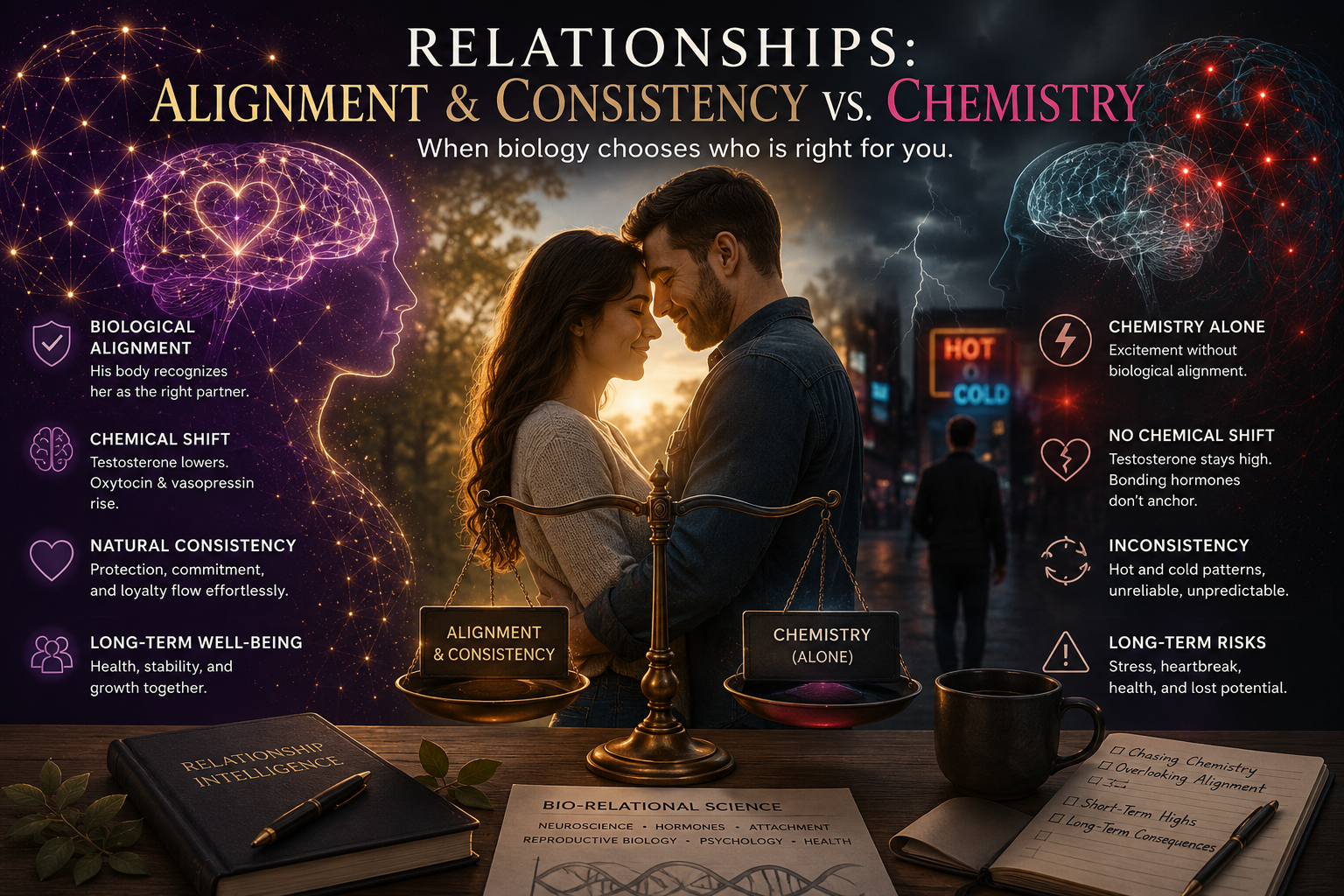
Relationships: Alignment & Consistency Vs. Chemistry
A research-informed exploration of how biological chemistry, alignment, and consistency work together in partner choice and long-term relationship outcomes. It also examines why excitement without biological alignment can produce instability rather than security. Relationship Biology Read the article
Happily Married Husbands Cheat?
An evidence-informed examination of why marital happiness alone does not guarantee fidelity. The article considers pair bonding, attachment security, sexual satisfaction, personality, opportunity, and the depth of a husband’s exclusive relational investment. Marital Fidelity Read the article
Why Relationship Education Has Failed
An interdisciplinary examination of why relationship education remains incomplete when communication strategies are separated from the biological systems that shape attachment, intimacy, stress, vulnerability, and behavior. Relationship Education Read the article
Micro-Cheating
A research-informed discussion of subtle boundary-testing behaviors, secrecy, emotional investment, and the ways seemingly minor actions can affect trust, attachment, and relationship security. Trust and Boundaries Read the article
Why Do I Feel Like I Do Not Deserve to Be Loved and Respected?
A bio-relational analysis of how conditional attachment, relational injury, intermittent reinforcement, and emotionally unsafe environments can create learned feelings of unworthiness, and how self-worth can be rebuilt through safety, boundaries, consistency, and healing. Self-Worth and Attachment Read the article
I’m Looking for Love. What Should I Do?
A bio-relational framework for preparing to recognize, receive, and sustain healthy romantic love through self-respect, attachment awareness, clear relational criteria, careful observation, reciprocity, consistency, and emotional safety. Romantic Discernment Read the article
Dating Without Exclusivity: A Bio-Relational Analysis
A bio-relational analysis of how non-exclusive dating affects attachment, pair bonding, emotional investment, and relational boundaries, particularly when one partner seeks commitment while the other preserves relational optionality. Dating and Exclusivity Read the article
How Do I Become a Better Partner and Improve My Relationship?
A bio-relational framework examining how genuine bonding, attachment, reciprocity, stress regulation, and relational fit determine whether communication and behavioral change can meaningfully strengthen a relationship. Relationship Growth Read the article
Types of Love: A Bio-Relational Framework
A scholarly framework distinguishing familial, platonic, universal, and romantic love through attachment science, neuroscience, and relational biology. Types of Love Read the article
Trauma Bonding: A Bio-Relational Analysis
A bio-relational analysis explaining how intermittent reinforcement, attachment learning, and neurobiological conditioning can make instability feel like love. Trauma Bonding Read the article
Can a Guy Change? A Bio-Relational Analysis
A bio-relational examination of whether behavioral change reflects secure attachment, accountability, and relational safety, or remains only a repeated promise. Behavioral Consistency Read the articleNothing in the library matches that search yet.